

A schedule rarely slips all at once. More often, a trade is ready to start before a decision, approval, or material is in place. Avoiding construction project delays starts with finding and resolving those dependencies early, not discovering them in a schedule update after options have narrowed.
Commercial project teams know that trades rely on one another and that late scope decisions can disrupt planned work. The challenge is making those risks visible soon enough to act. A schedule is most useful when it ties upcoming work to clear decisions, accountable owners, and due dates.
This guide explains how to identify constraints before they affect fieldwork, coordinate trade handoffs, and use a consistent process to track approvals, procurement, and scope decisions. It also covers how unified oversight can clarify responsibility across project phases. No process can prevent every disruption, but a clear view of upcoming work helps teams respond before avoidable issues grow.
Key Takeaways
- Separate coordination risks your team can manage from external events that call for contingency planning.
- Build the schedule around dependencies, procurement, approval gates, trade handoffs, and readiness checks.
- Compare coordination models by how clearly they assign responsibility, surface schedule risks, and maintain consistent quality.
- Support avoiding construction project delays with a recurring review process and a shared log of decisions, constraints, and owners.
- Connect planning, field execution, and close-out through clear ownership and timely updates across project phases.
Why Commercial Construction Projects Get Delayed, and Which Risks Teams Can Control
A carefully planned commercial schedule can lose momentum when a scope decision arrives late, an approval remains unresolved, or one trade finishes without a clear handoff to the next. These issues often connect. Incomplete scope can hold up approvals or purchasing, while missing materials or site access can leave scheduled fieldwork unready. Finding those links early is central to avoiding construction project delays.
A schedule risk is a dependency or unresolved constraint that could prevent a planned activity from starting or finishing on schedule. Teams can address coordination risks by assigning owners, confirming requirements, and tracking due dates. External events, such as severe weather, may remain outside the team's control. Prevention reduces avoidable exposure, but it can't guarantee a delay-free project. The Project Management Triangle also helps frame the trade-offs: a change to time may affect scope or cost.
Which delay causes can project teams address early?
Start by checking whether the work is defined well enough to approve, procure, and execute. Unclear scope or late design decisions can hold up approvals and purchasing, then affect field activities that depend on them. Procurement lead times matter too: an installation is not ready simply because its start date appears on the calendar.
For each upcoming activity, check required materials, site access, predecessor work, and the handoff to the next trade. Rework is another preventable risk. If completed work doesn't meet agreed requirements, follow-on activities may have to wait while corrections are made. A risk is not the same as an actual delay. If an approval is still pending but the affected field activity hasn't started, the team may still have time to escalate, adjust the sequence, or clarify responsibility before the schedule slips.
How do delays spread across a commercial schedule?
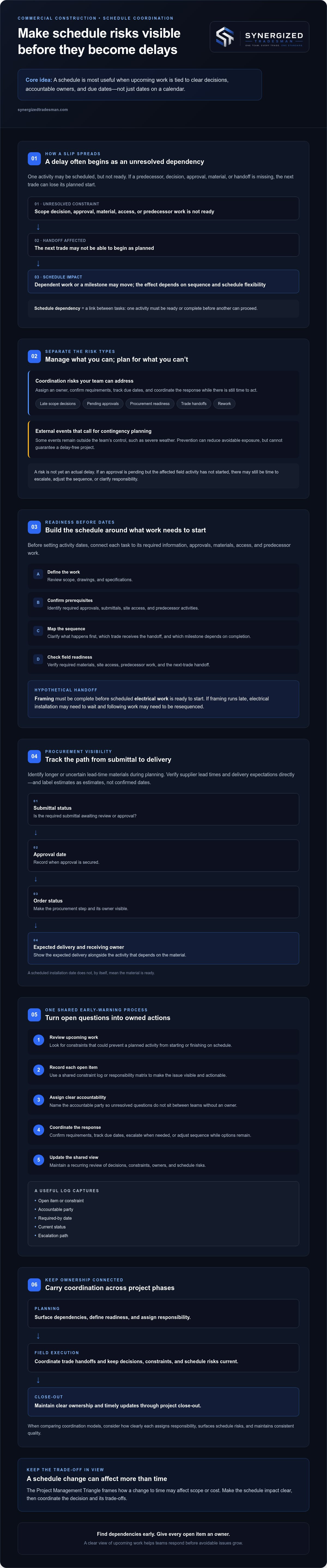
Activities often depend on earlier work being complete. If a predecessor finishes late, the next trade may lose its planned start, and dependent work or a milestone may move as well. The effect depends on the sequence and flexibility in the schedule. Teams should map those connections rather than treat each activity as an isolated date.
A schedule dependency is a link between tasks: one activity must be ready or complete before another can proceed.
Hypothetical sequence: Electrical work is scheduled after framing is complete. If framing runs late, electrical installation may not be ready to start, and the following work may need to be resequenced. A handoff review can reveal the constraint while there is still time to coordinate next steps. The goal is not to assume every risk can be resolved, but to surface it early and make its schedule impact clear.
Build a Construction Schedule Around Readiness, Dependencies, and Procurement
A useful construction schedule does more than assign dates. It connects each activity to the information, approvals, materials, access, and predecessor work needed to start. This readiness-based approach helps teams identify constraints while there is still time to coordinate a response. For more on cross-trade planning, see this commercial construction coordination guide.
How should teams identify schedule dependencies before mobilization?
Before setting activity dates, review the scope, drawings, specifications, required approvals, site access, and predecessor activities. Confirm which decisions or submittals must be complete before an item can be ordered or installed. Then map the sequence: what needs to happen first, which trade receives the handoff, and what milestone depends on completion?
Use a responsibility matrix or shared constraint log to make open items actionable. For each item, record an accountable party, required-by date, current status, and escalation path. Naming an owner keeps an unresolved question from sitting between teams without anyone responsible for moving it forward.
How can procurement planning reduce material-related delays?
Identify materials with longer or uncertain lead times during planning, before fieldwork depends on them. Verify supplier lead times and delivery expectations directly, and label estimates as estimates rather than confirmed dates. A planning assumption is not a guaranteed delivery date.
Track each item through the steps that affect readiness: submittal status, approval date, order status, expected delivery, and the person responsible for receiving it. If a submittal is awaiting approval, show that alongside the activity that relies on the material. This gives the team an early warning instead of a surprise when installation is due to begin.
Use this planning sequence to build the schedule baseline:
- Confirm scope. Identify what is included and which details still need resolution.
- Map dependencies. Link predecessor work, trade handoffs, approval gates, and milestones.
- Plan procurement. Flag long-lead or uncertain items, confirm supplier information, and track required approvals.
- Check access and readiness. Confirm that site access and required inputs are in place for planned activities.
- Assign and baseline. Give each constraint an owner, due date, status, and escalation path, then set activity dates against verified dependencies.
Review the baseline whenever scope, approvals, procurement, or access assumptions change. This makes avoiding construction project delays a recurring management practice rather than a one-time scheduling exercise. Teams comparing who will coordinate planning, procurement, and field handoffs can review commercial construction coordination support as one approach.
Compare Project Coordination Models Before Schedule Risks Become Disputes
Coordination may be organized trade by trade, with each party managing its own work and interfaces, or through centralized multi-trade oversight that connects schedules, handoffs, and open decisions. Neither model suits every project. Compare how each assigns responsibility and shares information before selecting an approach. For a related framework, see the multi-trade commercial construction accountability model.
What should an owner compare between coordination approaches?
Look beyond the meeting schedule. Confirm who maintains the integrated schedule, tracks trade interfaces and open decisions, communicates changes, and escalates issues. Ask how the team reviews progress and connects quality checks and close-out requirements to delivery. Planned communication creates shared visibility; it doesn't mean duplicating each trade's work or reporting.
| Criterion | Trade-by-trade coordination | Centralized multi-trade oversight |
|---|---|---|
| Responsibility clarity | Ownership may sit with separate parties; confirm who resolves cross-trade issues. | A defined coordinating point can clarify who tracks shared dependencies. |
| Handoffs | Trades coordinate interfaces directly; confirm how handoff status is shared. | Handoffs can be reviewed across the work sequence. |
| Schedule visibility | Updates may be distributed across separate schedules or reports. | One integrated view can connect progress and upcoming constraints. |
| Escalation | Agree how unresolved issues move to the decision-maker. | Set a clear route for raising cross-trade risks. |
| Quality and close-out | Clarify how checks and completion requirements are coordinated. | Align shared standards and close-out tasks across project phases. |
How does clear accountability help teams act sooner?
Name an owner for each unresolved decision or dependency, with a due date and escalation route. For example, if an approval could affect a downstream trade or milestone, the assigned owner can flag it in a progress review and elevate it to the appropriate decision-maker before the next activity is affected.
Clear ownership makes schedule risks visible early enough for the team to assess its options. This helps teams avoid construction project delays, though coordination alone can't prevent every disruption. The best-fit model depends on project complexity, trade count, scope, and the client's capacity to manage interfaces and updates. Teams comparing connected oversight across planning, procurement, and field execution can review commercial construction coordination as one option.
Use a Repeatable Early-Warning Workflow to Prevent Avoidable Delays
A schedule review is most useful when it compares three things: what was planned, what was completed, and what must be ready next. A recurring weekly review gives the team a regular opportunity to surface changes, confirm upcoming work, and assign follow-up before an unresolved constraint affects a milestone. Keep the record in one shared log so everyone can work from the same status.
What should a weekly schedule-risk review cover?
Review near-term activities with the responsible parties. Confirm required inputs and readiness evidence, such as an approved submittal, completed predecessor work, available materials, confirmed access, or a coordinated trade handoff. Include decisions, inspections, procurement status, and any open item that could affect planned work.
For each variance or constraint, record:
- Issue and likely impact: What is unresolved, and which activity or milestone could it affect?
- Mitigation owner and deadline: Who will take the next action, and by when?
- Status and escalation path: What decision or support is needed if the item remains open?
- Next review date: When will the team confirm progress or reassess the risk?
Set escalation triggers in advance. A missed commitment, unresolved predecessor activity, or approval still outstanding on its required date should prompt review. Don't wait until the affected crew is ready to start. For related coordination practices, see this guide to commercial renovation management services.
How should teams respond when a milestone is at risk?
First confirm the cause and trace its effect through dependent activities. Identify the affected work, related trade handoffs or approvals, and whether the risk changes the milestone forecast. Don't treat a proposed schedule adjustment as a decision until the affected parties have reviewed it.
Recovery differs from prevention. Prevention addresses constraints before planned work is disrupted. Recovery evaluates options after a risk threatens the schedule. Before resequencing work, consult affected trades and assess implications for scope, quality, access, and safety requirements. If a scope change is proposed, route it through the appropriate decision process rather than assuming it will solve the schedule problem.
Once a response is approved, document the change, confirm owners and dates, communicate it to affected parties, and update the working schedule and constraint log. This gives the next review a clear record and supports avoiding construction project delays through earlier, accountable action. Synergized Tradesman coordinates commercial construction work across planning, field execution, and close-out. You can learn more about its services.
Connect Planning, Field Execution, and Close-Out Under One Accountable Approach
Schedule visibility depends on more than setting dates. Planning decisions, procurement updates, field progress, trade handoffs, and close-out requirements need to remain connected as work advances. When responsibility is clear across these phases, teams can see who is managing each interface and where an unresolved item may affect the next step.
Multi-trade oversight is one way to organize that work. A single accountable relationship can simplify communication across phases and clarify cross-trade responsibilities. It doesn't eliminate every delay: external events, changing conditions, or unresolved decisions may still affect delivery. The value is a consistent way to share updates, check quality, and track completion requirements, rather than leaving each phase disconnected.
What does end-to-end coordination include?
For commercial construction, renovation, or retail refresh work, coordination can connect planning and procurement with field execution, trade sequencing, and project close-out. The trades involved depend on the approved project scope. Relevant service categories may include demolition, metal stud framing and drywall, ACT ceilings, painting and wallcovering, flooring and tile, millwork and fixture installation, electrical, plumbing, final cleaning, and project close-out.
Consistent standards help make expectations repeatable. Teams can align communication, quality checks, and close-out requirements across phases, so completion is considered throughout delivery rather than left until the final handoff. Synergized Tradesman manages commercial construction and renovation projects through these phases, coordinating multiple trades through one accountable relationship. This is one option for decision-makers comparing ways to clarify ownership, not a promise that a particular model will prevent every schedule disruption.
What should decision-makers prepare before discussing a project?
Gather information that will help a coordination discussion focus on real constraints and responsibilities. Prepare:
- Scope materials: Available drawings, specifications, and a summary of the work under consideration.
- Schedule context: Target milestones, known deadlines, and activities or approvals that could affect timing.
- Project complexity: The number of locations or trades involved, where applicable, plus known access or procurement constraints.
- Coordination questions: Who owns the integrated schedule? How will procurement status be visible? How often will progress and risks be reviewed? How will quality checks and close-out be tracked?
These details give both sides a clearer basis for discussing responsibilities and fit. A structured approach to avoiding construction project delays starts with shared facts, defined ownership, and realistic schedule expectations. To discuss your commercial construction project, contact Synergized Tradesman.
Make Schedule Readiness Part of Every Project Decision
A dependable schedule starts before crews reach the field. Confirm scope, approvals, procurement, access, and trade handoffs before work begins. Then review planned work, completed work, and upcoming constraints on a regular cycle so owners can address risks while options remain. This disciplined process supports avoiding construction project delays, though no coordination model can remove every disruption.
Clear ownership matters across project phases. One accountable relationship can connect planning, procurement, field execution, and close-out, helping teams maintain schedule visibility and consistent expectations. Synergized Tradesman manages multi-trade commercial construction and renovation projects and is a certified women-owned commercial construction firm.
If your team is assessing coordination for an upcoming project, discuss your commercial construction project. With clear information, assigned owners, and a practical review process, you can make informed decisions and keep work moving with greater confidence.
Frequently Asked Questions
How can construction project delays be prevented?
Prevent avoidable delays by building a realistic schedule around confirmed scope, dependencies, and readiness, then assigning owners to approvals, procurement, access, and trade handoffs. Review upcoming work against its required inputs, not just planned dates. To avoid construction project delays, escalate missed commitments while there is still time to assess options. This approach improves visibility and response, but it can't remove every external event or unforeseen condition.
What are the most common causes of commercial construction delays?
Common causes include incomplete scope, late approvals, uncertain procurement, unavailable work areas, poorly sequenced trades, and rework. Their effects depend on project conditions and how tasks rely on one another. For example, an approval that holds up purchasing may also affect the planned installation. Document assumptions, track open constraints, and verify required inputs before scheduling work to reduce avoidable disruption.
How often should a construction project schedule be updated?
Set a review cadence that matches the project's complexity and pace, and update the working schedule when confirmed conditions change. At each review, compare planned work with completed work, check readiness for upcoming activities, and assign owners to constraints. A useful update explains what changed, which activities or milestones may be affected, and what decisions are needed. Simply replacing old dates with new ones hides the cause.
Can better trade coordination prevent construction delays?
Better trade coordination can reduce avoidable delays caused by unclear handoffs, conflicting sequences, or unresolved responsibilities, but it can't control every supply, design, or site condition. Define who maintains the integrated schedule, how trades confirm readiness, and when issues move up the escalation path. For multi-trade projects, compare approaches by accountability, schedule visibility, and decision-making clarity to determine which fits the scope.
What is a construction schedule constraint log?
A construction schedule constraint log records issues that must be resolved before planned work can proceed. Each entry should identify the constraint, responsible owner, required-by date, status, potential schedule impact, and escalation path. Examples include a pending approval, unavailable material, unresolved access, or incomplete predecessor work. Review the log alongside upcoming activities so the team can address blockers before they affect field execution.
How should a project team respond when a construction milestone is at risk?
First verify the cause and identify affected activities and dependencies. Then review feasible responses with the responsible parties, such as resolving a blocker or resequencing work where appropriate. Check the implications for quality and safety before approving a change. Document the decision, assign owners and due dates, communicate the revised plan to affected parties, and update the working schedule. Don't change a milestone without explaining the schedule impact.
Does one project manager or point of contact guarantee a project will finish on time?
No project management arrangement can guarantee an on-time finish. A clear point of accountability can make responsibilities, handoffs, and escalation easier to manage, particularly when several trades depend on one another. Synergized Tradesman coordinates planning, procurement, field execution, and close-out through one accountable relationship. Before choosing an approach, ask who owns schedule updates, tracks constraints, coordinates procurement, and communicates decisions, then confirm it fits the project scope.


