

What if the renovation with the lowest upfront estimate delivers the weakest return? Calculating ROI for a commercial renovation means looking beyond the initial cost to measure operating benefits, business disruption, and the time required to realize value. A project can appear financially sound on paper and still miss its targets if costs are incomplete, benefits are hard to verify, or completion is delayed.
That makes the decision more involved than comparing contractor estimates. Costs may span several trades, while benefits such as improved efficiency or a better customer experience need clear measures before they can support a business case. A useful model shows what is included, how each benefit will be tracked, and which assumptions could change the result.
This guide explains how to build a transparent, auditable ROI model and compare renovation options on consistent terms. It covers project costs, measurable benefits, timing, and delivery risks, including how coordinated scope and closeout records can help compare projected results with actual performance. The goal is a decision grounded in operational and financial evidence, not a best-case estimate.
Key Takeaways
- Start with the decision you need to make, then define the renovation scope and baseline against which options will be compared.
- When calculating ROI for a commercial renovation, account for direct project costs and indirect impacts such as relocation, lost operating time, and internal staff effort.
- Use ROI alongside payback, NPV, and IRR. Each measure answers a different question, so consistent assumptions and a defined time horizon matter.
- Build a traceable scenario model that records expected benefits, calculation assumptions, and stress-test conditions.
- Turn the preferred scenario into an executable plan with procurement milestones, schedule controls, change tracking, and owners for measuring results.
Calculating ROI for a Commercial Renovation Starts with the Decision
First, define the decision the analysis needs to support. Are you deciding whether to proceed, revise the scope, phase the work, or compare renovation options? Without a clear question, teams can gather precise-looking figures that do not resolve the choice in front of them.
Renovation ROI compares benefits attributable to a project with the complete project investment. In a basic model, ROI is the net benefit divided by the total investment, expressed as a percentage. Payback period answers a different question: how long it takes for cumulative benefits to recover the investment. ROI summarizes return over a defined period; payback focuses on time to recovery.
Separate three categories from the outset: one-time project costs, recurring operating effects, and nonfinancial objectives. Lower maintenance or operating expenses may be measurable recurring effects. Compliance, safety, brand, or workplace goals may be essential to the decision, but should not be presented as financial returns unless you can define a defensible way to measure their financial impact. This discipline is part of capital budgeting, the evaluation of long-term investment decisions.
What ROI can and cannot tell a decision-maker
ROI is a useful summary, not a guarantee of future performance. Its result depends on the assumptions behind the costs, expected benefits, and analysis period. Give every claimed benefit a baseline, a timeframe, and a defensible attribution method. For example, if an operating expense is expected to decline, record current spending, the period it covers, and how the renovation is expected to affect it. Keep unquantified objectives visible, but separate them from calculated returns.
Set the project boundary before estimating returns
Define the space, renovation scope, operating period, and decision owner. Then specify whether the analysis covers one site, a portfolio, or a rollout. A consistent boundary lets decision-makers compare options without mixing cost categories or timeframes. For projects involving multiple trades, a coordinated scope and clear accountability help establish a reliable baseline and make schedule, quality, and scope changes easier to track.
This is also where multi-trade commercial construction accountability matters. When procurement, field execution, and closeout records connect to the same defined scope, the team has a clearer basis for comparing modeled results with actual project outcomes. Set the boundary first, then gather the costs and benefits that belong inside it.
Gather the Costs and Benefits Needed to Calculate Renovation ROI
A useful model depends on complete inputs, not just the construction estimate. List each cost and expected benefit, identify its source, and mark whether it is confirmed or provisional. This creates a traceable record for calculating ROI for a commercial renovation and reduces the risk of comparing options built on different assumptions.
Build a complete project investment baseline
Start with the approved scope, then inventory direct costs across design, materials, labor, permitting, equipment, and project management. Check that estimates cover every trade and scope component, such as demolition, framing, finishes, electrical, plumbing, fixtures, and closeout where applicable. Include procurement assumptions, contingency, and owner-provided items or work.
Keep exclusions visible. Separate confirmed estimates from provisional allowances or assumptions, and assign an owner to resolve open items. A coordinated scope helps prevent gaps between trade estimates from being mistaken for savings.
Indirect costs belong in the model too. Identify temporary operations, relocation, lost operating time, and internal staff effort. Break disruption down by project phase, such as work that affects normal operations and any temporary operating arrangements. Document the calculation method, such as estimating affected operating hours and applying a consistent measure of business impact. Do not bury costs in a general contingency when they can be estimated separately.
Measure benefits against current performance
Choose measures that match the renovation’s intended outcomes. Depending on the project, these may include utility use, maintenance spending, occupancy, throughput, sales, or labor requirements. Record current performance before work begins, identify the data source, and set a comparison period that can also be used after completion.
A documented baseline makes benefit attribution more credible because it shows what changed from a defined starting point and over what period. Account for known operational changes, such as different occupancy or business hours, so the model does not credit the renovation for unrelated shifts.
- Energy and maintenance: Compare utility consumption or maintenance records across consistent periods.
- Capacity and labor: Define the operational measure, such as throughput or staff time, and document how it will be tracked.
- Rent and sales: Include projected changes only when evidence supports the link to the renovation and the method is documented.
Keep qualitative outcomes, such as brand presentation or workplace experience, visible as decision factors. Do not assign them a financial value without a documented method. For projects with multiple trades, a clear scope and coordinated delivery records can help preserve cost and change visibility. The information about commercial renovation project coordination describes how scope, procurement, execution, and closeout can be managed as connected stages.
Compare ROI, Payback, NPV, and IRR Without Misreading the Results
A single ROI percentage can make a renovation look straightforward while hiding when benefits arrive, how long recovery takes, or what happens if delivery is delayed. Each metric answers a different question. Use them together to assess return, timing, and financial impact, including the effect of disruption on projected cash flows.
For a simple ROI calculation, use:
ROI = (Total benefits − Total investment) ÷ Total investment × 100
Total benefits are the financial gains attributed to the renovation over the chosen analysis period. Total investment includes project costs and other applicable costs within the model boundary. State the period and included items alongside the result. Otherwise, two ROI percentages may not be comparable.
Choose the metric that matches the decision
Use simple ROI as a compact summary when assumptions and the analysis period are clearly defined. Payback shows how long it takes for cumulative benefits to recover the investment, but it ignores benefits received after that point. Net present value (NPV) and internal rate of return (IRR) account for the timing of cash flows, but require consistent periods and a justified discount rate.
| Metric | Question it answers | Key limitation |
|---|---|---|
| ROI | How does net benefit compare with total investment? | May hide when benefits arrive and how risk affects them. |
| Payback | How long until cumulative benefits recover the investment? | Doesn’t count benefits after the recovery point. |
| NPV | What are projected cash flows worth in today’s terms, after discounting? | Depends on the discount rate and cash-flow assumptions. |
| IRR | What discount rate makes NPV equal zero? | Can be difficult to interpret across options with different scale or cash-flow patterns. |
Compare alternatives on equal terms
When calculating ROI for a commercial renovation, apply the same analysis horizon, operating assumptions, and cost inclusions to every option. Compare a phased renovation with a full-scope alternative if both are feasible, and account for how phasing may shift costs, benefits, and disruption over time. A different schedule can change the timing of cash flows, and therefore affect NPV, IRR, and payback, even when total projected benefits appear similar.
Have the finance team validate the discount rate, cash-flow periods, and accounting conventions before relying on NPV or IRR. Then review the assumptions behind the results. A higher return under one scenario is not a decision by itself if it depends on optimistic timing or excludes delivery risks.
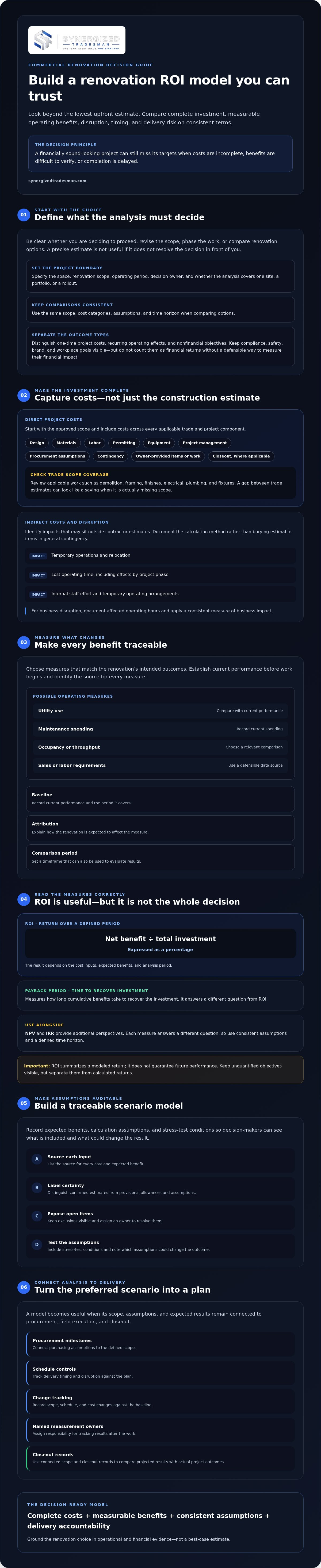
Calculate Commercial Renovation ROI with a Traceable Scenario Model
Turn the cost and benefit inputs into a model another decision-maker can review and reproduce. Keep evidence and assumptions visible beside the results. A spreadsheet or investment memo should distinguish source data from estimates, and formulas from manual inputs.
- Define the baseline. Record current operating measures, the space and scope under review, and the period the analysis covers.
- Scope the investment. Enter project costs by category, including approved scope, procurement assumptions, contingency, owner-provided costs, and estimated disruption.
- Estimate benefits. Tie each projected operating or financial benefit to evidence, a measurement method, and an accountable owner.
- Choose the analysis horizon. Apply the same period to costs and benefits, and document why it fits the decision.
- Calculate the selected metrics. Use the formulas consistently and retain the underlying cash flows and assumptions.
- Stress-test the result. Compare downside, expected, and upside cases for uncertain costs, schedule, downtime, and operating benefits.
Build a transparent spreadsheet or investment memo
Separate inputs, formulas, evidence sources, assumptions, and outputs so reviewers can trace each result back to its basis. Assign an owner to each input and record when it was last updated. For example, a schedule estimate should identify its source and date, while an operating benefit should show the baseline measure and calculation method. This record helps the team revisit assumptions as procurement and delivery details change.
Use a consistent project scope throughout the model. Coordinating scope, procurement, multiple trades, and closeout can make cost and schedule changes easier to track. More context is available about coordinated commercial renovation planning.
Stress-test the assumptions that can change the result
Model downside, expected, and upside cases rather than relying on one forecast. Vary completion timing, scope changes, downtime, and measured benefits. Then identify which assumptions move the decision most. If a modest schedule delay changes whether the project meets the decision threshold, schedule control deserves closer attention. If results depend on an unverified operating benefit, treat that input as a decision risk, not a settled return.
Document why each scenario differs and who approved its assumptions. Modeled outcomes are estimates, not guaranteed results. Update the model when scope, procurement, or schedule information changes, then compare projected outcomes with actual costs and performance records at closeout.
Turn the ROI Analysis into an Executable Commercial Renovation Plan
A favorable model supports a sound decision only if the delivery plan preserves its assumptions. Convert the preferred scenario into an approved scope, procurement milestones, schedule controls, and named owners for each operational measure. Clarify responsibilities before work begins so the team knows who tracks cost changes, schedule impacts, and the benefits expected after completion.
Connect the financial model to delivery accountability
Assign an owner to each scope, cost, schedule, and performance measure. Coordinate relevant trades against the same approved scope and project standard, with reporting checkpoints that show progress against the baseline. Set a change-control process: document each proposed change, its cost and schedule effect, and whether it alters expected benefits before approving it.
Synergized Tradesman provides one accountable relationship across planning, procurement, field execution, and closeout. This coordinated approach supports visibility across multiple trades. Keep closeout documentation with the project record so modeled costs and outcomes can later be compared with actual results.
Move from analysis to a decision-ready next step
Prepare a concise decision memo that records the preferred option, key assumptions, scenario results, delivery risks, and recommended next action. Identify estimates that still need confirmation and any financial, tax, accounting, or other specialist assumptions that require professional review before approval or commitment.
During delivery, report against the approved scope, procurement milestones, schedule, and cost baseline. At closeout, reconcile modeled project costs with actual documented costs. At a defined operating review point, compare measured performance with the original baseline and benefit assumptions. Record differences and their causes. This closes the loop between calculating ROI for a commercial renovation and assessing what the project delivered.
Use the findings to inform future renovation or rollout decisions. A consistent record of scope, changes, closeout details, and operating measures gives decision-makers a stronger basis for refining assumptions across sites or projects.
If you’re evaluating a commercial renovation or rollout, discuss your project scope and delivery plan with Synergized Tradesman.
Make the Next Renovation Decision With Clearer Evidence
A defensible renovation decision starts with a defined scope and complete investment baseline. Measure benefits against current operating performance, then compare ROI with payback, NPV, or IRR using consistent assumptions. Stress-test schedule, cost, and operating uncertainties before selecting an option.
Calculating ROI for a commercial renovation is not only a finance exercise. The model must connect to delivery controls, named measurement owners, and closeout records so decision-makers can compare projected costs and benefits with actual outcomes.
Synergized Tradesman manages multi-trade commercial construction and renovation through one accountable relationship spanning planning, procurement, field execution, and closeout. As a certified women-owned commercial construction firm, it can help coordinate the project scope and delivery information that support a transparent decision process.
Discuss your commercial renovation or rollout with Synergized Tradesman to bring your project assumptions into a coordinated planning conversation. With clear scope, accountable execution, and measurable review points, your team can move forward with greater confidence.
Frequently Asked Questions
How do you calculate ROI for a commercial renovation?
Define the analysis period, total project investment, and financial benefits attributable to the renovation. For simple ROI, subtract investment from benefits, then divide the net benefit by investment and multiply by 100. State whether the result is cumulative for the full period or annualized. Include relevant disruption and ongoing operating effects. Document each assumption and baseline so decision-makers can interpret the result and understand what the calculation does and does not measure.
What costs should be included in a commercial renovation ROI calculation?
Include costs needed to deliver and operate the defined scope. Depending on the project, these may include design, materials, labor, procurement, project management, permits, equipment, contingency, relocation, temporary operations, and lost operating time. Separate confirmed estimates from provisional assumptions, and check for duplicate entries across cost categories. Ask finance or project professionals to confirm which costs belong in the analysis and how they should be treated under your organization’s accounting conventions.
Can a commercial renovation have a positive ROI if it does not increase sales?
Yes. A renovation may produce measurable value through lower energy or maintenance expenses, improved capacity, reduced downtime, or other documented operating effects. Whether those benefits justify the investment depends on their size, timing, project costs, and the analysis period. Establish a baseline and evidence for each claimed benefit. Keep qualitative outcomes, such as improved workplace experience, separate from financial returns unless you have a defensible method to assign them monetary value.
How long should the ROI period be for a commercial renovation?
Choose a period that fits the decision, expected useful life of the improvements, available evidence, and your organization’s finance policy. Apply the same horizon when comparing alternatives. A shorter period may leave out later benefits, while a longer period introduces greater uncertainty into forecasts. State the timeframe clearly and test how a different horizon changes the result. No single analysis period is right for every renovation or business decision.
What is the difference between renovation ROI and payback period?
ROI compares net benefits with the total investment over a stated period. Payback estimates how long it takes for cumulative benefits to recover the initial investment. Payback is easy to communicate, but it generally excludes benefits received after recovery and does not fully account for the time value of money. Use both measures when they help answer the decision at hand, and disclose the assumptions and timeframe behind each result.
Should I use NPV or IRR to evaluate a commercial renovation?
NPV estimates the present value of future cash flows using a selected discount rate. IRR estimates the rate at which those cash flows produce a zero NPV. Both can help evaluate timing and compare investment alternatives, but their results depend on reliable cash-flow assumptions and consistent finance conventions. Ask your finance team to validate the discount rate, cash-flow periods, and interpretation before using either measure to support an approval decision.
How can renovation downtime affect projected ROI?
Downtime can interrupt operations, reduce sales, require temporary relocation, or delay the benefits used to justify the investment. Estimate disruption by project phase using business-specific operating information, and document the method and evidence. Where practical, compare phased and full-scope options to assess differences in interruption and benefit timing. During delivery, track schedule changes and update the model if timing or operating impacts differ materially from the approved scenario.


