

Budget overruns rarely start with one dramatic mistake. They build when incomplete planning, scope changes, procurement choices, and field decisions add costs that aren’t visible until it’s harder to respond. Avoiding construction budget overruns starts with making decisions traceable and addressing risks early.
If the final cost feels difficult to predict, that concern is understandable. A realistic budget needs a documented baseline, clear ownership, and updates that reach decision-makers in time to act. A checklist helps teams apply those controls throughout delivery, not just during estimating.
This guide covers practical steps for establishing the budget, identifying scope gaps, reviewing changes before they affect downstream work, and tracking procurement and field decisions. It also explains how to keep closeout costs in view. From demolition and drywall through flooring, electrical, plumbing, and final cleaning, coordinated trade execution can make cost ownership clearer. The goal isn’t to guarantee against overruns. It’s to keep costs visible and give the project team a chance to respond before small issues compound.
Key Takeaways
- Build a documented budget baseline that separates approved scope, assumptions, allowances, contingency, and exclusions before field work begins.
- Compare delivery structures by how clearly they assign decision ownership, coordinate procurement, and report changes.
- Use a recurring review to reconcile commitments, pending changes, actual costs, and forecasts against the current baseline.
- For avoiding construction budget overruns, make change impacts visible early enough for decision-makers to assess and respond.
- Reconcile the final account at closeout, then use open items and project records to inform the next budget.
Avoiding construction budget overruns starts with understanding where costs grow
Cost growth often develops across connected decisions, not from one isolated line item. A scope gap can affect procurement; a delayed delivery can disrupt field sequencing; and a field decision can require additional labor or materials. The practical goal of avoiding construction budget overruns is to make these impacts visible early and manage decisions, not to promise a project will have no changes.
A cost overrun occurs when actual costs exceed the budget established for the project. Distinguish that from an approved scope change or a documented contingency draw. Review and formally approve scope changes, then record their budget impact. A contingency draw uses a planned reserve for an identified risk. Neither should disappear into the ledger without documentation. Track the original baseline and approved revisions so decision-makers can see what changed and why.
Early cost visibility gives project owners more options: they can assess trade-offs before a cost or schedule decision creates further commitments.
Which construction budget risks should owners watch first?
Start with the scope and its assumptions. Check that labor, materials, finishes, and closeout work are accounted for, and record what’s excluded. If one stakeholder assumes existing utilities can be reused while another expects replacement, the budget may reflect different expectations. Make those assumptions explicit before work begins.
Separate a known risk allowance from an untracked cost. An allowance is a recorded amount for a defined uncertainty; an undocumented change has no clear approval or budget treatment. Identify the risk, its owner, and the process for using the allowance, then log any draw against the current baseline.
How do trade handoffs affect budget visibility?
Gaps in sequencing between trades can leave work incomplete, trigger rework, or require crews to return for another mobilization. In a commercial renovation, demolition may expose utilities that need electrical or plumbing work before drywall and finishes proceed. Fixture installation then depends on the finished space and confirmed locations. If these dependencies aren’t coordinated, delays or repeat work can affect costs.
Assign responsibility for confirming readiness at each handoff. Record what must be complete, who verifies it, and whether a change affects procurement or downstream work. A multi-trade construction accountability model can help clarify ownership across trades. Clear coordination improves cost visibility, but it doesn’t guarantee that costs won’t change.
Build a reliable commercial construction budget before work begins
A usable budget starts with a defined scope and a record of what remains uncertain. Before authorizing field work, establish one approved baseline that the owner and project team can use to track commitments, changes, and forecasts. This is a core step in avoiding construction budget overruns because it gives every later decision a clear point of comparison.
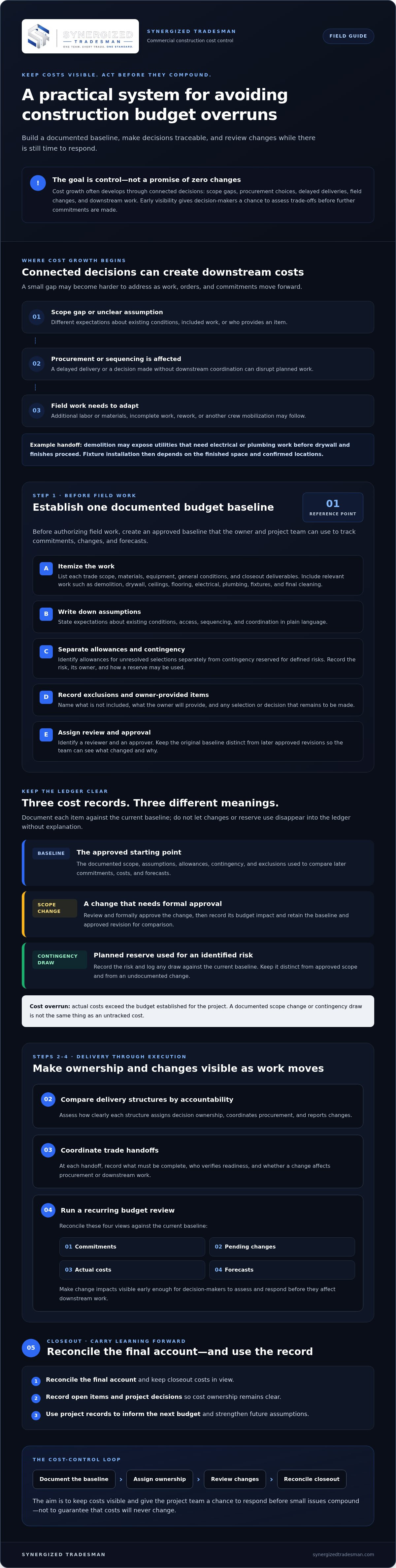
A useful budget baseline combines approved scope, documented assumptions, and controlled records of every authorized change. Keep the baseline distinct from later revisions so the team can see the original plan and understand how decisions affect it.
What should a commercial construction budget include?
Use this checklist before procurement or field execution. Assign a reviewer and an approver to confirm the record is complete and authorized.
- 1. Itemize the work. List each trade scope, materials, equipment, general conditions, and closeout deliverables. Include relevant work such as demolition, drywall, ceilings, flooring, electrical, plumbing, fixtures, and final cleaning.
- 2. Write down assumptions. State what the estimate assumes about existing conditions, access, sequencing, and coordination. Use plain language so the owner and project team aren’t relying on different interpretations.
- 3. Separate allowances and contingency. Identify allowances for unresolved selections separately from contingency reserved for defined risks. Don’t combine either with approved scope.
- 4. Record exclusions and owner-provided items. Name what isn’t included, what the owner will provide, and any selection or decision that remains open.
- 5. Approve and control the baseline. Document who reviews the estimate, who approves it, and how changes will be assessed, authorized, and recorded.
Procurement certainty depends partly on confirmed selections and timing. An unresolved finish, fixture, or equipment choice may prevent the team from confirming the specification and purchase commitment. Record the selection status, the person responsible for the decision, and any supplier information that still needs confirmation. The CPARS cost-control criteria also emphasize effectiveness in forecasting, managing, and controlling cost, reinforcing the value of active oversight rather than a one-time estimate.
How should teams assess contingency and uncertainty?
Treat contingency as a documented response to identified uncertainty, not as spare spending authority. For each reserve, describe the risk it addresses, who can authorize its use, and how a draw will be reflected in the forecast. Don’t apply a generic percentage without project-specific support. Verify any proposed contingency figure against the project’s documented risks and estimating basis.
For teams coordinating procurement, field execution, and closeout across trades, Synergized Tradesman’s commercial construction coordination is one option to consider when defining project ownership and cost reporting responsibilities.
Compare cost-control approaches before choosing a project delivery structure
The project structure determines how trade updates, procurement information, and field decisions reach the people managing the budget. It doesn’t determine the final cost on its own. Scope clarity, timely decisions, and consistent change control still matter. For owners focused on avoiding construction budget overruns, compare how each approach makes costs and responsibilities visible during delivery.
What should owners compare across cost-control models?
Consider three common approaches. With fragmented trade coordination, the owner may receive updates from separate contractors and need to reconcile them. With owner-managed coordination, the owner or its project team gathers those updates and oversees handoffs. With a single accountable multi-trade relationship, one relationship coordinates multiple trades, procurement, field execution, and closeout. Exact responsibilities depend on the agreed scope and working arrangements.
Compare the approaches against the same operating criteria:
- Change visibility: Who identifies a proposed change, obtains its cost and schedule implications, and keeps the decision record current?
- Procurement coordination: Who tracks selections, purchase commitments, delivery status, and dependencies between materials and field work?
- Decision ownership: Is there a named person responsible for routing questions to the right approver and documenting the outcome?
- Reporting cadence: How often do owners receive a consolidated view of commitments, pending changes, and forecast costs?
- Closeout: Who tracks open items, final invoices, and records needed to reconcile the final account?
Ask each prospective team to describe its process using a real decision path. For example, what happens when a fixture selection changes after procurement planning begins? The answer should show who assesses the impact, who approves it, and where the revised cost and status will be recorded. A commercial construction coordination guide can provide additional context on organizing work across trades.
When does single-point accountability help with budget control?
A single accountable relationship can be useful when several trades, procurement tasks, and site decisions intersect. It gives the owner a clearer route for updates and questions, while consistent reporting can make unresolved selections or pending approvals easier to spot. That clarity supports oversight. It doesn’t mean the price is fixed or guarantee a particular cost outcome.
Before selecting a structure, confirm what coordination it includes, how changes are handled, and who maintains the current forecast. Choose the model whose reporting and decision ownership match the project’s complexity and the owner’s capacity to manage handoffs.
Use this construction budget checklist during procurement and field execution
A budget baseline only helps if the team keeps it current as commitments are made and work progresses. Set a regular review cadence, such as a weekly check-in, and use the same cost record to connect procurement status, field updates, approvals, and forecasts. This makes avoiding construction budget overruns an ongoing control process rather than a one-time estimating exercise.
What should a weekly construction budget review cover?
Review each cost category against the current authorized budget, including approved changes. Separate amounts already incurred or invoiced from commitments not yet invoiced, pending proposals, and forecast costs for remaining work. Avoid counting the same cost twice. The review should show both what has been spent and what the team expects to spend to complete the approved scope.
Use a consistent sequence:
- Commitments: Reconcile purchase orders and other confirmed commitments against their budget categories. Check procurement status and flag items awaiting selections or confirmation.
- Changes: List proposed changes separately from approved ones. Keep unapproved proposals visible, but don’t treat them as authorized budget revisions.
- Actuals and remaining work: Review invoices and costs incurred, then confirm what work and commitments remain.
- Forecast and decisions: Update the projected final cost, explain any movement, and assign an owner and due date to each unresolved cost-impacting decision.
For every forecast change, record the reason, supporting documentation, and approval status. Compare the revised projection with the current baseline, which should reflect the original approved budget plus formally approved changes. This makes it easier to distinguish authorized scope growth from a cost variance that still needs review.
How should teams control change orders and field decisions?
Before approving a change, document its scope, cost, schedule effect, and responsibility. Route field questions to the designated decision-maker, then record the response and any resulting instruction. Verbal directions can be misinterpreted later, so capture the decision in the project record before updating the forecast or related commitments.
Check downstream effects before accepting a substitution or resequencing work. A replacement finish, for example, may affect purchasing, installation, or work that follows. Confirm relevant trade and procurement impacts, identify who must approve them, and update the record once the decision is authorized. Keep unresolved items on the review list until they’re closed or clearly carried in the forecast.
For help coordinating commercial procurement, field execution, and closeout, review Synergized Tradesman’s commercial project services.
Keep budget accountability through closeout and the next project
Closeout provides a final check against the project’s approved budget and authorized changes. Without clear reconciliation, paid costs, outstanding commitments, and unresolved items can blur together. Tie the final account to the budget baseline and its change records so the owner can see what was approved, what was spent, and what remains open.
What should the final budget reconciliation document?
Bring the core records together and reconcile each cost category. Compare the approved budget and authorized changes with commitments, paid costs, and remaining obligations. Show allowance amounts and draws separately, including any unused balance. Keep unresolved invoices or claims clearly identified as pending, not as settled costs.
Pair the financial reconciliation with a closeout log covering open work, final cleaning, warranty information, and required turnover documentation. Attach relevant approvals, invoices, change records, and completion records, or note where they’re stored. A complete record makes it easier to explain final variances and review the project later.
How can project teams prevent repeat budget problems?
Use the closeout review to identify why a variance occurred, not just where it appeared. Classify each cause as a scope-definition gap, procurement issue, trade coordination problem, field condition, or decision delay. Then assign a process owner to each corrective action. For example, if a finish selection delayed a purchase commitment, clarify who must confirm selections and by when on the next project.
Carry those actions into planning documents, decision logs, procurement reviews, and reporting routines. The commercial general trades contractor accountability model offers a related perspective on clarifying ownership across commercial work.
For commercial clients preparing a renovation, retail refresh, or rollout, discuss how planning, procurement, field execution, and closeout responsibilities can be coordinated with Synergized Tradesman. A disciplined review won’t prevent every change, but it can turn project records into practical controls for avoiding construction budget overruns on future work.
Carry stronger cost controls into your next commercial project
A dependable cost-control process starts before field work and continues through closeout. Document the approved scope, assumptions, and contingency; review commitments, changes, and forecasts regularly; then reconcile the final account and capture lessons for future planning. These habits support avoiding construction budget overruns by helping owners see cost impacts while decisions are still actionable.
Clear accountability matters across planning, procurement, field execution, and closeout. Synergized Tradesman coordinates multi-trade commercial construction and renovation through one accountable relationship, helping clarify who manages information and decisions. This structure supports visibility, but no delivery approach can guarantee a particular budget outcome.
Discuss your commercial construction project with Synergized Tradesman to explore coordination across project phases. With a documented baseline and consistent oversight, your team can make informed decisions and carry practical cost controls into the work ahead.
Frequently Asked Questions
What is the most common cause of construction budget overruns?
There isn’t one cause that explains every overrun, but incomplete scope and poorly controlled changes are common contributors. If labor, materials, finishes, or closeout tasks are missing from the estimate, the baseline may not reflect the work required. Unclear assumptions and trade handoff gaps can compound the issue. Track what changed, why it changed, who approved it, and how it affects the remaining forecast.
How can I prevent construction budget overruns before work starts?
Establish a documented budget baseline before authorizing field work. Itemize trade scopes, materials, equipment, general conditions, and closeout deliverables. Record assumptions, exclusions, owner-provided items, unresolved selections, allowances, and contingency separately. Name who reviews and approves the baseline, and define how proposed changes will be assessed and recorded. Confirm procurement responsibilities and decision owners so unresolved selections don’t become invisible costs during execution.
Can a contingency fund prevent a construction project from going over budget?
No. A contingency can provide a planned reserve for identified uncertainties, but it can’t guarantee that the project will stay within its approved budget. Define which risks it addresses, who can authorize a draw, and how each use will be documented in the forecast. Keep contingency separate from approved scope and allowances for unresolved selections. If the reserve is insufficient or a risk changes, report the impact rather than treating contingency as spare spending authority.
How often should a construction budget be reviewed?
Set a regular review cadence that matches the project’s pace and decision needs. A weekly review during active procurement and field execution can help teams assess commitments, invoices, pending changes, actual costs, and forecast costs before issues linger. Review sooner when a major scope decision, procurement substitution, or field condition could affect downstream work. Document each review, assigned actions, owners, and due dates so follow-up doesn’t depend on memory.
What should a construction budget tracking report include?
A useful report shows the current approved budget baseline, authorized changes, commitments, actual costs, pending proposals, and forecast costs for remaining work. It should distinguish approved changes from unapproved requests and identify unresolved invoices or claims without treating them as settled. Include variance explanations, supporting records, and cost-impacting decisions with an owner and due date. This gives decision-makers a consistent view of the budget position and what needs attention.
Does one accountable construction partner guarantee a project stays on budget?
No. A single accountable relationship can clarify who coordinates trade updates, procurement, field execution, and closeout, but it doesn’t guarantee a specific cost outcome. Scope completeness, timely owner decisions, field conditions, and change control still affect the final account. Before selecting a partner, confirm responsibilities, reporting cadence, approval procedures, and how commitments and forecast changes will be documented. Accountability improves clarity; it isn’t a substitute for active budget oversight.
What should I do when a construction project is already over budget?
First, confirm the current position. Reconcile the approved baseline and authorized changes against actual costs, commitments, pending proposals, and the forecast to complete. Identify the sources of variance, such as scope gaps, procurement decisions, coordination issues, field conditions, or delayed approvals. Then ask the responsible team to present documented options, including cost and schedule implications. Approve any revised scope or budget through the project’s change process, and update the forecast.


