

Who owns the decision when a trade misses a commitment, procurement falls behind, or field conditions change? In commercial construction, responsibility can get lost across separate updates and open handoffs. Accountability in commercial construction starts with naming an owner who can connect decisions, coordination, issue resolution, and closeout.
Project teams know that clear ownership matters. The challenge is making it work across multiple trades, schedules, and stakeholders, with enough visibility to verify progress and resolve issues before they spread. More status reports won’t close gaps if no one is responsible for bringing the information together.
This practical framework for 2026 explains how to define accountable ownership from planning and procurement through field execution and closeout. It also shows how to compare delivery models by their project controls, not just their labels, and what to confirm before work begins. The goal is a consistent standard for decisions, documented handoffs, and execution across projects and locations.
Key Takeaways
- Define accountability through four practical elements: assigned ownership, decision authority, visibility, and follow-through.
- Map each project phase to its lead, required inputs, key decisions, and evidence needed to confirm completion.
- Compare delivery models by who owns coordination, how information moves, and how closeout is verified, rather than by model labels alone.
- Before work starts, document scope boundaries, decision rights, reporting, escalation paths, and acceptance criteria. Assign an owner to each deliverable and open issue.
- Use accountability in commercial construction to create clearer handoffs across planning, procurement, field execution, and closeout.
What Accountability in Commercial Construction Actually Means
Several parties may work on the same commercial project without anyone owning the outcome across all of them. The owner may hold separate trade contracts, each contractor may report its own progress, and a decision affecting multiple scopes may remain unresolved. Accountability in commercial construction closes that gap by naming who owns decisions, dependencies, issue resolution, communication, and follow-through.
Accountability is related to, but distinct from, coordination, supervision, documentation, and contractual responsibility. Coordination connects activities and schedules. Supervision directs work within an assigned scope. Documentation records decisions, progress, and issues. Contracts define parties’ obligations and scope, but they don’t necessarily establish who will manage a cross-trade handoff or keep an open decision moving. An effective operating model makes that ownership explicit while respecting contract terms, each trade’s defined scope, and professional obligations.
Ownership needs to continue through planning, procurement, field execution, and closeout. A planning decision can affect what gets procured; a delivery constraint can change the sequence of field work; and incomplete verification can delay acceptance. Construction management provides a broad overview of responsibilities across the project lifecycle. The practical test is whether each phase has a clear lead, a decision path, and a record of what was completed.
What does accountable project delivery look like?
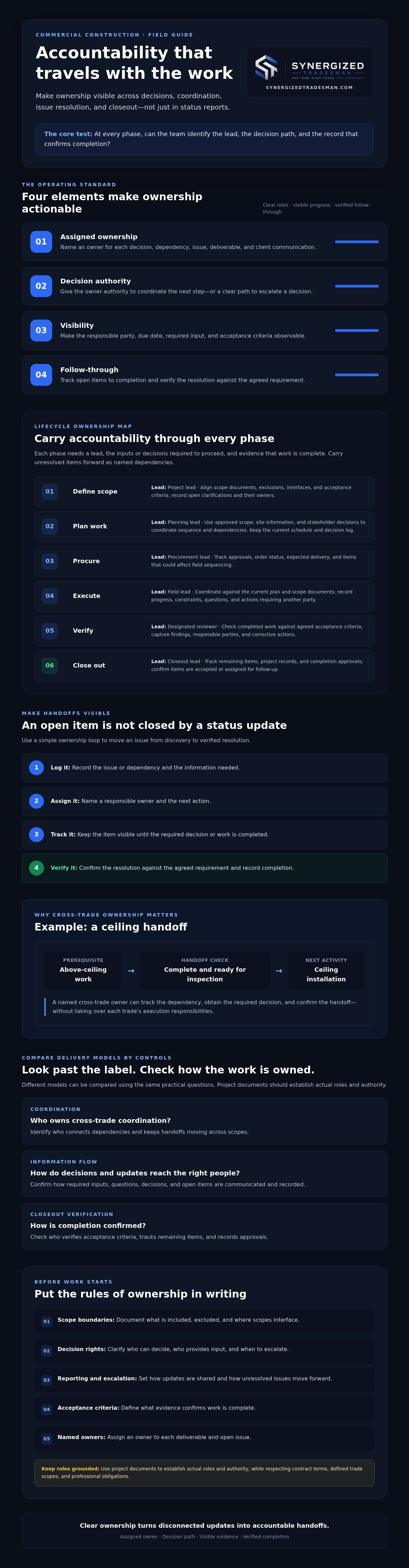
Name an owner for each decision, dependency, issue, and client communication. Give that person clear authority to coordinate the next step or escalate a decision. Tie commitments to observable records: the responsible party, due date, required input, and acceptance criteria. When an open item arises, log it, assign an action and owner, track it to completion, and verify the resolution against the agreed requirement. A status update alone doesn’t close an item.
Why do commercial projects lose accountability?
Separate contracts and reporting channels can make each trade’s progress visible without showing how one scope depends on another. For example, ceiling installation may depend on above-ceiling work being complete and ready for inspection. If the handoff status, decision authority, or acceptance step isn’t clear, teams may wait for one another while the schedule impact remains unassigned. A named cross-trade owner can track the dependency, obtain the required decision, and confirm the handoff without taking over each trade’s execution responsibilities.
How Accountability Works Across the Commercial Construction Lifecycle
Accountability needs to travel with the work, not stop at contract award or a progress meeting. At each phase, identify the accountable lead, the inputs and decisions needed to proceed, and the record that will show the work is complete. If an item remains unresolved, carry it forward as a named dependency instead of letting it disappear between phases.
- Define scope: The project lead aligns scope documents, exclusions, interfaces, and acceptance criteria. Record open clarifications and who must resolve them.
- Plan work: The planning lead uses approved scope, site information, and stakeholder decisions to coordinate sequence and dependencies. Keep the current schedule and decision log as evidence of agreed direction.
- Procure: The procurement lead works from approved requirements, submittals, and delivery needs. Track approvals, order status, expected delivery, and items that could affect field sequencing.
- Execute: The field lead coordinates work against the current plan and applicable scope documents. Record progress, constraints, questions, and actions requiring another party.
- Verify: The designated reviewer checks completed work against agreed acceptance criteria. Capture findings, responsible parties, and any corrective actions that remain open.
- Close out: The closeout lead tracks remaining items, required project records, and completion approvals. Confirm each item is accepted or clearly assigned for follow-up.
This illustrative responsibility matrix is a planning aid, not contractual advice. Project documents should establish actual roles and authority.
- Scope and decisions: The project lead owns clarification tracking; the client representative provides decisions within their authority.
- Procurement and delivery status: The procurement lead tracks approvals, orders, and delivery information; the field lead flags schedule dependencies.
- Field issues and acceptance: The field lead assigns and tracks actions; the designated reviewer records whether acceptance criteria are met.
Which controls make ownership visible?
Use a decision log for approvals, a responsibility matrix for roles, a look-ahead schedule for near-term work, and an issue register for constraints and unresolved items. Each entry should show its date, named owner, current status, and next action. Photos and reports can support verification, but they’re evidence inputs, not substitutes for responsibility. For broader delivery context, see this multi-trade commercial construction accountability model.
How should teams manage handoffs and escalation?
A procurement-to-field handoff should include the approved requirement, current submittal or selection status, delivery information, dependencies, and any unresolved decision. Agree in advance how blocked decisions and cross-trade conflicts move from the responsible lead to the next decision-maker. The accountable owner drives resolution, tracks the next action, and confirms the outcome.
Professional accountability also means acting within the obligations and authority assigned to each role. The American Institute of Constructors outlines relevant ethical and legal responsibilities in construction. For an example of a single accountable relationship coordinating planning, procurement, field execution, and closeout, explore Synergized Tradesman’s multi-trade construction coordination.
Which Accountability Model Fits a Commercial Construction Project?
The right delivery model depends on project scope, procurement strategy, and the owner’s capacity to manage multiple relationships. Compare how each model assigns coordination and communication, not just what it’s called. For accountability in commercial construction, the key question is whether someone has clear responsibility for connecting trade activities and moving shared issues toward resolution.
What changes between fragmented and coordinated delivery?
With owner-managed multiple contracts, the owner holds direct relationships with separate trades and may manage communication and cross-trade dependencies. A construction manager can coordinate parties under an agreed scope, giving the project a defined coordination lead while contracts may remain separate. A single accountable multi-trade relationship brings multiple scopes into one coordinating relationship. Each model can suit a project when roles, authority, and reporting expectations match the owner’s needs.
| Factor | Owner-managed multiple contracts | Construction manager coordinating parties | Single accountable multi-trade relationship |
|---|---|---|---|
| Ownership | Owner manages separate trade relationships. | Manager coordinates within its agreed role. | One relationship coordinates the included trade scopes. |
| Communication paths | Often run between owner and each trade. | Can route coordination through the manager. | Can provide a central coordination path for included work. |
| Trade coordination | Owner connects dependencies across contracts. | Manager tracks interfaces as defined in its scope. | Coordinating party aligns included scopes and handoffs. |
| Visibility | Owner consolidates separate updates. | Depends on agreed reporting and access. | Can consolidate status across coordinated scopes. |
| Closeout | Owner tracks completion across each contract. | Manager coordinates closeout if included in its role. | One relationship can coordinate closeout for included work. |
These are general distinctions, not guarantees of how a particular contract will work. A project with a capable owner team and clearly bounded packages, for example, may suit multiple direct contracts. A project with numerous interdependent scopes may benefit from a defined coordination lead. Review proposed roles and deliverables before deciding. This commercial general trades contractor selection guide offers additional criteria for evaluating a coordinated approach.
Does one point of accountability mean less client control?
No. The owner retains the approvals, priorities, and acceptance decisions assigned in the project documents. A coordination lead clarifies where questions go and how unresolved matters are escalated; it doesn’t remove client involvement. Nor does a single relationship automatically change contractual risk allocation or eliminate trade-specific scopes. Confirm in the project documents who performs each scope, who coordinates interfaces, and who has authority to approve changes.
How to Set Accountability Expectations Before Work Starts
Set accountability before award and mobilization, while scope boundaries, decision authority, and reporting expectations can still be clarified. A project accountability plan should turn broad promises into named roles and repeatable controls. For accountability in commercial construction, assign one owner to each deliverable, dependency, open issue, and approval. That owner drives the next action, even when another party performs the work or makes the final decision.
What should the accountability plan document?
Record the operating rules in a project-specific plan and confirm they align with the contract documents. A useful pre-award checklist includes:
- Scope and interfaces: Define what each party provides, where scopes meet, and who resolves unclear boundaries.
- Roles and authority: Name project leads, document authority limits, and identify who can approve decisions or changes.
- Communication and reporting: Set channels, meeting cadence, and reporting fields. Agree on status, owner, due date, dependencies, decision needed, and next action. Choose a cadence that fits project phases and coordination needs instead of assuming one frequency suits every job.
- Escalation and change control: Document how blocked decisions, cross-trade conflicts, and proposed changes are routed, recorded, and brought to the authorized decision-maker.
- Quality, safety, and completion: Specify how observations, safety concerns, and incomplete work are reported and tracked. Define closeout deliverables, responsible parties, review steps, and the evidence required for acceptance before mobilization.
Closeout should not be an end-stage surprise. Identify required records and acceptance criteria early, then track them as deliverables through execution. This makes missing information and unresolved work visible while there’s still time to assign action and confirm responsibility. For a broader view of organizing responsibilities and handoffs, use this commercial construction coordination guide.
How can buyers test accountability during selection?
Ask each bidder to walk through a realistic cross-trade issue, such as a delivery dependency that affects field sequencing. Listen for a clear sequence: who records the issue, who owns the next action, which party has decision authority, how the schedule impact is communicated, and what confirms resolution. Request sample reporting structures or closeout lists with confidential details removed. Specific roles and records reveal more than general assurances about being proactive.
Before work begins, verify that the proposed lead can explain how ownership works across procurement, field execution, and closeout while preserving the client’s agreed approval rights. To discuss coordinated multi-trade commercial construction, connect with Synergized Tradesman.
How Synergized Tradesman Applies Accountability to Multi-Trade Work
Synergized Tradesman manages multi-trade commercial construction, renovation, retail refresh, and rollout programs through a single accountable relationship. That structure gives clients one relationship to discuss how included trade scopes connect, how procurement status relates to field execution, and how open items move toward closeout. The company applies a consistent operating standard across projects, providing a basis for repeatable reporting and closeout expectations.
Where does a single accountable relationship add coordination value?
Coordination value comes from connecting information that might otherwise sit in separate trade updates. For example, a procurement status change can be shared with the field team when it affects sequencing, while an unresolved field question can be tracked with a named next action. This creates a clearer path for surfacing dependencies and decisions across the work included in the project.
A single accountable relationship doesn’t erase trade-specific scopes, each party’s responsibilities, or client approval rights. Those boundaries should remain clear in the project documents. The coordination role connects the work and communicates status; it doesn’t replace the client’s agreed decisions or redefine who performs each trade’s work. This distinction is central to practical accountability in commercial construction: unified oversight can coexist with defined scopes and approvals.
Synergized Tradesman coordinates planning, procurement, field execution, and closeout. Its one-standard approach across projects gives commercial clients a consistent basis for reporting expectations and completion records, including for renovation, refresh, and rollout work. The approach describes how work is coordinated, not a promise of a specific cost, schedule, or quality result. Synergized Tradesman is also a certified women-owned firm; that status is a company attribute, not a guarantee of project performance.
What should a prospective client discuss first?
Start with the operating facts that shape coordination. Outline the project type, trades involved, site or business constraints, and required completion milestones. Then identify where ownership is unclear today: procurement dependencies, cross-trade handoffs, open decisions, reporting gaps, or closeout requirements. These details help establish whether a single accountable relationship fits the project’s scope and coordination needs.
Bring relevant scope information and approval expectations into the discussion. Clarify which decisions remain with the client, what information should be reported, and what evidence will support completion and acceptance. Synergized Tradesman’s work includes multi-trade commercial construction and project closeout, with coordination structured around the project’s defined requirements.
Discuss your commercial construction project to review scope, coordination needs, and accountability expectations.
Put Clear Ownership Into Your Next Project
Strong accountability in commercial construction takes more than a delivery model. It requires named owners, visible decisions, and documented follow-through from early planning through acceptance. Before work begins, confirm who manages cross-trade dependencies, how client approvals are handled, and what evidence will establish completion.
Synergized Tradesman brings these responsibilities together through one accountable relationship coordinating planning, procurement, field execution, and closeout. The company applies one operating standard across projects and is a certified women-owned commercial construction firm. These facts describe its approach and status, not a guarantee of project performance. Project scope, authority, and acceptance expectations still need to be clearly agreed.
If your project involves multiple trades, renovations, refreshes, or rollout work, start by identifying where coordination needs clearer ownership. Discuss your commercial construction project and the accountability expectations that matter to your team. Clear roles and consistent controls give everyone a stronger basis for moving the work forward.
Frequently Asked Questions
What does accountability mean in commercial construction?
Accountability means clearly assigning responsibility for decisions, coordination, issue resolution, and follow-through. It also requires enough visibility to see whether commitments are on track and what evidence confirms completion. A project can have frequent updates and detailed records yet still lack accountability if no one owns the next action. Define the role, its authority, and its limits in the project documents so responsibility is clear without replacing each trade’s obligations.
Who is accountable for delays in a commercial construction project?
Responsibility for a delay depends on its cause, the affected scope, and the project’s contract documents. A delay may involve a pending approval, a procurement dependency, a field condition, or a handoff between trades. Identify who owns tracking and communicating the schedule impact, then review the relevant records and contractual responsibilities to determine any further allocation. Don’t assume that the party reporting a delay is automatically responsible for it.
Does a single point of contact improve construction accountability?
A single point of contact can improve visibility and issue routing when that role has a defined coordination scope, authority, and escalation path. It gives stakeholders a clear place to raise cross-trade questions and check progress. It doesn’t automatically resolve issues or replace client approvals, individual trade scopes, or contractual responsibilities. Confirm what the contact coordinates, what decisions they can make, and which matters must go to the owner or another authorized party.
How can a commercial construction team track accountability?
Track accountability with practical project controls, not status updates alone. Maintain a decision log, responsibility matrix, look-ahead schedule, and issue register. For each open item, record its description, named owner, date, status, next action, due date, and any required decision. Use meeting notes, reports, and photos as supporting evidence. Close an item only after the assigned action is complete and the result has been checked against the relevant requirement or acceptance criteria.
What should an accountability plan include before construction starts?
An accountability plan should identify project roles, decision authority, communication channels, reporting expectations, and escalation routes. It should also clarify scope boundaries, trade interfaces, procurement dependencies, change-control steps, and how incomplete work or concerns will be tracked. Define closeout deliverables, who supplies or reviews each one, and what evidence supports acceptance. Align the plan with the contract documents and project requirements before mobilization so teams understand how ownership works from the start.
Can one construction partner manage multiple trades?
Yes. A construction partner can coordinate multiple trade scopes when its agreed project role includes that work. Synergized Tradesman provides a single accountable relationship for multi-trade commercial construction, renovation, retail refresh, and rollout programs, coordinating planning, procurement, field execution, and closeout. Coordination doesn’t remove trade-specific scopes or client approvals. Confirm which trades and deliverables are included, who performs each scope, and how decisions and interfaces will be managed.
How does accountability continue through project closeout?
Accountability continues through closeout by keeping remaining work and required records assigned, visible, and tied to acceptance criteria. Name an owner for each open item, identify who must complete or review it, and track its status through verification. Clarify who confirms acceptance and how unresolved items are documented for follow-up. Closeout is not just collecting documents at the end; its requirements and responsibilities should be established before work begins and maintained as the project progresses.


