

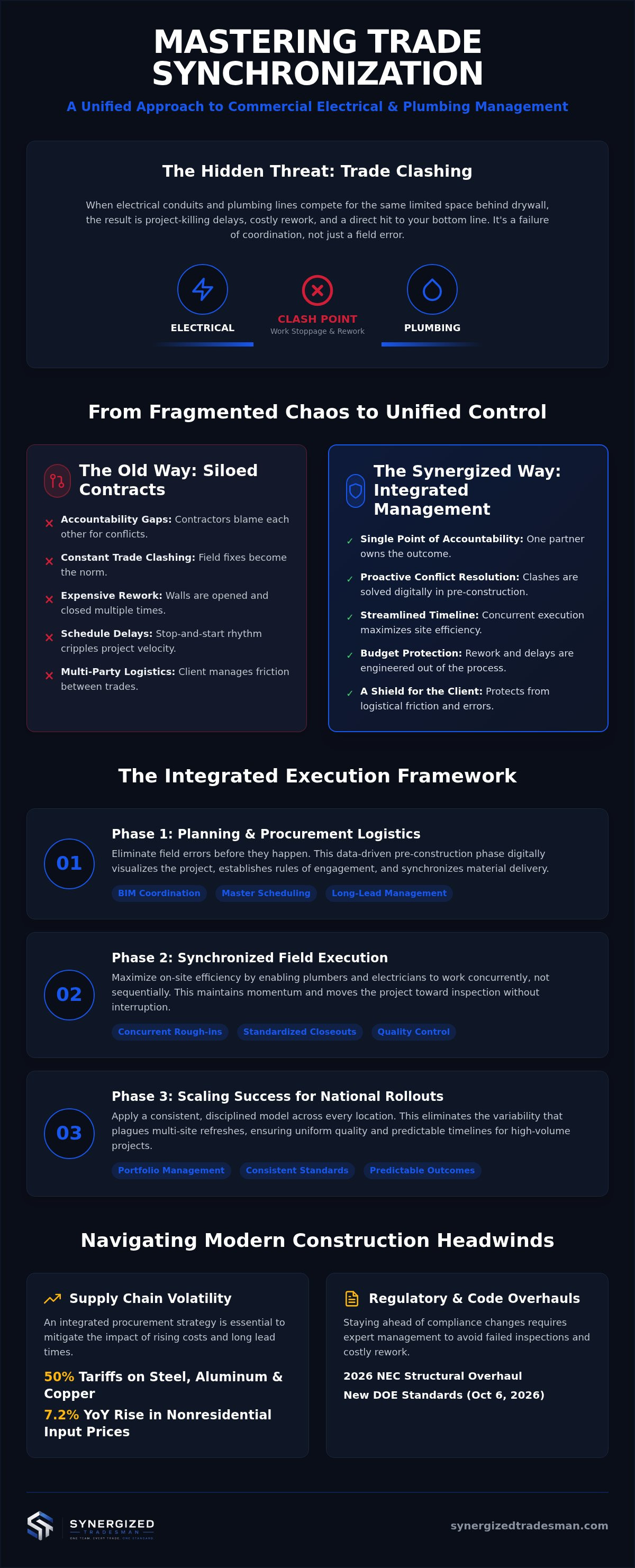
A project's success is often decided behind the drywall long before the final inspection occurs. When electrical conduits and plumbing lines compete for limited space, the result is an immediate hit to your schedule and your bottom line. You understand that trade clashing isn't just a field error; it's a failure of coordination that creates accountability gaps between separate contractors. Effective commercial electrical and plumbing management requires a unified approach that treats these systems as a single infrastructure layer rather than isolated silos.
This guide provides the strategic framework you need to master trade synchronization for your next national retail rollout or commercial renovation. We'll show you how to eliminate field execution errors and maintain a streamlined timeline through a single point of accountability. You'll learn to navigate the 2026 NEC structural overhaul and new DOE efficiency standards while mitigating the impact of rising copper and steel costs. This guide breaks down the transition from fragmented logistics to a disciplined, managed execution model that acts as a shield for your project's budget.
Key Takeaways
- Identify the primary risks associated with trade clashing and learn how integrated planning prevents schedule-killing conflicts.
- Evaluate the cost-saving benefits of a single-partner accountability model compared to managing multiple siloed trade contracts.
- Master the logistics of commercial electrical and plumbing management to synchronize high-voltage and wet-utility systems effectively.
- Streamline field execution by coordinating concurrent rough-ins and standardized closeout procedures across national locations.
- Utilize BIM coordination and centralized procurement to maintain project timelines during high-volume retail refreshes and rollouts.
The Logistics of Commercial Electrical and Plumbing Management
Integrated management is the tactical synchronization of high-voltage electrical systems and wet-utility plumbing infrastructure. These two trades represent the highest risk for project delays due to their physical density within commercial walls and ceilings. Effective Construction management treats these as a unified layer rather than separate silos. When trades operate in isolation, they focus solely on their own path of travel, often at the expense of the next contractor. This lack of coordination leads to trade clashing, where conduits and pipes physically occupy the same space.
Common clashing points in retail and commercial interiors include overhead conduit runs competing with gravity-sloped drain lines and the placement of electrical panels near wet-utility access points. Without oversight, these conflicts remain hidden until field execution. At that stage, they force immediate work stoppages and expensive field fixes. A single accountable relationship eliminates these gaps by centralizing commercial electrical and plumbing management under one management umbrella. This model acts as a shield, protecting the client from the friction of multi-party logistics and ensuring the infrastructure is built for long-term compliance.
Why Synchronization is Critical for Commercial Timelines
Rework costs escalate exponentially when electrical and plumbing paths intersect incorrectly after walls are closed. Integrated management reduces Request for Information (RFI) cycles by solving spatial conflicts during the pre-construction phase. In high-volume rollouts, avoiding even a single day of trade-related rework across fifty locations can save weeks on the overall project critical path. Precision scheduling ensures that plumbers and electricians aren't tripping over one another. This keeps the site moving toward the final inspection without the typical stop-and-start rhythm of uncoordinated trades.
Core Components of Integrated Utility Management
Unified procurement is a primary pillar of this model. Managing the delivery of specialty plumbing fixtures and long-lead electrical components simultaneously ensures that site teams aren't waiting on one trade to finish before the other can start. Concurrent field execution strategies allow for the simultaneous installation of pipe and wire, maximizing site efficiency. This approach also guarantees standardized quality control across national project portfolios. By applying the same rigorous standards to every site, you eliminate the variability that often plagues multi-location refreshes. It creates a single source of truth for the entire utility infrastructure layer.
Phase 1: Planning and Procurement Logistics
Planning starts with a rigorous scope analysis. You must identify total electrical load requirements and detailed plumbing infrastructure needs before field teams mobilize. BIM serves as the primary tool for pre-construction trade coordination. It allows managers to visualize the collision of pipes and wires in a digital environment. This data-driven approach aligns with the standards established by the Construction Management Association of America for maintaining project integrity. Build a unified master schedule to dictate the sequence. This ensures that heavy plumbing rough-ins precede electrical conduit runs to account for gravity-fed drainage slopes. This level of commercial electrical and plumbing management prevents the spatial conflicts that derail national rollouts.
The Pre-Construction Coordination Meeting
A successful kick-off requires the project manager, lead electrician, and master plumber to meet before demolition. This meeting establishes "no-fly zones" within the plenum space and behind walls. These are designated corridors where only one trade may install equipment. It prevents the chaotic first-come, first-served installation style that leads to rework. Teams must also address local code compliance within the national rollout framework. While the 2026 NEC provides a national baseline, local amendments require specific attention to avoid inspection failures. Precise coordination at this stage acts as a shield against future field errors.
Procurement and Long-Lead Item Management
Procurement strategies in 2026 must account for significant supply chain volatility. Tariffs on steel, aluminum, and copper currently sit at 50%, while input prices for nonresidential construction have risen by 7.2% year-over-year. Managing switchgear and commercial water heating lead times is critical for your timeline. New DOE standards taking effect October 6, 2026, mandate 95% thermal efficiency for gas units. This shift requires early procurement of condensing water heaters to avoid project stalls. Centralized procurement ensures multi-location consistency and price stability across your entire portfolio. Utilizing commercial construction project coordination streamlines these early phases by securing materials before price hikes occur. This protects your budget from the 26% increase in copper mill shapes reported this year. To secure your project's timeline, consider how integrated trade management can stabilize your procurement process.
Accountability Models: Single Partner vs. Multi-Contractor
Traditional procurement often separates electrical and plumbing into distinct contracts. This siloed approach creates a fragmented project environment where vital information is lost between trades. In contrast, the synergized accountability model integrates commercial electrical and plumbing management into a single, cohesive workflow. High-level coordination requires managers with professional certifications to oversee the technical dependencies between high-voltage and wet-utility systems. This transition from multiple vendors to a single partner eliminates the operational friction that typically delays national rollouts.
The Risks of Fragmented Trade Management
When things go wrong behind the drywall, the "Blame Game" begins. Plumbers might blame electricians for blocking a drain line path, while electricians claim the plumbing layout forced an expensive conduit reroute. These finger-pointing sessions create accountability gaps that force the client to mediate disputes. Managing multiple trade-specific contracts across national regions also leads to inconsistent execution standards. One location might adhere to rigorous 2026 NEC updates, while another fails due to a lack of centralized oversight. The hidden administrative costs of managing separate invoices, insurance certificates, and schedules often exceed the initial perceived savings of separate bidding.
The Synergized Tradesman Advantage
The primary alternative is operating under one standard for multi-trade commercial construction. This creates a "Shield" effect for the client. The management firm takes on the total burden of field execution logistics, including the synchronization of rough-ins and the resolution of spatial conflicts. Billing and project documentation are simplified through a single relationship, reducing the volume of invoices and streamlining the close-out process. This model provides a single source of truth for the entire project lifecycle, ensuring that field data is accurate and transparent.
As a WBE-certified firm, Synergized Tradesman also helps clients meet corporate diversity goals without sacrificing operational quality. This model simplifies the hand-off package at the end of a project. When the same entity manages both electrical and plumbing, the documentation is unified and inspections are coordinated more effectively. The result is a faster transition from construction to operations, allowing your facility to open on schedule with its utility infrastructure fully documented and compliant.
Field Execution: Synchronizing Rough-ins and Closeouts
Field execution is where strategic coordination meets physical reality. Successful commercial electrical and plumbing management depends on a disciplined, five-step sequence that begins with site preparation and ends with a clean, operational facility. This phase requires active oversight to ensure that the digital plans created during BIM coordination are accurately reflected in the physical build.
Step 1 involves clearing the site through professional commercial demolition services. This phase ensures all legacy systems are removed, creating a clean slate for new utility paths. Step 2 focuses on concurrent rough-ins. Managing the sequence of pipe and wire is critical; gravity-sloped drain lines must be established before electrical conduits occupy the plenum space. Step 3 requires rigorous quality control inspections before wall enclosure to verify compliance with 2026 NEC and IPC standards. Step 4 covers the final trim, fixture installation, and system testing. Finally, Step 5 provides the final cleaning and comprehensive project close-out.
Managing the Critical Rough-in Window
The rough-in window is often the most congested phase of a project. Teams must share limited space in commercial ceilings and vertical chases without compromising code clearances. Coordination ensures electrical support is ready for plumbing equipment, such as booster pumps and high-efficiency water heaters. Daily field reporting and accountability protocols track progress in real-time. This visibility allows managers to address spatial conflicts before they require rework. It keeps the site moving toward the next milestone without the friction of trade-on-trade disputes.
Close-out and Final Deliverables
Close-out transforms a construction site into a functional business environment. All systems must meet interior commercial construction management standards to ensure long-term reliability. Accurate "as-built" drawings are a non-negotiable deliverable. These documents provide a precise map of all utility runs, which is essential for future facility maintenance and refreshes. Post-construction cleaning removes trade debris and dust, preparing the space for immediate retail operations. This structured hand-off ensures that your operations team receives a fully documented and functional facility.
A single source of truth for field execution protects your timeline from the typical "last-mile" delays. To ensure your next project transitions smoothly from rough-in to grand opening, partner with a master coordinator today.
Scaling Success: Managing National Rollouts and Refreshes
Scaling a retail rollout requires more than just local trade partners; it demands a repeatable execution engine. Maintaining consistent standards across 50 or 100 locations is impossible without centralized commercial electrical and plumbing management. You need a model that replicates quality regardless of regional market conditions. Leveraging a commercial general trades contractor allows you to bypass the variability of local subcontractors. This approach ensures that every site follows the same technical specifications and safety protocols. By optimizing these multi-trade workflows, you significantly reduce the time-to-market for new locations or refreshed brand identities.
Standardization Across National Portfolios
Success at scale begins with a prototype scope. This document defines the exact electrical and plumbing requirements for every refresh, ensuring that a facility in one region matches the quality of a facility in another. It eliminates regional quality variances by providing field teams with a standardized roadmap. Centralized field management acts as the single source of truth for your entire portfolio. A national partner ensures brand-wide consistency through several key protocols:
- Uniform fixture selection for simplified long-term maintenance.
- Standardized wiring diagrams to assist future facility managers.
- Centralized permit management to prevent localized site delays.
This discipline prevents the drift in quality that often occurs when managing trades through multiple regional vendors. It provides the oversight necessary to maintain compliance with the 2026 NEC updates across every state in your program.
Logistics of High-Volume Programs
High-volume programs operate on a wave schedule. This logistical strategy groups projects by region or type to maximize resource efficiency and trade mobilization. Procurement scaling becomes a competitive advantage when ordering for 100 sites simultaneously. It allows you to secure long-lead items, like the 95% thermal efficient water heaters required by October 2026 DOE standards, well in advance of the deadline. Effective program logistics include:
- Strategic material staging to prevent on-site congestion.
- Coordinated trade mobilization to reduce mobilization costs.
- Real-time digital reporting for portfolio-wide visibility.
Every site must meet the same strict close-out standards to ensure a seamless operational hand-off. Managing these logistics through a single accountable relationship simplifies the administrative burden on your corporate team. It transforms a complex rollout into a controlled, predictable sequence of successful completions that meet your budget and schedule requirements.
Mastering Multi-Trade Infrastructure for National Growth
Effective commercial electrical and plumbing management is the foundation of a resilient facility. It moves beyond the friction of siloed trades to create a unified infrastructure layer. By synchronizing rough-ins and centralizing procurement, you eliminate the accountability gaps that often lead to budget overruns. This disciplined approach ensures your project meets the 2026 NEC and DOE standards without compromising your timeline. High-volume rollouts require a repeatable execution engine that delivers standardized quality across every location.
Synergized Tradesman provides the oversight needed to act as a shield for your operations. We offer a single accountable relationship and WBE-certified excellence to ensure consistent results across the United States. Our model is built for national project execution and high-volume demands. Streamline your next commercial rollout with Synergized Tradesman today. You don't have to manage the complexity of multi-party logistics alone. We are ready to help you maintain command of your project lifecycle from planning to close-out.
Frequently Asked Questions
What is the difference between facility maintenance and commercial construction management?
Facility maintenance focuses on the ongoing upkeep and repair of existing systems to prevent operational failure. Commercial construction management involves the strategic planning, procurement, and field execution of new infrastructure or major renovations. While maintenance handles the 24/7 lifecycle of a building, construction management ensures that the initial installation is delivered on schedule and under budget. We provide the oversight necessary to build these systems correctly from the start.
Why should I use a single partner for both electrical and plumbing trades?
Using a single partner eliminates the accountability gap that occurs when trades operate in silos. Integrated commercial electrical and plumbing management allows for the simultaneous coordination of rough-ins, reducing spatial conflicts behind walls. A single point of contact simplifies communication and ensures that electrical support is ready for plumbing equipment without the friction of managing separate contracts. This unified model acts as a shield for your project timeline and budget.
How does a WBE-certified firm help my commercial construction project?
A WBE-certified firm like Synergized Tradesman helps corporate clients meet essential diversity and inclusion goals while maintaining rigorous operational standards. This certification signals a commitment to transparency and disciplined project execution. Beyond compliance, it provides a reliable partnership model that emphasizes total responsibility for multi-party logistics and standardized quality across national project portfolios. We combine strategic planning with a disciplined organizational model to deliver high-volume demands with total compliance.
Can you coordinate electrical and plumbing for a national retail rollout?
Yes. We manage high-volume national retail rollouts by applying a single execution standard across all project sites. This centralized approach eliminates regional quality variances and ensures that every location adheres to the same prototype scope. Our national reach allows us to mobilize trades and manage procurement for 50 or more locations simultaneously, maintaining a consistent timeline for your entire portfolio. This disciplined process reduces time-to-market by optimizing multi-trade workflows and standardized close-out procedures.
What are the common causes of delays in commercial multi-trade projects?
Trade clashing is the primary cause of delays, where plumbing and electrical lines compete for the same physical space. Other factors include uncoordinated procurement of long-lead items and lengthy RFI cycles caused by poor pre-construction planning. Inconsistent execution between different regional contractors also creates bottlenecks that prevent a project from moving into the final trim phase on schedule. Integrated management solves these issues by establishing a single source of truth before mobilization begins.
How do you ensure consistent quality across multi-location renovations?
Consistency is achieved through the use of a prototype scope and centralized field management. We establish a single source of truth for technical specifications that every site must follow regardless of location. This disciplined model replaces the variability of local subcontractors with a standardized execution plan, ensuring that inspections and quality control protocols remain uniform. By applying the same rigorous standards to every site, we eliminate the regional variances that plague multi-location renovation programs.
What is involved in the project close-out phase for commercial utilities?
The close-out phase involves rigorous system testing, final fixture installation, and the delivery of accurate as-built drawings. These drawings provide a permanent record of all utility paths for future maintenance and facility refreshes. We also complete final cleaning and project close-out documentation to ensure the facility is ready for immediate retail operations. This structured hand-off ensures that your operations team receives a fully documented, functional, and compliant facility at the end of construction.
How does pre-construction planning reduce field execution errors?
Pre-construction planning identifies spatial conflicts and load requirements before field teams mobilize. By using BIM coordination, we resolve trade clashes in a digital environment, which prevents expensive rework during the rough-in phase. This early intervention reduces the volume of field corrections and ensures that the master schedule respects the dependencies between electrical systems and plumbing infrastructure. Effective planning acts as a shield against the execution errors that typically derail high-volume commercial construction projects.


