

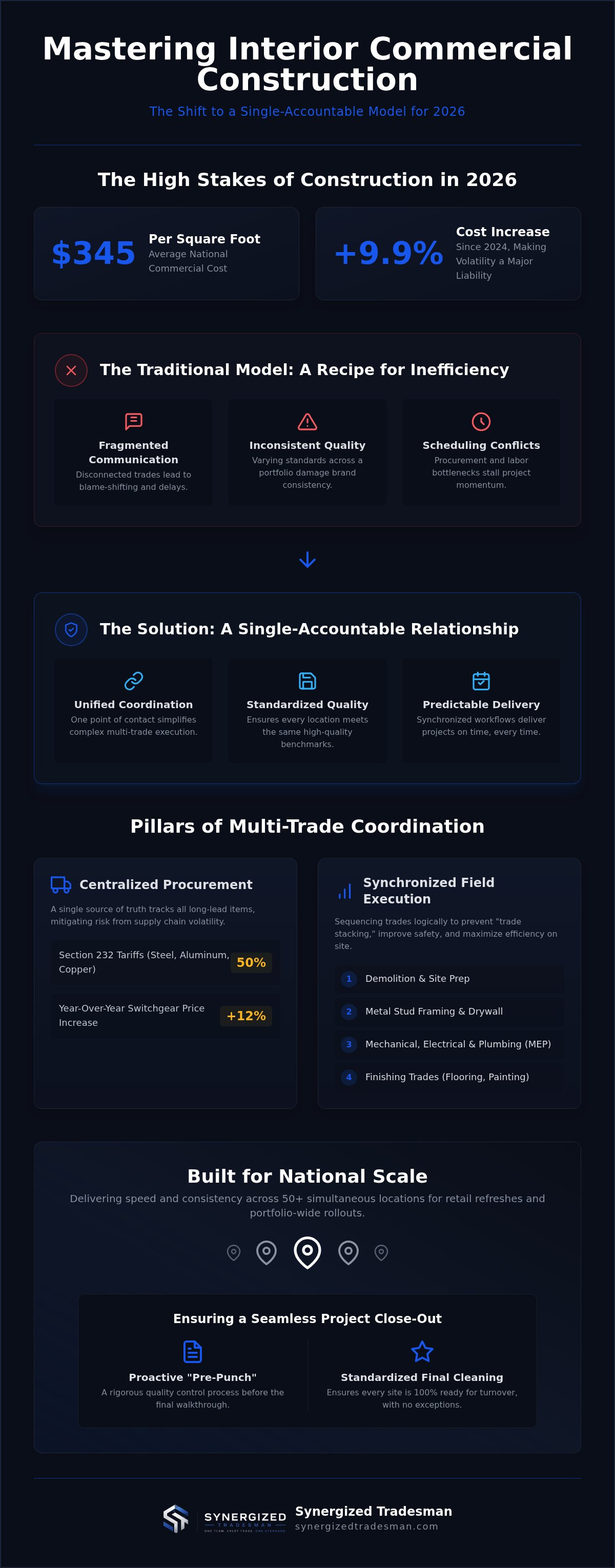
National commercial construction costs reached an average of $345 per square foot in 2026, marking a 9.9% increase since 2024. For many project leaders, this volatility makes the traditional model of juggling disconnected trade partners a liability rather than a strategy. You're likely tired of managing fragmented communication and seeing inconsistent quality across high-volume retail refreshes. It's difficult to maintain a schedule when procurement delays for steel or copper impact your final close-out. You need a way to stabilize your operations despite rising input prices and complex labor markets.
This guide shows you how to master interior commercial construction management by moving toward a single-accountable relationship. You'll learn to navigate the complexities of multi-trade execution with a framework designed for national rollout precision. We cover everything from field execution strategies to the latest 2026 regulatory shifts, ensuring your portfolio remains standardized and predictable. By the end of this reference, you'll have the tools to act as a master coordinator, shielding your projects from the inefficiencies of multi-party logistics and ensuring every trade delivers to a singular, high standard.
Key Takeaways
- Shift from fragmented communication to a single-accountable relationship model that simplifies complex multi-trade coordination.
- Synchronize field execution across mechanical, electrical, and finishing trades to eliminate scheduling conflicts and procurement bottlenecks.
- Apply standardized technical specifications for metal stud framing and drywall to ensure uniform quality across your entire portfolio.
- Optimize interior commercial construction management for national retail rollouts, balancing speed and consistency across 50 or more simultaneous locations.
- Execute a proactive "pre-punch" quality control process and standardized final cleaning to ensure a seamless project close-out.
Understanding Interior Commercial Construction Management and Project Complexity
Interior commercial construction management is the disciplined coordination of specialized trades within an existing building envelope. Unlike traditional general contracting, which often relies on a fragmented network of subcontractors with minimal oversight, this model prioritizes a single source of truth. It integrates demolition, metal stud framing, electrical, and finishing trades into a synchronized workflow. This approach applies fundamental Construction management principles to the specific, high-pressure environment of interior builds.
Success in interior commercial construction management requires managing three primary challenges: compressed timelines, site constraints, and trade interference. Retail environments and corporate offices don't have the luxury of extended lead times. Projects must move from demolition to project close-out in weeks, not months. Without a single accountable relationship, communication breaks down. A manager acts as a shield, protecting the client from the logistical friction of multi-party coordination.
The Scope of Interior Commercial Builds
Project requirements vary based on the intent of the space. Tenant improvements (TI) focus on customizing a shell for a specific occupant. Retail refreshes involve high-volume, repetitive updates across national portfolios. Full interior renovations often involve gutting an existing space to the studs to reorganize the floor plan entirely.
Management needs also shift based on the store status. "Open-store" construction requires rigorous dust mitigation and safety protocols to protect staff and customers during business hours. "Closed-store" environments allow for accelerated execution but demand maximum speed to minimize lost revenue. In 2026, multi-trade accountability means managing the entire interior lifecycle from initial demolition to final cleaning under a unified delivery standard.
The Shift Toward Accountability Models
The industry is moving away from fragmented trade hiring. Managing five or six separate contracts for flooring, painting, and drywall leads to inconsistent quality and blame-shifting when delays occur. Centralized oversight ensures that every trade partner follows the same quality control benchmarks from day one. It's about eliminating the "not my job" mentality that stalls projects.
This shift is critical for corporate brand consistency. When a retail brand refreshes 50 locations, the finish on the wallcovering and the tile alignment must be identical in every city. By adopting a multi-trade commercial construction model, firms eliminate the quality gaps inherent in decentralized management. This centralized approach provides the predictable timelines and standardized outputs required for national rollout success.
The Pillars of Multi-Trade Construction Coordination
Effective coordination is the operational engine of interior commercial construction management. It shifts the focus from simple task management to the tactical synchronization of labor and materials. The role of a construction manager in a multi-trade environment is to serve as the central hub for all logistical decisions. This oversight ensures that the critical path remains clear of avoidable bottlenecks. It requires a disciplined approach to both off-site procurement and on-site execution.
Procurement and Supply Chain Management
Managing long-lead items is a primary priority for project stability. In 2026, Section 232 tariffs remain at 50% for steel, aluminum, and copper. These costs, combined with a 12% year-over-year increase in switchgear prices, make procurement a high-stakes financial responsibility. A single accountable entity tracks fixtures, millwork, and specialty materials under one management umbrella. This "single source of truth" eliminates the risk of site delays caused by missing components or shipping errors. It allows for proactive adjustments when supply chain volatility threatens the schedule.
Synchronized Field Execution
Field supervisors prevent "trade stacking" by controlling the density of workers in a specific area. They sequence mechanical, electrical, and finishing trades to ensure that no one is waiting for another trade to finish. This logical progression maintains safety and improves efficiency. When plumbing and electrical work is synchronized with drywall installation, the project moves forward without the friction of overlapping schedules. Optimizing field execution directly reduces renovation downtime by ensuring that every hour on-site contributes to the project's completion.
Managing material flow in urban or high-traffic environments requires precise just-in-time delivery strategies. Constrained site footprints don't allow for excess material storage on the floor. Field managers must coordinate deliveries to match the immediate needs of the crew. Maintaining a single standard across national portfolios is equally vital. It ensures that a project in Texas, where costs average $260 per square foot, meets the same rigorous quality benchmarks as a project on the West Coast at $430 per square foot. If you need a partner to act as your shield against these complexities, a national multi-trade management firm offers the standardized oversight required for high-volume success.
Key Trades and Technical Specifications in Commercial Interiors
Turnkey interior builds require the seamless integration of demolition, structural framing, and high-performance finishes. Effective interior commercial construction management ensures these trades don't work in isolation. Managers must enforce industry standards of practice to maintain quality across every square foot of the build-out. This is particularly vital for metal stud framing and drywall, where precision determines the success of every subsequent trade. Every partition must be plumb and square to support the millwork and fixtures that follow.
Structural and Finishing Trades
Renovations begin with surgical demolition to prepare the site without damaging existing structural elements. Metal stud framing provides the necessary rigidity for commercial environments while allowing for rapid installation. Drywall finishing must meet specific standards; retail environments often require Level 5 finishes for high-gloss brand wallcoverings. Commercial flooring and tile installation must meet durability standards for high-traffic use while complying with slip-resistance regulations. Millwork and fixture installation represent the final touchpoints of the brand experience. Consistency here is non-negotiable. Painting protocols must align with corporate color palettes across all national locations to ensure brand integrity.
MEP Coordination and Utility Management
Managing electrical and plumbing trades within interior partitions requires advanced planning to avoid rework. The commercial general trades contractor serves as the single point of accountability for utility oversight. They ensure that conduit and piping are placed correctly before the walls are closed. This coordination extends to the ceiling, where HVAC diffusers and lighting must align perfectly with Acoustic Ceiling Tile (ACT) layouts. Misalignment in the ceiling grid often leads to costly delays during the finishing phase.
Compliance with the 2010 ADA Standards is a critical management task. Doorways must provide at least 32 inches of clear width when open at 90 degrees. Threshold heights are capped at 0.25 inches for interior doors to maintain an accessible route. In restrooms, managers must verify that grab bars are installed precisely at 33 to 36 inches above the floor. These technical details aren't suggestions; they are mandatory requirements for project close-out. By centralizing the management of these trades, firms eliminate the technical gaps that lead to inspection failures and ensure a standardized finish across the entire project.
Strategic Management of National Retail Refresh Programs
Executing a national retail refresh program requires more than just construction knowledge; it demands a logistics-first mindset. When managing 50 or more locations simultaneously, the complexity of interior commercial construction management shifts from individual site hurdles to program-wide synchronization. Success depends on balancing speed, cost, and brand consistency across diverse markets. Partnering with a WBE-certified firm provides the added benefit of meeting corporate diversity requirements while ensuring a single standard of accountability. This model allows corporate leaders to focus on high-level strategy while the management partner handles the multi-party logistics of national execution.
Centralized oversight is the only way to prevent regional quality variance. Without it, a store in a high-cost West Coast market might receive different finish levels than one in Texas. A master coordinator acts as a shield for the client, absorbing the friction of local labor shortages and supply chain delays. This centralized approach provides a predictable timeline that allows retail brands to plan their marketing and grand re-openings with total confidence.
High-Volume Rollout Logistics
Managing standardized procurement for national programs ensures that materials arrive on-site exactly when needed. This just-in-time approach is vital for retail brands that cannot afford operational disruption. Field execution must be scheduled during off-hours or in phases to keep doors open for customers. Centralized management allows for the bulk purchasing of long-lead items, which mitigates the impact of 2026 material price volatility. It ensures that every location follows the same critical path, regardless of local labor market fluctuations. This systematic scheduling prevents site congestion and keeps the rollout moving at a steady, methodical pace.
Maintaining Brand Consistency Across Sites
Developing a "master standard" for interior finishes and fixture placement is mandatory for brand integrity. This standard serves as the blueprint for every trade involved, from painting and wallcoverings to specialized millwork installation. Field audits and comprehensive project close-out documentation verify that every site meets these rigorous specifications. Using digital documentation ensures that records are consistent and easily retrieved for future facility maintenance. A single accountable relationship protects retail brand integrity by ensuring that the thousandth store looks exactly like the first. If you are preparing for a large-scale program, select a national multi-trade rollout partner built for high-volume demands.
Implementing Quality Control and Project Close-Out Standards
Quality control is the final test of interior commercial construction management. It determines whether a project succeeds or stalls during the final 5% of its lifecycle. Proactive management replaces the traditional reactive punch list with a "pre-punch" process. This internal audit identifies and corrects deficiencies before the client ever walks the site. By centralizing oversight, the management partner ensures that every trade meets the project's rigorous specifications without the need for repetitive site visits. This disciplined approach protects the timeline and prevents the budget creep often associated with lingering close-out tasks.
The single accountability model simplifies this final phase by providing one point of contact for every trade. You don't have to chase five different trade partners for final signatures or minor repairs. Instead, the manager acts as the "shield," ensuring that every trade delivers to the master standard before they leave the site. This unified oversight is critical for maintaining the 2026 standards of operational efficiency.
Field Accountability and Execution Standards
Rigorous handoff checklists are the foundation of zero-defect delivery. A framing crew cannot hand off a site until the manager verifies every stud is plumb and every partition matches the architectural drawings. This prevents quality issues from cascading into the finishing phases where they become more expensive to fix. Professional field management sets a high baseline for performance, holding each trade partner accountable to the same quality benchmarks across a national portfolio. This systematic approach ensures that the transition from mechanical rough-ins to final painting is seamless and predictable.
The Final Cleaning and Documentation Phase
A project is not complete until the site is ready for immediate occupancy. Final cleaning is a specialized trade that removes the residue of multi-trade activity. It ensures that flooring, glass, and fixtures are pristine for the grand opening. Simultaneously, the manager compiles a comprehensive documentation package. This package includes:
- O&M Manuals: Operation and maintenance instructions for all installed systems.
- Warranties: Consolidated records of all manufacturer and labor warranties.
- As-Built Drawings: Accurate records of the final utility and structural layouts.
In 2026, the shift toward standardized digital records simplifies this phase. California's 2026 mandate for a 5% retention cap on private contracts further emphasizes the need for a swift, efficient close-out. A clean project hand-off provides corporate stakeholders with the peace of mind that their asset is fully compliant and operational. Organized documentation serves as the single source of truth for the building's lifecycle, making future facility management straightforward and cost-effective.
Advancing Your Multi-Trade Execution Strategy
Mastering interior commercial construction management requires a shift from managing individual tasks to synchronizing a unified delivery model. This guide has detailed how centralized oversight eliminates trade interference and ensures brand consistency across national portfolios. We've examined the critical path of procurement and the necessity of proactive "pre-punch" quality control to ensure zero-defect delivery. By prioritizing these operational pillars, you can navigate the rising costs and regulatory complexities of the 2026 market with total confidence.
As a certified WBE with national reach, Synergized Tradesman provides the single accountable relationship necessary to protect your timeline and budget. We act as your shield, taking on the burden of multi-party logistics so your team can focus on high-level strategy. Contact Synergized Tradesman to streamline your next multi-trade commercial project and secure a predictable path to completion. Your portfolio deserves a management partner built for high-volume demands and standardized excellence. We're ready to help you execute your vision with precision.
Frequently Asked Questions
What is the role of an interior commercial construction manager?
An interior commercial construction manager acts as the single point of accountability for every specialized trade within a project. They coordinate everything from initial demolition and metal stud framing to final plumbing and electrical work. By serving as a master coordinator, they shield the client from the logistical friction of managing multiple trade partners. This role ensures that complex interior builds remain on schedule while meeting rigorous technical specifications.
How does a multi-trade management model differ from a general contractor?
Traditional general contractors often rely on a fragmented network of subcontractors with minimal centralized oversight. In contrast, the multi-trade management model prioritizes a single accountable relationship for all interior trades. This approach ensures a unified delivery standard and eliminates the blame-shifting that often occurs between disconnected trade partners. It provides a more streamlined, predictable framework for interior commercial construction management, especially in high-pressure retail or corporate environments.
Why is single accountability important for retail rollout programs?
Retail rollout programs involve high-volume, repetitive updates across dozens of national locations simultaneously. Single accountability is critical because it ensures brand consistency and standardized quality regardless of the project's location. Without a centralized management partner, regional quality variance can compromise the brand's image. This model provides corporate stakeholders with a single source of truth for timelines, budgets, and finish standards across their entire national portfolio.
What are the most common delays in interior commercial renovations?
Delays in interior commercial renovations frequently stem from trade stacking and procurement bottlenecks. When multiple trades attempt to work in a constrained site footprint without synchronized scheduling, productivity drops significantly. Additionally, current 2026 market conditions, such as the 50% tariffs on steel and aluminum, can lead to material shortages if not managed proactively. Professional managers anticipate these risks by controlling site density and securing long-lead items early.
How do you manage procurement for high-volume retail refreshes?
Managing procurement for high-volume refreshes requires a centralized logistics strategy. Managers track fixtures, millwork, and specialty materials under one management umbrella to prevent site-level delays. This just-in-time delivery model matches material arrivals to the immediate needs of the field crew, which is vital for constrained urban sites. Bulk purchasing strategies also help mitigate the impact of material price volatility, ensuring that national rollout costs remain predictable and within budget.
What documentation is required for a commercial construction project close-out?
Successful project close-out requires a comprehensive documentation package that supports future facility management. This includes Operations and Maintenance (O&M) manuals, consolidated warranty records, and as-built drawings that reflect the final structural and utility layouts. Digital documentation is now the standard for ensuring these records are easily retrieved. Providing a clean hand-off with all necessary certifications ensures that corporate stakeholders can transition the asset into full operation without administrative hurdles.
Can a WBE-certified firm handle national construction management?
A WBE-certified firm like Synergized Tradesman is fully equipped to provide national service coverage for high-volume programs. Certification as a Women-Owned Business Enterprise helps corporate clients meet diversity spend requirements while benefiting from professional, multi-trade expertise. These firms operate under a single standard across the United States, providing the same level of accountability for a project in Texas as they do for one on the West Coast.
How is quality controlled across multiple trades in a commercial build?
Quality control across multiple trades is maintained through a proactive "pre-punch" process and standardized field audits. Professional field managers use rigorous checklists for every handoff, ensuring that structural work like metal stud framing is perfect before finishing trades begin. This systematic approach prevents minor errors from cascading into major defects. By holding every trade partner to the same master standard, the management firm ensures a zero-defect delivery for the client.


