

Managing a high-volume commercial rollout shouldn't feel like a constant exercise in crisis management. In 2026, the success of a 50-store refresh depends less on the skill of individual trades and more on the integrity of your oversight model. Complexity requires coordination. You've likely dealt with the friction of fragmented communication across multiple vendors. It's a system that often leads to inconsistent quality between sites and budget overruns caused by poor procurement coordination. Selecting a dedicated commercial general trades contractor solves these issues by establishing a single source of truth for every phase of the project.
You deserve a project lifecycle that moves with precision from demolition to final closeout. This article explains how a single accountability model ensures consistent quality and operational efficiency across your entire portfolio. You'll learn how to achieve predictable timelines and transparent procurement through a relationship built for high-volume demands. We'll break down the strategic advantages of consolidating your trades into one streamlined, professional workflow that reduces the administrative burden on your internal team.
Key Takeaways
- A commercial general trades contractor acts as a single source of truth by managing the full spectrum of interior and exterior trades under one accountable relationship.
- Centralizing multi-party logistics reduces administrative overhead and eliminates the friction typically found between fragmented vendor teams.
- Standardized quality and brand consistency across national real estate portfolios are achieved through strategic procurement and disciplined field execution.
- Utilizing WBE-certified firms offers a strategic advantage for meeting corporate diversity goals while maintaining rigorous operational and compliance standards.
- High-volume retail refreshes require a modular workflow that manages the entire project lifecycle, from initial demolition to final cleaning and closeout.
What is a Commercial General Trades Contractor?
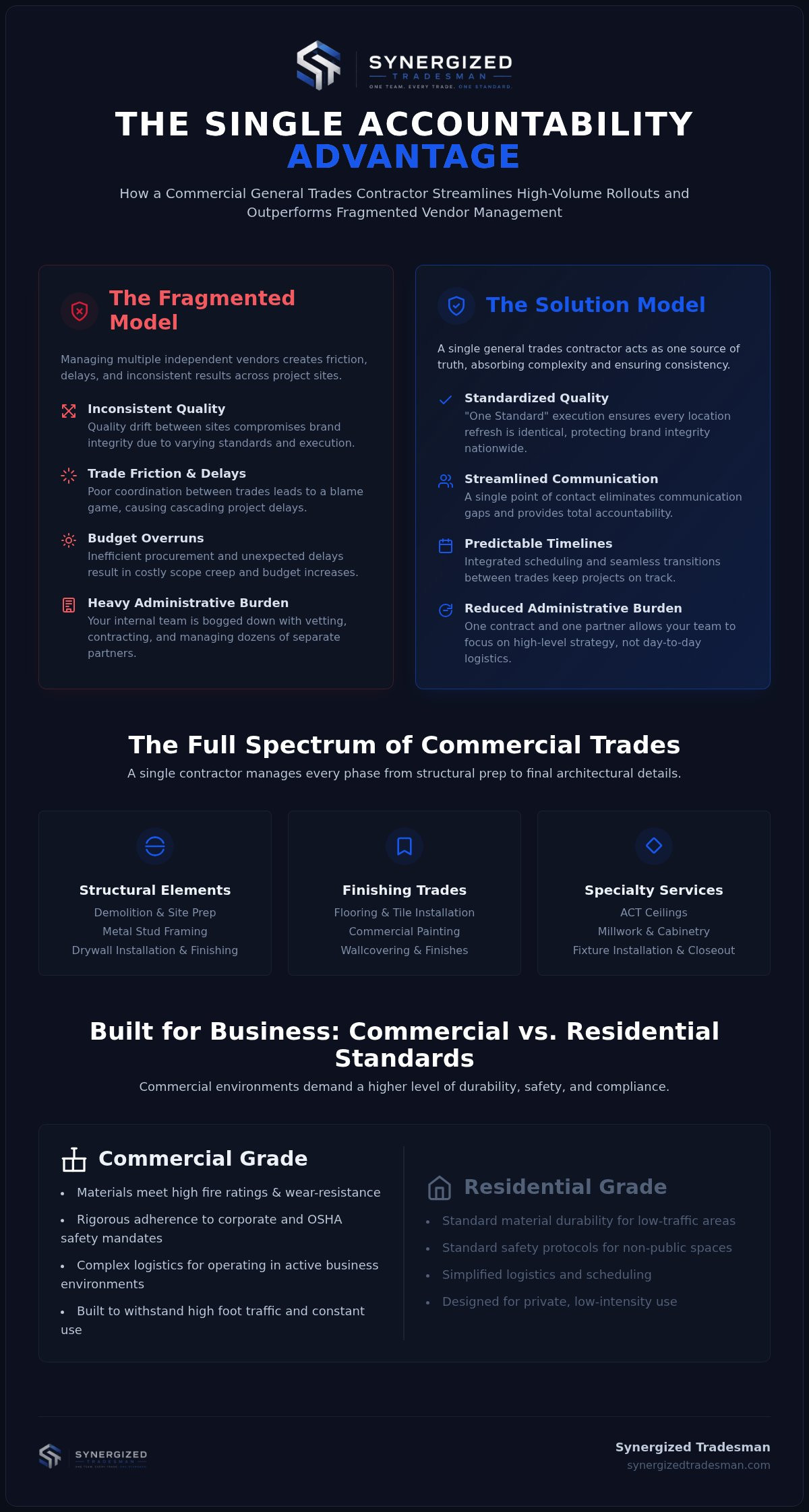
A commercial general trades contractor is a specialized firm that manages the full spectrum of interior and exterior trades for commercial environments. This model moves away from the traditional, fragmented approach of hiring individual vendors for every task. Instead, it offers a consolidated management structure. By acting as a single point of accountability, this contractor oversees everything from initial demolition to the final installation of fixtures. It's a role built for high-volume demands where speed and consistency are the primary metrics for success.
Understanding the distinction between a general contractor and a general trades specialist is vital for procurement teams. While the broad definition of What is a General Contractor? includes any party responsible for site oversight, the general trades model is more granular. It focuses on the specific coordination of finishing trades that define the user experience within a space. This specialized approach is highly effective for retail refreshes and interior renovations. It provides a shield for the client, absorbing the logistical burden of managing dozens of separate contracts.
The Scope of Multi-Trade Commercial Execution
Execution begins with structural preparation and ends with architectural details. A commercial general trades contractor manages a diverse list of services to ensure project continuity. This integrated scope ensures that one trade doesn't delay another. When the framing team and the drywall crew report to the same manager, the transition between phases is seamless. Key areas of execution include:
- Structural elements: Demolition, metal stud framing, and drywall.
- Finishing trades: Flooring, tile, painting, and wallcovering.
- Specialty services: ACT ceilings, millwork, and fixture installation.
Commercial vs. Residential Contracting Standards
Commercial environments demand a level of durability and compliance that residential projects don't require. Materials must meet specific fire ratings and wear-resistance standards to handle high foot traffic. Beyond material quality, safety protocols are more rigorous. All work must adhere to corporate safety mandates and 2026 OSHA standards, including new PPE fit requirements and silica dust exposure rules. Logistical planning is also more complex. Contractors must often operate in active environments where business operations continue. This requires disciplined scheduling and a commitment to maintaining a clean, safe site for both workers and the public.
The Single Accountable Relationship: A Superior Management Model
Efficiency in commercial construction is often lost in the gaps between vendors. Trade friction occurs when a drywall contractor blames a framer for a crooked wall, or when a painter waits on an electrician who hasn't finished their rough-in. A commercial general trades contractor eliminates this cycle by owning the entire sequence. This single point of truth ensures that accountability isn't passed around; it stops with one partner. By adopting a single accountability relationship, firms can shield themselves from the chaos of multi-vendor coordination.
Centralized oversight directly reduces the administrative burden on your internal team. Managing ten trade partners across fifty locations creates a massive procurement loop. It involves constant vetting, contract negotiation, and invoice processing. Consolidating these trades into a single relationship allows your team to focus on strategy rather than logistics. This model adheres to the high professional standards championed by organizations like the Associated General Contractors of America, ensuring that project management follows industry best practices. You gain a partner that functions as a "shield," absorbing the complexities of multi-party logistics with total responsibility.
The "One Standard" approach ensures that a store refresh in Maine looks identical to one in California. Standardizing field execution protocols prevents quality drift where local variations compromise brand integrity. You get predictable results because the same management logic applies to every site. This consistency is vital for maintaining brand standards across a diverse real estate portfolio.
Streamlining Procurement and Logistics
In 2026, material cost volatility remains a critical challenge for large-scale projects. Centralized material sourcing ensures consistency across all sites and leverages bulk purchasing power. We manage long-lead items, such as custom millwork or specialty flooring, across your entire national portfolio. This coordination reduces shipping and warehousing complexities. It prevents the delays that occur when individual local vendors struggle with supply chain disruptions. Everything arrives on-site according to a master schedule, optimized for immediate installation.
Accountability in Field Execution
A master coordinator oversees daily trade schedules to prevent site congestion. When site conditions change, the responsibility for rapid problem-solving is clear. You don't have to mediate between conflicting trades. Instead, the commercial general trades contractor manages the integration of electrical and plumbing trades with interior finishes. This disciplined execution ensures that the transition from demolition to final cleaning is seamless. It protects your timeline and keeps the project moving toward a predictable closeout date.
Evaluating Performance: Selection Criteria for National Contractors
Selecting a commercial general trades contractor for a national rollout requires a framework that goes beyond simple price comparisons. Many firms operate only within specific cities, which forces procurement teams to manage a patchwork of local vendors. A true national partner provides a standardized oversight model across every project site. This consistency ensures that corporate standards are met without the "choice paradox" of vetting hundreds of independent contractors. You need a partner that functions as a single source of truth for your entire portfolio.
Compliance serves as a non-negotiable metric for high-volume programs. You must review safety records and the Experience Modification Rate (EMR) to verify commercial suitability. In 2026, adherence to updated OSHA regulations is mandatory. This includes new PPE fit requirements and stricter enforcement of silica dust exposure standards. Following the professional guidelines established by the Construction Management Association of America ensures that your contractor maintains rigorous management standards during complex executions. Transparency in documentation is the final pillar of performance; every project must conclude with a clear, verifiable closeout process.
Strategic Benefits of WBE Certified Partners
Utilizing a certified Women Business Enterprise (WBE) offers a strategic advantage for corporate diversity procurement goals. It allows you to meet diversity spend targets through a prime contractor rather than searching for smaller tier-two vendors. The vetting process for WBE certification is rigorous. It acts as a proxy for operational excellence and financial stability. Diversity in construction leadership often drives more innovative project management. These firms are built on disciplined execution and transparent communication, which are essential for managing multi-party logistics.
Technological Integration in Project Management
Transparency depends on the tools used to track progress. A modern commercial general trades contractor utilizes centralized platforms for multi-site rollout tracking. This provides real-time reporting and field execution visibility. You can monitor dozens of locations from a single dashboard without visiting every site. Digital closeout packages are equally important. They ensure that all warranties, O&M manuals, and final cleaning certifications are organized and accessible. This eliminates the administrative delays often found in project closeout, providing a clean transition to your operations team.
Managing Retail Refreshes and High-Volume Rollout Programs
Speed-to-market is the primary metric for any successful retail refresh. Every day a storefront remains behind a construction barricade represents lost revenue and potential customer attrition. A commercial general trades contractor manages this risk by synchronizing the entire project lifecycle. This includes the logistical coordination of "kit-of-parts" construction where fixtures, millwork, and specialty signage arrive on-site for immediate installation. By treating the renovation as a predictable sequence rather than a series of isolated events, we ensure that stores return to full operational capacity on schedule.
Consistency Across National Portfolios
Maintaining brand identity across a diverse real estate portfolio is a core challenge for national retailers. You can't afford quality drift where a location in one region looks noticeably different from another. We utilize a "one standard" approach that applies the same rigorous quality control audits to every site. Field teams receive specific training on brand requirements for finishes, from paint sheen to millwork alignment. This disciplined oversight ensures that the physical environment reflects your brand standards consistently. Learn how our national rollout programs provide the oversight needed for your next refresh.
Operational Continuity During Renovation
Minimizing downtime often requires working in open-store environments. This strategy demands precise logistical planning to ensure customer safety and store revenue generation. We implement phased demolition and construction protocols to isolate work zones effectively. This includes strict dust mitigation and sound control measures in all customer-facing spaces. Night-shift execution is often the preferred model for high-impact areas. Our teams follow a morning "hand-back" protocol, ensuring the site is clean, safe, and ready for business before the doors open to the public.
Integrating electrical and plumbing updates with interior finishes is essential for a seamless rollout. When a single partner manages these trades alongside flooring and painting, the risk of scheduling conflicts disappears. This unified management model acts as a shield for your internal team, taking on the burden of multi-party logistics. You receive a finished product that is built for high-volume demands and compliant with all corporate standards.
The Synergized Tradesman Standard: From Planning to Closeout
The Synergized Tradesman Standard is a four-phase operational roadmap. It ensures that the transition from a concept to a revenue-generating space is methodical and predictable. This framework provides a single accountable relationship that oversees every detail from initial procurement to the final handover. Selecting a commercial general trades contractor who follows a structured lifecycle eliminates the ambiguity often found in multi-trade projects. Success isn't left to chance; it's the result of a sequential workflow where each phase builds upon the previous one to maintain the integrity of the project timeline.
Phase 1 focuses on strategic planning and procurement optimization. We identify long-lead items early to prevent supply chain bottlenecks. Phase 2 moves into disciplined field execution across all interior trades. This is where the coordination of framing, drywall, and specialty installations occurs under one management umbrella. Phase 3 involves rigorous quality control and punch-list management. We address site conditions in real time to ensure the finished product meets corporate standards. Phase 4 concludes with final cleaning and a comprehensive project closeout, ensuring the space is ready for immediate use.
The Closeout Excellence Protocol
Professional closeout goes beyond a simple broom-clean site. Final cleaning is a specialized trade that prepares the environment for immediate occupancy and customer interaction. We standardize the handover experience for facility managers by providing a complete digital package. This package includes all electrical and plumbing certifications, filed correctly and ready for audit. Ensuring that these documents are organized and accessible is a critical step in reducing the administrative burden on your internal team. It provides a clean transition from construction to daily operations.
Partnering for Long-Term Scalability
A single accountable relationship with a commercial general trades contractor often evolves from a one-off project into a long-term program. This evolution allows us to leverage historical data to optimize future rollout costs. We identify patterns in site conditions and material usage to drive further efficiencies across your national portfolio. This programmatic approach ensures that your brand identity remains consistent while your operational costs become more predictable. It's a model built for high-volume demands and long-term growth.
Optimize your next multi-trade project with Synergized Tradesman to experience a higher standard of accountability and execution.
Implementing the Single Accountability Model for 2026
Successful commercial construction in 2026 requires a shift from managing individual vendors to managing a unified system. By selecting a dedicated commercial general trades contractor, you establish a single point of accountability that protects both your budget and your timeline. This model ensures that every site refresh follows the same rigorous standards, whether you're managing five locations or fifty. You gain a partner that acts as a shield, absorbing the logistical complexities of multi-party coordination while delivering predictable results across your entire national portfolio.
Synergized Tradesman provides the national multi-trade coordination needed to streamline complex rollout programs. As a certified women-owned (WBE) firm, we prioritize transparency and disciplined execution from initial planning to final closeout. It's time to replace fragmented communication with a reliable, single source of truth. Streamline your commercial project management with Synergized Tradesman and secure the operational efficiency your portfolio demands. We're ready to help you achieve a higher standard of project success.
Frequently Asked Questions
What is the difference between a general contractor and a general trades contractor?
A general contractor manages the entire project site, whereas a commercial general trades contractor focuses specifically on the multi-trade execution of interior and exterior finishes. While a GC handles high-level administration, the general trades specialist coordinates the hands-on delivery of framing, flooring, and millwork. This distinction allows for more granular oversight of the trades that directly impact brand aesthetics and the customer experience.
How does a single accountable relationship save money on multi-site rollouts?
Consolidating trades under one partner reduces administrative overhead by eliminating the need to vet and manage dozens of local vendors. Centralized management prevents costly trade friction and scheduling delays that occur when fragmented teams work in isolation. Bulk procurement of materials across multiple sites also captures economies of scale. This model protects your budget by ensuring that logistics and field execution are synchronized under a single, predictable management structure.
Why is WBE certification important for commercial construction procurement?
WBE certification allows corporations to meet diversity spend goals through a prime contractor rather than searching for smaller tier-two vendors. This strategic advantage simplifies procurement while fulfilling corporate governance mandates. The rigorous vetting process required for this certification also serves as a proxy for operational excellence and financial stability. It ensures that you are partnering with a firm built on disciplined execution and transparent project management standards.
Can you manage retail refreshes while the store remains open to the public?
Yes, executing refreshes in open-store environments is a standard operational practice achieved through phased construction and strict dust mitigation. We implement sound control and safety barricades to isolate work zones from customer-facing areas. Night-shift execution is frequently utilized to handle high-impact zones, followed by morning hand-back protocols. This approach ensures that your store remains revenue-generating while the physical environment is upgraded according to the master schedule.
What trades are typically included in a commercial general trades scope?
The scope typically encompasses the full lifecycle of interior and exterior finishes. We manage the following trades under a single point of accountability:
- Demolition, metal stud framing, and drywall
- ACT ceilings, flooring, and tile
- Painting, wallcovering, and millwork
- Fixture installation, electrical, and plumbing
- Final cleaning and project closeout
This comprehensive list ensures that every surface and system is synchronized for maximum operational efficiency.
How do you ensure consistent quality across a national construction program?
Consistency is maintained through a "one standard" approach that applies identical quality control audits to every site in the portfolio. We utilize a commercial general trades contractor model to train field teams on specific brand requirements for fixtures and finishes. Centralized project management platforms provide real-time visibility into site conditions, allowing for immediate course correction. This disciplined oversight prevents local variations and ensures that brand identity remains uniform across all national locations.
What does a professional construction closeout package include?
A comprehensive closeout package includes all warranties, O&M manuals, and as-built drawings required for long-term facility management. It also contains electrical and plumbing certifications, final inspection reports, and proof of professional final cleaning. Providing these documents in a structured digital format ensures that facility managers have immediate access to critical operational data. This transparency simplifies the transition from the construction phase to the daily maintenance of the commercial environment.
How do you handle procurement for high-volume retail fixture installations?
Procurement is managed through a centralized "kit-of-parts" strategy that synchronizes material delivery with the field execution schedule. We coordinate long-lead items across the national portfolio to prevent supply chain bottlenecks at individual sites. This method ensures that custom millwork and specialty fixtures arrive on-site only when the space is ready for installation. Centralizing these logistics reduces warehousing complexities and ensures that every location receives the correct components on time.


