

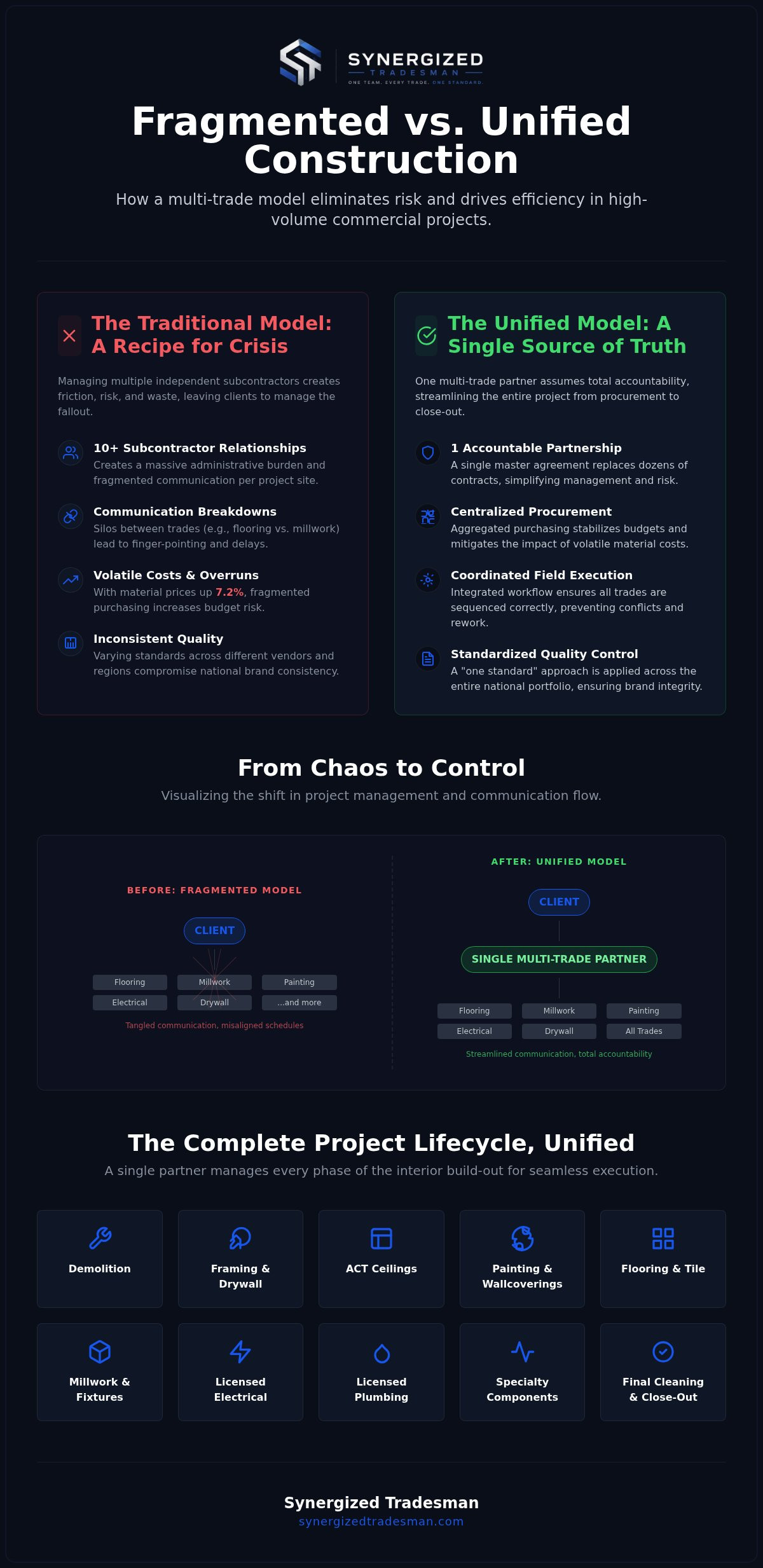
Managing ten different subcontractors for a single retail rollout isn't project management; it's a recipe for crisis containment. When deadlines loom and a flooring delay triggers a millwork bottleneck, the resulting finger-pointing often leaves the client holding the bill. You've likely experienced the frustration of fragmented communication and inconsistent quality across different geographic regions. With construction material prices rising 7.2% on average over the past year, there's no room for the waste caused by poor trade coordination.
This article demonstrates how a unified approach to multi-trade commercial construction eliminates these logistical headaches by providing a single source of truth. We'll explore the accountability model for 2026, which prioritizes standardized quality and faster project close-outs. You'll discover how to move away from managing silos and toward a single, accountable relationship that protects your national portfolio. We'll break down the operational shifts required to reduce your administrative burden while maintaining rigorous standards across every phase, from demolition and framing to millwork and final cleaning.
Key Takeaways
- Learn why shifting to multi-trade commercial construction is the most effective way to eliminate the "gap" between subcontractor scopes and project risks.
- Discover how centralized procurement and coordinated field execution prevent material delays and cost overruns in a high-inflation market.
- Understand the operational advantages of a single-source-of-truth model for managing high-volume retail refreshes across a national portfolio.
- Identify ways to reduce administrative burden by replacing dozens of subcontractor relationships with one accountable partnership.
- Explore how leveraging a WBE-certified partner provides a strategic advantage in project close-out and national compliance management.
What is Multi-Trade Commercial Construction?
Multi-trade commercial construction is a unified management model that consolidates diverse project scopes under a single operational umbrella. It represents a strategic shift away from traditional subcontracting, where a general contractor manages a disconnected web of independent vendors. In this model, one entity takes full responsibility for the logistics, quality, and sequencing of all trades involved. This approach is essential for complex multi-trade commercial construction projects like renovations and retail refreshes where speed and consistency are non-negotiable. Instead of managing a hierarchy of silos, the client interacts with a single source of truth that oversees every moving part of the build.
The traditional model often fails because individual trades operate in isolation. A flooring contractor might not communicate with the millwork team, leading to installation conflicts that delay the entire schedule. Multi-trade construction solves this by treating the project as a single, integrated workflow. It’s a management technology designed to reduce friction and eliminate the logistical blind spots that typically plague large-scale commercial projects. By centralizing oversight, this model ensures that every phase, from initial demolition to the final coat of paint, aligns with the client’s national standards.
The Single Accountable Relationship Explained
Managing a national rollout often involves signing ten or more individual trade agreements per site. This creates an administrative burden that scales poorly and increases the risk of communication breakdowns. A multi-trade partner replaces these fragmented contracts with a single master agreement. The master coordinator acts as a shield for the client, handling the complexities of multi-party logistics with total responsibility. This oversight eliminates the gaps where errors usually occur. Accountability in commercial construction means that a single partner owns the project timeline from start to finish without passing blame to third-party vendors.
Core Services in a Multi-Trade Scope
The scope of a multi-trade project covers the entire lifecycle of a commercial interior. It begins with demolition and progresses through metal stud framing and drywall installation. High-visibility finishes like ACT ceilings, painting, and wallcoverings follow in a coordinated sequence. Flooring and tile work are integrated with the installation of millwork, fixtures, and specialty components. This sequencing is vital for maintaining a clean and efficient jobsite.
A true multi-trade model also incorporates licensed construction trades like electrical and plumbing into the general construction flow. This integration ensures that rough-ins happen exactly when they should, preventing the need to tear out fresh drywall to fix a wiring or piping oversight. The process concludes with final cleaning and project closeout, delivering a turnkey space ready for immediate use. By combining these services, the multi-trade model provides a streamlined path to completion that individual subcontractors cannot match.
Operational Efficiencies: Procurement and Field Execution
Operational success in multi-trade commercial construction hinges on the synergy between material logistics and on-site labor. In a market where material costs have risen 7.2% on average over the last 12 months, fragmented purchasing is a significant liability. Centralized oversight allows for a more disciplined approach to budgeting and scheduling. This model ensures that the "one standard" approach isn't just a goal but a repeatable outcome across a national portfolio. It transforms construction from a series of tasks into a controlled manufacturing process on-site.
Centralized Procurement Strategies
Centralized procurement stabilizes project budgets by aggregating demand across multiple trades. Instead of ten different subcontractors sourcing materials independently, a single management interface handles the acquisition of drywall, flooring, and millwork. This consolidation helps mitigate the impact of volatile pricing for commodities like aluminum mill shapes, which have increased by 52.4% recently.
Managing long-lead items through one point of contact reduces the risk of site delays. In high-volume retail rollouts, missing a single fixture delivery can derail an entire grand opening. A unified partner tracks these assets from procurement to final installation, ensuring that logistics never dictate the construction timeline. This level of oversight is a strategic advantage for procurement departments managing tight annual budgets and strict delivery windows.
Synchronized Field Execution
Synchronized field execution is the process of eliminating "dead time" during trade handoffs. In traditional models, a painter might wait days for a drywaller to finish sanding. A multi-trade team operates on a fluid schedule where tasks overlap safely. For example, rough-in electrical and plumbing work are sequenced precisely with metal stud framing to prevent rework. This eliminates the "gap" where project momentum usually dies between subcontractor transitions.
Site conflicts are resolved in real-time without the typical delays of multi-party negotiation. Because the team answers to one project manager, there is no finger-pointing when a layout issue arises. This internal accountability keeps the project moving in active commercial environments where minimizing disruption to ongoing business is critical. Standardized site protocols ensure that every location in a national rollout meets the same rigorous quality benchmarks.
Safety and compliance also benefit from a single site-management protocol. Adhering to the 2026 OSHA priorities, including heat illness prevention and enhanced recordkeeping, is more manageable when one entity controls the entire jobsite. This unified oversight acts as a shield, protecting the client from the legal and operational risks of multi-party mismanagement. If you are looking to streamline your next project, consider how multi-trade commercial construction can consolidate your oversight.
Fragmented vs. Unified Management: Solving the Finger-Pointing Problem
The primary risk in commercial construction isn't a single trade failure. It's the "gap" that exists between subcontractor scopes. In a traditional model, responsibilities often blur where one trade ends and another begins. This ambiguity leads to the finger-pointing problem, where site readiness issues become a source of conflict rather than a task for resolution. When a project stalls because the flooring contractor claims the slab isn't ready and the concrete team insists they've met the spec, the client pays for the delay. Multi-trade commercial construction eliminates these gaps by placing every phase under a single management structure.
A unified partner acts as a shield for the client's internal procurement team. Instead of coordinating communications between ten different vendors, the client manages one relationship. This structure transfers the burden of multi-party logistics from the client to the expert coordinator. It ensures that site conflicts are resolved internally before they ever reach the stakeholder's desk. By centralizing accountability, the unified model transforms a chaotic site environment into a predictable operational workflow.
The Hidden Costs of Fragmented Trades
Managing a fragmented vendor list carries significant administrative overhead. Every additional subcontractor requires separate vetting, insurance verification, invoicing, and scheduling. This administrative burden scales rapidly during national rollouts, consuming internal resources that should focus on strategy. Fragmented models also suffer from "margin stacking." Because each independent subcontractor adds their own overhead and profit margin to their specific scope, the total project cost often exceeds that of a unified multi-trade approach.
- Scope Gaps: Tasks like final site cleaning, fixture preparation, or minor debris removal often fall through the cracks because they aren't explicitly assigned to a specific trade.
- Site Readiness Delays: Independent subs have no incentive to prep the site for the next trade, leading to "dead time" and rescheduling fees.
- Communication Silos: Fragmented trades rarely share data, meaning errors in one phase aren't caught until they impact the next.
Building a Single Source of Truth
Unified reporting provides the transparency necessary for high-level decision-making. A single accountable partner delivers a consolidated project status that covers everything from demolition to final close-out. This simplifies the audit process, as all financial and operational data resides in one system. Close-out happens faster because there's no need to chase ten different vendors for warranties or lien waivers. Unified management prevents the "not my job" syndrome by ensuring that the person identifying the problem is also responsible for the solution. This level of total responsibility is the foundation of the accountability model for 2026.
Scalability in Retail Refreshes and National Rollout Programs
Scaling a retail refresh across dozens of locations requires more than just a large workforce. It demands a management architecture that can replicate results with surgical precision. High-volume rollout programs face the dual pressure of maintaining brand consistency while meeting aggressive speed-to-market targets. Traditional management models often buckle under this weight because they rely on localized subcontractor pools with varying standards. Multi-trade commercial construction solves this by deploying a centralized management team that oversees every site through a single lens of accountability. This ensures that a tenant improvement project in one region mirrors the quality and execution of a project across the country. With the industry projected to need nearly 499,000 additional workers by the end of 2026, having a partner that can manage labor resources at a national level is a critical safeguard against site delays.
Consistency Across National Portfolios
Brand integrity relies on uniformity. Corporate clients with widespread assets cannot afford local interpretations of their design standards. Applying one standard to a portfolio of 50 or more locations ensures that every fixture, flooring transition, and paint finish meets the exact same specification. A multi-trade partner adapts to varying site conditions without compromising the master schedule. This national reach provides a strategic advantage for procurement teams who need a reliable partner to shield them from the complexities of managing multiple regional vendors. By standardizing the process, the risk of geographic quality variance is eliminated. This model also simplifies the adoption of new standards, such as the 2025 editions of national building codes and regulations, by applying compliance updates across all relevant sites simultaneously.
Speed-to-Market for Retail Brands
Revenue loss during store closures is a primary concern for retail brands. Reducing the duration of these closures requires synchronized trade execution where demolition, framing, and finishing happen in a tight, overlapping sequence. Pre-planning and centralized procurement play a vital role here. By securing long-lead items like specialty millwork and fixtures in advance, the team prevents on-site delays. Managing these installations at scale requires a partner who understands the nuances of retail logistics, including strict debris management and final cleaning protocols. This synchronized approach allows brands to reopen doors faster, maximizing their return on investment. For brands planning a national expansion or a rapid refresh, multi-trade commercial construction provides the operational speed necessary to stay ahead of the competition.
The Synergized Tradesman Approach: Accountability as a Service
Synergized Tradesman operates as a master coordinator, delivering end-to-end management for multi-trade commercial construction. This model is built on a "General Trades" philosophy that prioritizes owning the project outcome over simply finishing individual tasks. It moves beyond the traditional scope of work to provide a comprehensive service that covers every phase from initial planning to final project close-out. By acting as a single source of truth, the firm removes the burden of oversight from the client and handles the complex logistics inherent in national rollouts. This approach ensures that the project timeline remains intact and that the final build meets the exact specifications of the design team.
The core of this model is accountability. In a traditional construction environment, the client often becomes the mediator between conflicting trades. The Synergized Tradesman approach reverses this dynamic. It acts as a shield, absorbing the friction of multi-party logistics so the client can focus on their broader business objectives. This means taking full responsibility for the sequencing of demolition, framing, and finishing. It also involves managing the rough-in phases of electrical and plumbing to ensure they align perfectly with the general construction flow.
Certified Excellence and Diversity Spend
Partnering with a certified women-owned (WBE) firm provides a distinct strategic advantage for corporate clients. Many organizations have mandatory diversity and inclusion goals for their annual construction and procurement spend. Synergized Tradesman helps clients meet these requirements while delivering the high-level professional management expected in the commercial sector. This certification represents more than just a diversity metric. It signals a commitment to the rigorous standards required for national commercial construction compliance.
Current regulatory demands require a disciplined partner. Adhering to the 2026 OSHA priorities, including heat illness prevention and enhanced injury reporting, is a necessity for risk mitigation. A WBE-certified firm that operates across the United States provides a stabilizing force for complex renovations. It ensures that every site, regardless of its location, adheres to a single standard of quality and safety. This consistency is vital for maintaining brand integrity across a national portfolio of assets.
Project Close-Out and Post-Construction
A project isn't truly finished until the site is ready for immediate operation. The Synergized Tradesman approach defines a "clean" project handoff through specific, turnkey deliverables. This includes the specialized installation of millwork, fixtures, and specialty components that define the retail environment. Because these final trades are integrated into the master schedule, there's no delay between construction and store opening. The process concludes with a comprehensive final cleaning that removes all traces of the build.
This focus on post-construction details prevents the common "punch list" delays that often plague fragmented projects. By owning the outcome from start to finish, the team ensures that every fixture is in place and every surface is finished to the highest standard. This level of oversight reduces the administrative burden on the client's internal team and accelerates the time-to-market for retail brands. Simplify your next commercial rollout with Synergized Tradesman to experience an accountability model built for national scale and operational excellence.
Securing Operational Stability for 2026 and Beyond
The shift toward multi-trade commercial construction represents more than an organizational change; it's a strategic necessity for high-volume retail and commercial portfolios. By replacing a fragmented web of subcontractors with a single source of truth, brands eliminate the gaps that lead to finger-pointing and site delays. Centralizing procurement and field execution under one management interface ensures that national rollouts maintain brand integrity regardless of geographic location. This model provides the oversight required to navigate rising material costs and labor shortages with precision.
Synergized Tradesman offers a single accountable relationship model that acts as a shield for your internal team. As a certified women-owned business (WBE) with national project execution capability, we own the outcome of every project from demolition to final cleaning. This commitment to one standard across all project phases simplifies the audit process and accelerates your speed-to-market. You don't have to manage the chaos of multi-party logistics when a unified alternative exists.
Streamline your construction logistics with Synergized Tradesman and regain control over your project lifecycles today. We're built to deliver the reliability your national portfolio demands.
Frequently Asked Questions
What is the primary difference between a general contractor and a multi-trade construction firm?
The primary difference lies in the management structure. A traditional general contractor coordinates a web of independent subcontractors, often leading to communication silos. A multi-trade construction firm unifies these diverse scopes into a single accountable relationship. This model eliminates the "gap" between trades, ensuring that one entity owns the entire project lifecycle from demolition to finishing. It replaces fragmented logistics with a single source of truth for the client.
How does a multi-trade model help with retail rollout project management?
Multi-trade commercial construction streamlines retail rollouts by enabling simultaneous project execution across multiple locations. It uses a "one standard" approach to ensure brand uniformity and speed-to-market. By synchronizing trade handoffs, the team reduces store closure durations. This model is built for high-volume demands where consistency and rapid deployment are essential for maintaining a competitive advantage in a fast-moving market.
Can a multi-trade construction partner handle specialized electrical and plumbing work?
Yes, licensed trades like electrical and plumbing are fully integrated into the general construction flow. This coordination prevents the common site conflicts that occur when independent trades work in isolation. By managing these scopes rough-ins alongside framing and drywall, the firm ensures that technical requirements are met without the need for rework. This integrated approach maintains the project timeline and ensures rigorous compliance with all safety standards.
What are the benefits of hiring a WBE-certified construction firm for commercial projects?
Partnering with a WBE-certified firm allows corporate clients to fulfill mandatory diversity and inclusion goals while maintaining high professional standards. It provides a strategic advantage in procurement and national compliance management. Beyond meeting spend requirements, a WBE-certified partner acts as a stabilizing force for complex renovations. This certification reflects a commitment to disciplined execution and adherence to the most current national construction regulations.
Does Synergized Tradesman provide services for residential construction or emergency repairs?
No, Synergized Tradesman does not provide residential construction or 24/7 emergency repair services. The firm is built exclusively for end-to-end management of multi-trade commercial construction, focusing on retail refreshes and national rollout programs. This specialization allows the team to maintain total responsibility for high-volume commercial demands. Clients looking for residential work or immediate after-hours repairs should contact specialized providers in those specific sectors.
How does centralized procurement affect the overall cost of a commercial renovation?
Centralized procurement stabilizes budgets by aggregating material demand across multiple trades and sites. This consolidation protects against price volatility for commodities like aluminum or steel mill products. By sourcing everything through a single management interface, the firm reduces the risk of long-lead item delays that derail schedules. This disciplined approach to logistics ensures that material costs remain predictable even in an environment of rising industry averages.
What is included in a typical project close-out for a retail refresh program?
A typical close-out for a retail refresh includes final fixture setup, millwork installation, and a comprehensive site cleaning. The goal is to deliver a turnkey space that is ready for immediate operation. This phase also includes the delivery of all warranties, lien waivers, and project documentation through a single accountable partner. By owning the final details, the firm ensures a clean handoff that minimizes the client's administrative burden.
How is quality control maintained across multiple national construction sites?
Quality control is maintained through standardized site protocols and centralized oversight by a master coordinator. Every project, regardless of its location, adheres to the same rigorous benchmarks for execution and safety. This "one standard" methodology prevents the geographic quality variance often seen with regional subcontractor pools. By using a single management lens, the firm replicates successful outcomes across a national portfolio of commercial assets.


