

A store refresh can meet the plan at one location and still miss the brand standard across the program. High volume retail refresh programs aren’t simply a matter of repeating the same scope. Each location brings its own readiness conditions, access constraints, and potential changes that can disrupt sequencing. As the number of stores grows, trade coordination and field oversight become harder to keep aligned.
That complexity is familiar to teams managing multiple locations. A consistent result depends on more than a shared design or scope document. It requires clear ownership, coordinated trades, and a defined process for handling exceptions without letting local changes weaken program standards.
This guide explains how to structure a repeatable refresh program, from planning and procurement through fieldwork and closeout. You’ll learn how to assign responsibility across each phase, coordinate trades under a single program structure, prepare sites for planned work, and manage scope changes with clear controls. The result is a practical framework for delivering consistent quality across stores while keeping location-level differences visible and manageable.
Key Takeaways
- Structure high volume retail refresh programs around shared scope, standards, oversight, and reporting so stores operate as one coordinated program.
- Break approved scope into repeatable work packages with clear completion criteria, then carry those requirements through procurement, fieldwork, and closeout.
- Keep brand and scope requirements consistent while documenting site conditions that call for controlled, location-specific adjustments.
- Use readiness, scope, trade progress, quality, and closeout reporting to make exceptions visible and support timely decisions.
- Align relevant trades under clear accountability, matching the work to each refresh scope rather than assuming every location needs the same trades.
What Makes High-Volume Retail Refresh Programs Different?
A coordinated refresh across multiple stores is more than a series of similar construction jobs. Each location must meet the same approved brand requirements, even when site conditions, readiness, and trade sequencing differ. Depending on the scope, work may include demolition, flooring, painting, fixture installation, or electrical updates. Managing these activities as a program creates shared controls for planning and execution, rather than leaving each store team to interpret requirements independently.
A retail refresh program is a coordinated set of repeatable improvements across multiple stores, governed by shared scope, standards, schedules, oversight, and reporting.
Store count alone doesn’t determine complexity. A group of locations with the same work, similar readiness, and limited trade overlap may be easier to coordinate than fewer stores with different scopes, access conditions, or dependencies between trades. The Retail sector includes varied store formats and operating models, so a program needs to reflect the locations it serves. The central challenge is preserving brand requirements while controlling how approved work is delivered at each site.
When Does a Store Refresh Become a Program?
A refresh becomes a program when locations share objectives and recurring work packages, and their schedules, decisions, and reporting are coordinated. Central oversight can establish common scope documents, map dependencies, and make location-specific exceptions visible. By contrast, project-by-project delivery can leave each store with separate interpretations and reporting. The right operating model depends on the portfolio scope, site conditions, and how much work can genuinely be standardized.
For example, a group of stores may share a paint and flooring package, while only some need fixture replacement or electrical work. The common package can use the same specifications and acceptance criteria, while additional work is identified and tracked by location. This keeps variation explicit instead of allowing it to become an undocumented change to the program.
Which Outcomes Should the Program Define First?
Before scheduling locations, define what “complete” means in terms teams can verify. Separate fixed brand requirements from details that may adapt to documented site conditions. A useful baseline covers:
- Scope: Approved work by store, including defined inclusions and exclusions.
- Quality: Inspection criteria for visible finishes, installed fixtures, and completed trade work.
- Documentation: Required records of completed work, approved changes, and outstanding items.
- Handoff: A closeout status that identifies completion, open issues, and responsibility for follow-up.
These criteria give field teams a consistent reference and let program leads compare progress without treating every location as identical. Brand standards, such as a required finish or fixture specification, remain fixed. A documented site condition may change the installation approach or sequence, but it should not silently change the intended outcome. Set the approval path for exceptions early so teams know how to record a difference, assess its effect, and preserve the shared standard.
How to Structure High-Volume Retail Refresh Execution
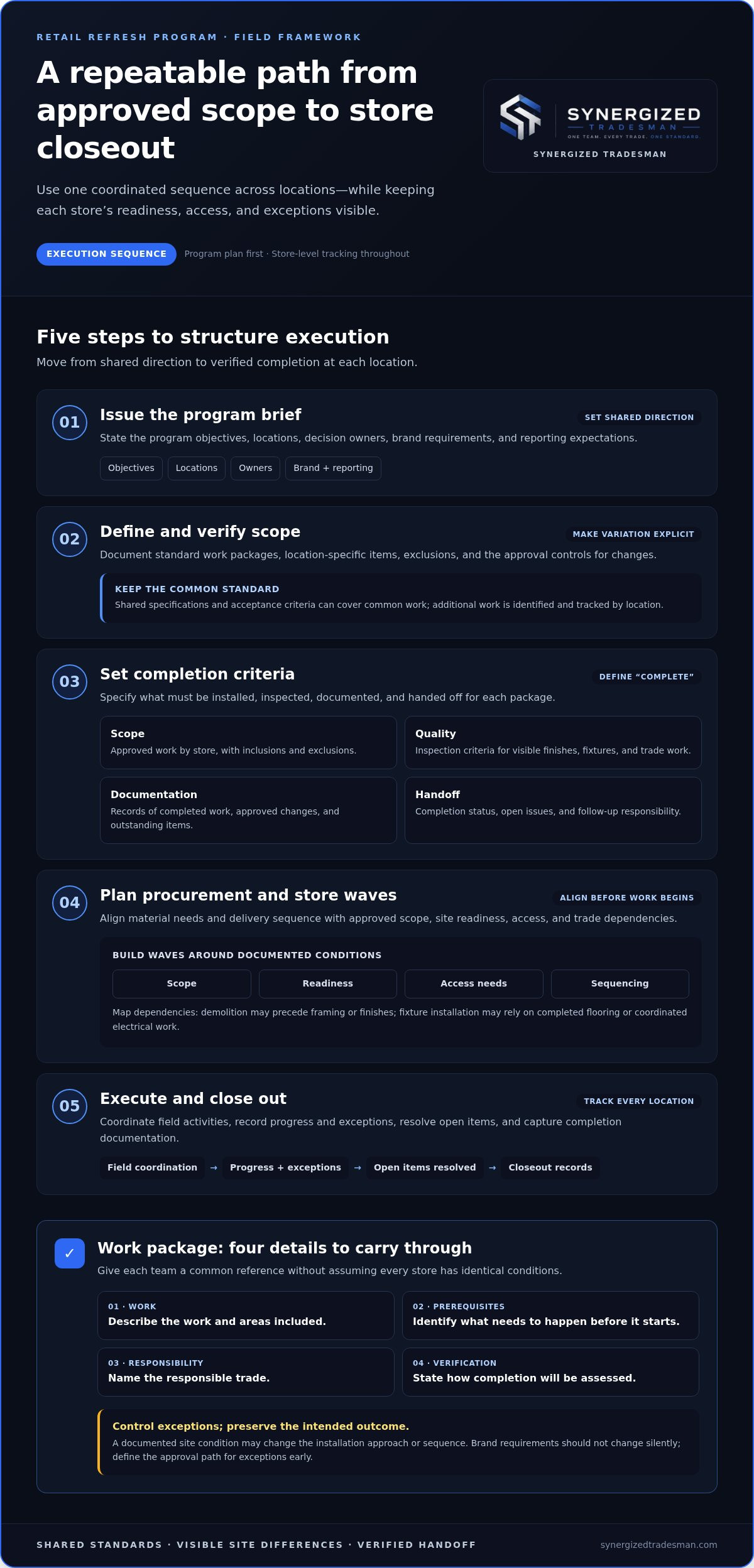
A repeatable execution plan turns an approved refresh concept into work teams can schedule, supply, deliver, and close out across locations. For high volume retail refresh programs, sequence matters: procurement depends on a stable scope, and field teams need materials, access, and trade handoffs aligned before work begins. Build a program-level plan, then track each store against it.
Use this sequence as a working framework:
- Issue the program brief. State the objectives, locations, decision owners, brand requirements, and reporting expectations.
- Define and verify scope. Document standard work packages, location-specific items, exclusions, and approval controls for changes.
- Set completion criteria. Specify what must be installed, inspected, documented, and handed off for each package.
- Plan procurement and waves. Align material needs and delivery sequence with approved scope, site readiness, access, and trade dependencies.
- Execute and close out. Coordinate field activities, record progress and exceptions, resolve open items, and capture completion documentation.
Each work package should describe the work, its prerequisites, the responsible trade, and how completion will be assessed. For example, a flooring package can identify the areas included, preparation required before installation, and the inspection or documentation needed at handoff. This level of definition gives teams a common reference without assuming every store has identical conditions.
Build Store Waves Around Readiness and Dependencies
Group stores using documented scope, readiness, access requirements, and sequencing needs, not just geography or a target start date. Map dependencies between activities: demolition may need to finish before framing or finishes begin, while fixture installation may rely on completed flooring or coordinated electrical work. Treat waves as a planning tool, not a fixed rule. If a site condition changes, adjust the affected location and make the reason and schedule impact visible.
Before assigning a store to a wave, record whether the approved work area is accessible, the required site information is available, and prerequisite activities can proceed. Flag unresolved items early. A location that isn’t ready should not quietly disrupt the sequence for prepared stores. Move it through a defined exception and resequencing process instead.
Coordinate Procurement and Multiple Trades
Procurement should follow the approved package and planned store sequence. Match material requirements to the work at each location, account for delivery and storage conditions, and communicate changes that affect field needs. Coordinate trades around clear handoffs so the next activity starts only after its prerequisites are complete. Keep material needs, site readiness, and trade dependencies visible in the same planning process so a change at one location can be assessed before it affects fieldwork.
Keep one current schedule and scope record as the shared reference for planning, procurement, and field execution. Synergized Tradesman coordinates retail refresh work from planning and procurement through field execution and closeout, bringing relevant trades together under a single accountable relationship. Learn more about Synergized Tradesman’s retail refresh coordination.
How to Balance Standardization With Store-Level Differences
Standardization doesn’t mean every store has identical conditions. It means each location is assessed against the same approved requirements, and any departure from the baseline is documented and authorized. Without that distinction, field teams may treat a genuine site constraint as permission to change the scope, or flag acceptable adaptations as inconsistent work. High volume retail refresh programs need a clear line between what must remain fixed and what can vary through review.
Set that line in the program documents before work begins. Use a comparison framework to give field teams a practical reference:
- Standard work: Approved scope, specified finishes, installation direction, and completion evidence that apply to each location.
- Permitted variation: Adjustments to the work method or sequence that respond to documented site conditions without changing the approved outcome.
- Approval ownership: The designated role responsible for reviewing an exception, recording the decision, and issuing updated direction.
Which Refresh Requirements Should Remain Consistent?
Use the retailer’s approved program as the baseline, not a universal template. Identify the scope and finish expectations that define the intended result, along with installation instructions and the evidence required to review completed work. A shared baseline lets reviewers assess locations using the same criteria, even when the underlying conditions differ. Keep requirements specific enough to guide field decisions and practical enough to apply across the included stores.
For instance, the program may set a consistent finish specification while allowing the installation sequence to respond to site access. The finish remains the control; the sequence can adapt if the reason is recorded and the final work still meets the approved requirements. This prevents flexibility from becoming informal scope drift.
How Should Teams Handle Location-Specific Exceptions?
Use a defined path for every variance: record the observed condition, identify affected work, assign a decision owner, document the approved resolution, and update the field direction. Then carry the decision into the relevant schedule and location record. This makes the exception traceable from review through execution and closeout, rather than leaving crews to rely on verbal instructions or outdated scope documents.
- Record the site condition and the specific requirement it affects.
- Review the impact on scope, quality expectations, trade sequence, and schedule.
- Decide whether to proceed as scoped, adapt the method, or approve a scope change.
- Communicate the authorized direction to affected field teams and update location documentation.
A legitimate variation is supported by a site condition and an authorized decision. Incomplete work or a finish that differs from the approved requirement is not a site exception simply because it occurred at one store. For example, if an existing condition affects fixture placement, record the constraint and obtain a decision before issuing revised direction. If the approved resolution changes the sequence, update the schedule and notify the trades it affects. That distinction protects brand consistency while giving teams a controlled way to address real differences.
What Controls Keep a Multi-Store Refresh on Track?
A shared plan needs shared controls. For high volume retail refresh programs, each store should report against the same core categories: readiness, approved scope, trade progress, quality, and closeout. These controls give program leads a comparable view of work while keeping location-specific issues visible. They also clarify who owns the next action, instead of leaving blockers buried in general status updates.
Use a concise control set that captures:
- Readiness: Whether access, site information, and prerequisites are in place for planned work.
- Scope: Approved work, authorized changes, and any unresolved scope questions.
- Trade progress: Current activity, completed handoffs, upcoming dependencies, and blockers.
- Quality: Inspection results against the project’s approved requirements, including items needing correction.
- Closeout: Completion records, open items, and handoff status for the location.
Define status terms before field reporting begins. “Ready,” “in progress,” “blocked,” and “complete” should mean the same thing across all stores. Require updates to identify the affected work, the decision or action needed, and the accountable owner. This structure makes reports useful for action, not just for recording activity.
Track Progress With Comparable Store-Level Information
Use one reporting format across locations, but review the information at two levels. Program-level trends can reveal repeated blockers or trade handoff issues; store-level details show where a specific decision or intervention is needed. Record scope changes and approvals against the location they affect. Consistent reporting helps distinguish a recurring program concern from an isolated site condition without assuming every store follows an identical path.
Pair progress reporting with defined inspection points. For each relevant work package, specify what must be reviewed, who records the result, and how an incomplete item is tracked to resolution. For example, a finish inspection can document whether the installed work matches the approved requirements and identify any correction needed before the store advances to handoff. Tie the inspection record to the scope and location so teams can trace findings to the applicable direction.
Close Each Location Against the Approved Scope
Closeout should verify the work delivered against the approved scope and document authorized changes. Collect records relevant to that scope, such as inspection results, completion documentation, and a clear list of unresolved items with assigned ownership. A location shouldn’t be reported as fully closed while required work or handoff information remains outstanding. For a practical closeout review, compare the location record against the approved scope, confirm required inspections are documented, and assign an owner to each open item.
Useful closeout evidence is a location-specific record of completed approved work, inspection results, authorized changes, and any outstanding items with assigned owners. This provides a consistent basis for handoff and a traceable record of each store’s status.
For coordinated commercial refresh execution from planning through closeout, work with Synergized Tradesman.
How Synergized Tradesman Coordinates Retail Refresh Programs
Synergized Tradesman manages commercial retail refresh programs from planning and procurement through field execution and closeout. A single accountable relationship connects decisions across those phases, so the approved scope, material coordination, trade activity, and completion records stay aligned. This gives retailers a clear point of coordination across participating trades without assuming every location requires the same work.
Trade capabilities are matched to the approved refresh scope. Depending on the work, coordination may include demolition, finishes, fixture installation, electrical, plumbing, or final cleaning. A store receiving flooring and paint work has different trade needs from one that also requires fixture or utility updates. The operating plan reflects those differences while applying one standard across projects. Documented site exceptions are handled within that framework, with field direction tied to the approved decision.
One Accountable Relationship Across Project Phases
Planning decisions guide procurement and field execution, while closeout records capture what was completed and any remaining items. Connecting these phases helps keep responsibilities and project information aligned as work moves from scope definition to handoff. Synergized Tradesman is a certified women-owned commercial construction firm that coordinates multiple trades through this model. Clear responsibility for each phase also helps teams carry scope decisions into procurement, field sequencing, and completion review.
For program teams, the practical value is continuity: scope decisions made during planning can inform procurement, trade sequencing, and completion review. Coordination is tailored to the project rather than built around a fixed package of trades. This matters across a store portfolio, where common standards can coexist with different scopes and documented conditions at each location.
Prepare a Clear Program Brief
A concise program brief gives the coordination team a working reference. Organize the core information before execution begins, then identify gaps or location-specific constraints that could affect the plan. Synergized Tradesman tailors coordination to the program’s requirements and the approved work at each store. The brief should capture:
- Objectives: The intended result and priorities for the refresh.
- Locations: The store list and any known differences in readiness or access.
- Scope: Shared work packages, store-specific work, and exclusions.
- Standards: Approved finishes, installation direction, and completion criteria.
- Constraints: Known site conditions, dependencies, or decisions still required.
Use this brief to establish a shared starting point, not to assume every site is identical. As location information develops, record approved changes and communicate updated direction to affected teams. That keeps the program standard visible while allowing coordination to respond to actual site conditions.
To discuss your program scope, store locations, and trade coordination needs, connect with Synergized Tradesman.
Set the Next Refresh Program Up for Clear Decisions
The next step for high volume retail refresh programs is to turn operational priorities into a brief that decision-makers and field teams can use. Before work is scheduled, align on the outcomes that matter most, the locations in scope, and how teams will resolve a site condition that changes the planned work. That preparation gives the program a clear basis for decisions as execution moves forward.
It also helps teams distinguish a necessary adjustment from a change that needs formal approval. Keep that distinction visible as the program develops, so updates can be assessed against the intended result rather than handled store by store without context.
Synergized Tradesman can help shape the coordination approach around your program’s scope and requirements. Discuss your retail refresh program with Synergized Tradesman to identify a practical starting point for planning the work. With clear priorities and a defined path for decisions, your team can move into execution with greater alignment.
Frequently Asked Questions
How many locations make a retail refresh program high-volume?
There isn’t a fixed store count that defines a high-volume program. The key factor is whether locations share repeatable work and need coordinated planning, scheduling, and oversight. A smaller group with overlapping trades, different site conditions, or complex sequencing may need program-level controls, while a larger group with simple, similar work may be easier to manage. High volume retail refresh programs are defined by coordination demands as much as by location count.
Can retail refresh work be completed while stores remain open?
Sometimes, but it depends on the work scope, store operations, access, and how activities can be phased. A refresh affecting a limited area may be sequenced differently from work involving major fixtures, utilities, or customer pathways. Before setting the plan, map work zones, material movement, trade access, and operational constraints with the store team. The schedule should identify which activities can proceed without disrupting operations and which require a change in phasing or access.
How much does a high-volume retail refresh program cost?
There’s no reliable single cost for a multi-store refresh without understanding the scope and conditions at each location. Demolition, finishes, fixtures, electrical or plumbing work, material requirements, and site-specific changes all affect the estimate. Build a cost plan from defined work packages, then separate shared scope from location-specific items. This makes it easier to see which assumptions apply across the program and which stores may require a distinct allowance or approved scope adjustment.
What happens when a store is not ready for its scheduled work?
Identify the reason it isn’t ready, record the affected work, and assess whether the issue blocks other trades or only a specific activity. The program lead can then decide whether to resolve the blocker, resequence work at that store, or move the location to another wave. Update the schedule and notify affected teams so procurement and field planning reflect the revised direction. Keep the original plan and approved change traceable in the location record.
How long does a multi-location retail refresh program take?
Program duration depends on the number of locations, the work at each store, site readiness, procurement needs, and how activities can be sequenced. Store count alone isn’t enough to set a dependable duration. Establish a baseline schedule using defined work packages and milestones, then refine it as site information and trade dependencies are confirmed. Track location progress against that baseline, and distinguish a single-store delay from a change that affects the wider rollout sequence.
Is a pilot necessary before expanding a refresh program?
A pilot isn’t required for every program, but it can help test an unfamiliar scope or reveal planning assumptions before broader rollout. Use a representative location to review the work package, material coordination, trade sequence, inspection criteria, and closeout records. Capture what worked, what required clarification, and which conditions may differ at other stores. Apply approved lessons to the program documents before expanding, while continuing to assess each location on its own readiness.
Who coordinates the trades in a multi-store refresh?
Synergized Tradesman coordinates relevant trades for commercial retail refresh work through a single accountable relationship. The coordination plan should also make decision rights clear: who approves scope changes, who provides store access information, and who receives progress or closeout updates. Defining those roles at the outset helps prevent field questions from circulating without an owner. Trade involvement is matched to the approved work, so each location’s coordination reflects its actual scope.


