

A low initial bid can hide gaps in scope, coordination, and accountability. This commercial contractor vetting checklist looks beyond the number on the proposal to assess whether a contractor can manage the work your project requires. Start by comparing what each proposal includes, who owns each phase, and how decisions and handoffs will be managed.
Proposals are difficult to compare when contractors define scope differently or divide responsibility across multiple trades. Qualifications matter, but they are only part of the picture. You also need to understand how planning, procurement, field execution, and close-out will be coordinated.
Use this project-focused framework to compare experience, scope, project controls, and delivery models on consistent terms. It highlights what to examine before committing, where accountability gaps can emerge, and how a single accountable relationship can support oversight across trades and project phases. The goal is to select a contractor and delivery approach that fit the project’s requirements and support consistent quality.
Key Takeaways
- Start with project risk: assess how the building’s use, scope, and delivery conditions affect contractor fit.
- Use a commercial contractor vetting checklist to compare relevant experience, scope alignment, and required project documentation.
- Compare proposals by inclusions, exclusions, assumptions, responsibilities, and project controls, not price alone.
- Clarify who coordinates procurement, trade sequencing, field communication, and issue escalation before award.
- Record evidence, open items, accountable roles, and approval status to support a consistent selection decision.
Why a Commercial Contractor Vetting Checklist Must Start With Project Risk
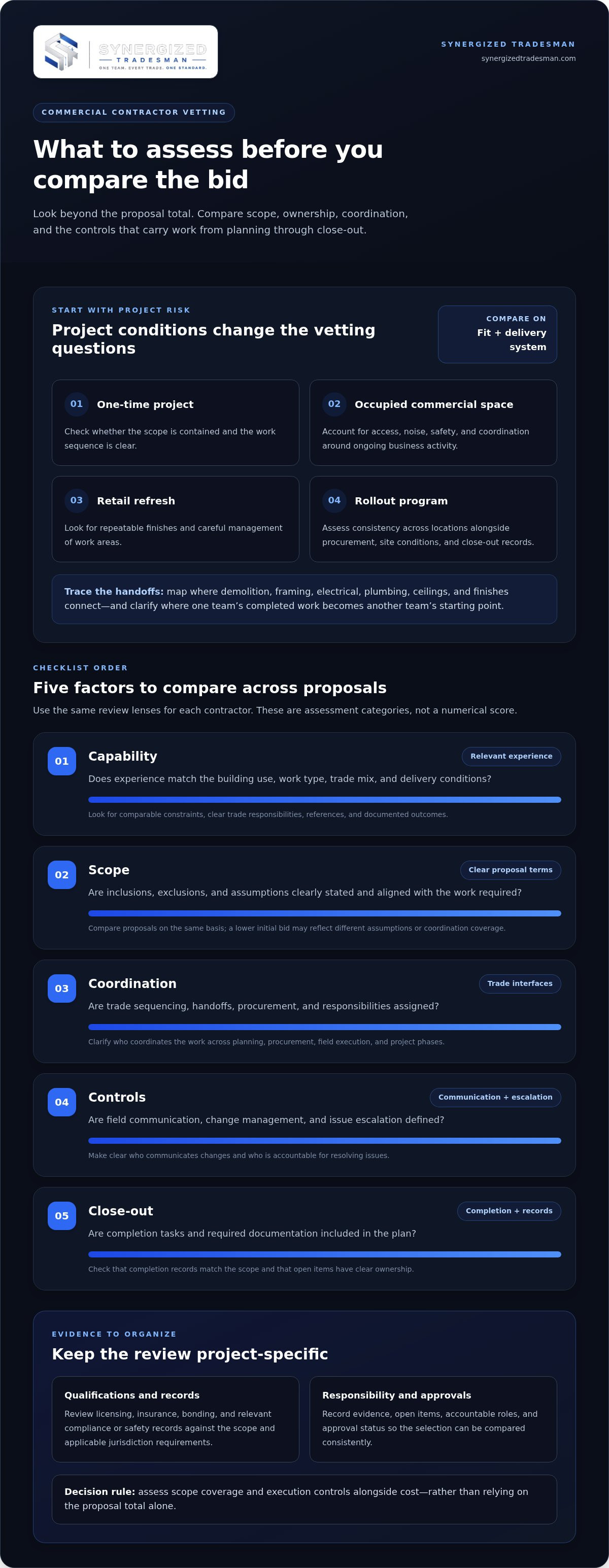
Choose a contractor by assessing two things: whether the firm is qualified for the work and whether its delivery system fits the project. A strong track record alone won’t show how procurement, trade sequencing, communication, and handoffs will be managed. Start your commercial contractor vetting checklist with the conditions that create risk, then examine how each proposal addresses them.
Project type changes the questions to ask. A defined renovation at one site may have a contained scope and a clear sequence. Work in an occupied commercial space must account for access, noise, safety, and coordination with ongoing business activity. A retail refresh may require repeatable finishes and careful management of work areas. A rollout program adds the need for consistency across locations, alongside coordination of procurement, site-specific conditions, and close-out records.
These differences matter because commercial work depends on handoffs between trades. Electrical or plumbing work may need to align with framing, ceilings, finishes, and fixture installation. If sequencing or responsibility is unclear, delays, rework, or unresolved items can surface at handoff. Contractor management principles offer context for evaluating risk, compliance, and oversight, but the project’s actual scope and delivery plan should guide your decision.
Which commercial project conditions change the vetting process?
First, define whether the work is a one-time project or part of a repeated program. Document operating constraints such as restricted access windows, occupied areas, or the need to coordinate around business activity. Then map the trade dependencies: identify where demolition, framing, electrical, plumbing, ceilings, and finishes connect, and where one team’s completed work becomes another team’s starting point.
For multiple locations, distinguish what must stay consistent from what may vary by site. This helps you evaluate whether a contractor can apply a shared delivery standard while accounting for differences in scope and conditions at each location.
What should the checklist help a buyer decide?
Use the checklist to decide whether the contractor’s operating approach matches the project’s complexity. Look for clear ownership across planning, procurement, field execution, and close-out. Identify who coordinates trade sequencing, communicates changes, and escalates issues. Make responsibilities visible before work begins rather than inferring them from a polished proposal.
Compare proposals on the same basis. A lower initial bid may reflect different assumptions, exclusions, or levels of coordination. Assess scope coverage and execution controls alongside cost.
- Capability: Does relevant experience match the building use and type of work?
- Scope: Are inclusions, exclusions, and assumptions clear?
- Coordination: Are trade interfaces and handoffs assigned?
- Controls: Are communication and issue escalation defined?
- Close-out: Are completion tasks and documentation included in the plan?
This risk-based review creates a consistent way to compare single-site renovations, occupied spaces, retail refreshes, and rollout programs. It also separates a contractor’s qualifications from the system that will carry the work from planning through completion.
Verify Commercial Contractor Qualifications, Experience, and Scope Alignment
Qualifications matter when they match the project. Evaluate experience against the building’s use, scope complexity, trade mix, and delivery conditions. A contractor with broad commercial experience may still have limited relevance to an occupied renovation or a repeatable retail refresh. Look for evidence that the contractor has handled comparable constraints and coordinated trades similar to those in your project.
Use the commercial contractor vetting checklist to organize evidence, not to impose a universal pass mark. Review licensing, insurance, bonding, and compliance documentation against the project scope and applicable jurisdiction requirements. Requirements can vary, so don’t rely on a single coverage figure, project count, or financial threshold as a stand-in for fit.
How should commercial project experience be assessed?
Compare examples by the work performed, operating conditions, trade mix, and delivery structure. A retail refresh in an active business environment may be more relevant than a larger project with a different use and sequence. For rollout work, assess whether the contractor has demonstrated a consistent approach across locations while accounting for site-specific conditions. References and documented outcomes can help clarify communication, issue resolution, and close-out practices.
Keep the review focused on execution. Look for evidence of clear responsibility between trades, coordination through project phases, and completion records that match the scope. Scale reference checks to the project’s risk and complexity rather than applying the same fixed process to every selection.
Which documents clarify qualifications and scope?
Organize project-specific records in one review file. Depending on applicable requirements, this may include licensing information, insurance documents, bonding information, and relevant compliance or safety records. OSHA provides resources on OSHA compliance and safety standards; review relevant materials in relation to the work and the project’s requirements.
Next, compare the proposal with the project brief, drawings, specifications, and other scope documents. Mark what is included, excluded, assumed, or assigned to another party. A proposal may name a trade without explaining who coordinates its procurement, sequence, site communication, or completion handoff. Record these responsibilities explicitly. A commercial general trades contractor accountability model offers a useful way to understand how one accountable relationship can connect multi-trade work across project phases.
- Experience: Match comparable work to the project’s use and conditions.
- Documentation: Review records against applicable project and jurisdiction requirements.
- Scope: Reconcile inclusions, exclusions, assumptions, and assigned responsibilities.
- Risk: Scale reference checks and financial review to the project rather than relying on universal thresholds.
For commercial renovations involving multiple trades, multi-trade commercial construction management brings planning, procurement, field execution, and close-out into one coordinated relationship.
Compare Commercial Contractor Proposals by Accountability and Delivery Model
Once qualifications and scope alignment are documented, compare how each proposal will manage the work. A bid total doesn’t show whether procurement, sequencing, communication, and issue resolution have clear owners. Apply the same comparison framework to every proposal so differences in scope and delivery are visible before award.
How can buyers compare proposals beyond the bid total?
Normalize the proposals first. Reconcile each one against the same project documents, then record inclusions, exclusions, allowances, assumptions, and clarifications. A price difference may reflect a different scope or allocation of responsibility, not simply a different price for equivalent work.
Use the framework below to make gaps easy to spot. For each proposal, identify a specific owner, process, or open item instead of treating a general statement as a documented commitment.
Scope coverage: What work is included, and which project requirements does it address?
Exclusions and assumptions: What work, conditions, or decisions are outside the proposal or assumed to be provided by others?
Responsibilities: Who coordinates procurement, trade sequencing, field communication, and handoffs?
Project controls: How are schedule updates, quality checks, changes, and issue escalation handled?
Close-out: Who tracks remaining items and coordinates final cleaning and project close-out?
Pay particular attention to trade interfaces. For example, a proposal may include ceilings and electrical work without explaining who coordinates the sequence or resolves a field conflict. Record that as an open responsibility, rather than assuming the teams will work it out. Apply the same scrutiny to change management: compare how proposed changes are documented, communicated, and reflected in the schedule and scope.
What does one accountable relationship change?
A single accountable relationship can connect decisions across planning, procurement, field execution, and close-out. Instead of leaving the client to reconcile separate updates and unresolved handoffs, a coordinated delivery model provides a clearer path for communication and escalation. Responsibilities still need to be defined, but ownership across phases becomes central to the comparison.
Review the delivery model as a set of connected controls. Schedule reporting should relate to trade sequencing. Quality checks should identify who records issues and tracks them to resolution. Close-out should account for remaining work and final cleaning, not stop at field completion. These details help show whether the proposal describes a working system or relies mainly on broad assurances.
The multi-trade commercial construction accountability model illustrates how coordinated ownership can connect separate scopes. In your comparison, distinguish documented commitments from general claims, list unresolved interfaces, and evaluate the lowest bid only after confirming what it covers and how the work will be controlled.
Use This Commercial Contractor Vetting Checklist Before Award
Turn the review into a documented sequence rather than relying on the impression left by proposal meetings. A commercial contractor vetting checklist should connect the project brief to each contractor’s qualifications, scope, delivery controls, and open items. Apply the same steps to every proposal, whether the work is a single renovation, an occupied-site refresh, or a program spanning multiple locations.
What belongs on a pre-award review checklist?
Start with the project documents and verify that each proposal addresses the same scope. Then assess qualifications and delivery responsibilities together. Record what the evidence supports, what remains unresolved, who owns each follow-up, and whether the item is approved. This creates a traceable decision record instead of relying on informal notes or broad assurances.
- Define the brief: Record building use, work areas, operating constraints, project documents, and any repeated requirements across locations.
- Reconcile the scope: Compare each proposal with drawings and specifications. List inclusions, exclusions, allowances, assumptions, and clarifications.
- Review qualifications: Log relevant commercial experience, references, licensing information, insurance, bonding, and applicable compliance materials.
- Assign responsibilities: Identify who coordinates procurement, trade sequencing, field communication, handoffs, and issue escalation.
- Review project controls: Document how schedule updates, changes, quality checks, and close-out will be managed.
- Complete the comparison: Summarize evidence, unresolved items, accountable roles, and approval status before award.
Keep requirements specific to the project. Licensing, regulatory, and insurance requirements can vary by jurisdiction and scope, so verify them against the project’s location and applicable requirements. Don’t assume one document or threshold applies everywhere. Record what was reviewed and any outstanding documentation in the decision file.
Which red flags warrant a closer review?
Pause the award decision when a proposal leaves material scope gaps or assigns no clear owner to a trade interface. A schedule without a described update process, a change process with no approval path, or close-out language that doesn’t identify responsibility can signal an execution gap. Treat these as items to resolve in writing, not details to infer later.
- Scope mismatch: Requested work is missing, excluded, or covered only by an unclear assumption.
- Unassigned coordination: No accountable role is named for procurement, sequencing, field communication, or issue resolution.
- Unsupported claims: Capacity or experience statements lack relevant examples or supporting records.
- Inconsistent documentation: Proposal details conflict with project documents or other submitted materials.
Close each item with a status, evidence reference, accountable role, and approval decision. If a key responsibility remains open, document it before award rather than treating silence as agreement. That record gives project stakeholders a shared basis for the selection and the work that follows.
For a multi-trade commercial project, review Synergized Tradesman’s commercial construction management approach to see how planning, procurement, field execution, and close-out can be coordinated through one accountable relationship.
Select a Commercial Contractor for Consistent Execution From Planning to Close-Out
Make the award decision based on documented capability, scope alignment, clear coordination ownership, and project controls suited to the work. A contractor should connect responsibilities across the delivery lifecycle, not simply present a qualified team or an attractive proposal. Use the commercial contractor vetting checklist to confirm that the selected approach addresses project requirements and makes key handoffs visible.
How does Synergized Tradesman align with the checklist?
Synergized Tradesman provides multi-trade commercial construction and renovation management, including retail refreshes and rollout programs. It coordinates planning, procurement, field execution, and close-out through a single accountable relationship, applying one standard across projects. As a certified women-owned commercial construction firm, Synergized Tradesman manages scopes that include demolition, framing and drywall, finishes, electrical, plumbing, and project close-out.
This delivery model connects work that might otherwise be treated as separate packages. Planning and procurement inform field execution, while coordination between trades helps carry scope and project requirements through to close-out. One accountable relationship gives the client a clear point of coordination across those phases. It also supports consistency when a commercial program involves multiple sites, while allowing project planning to account for each location’s conditions.
Use this decision standard to assess fit:
- Capability: Relevant commercial construction experience and a delivery approach suited to the project.
- Scope alignment: Work requirements and responsibilities connected across applicable trades.
- Coordination ownership: Clear oversight from planning and procurement through field execution.
- Controls and close-out: Defined processes that carry project needs through completion.
What information helps start a project discussion?
Prepare a concise brief with the project type, scope, locations, schedule constraints, and trade requirements. Include relevant plans or scope documents when available, along with operating conditions that may affect access or sequencing. These details help frame coordination needs across planning, procurement, field execution, and close-out.
Also note whether the work is a single renovation, a retail refresh, or part of a recurring program. That context helps align the delivery approach with the project’s scale and site conditions. When preparing the brief, map which responsibilities connect across phases and flag any trade handoffs that need particular attention.
Move forward with a clear project brief and a shared understanding of ownership. Discuss your commercial project scope and coordination needs with Synergized Tradesman to align the work, site conditions, trade requirements, and program needs from the outset.
Set Your Next Commercial Project Up for Clear Accountability
The contractor you select will shape how decisions move from the initial plan into field work and final completion. Use your commercial contractor vetting checklist as a decision tool, then carry its findings into the project discussion. Identify the outcomes that matter, the constraints that could affect delivery, and the responsibilities that need to remain clear as work progresses.
Synergized Tradesman is a certified women-owned commercial construction firm that brings planning, procurement, field execution, and close-out together through a single accountable relationship. This structure supports a consistent delivery standard across commercial projects and gives stakeholders a defined point of coordination as requirements develop.
Bring your project scope, site conditions, and program requirements into the discussion. Discuss your commercial construction project with Synergized Tradesman to take the next step toward coordinated, accountable execution.
Frequently Asked Questions
Is contractor vetting different for commercial renovations than for new construction?
Yes. Renovations require attention to existing conditions and how work may interact with an operating site, while new construction requires coordination across the planned scope. Use a common qualification review, then tailor the commercial contractor vetting checklist to the project. For example, note which areas will remain in use during a renovation and how access or sequencing affects the work. Capture these conditions in the project brief before reviewing bids.
Can I use the same vetting checklist for a multi-site commercial rollout?
Yes. Use a shared checklist for consistent evaluation, then attach a separate site record for each location. Include site-specific scope, access conditions, sequencing needs, and close-out items. A location matrix can distinguish standard requirements from exceptions, such as a different work area or operating constraint. Keep each site’s decisions, assigned responsibilities, and unresolved items together so a program-wide standard doesn’t obscure conditions that vary between projects.
What should a commercial contractor proposal include for a fair comparison?
A proposal should make its scope and delivery assumptions clear enough to compare against the project documents. Look for defined inclusions, exclusions, allowances, responsibilities, schedule approach, change process, and close-out expectations. For example, if flooring is included but preparation work is treated as an assumption, record that distinction. Use the same reference documents for every bid, and flag unclear items for resolution instead of interpreting silence as included work.
How do change orders affect commercial contractor selection?
Change management affects how scope adjustments are documented and coordinated. During selection, assess whether the proposed process records the requested change, describes its impact, identifies who reviews it, and captures approval before the work proceeds. A simple change log can track the description, status, decision owner, and related schedule or scope notes. Compare the proposed process across bids, and don’t treat a promise to avoid changes as a substitute for clear controls.
What happens after a commercial contractor is selected?
Translate the award documents into a working project plan. At the start, align stakeholders on the approved scope, communication channels, procurement milestones, field coordination, and how decisions will be recorded. Keep the decision record accessible so teams can refer to documented assumptions instead of relying on memory. As work progresses, update responsibilities and open items when decisions change. This carries the award’s expectations into execution and gives close-out a clear reference point.
How should I assess a contractor for work in an operating retail location?
Assess how the proposed approach accounts for occupied areas, site access, work sequencing, trade coordination, and communication with the people responsible for store operations. For example, map which spaces are affected by each phase and note how access constraints may shape trade handoffs. For a rollout, compare the shared operating standard with each location’s exceptions. Put assumptions in writing so the project team can plan around them rather than discover them during field work.
Should the lowest commercial construction bid determine the award?
No. First determine whether the bids cover comparable work. Differences in exclusions, allowances, assumptions, or assigned responsibilities can make headline totals misleading. Compare complete proposals against project requirements, including the qualifications and delivery controls relevant to the work. Then weigh documented fit and unresolved risks alongside price. A consistent comparison record helps explain why a proposal offers the strongest alignment, even if it isn’t the lowest initial bid.


