

Consistent retail execution depends less on making every store identical and more on giving every vendor the same clear operating framework. Retail rollout vendor management gets difficult when trades interpret scope differently, schedule changes get lost between handoffs, or overlapping work leaves accountability unclear. Each location has its own conditions, but the standards guiding the work should remain consistent.
A repeatable coordination model keeps procurement, planning, field execution, and closeout connected. It clarifies ownership, gives teams visibility into site-level issues, and creates a shared basis for managing quality without overlooking local requirements. The goal is not to remove flexibility. It is to make each adjustment visible, assigned, and managed.
This guide explains how to define vendor responsibilities, establish standards, manage handoffs, and track progress across a retail rollout. It also shows how one accountable relationship can coordinate trades such as demolition, framing and drywall, ceilings, finishes, electrical, and plumbing. The result is a consistent program-wide approach that still accounts for each location’s needs.
Key Takeaways
- Map scope, ownership, and trade handoffs early to reduce confusion when schedules shift or work overlaps.
- Build retail rollout vendor management around shared program standards and clear visibility from procurement through closeout.
- Separate fixed controls from location-level decisions so teams can maintain consistent quality while responding to site conditions.
- Use a repeatable governance sequence for communication, quality checks, issue review, and escalation across locations.
- Coordinate trades through one accountable relationship to connect planning, procurement, field execution, and closeout.
Why Retail Rollout Vendor Management Breaks Down Across Locations
A single-store project has one site, a defined set of trade scopes, and a team focused on one sequence of work. A rollout adds concurrent projects, repeated handoffs, and location-specific conditions. Demolition at one store may be ready to start while another location is waiting on a decision about electrical or finish work. Without clear ownership, teams can lose track of which scope applies, who can approve a change, and how a schedule adjustment affects the next trade.
That is where retail rollout vendor management can break down. Informal updates may work on one project but fail to give program leaders enough visibility across multiple locations. If vendors report progress differently, teams struggle to distinguish a site-specific obstacle from a recurring coordination problem. Software can store records, and logistics coordination can organize deliveries, but neither alone connects trade responsibilities to field decisions, quality checks, and closeout.
What retail rollout vendor management covers
Vendor management connects trade scopes, procurement, site execution, and closeout. It defines how responsibilities are assigned, how scope interfaces are managed, and how decisions and issues move toward resolution. It is not simply software administration or materials movement. Nor does it replace trade-specific work: electrical, plumbing, framing, ceilings, and finishes still need defined scopes. Coordination makes dependencies visible and gives each handoff an owner.
Why multi-location programs need visible accountability
When scopes intersect, unclear ownership can leave a decision sitting between vendors. A schedule change may affect the next trade, but if no one is responsible for communicating the impact, that team may plan from outdated information. Shared standards let teams compare locations using the same expectations, then identify where a site needs a different response instead of treating every variation as a failure.
In a multi-location rollout, vendor accountability means knowing who owns each scope, decision, handoff, and open issue at every site. That clarity should appear in project records and communication, not depend on individual memory. A consistent review structure can surface:
- Scope gaps or overlaps between trades before they disrupt sequencing.
- Schedule changes, the activities they affect, and who must communicate them.
- Site-level constraints that require an adjustment to the execution plan.
- Open quality items and the person responsible for resolving them before closeout.
Portfolio governance does not mean every store follows an identical field plan. It means each project uses a shared method to define scope, record decisions, and escalate issues. With that framework, leaders can see whether a delay is isolated or points to a broader coordination concern. They can address the cause, assign responsibility, and keep location-level changes visible across handoffs.
How a Retail Rollout Vendor Management Model Works from Procurement to Closeout
A dependable model links each phase of a rollout so decisions, deliverables, and handoffs remain visible from planning through completion. Retail rollout vendor management is more than assigning trades to locations. It connects procurement choices to site readiness, coordinates trade interfaces in the field, and defines how completed work is reviewed and documented.
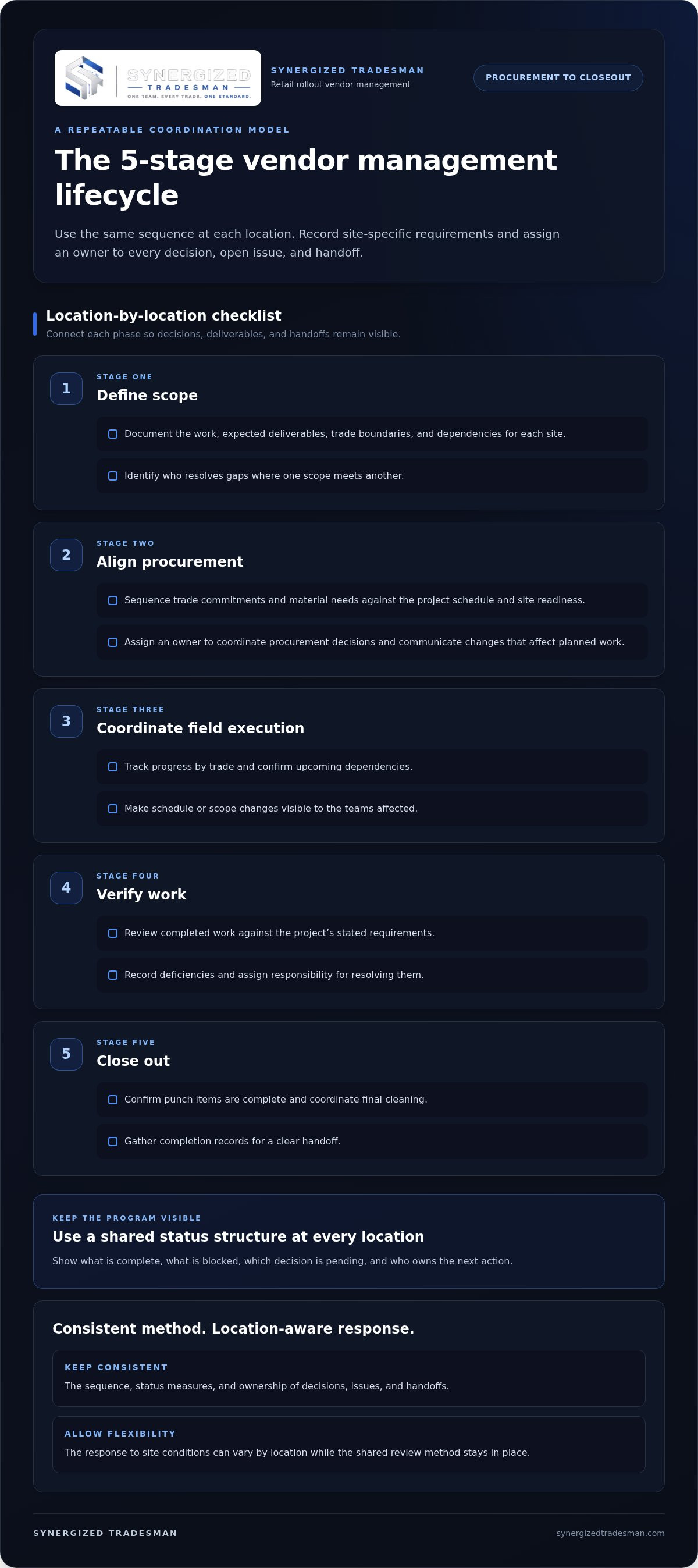
Use the same sequence at each location, recording site-specific requirements and assigning an owner to every decision, open issue, and handoff:
- Define scope. Document the work, expected deliverables, trade boundaries, and dependencies for each site. Identify who resolves gaps where one scope meets another.
- Align procurement. Sequence trade commitments and material needs against the project schedule and site readiness. Assign an owner to coordinate procurement decisions and communicate changes that affect planned work.
- Coordinate field execution. Track progress by trade, confirm upcoming dependencies, and make schedule or scope changes visible to affected teams.
- Verify work. Review completed work against the project’s stated requirements, record deficiencies, and assign responsibility for resolving them.
- Close out. Confirm punch items are complete, coordinate final cleaning, and gather completion records for a clear handoff.
A vendor management lifecycle defines scope, aligns procurement, coordinates field work, verifies completion, and records closeout under clear ownership. That sequence gives program leaders a consistent way to review progress across stores without treating different site conditions as errors. A shared status structure can show what is complete, what is blocked, which decision is pending, and who owns the next action. The measures stay consistent, while the response can vary by location.
Align scope and procurement before mobilization
Before work begins, translate the project scope into clear trade responsibilities and interfaces. For example, define the handoffs between framing, electrical rough-in, and drywall so each team knows what must be ready before its work proceeds. Procurement coordination should connect those requirements to site readiness and the schedule, rather than treating purchasing as a separate task. One accountable relationship can align multi-trade needs and keep decisions connected across the project.
Coordinate field execution and closeout
Communicate field progress alongside dependencies and issues, not as isolated trade updates. If a change affects a following activity, record the decision, identify the impacted scope, and assign responsibility for informing the relevant teams. Link each quality check to an owner and a resolution status. At closeout, confirm punch completion, final cleaning, and project documentation, then make the handoff clear to the party receiving the completed work.
For commercial programs that need coordinated planning, procurement, field execution, and closeout, multi-trade rollout coordination brings those phases into one accountable relationship.
Central Standards vs. Site Flexibility in Retail Rollout Vendor Management
Central governance does not require identical execution at every store. It establishes the controls that apply across the program, then provides a clear way to document and manage justified site-level adjustments. In retail rollout vendor management, this distinction helps leaders compare work consistently without imposing a field plan that does not fit the site.
The practical test is simple: keep expectations and accountability consistent, while adapting the sequence or approach when a location’s readiness, existing conditions, or access requires it. The comparison below separates the controls to standardize from decisions that may vary by site.
| Keep consistent across the program | Adapt to the location |
|---|---|
| Scope definitions, trade responsibilities, and handoff expectations | Work sequence based on site readiness and existing conditions |
| Communication roles, issue ownership, and escalation routes | Field coordination shaped by access constraints |
| Quality expectations and the process for recording open items | Site-specific steps needed to meet the shared expectations |
| Closeout requirements and completion records | Timing of activities when location conditions affect the schedule |
Which vendor controls should remain consistent
Set a common baseline for each trade’s responsibilities, how vendors communicate changes, and how work is reviewed. Use the same reporting structure at every location, including status, open issues, the responsible party, and the next decision. This gives program leads a reliable way to compare progress. The standard guides judgment, but does not replace it.
For example, teams can use one quality review process while documenting location-specific observations separately. This prevents a site adjustment from silently changing the program expectation. It also makes recurring gaps easier to identify: a missed handoff at one store may be isolated, while similar issues across several sites may indicate that scope or communication needs clarification.
Where location-level flexibility matters
Site readiness, existing conditions, access constraints, and the order in which trades can work may differ from store to store. A field team might need to adjust sequencing if an area is not ready for the next activity. Record what changed, why it was needed, which work or handoffs it affects, and who owns the decision and follow-up.
Standardized governance means applying the same rules for scope, communication, and quality, not assuming every site has the same conditions. Documenting exceptions protects that distinction. Keep the original standard visible, record the site-specific decision alongside it, and note how the change affects responsibilities or completion. Teams can then review progress consistently without confusing a necessary local adjustment with a shift in program expectations.
This approach balances control with practical field judgment: the program defines the baseline, and documented site decisions show how teams apply it responsibly.
A Practical Retail Rollout Vendor Governance Framework
A governance framework turns coordination into a repeatable operating process. For retail rollout vendor management, it should show who owns each decision, how trades hand off work, and how site-level exceptions fit into the program view. The framework does not need complex procedures. It needs clear responsibilities and records teams can use consistently.
Use this sequence to govern each location while keeping program oversight connected:
- Map scope and interfaces. Define each trade’s deliverables, dependencies, and boundaries. Identify where one team’s completed work becomes another team’s starting point.
- Assign decision ownership. Name who can resolve scope questions, approve adjustments, and communicate decisions to affected teams. Avoid leaving shared interfaces without a clear owner.
- Set the communication cadence. Establish regular reviews for schedule status, field issues, and pending decisions. Capture the responsible party and next action so updates lead to follow-through.
- Review quality and issues. Record the requirement, observed condition, resolution owner, and completion status for each quality item. Escalate issues that affect other scopes or the project sequence.
- Track exceptions by location. Record what differs from the program baseline, why the change is needed, and what work it affects. Keep the exception visible in the shared program view.
- Confirm closeout. Review outstanding items, completion records, and handoff responsibilities before marking a location complete.
This structure supports commercial construction coordination principles by connecting trade activities to decisions and field responsibilities, rather than relying on schedule visibility alone.
Set up vendor roles, handoffs, and communication
For each trade, document its scope, the work it depends on, its decision owner, and the party receiving its completed work. Then use a predictable review cadence to discuss schedule status, field issues, and open decisions. Tie location updates to shared standards, but record them under the specific site so program leads can distinguish a local constraint from a recurring coordination concern.
Manage quality, exceptions, and closeout consistently
Give each quality issue an owner, a corrective action, and a recorded completion status. Review exceptions by location and cause. A change prompted by site conditions is not automatically a failure, but it should remain visible and follow the program’s decision process. A multi-trade construction accountability model can clarify how one accountable relationship connects overlapping responsibilities without obscuring trade-specific work.
Use the same review structure across sites, then assess whether exceptions point to isolated conditions or a broader gap in scope definition, communication, or quality expectations. Synergized Tradesman coordinates commercial rollout work across planning, procurement, field execution, and closeout through multi-trade rollout coordination.
How Synergized Tradesman Coordinates Retail Rollout Vendors
Synergized Tradesman manages commercial construction, renovation, retail refresh, and rollout programs through one accountable relationship. That relationship connects planning and procurement to field execution and closeout, keeping trade responsibilities within a coordinated project framework rather than leaving each handoff to separate conversations. For retail rollout vendor management, this creates a clear point of coordination across program standards and site-level work.
Trade scopes can include demolition, framing and drywall, ceilings, finishes, electrical, and plumbing. Each trade performs its defined work. Coordination connects the scopes by clarifying how they relate, when one team’s work affects another, and how decisions move through the project. The firm’s retail store construction reference guide offers broader context for planning and delivering retail construction work.
Coordinate multiple trades through one accountable relationship
One accountable relationship connects trade requirements across project phases. During planning and procurement, responsibilities and interfaces can be aligned with the work expected at each location. In the field, coordination keeps dependencies and decisions connected to the relevant scopes. At closeout, completed work and remaining items can be brought into a clear handoff. Synergized Tradesman is a certified women-owned commercial construction firm.
The standard stays consistent across projects, while teams address the conditions at each store. A location may need a different sequence because of its readiness or existing conditions. The coordination model keeps those adjustments tied to the relevant scope and decision, while maintaining common expectations for quality and project closeout. This balances program oversight with practical field judgment.
For example, ceiling installation may depend on earlier framing or electrical work being ready. Coordinating that interface means making the dependency and responsible parties clear, rather than treating the trades as unrelated assignments. The same approach applies to procurement, field work, and completion records. It supports continuity without assuming every location follows an identical path, and helps teams understand how a change affects the work that follows.
Define the next step for a rollout program
A productive project discussion starts with the rollout scope, locations, trade requirements, and governance needs. These details help frame the work, clarify where trade coordination is needed, and show how planning, procurement, field execution, and closeout connect. One accountable relationship can provide continuity across the phases while respecting each site’s conditions.
To discuss commercial rollout requirements with Synergized Tradesman, connect with the retail rollout coordination team. Share the program scope and trade interfaces that need oversight. Clear project context is a practical starting point for aligning responsibilities and coordination across locations.
Set Your Rollout Program Up for Clear Ownership
Turn governance principles into decisions your team can use: define the locations in scope, identify trade interfaces that need coordination, and clarify how site-specific changes will be handled. A practical retail rollout vendor management approach gives decision-makers a stronger basis for planning and keeping responsibilities visible as the program advances.
Synergized Tradesman coordinates commercial construction through one accountable relationship, from planning and procurement to field execution and closeout. As a certified women-owned firm, it coordinates multiple trades under one standard across projects while allowing teams to address each location’s conditions.
Bring your rollout scope, location requirements, and trade coordination needs into the conversation. Discuss your retail rollout program with Synergized Tradesman and take a clear next step toward coordinated execution.
Frequently Asked Questions
What should a retail rollout vendor scorecard track?
A retail rollout vendor scorecard should track scope completion, schedule status, quality findings, open issues, handoff readiness, and closeout documentation. Define each field consistently so “complete” or “at risk” means the same thing at every location. Use the scorecard to guide decisions, not to promise results. Synergized Tradesman connects reporting with coordinated oversight from planning and procurement through field execution and closeout.
How often should teams review vendor performance during a retail rollout?
Review vendor performance on a cadence that reflects the project phase, schedule risk, and number of active locations. No single interval fits every rollout. Set predictable check-ins to confirm progress, upcoming dependencies, decisions needed, and unresolved issues. Add a focused review when a location has a significant exception, such as a readiness constraint affecting the next trade. Feed site updates into the program view so emerging patterns stay visible.
Can one vendor manage every trade in a retail rollout?
One accountable vendor relationship can coordinate a rollout, but that does not mean one party personally performs every trade. Retail construction may require distinct specialties, each with defined scope, sequencing, and responsibility. Synergized Tradesman coordinates multi-trade commercial construction and renovation work across planning, procurement, field execution, and closeout. This structure connects trade work and decisions while preserving the specialist responsibilities required to complete each scope.
What information should a retail rollout vendor handoff include?
A retail rollout vendor handoff should record the location and scope, current status, completed work, outstanding items, dependencies, decisions made, quality issues, and closeout records required for that work. An incoming trade needs to know what is ready, what remains open, and who owns unresolved items. Organize records by location and use common program terms. Tailor documentation to the project scope and applicable requirements.
How should a retailer handle a location that falls behind the rollout schedule?
First identify why a location is behind, then map the affected trade interfaces, decision owner, and schedule implications. A delayed site may have a readiness issue that changes the order of work, while another delay may depend on a decision or unresolved scope. Keep the issue visible in both the location update and portfolio view. Assign corrective actions after reviewing dependencies and site conditions, and report status without promising an unsupported recovery date.
When should vendor coordination begin for a retail rollout?
Vendor coordination should begin during planning and procurement, before field activities rely on aligned scopes, sequencing, and site readiness. Early review can expose trade interfaces, procurement dependencies, and location constraints while teams still have room to plan around them. Carry coordination into field execution, quality review, and closeout so decisions do not stop at mobilization. Synergized Tradesman manages commercial projects across these phases through one accountable relationship.


