

Consistency across a retail rollout doesn’t come from treating every store the same. It comes from standardizing shared decisions while managing the site-level details that vary. That’s the central challenge of multi-location retail rollout management: different site conditions affect schedules, brand standards can drift, and scattered ownership makes changes and closeout harder to track.
These pressures are familiar to teams coordinating work across a portfolio. A reliable process needs clear standards, visible responsibility, and enough flexibility to account for each location’s requirements. Without those controls, small differences can lead to larger execution gaps.
This guide explains how to build a repeatable rollout process with accountable ownership for procurement, field execution, and closeout. It covers how to set program standards, document site-specific conditions, coordinate work from planning through completion, and maintain consistent quality without forcing every location into an identical plan.
Key Takeaways
- Manage related store projects as one governed program, with a location-level plan for each site.
- Set repeatable standards and decision rules, then validate site conditions before finalizing execution plans.
- Compare rollout models by who owns decisions, communication, site adjustments, and closeout visibility.
- Use a shared tracker and clear escalation owners to surface readiness gaps, schedule variance, and changes early.
- Effective multi-location retail rollout management connects planning, procurement, field execution, and closeout through accountable ownership.
What Multi-Location Retail Rollout Management Actually Coordinates
Multi-location retail rollout management coordinates related store projects under shared program standards, with a location-level plan for each site. It brings scope, procurement, trades, schedule, quality, communication, and closeout into one governance structure. Teams can track shared decisions and requirements without assuming every store has the same conditions.
This differs from managing several construction projects independently. Separate projects may each have their own scope, schedule, approvals, and reporting. A coordinated program connects them: portfolio decisions guide repeatable work packages, while site plans record the conditions and adjustments specific to each location. The discipline draws on core project management practices, including planning and controlling scope, time, and resources.
How a rollout program differs from a single-store project
A single-store project can focus on that location’s deliverables and dependencies. A rollout must also account for relationships across the portfolio. For example, a shared fixture package or procurement decision may affect several locations, while a site-specific condition may require a documented adjustment. Program-level visibility helps teams see these dependencies and understand where a change could affect other work. Store count alone doesn’t determine complexity; variation in scope, readiness, sequencing, and approvals matters too.
Which teams need shared visibility
Retail operations, facilities, construction, procurement, and field teams each hold information that can affect delivery. Shared visibility gives them a common view of requirements, decisions, risks, and status. It also clarifies who must act when a site condition or change affects the plan.
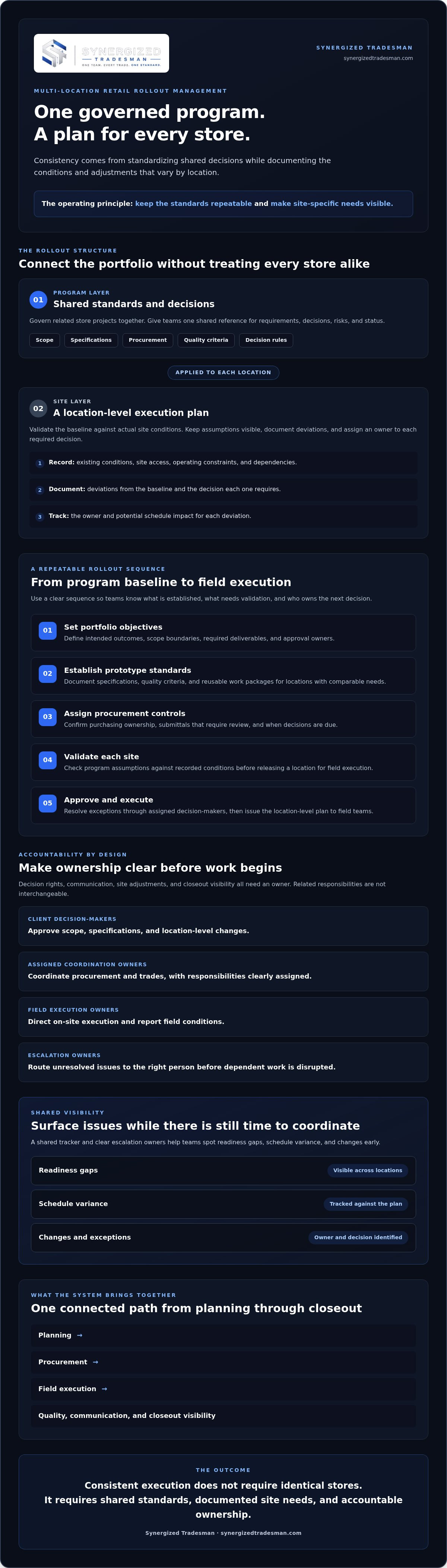
Set decision rights before work begins. Define who approves scope, specifications, and location-level changes; who coordinates procurement and trades; and who directs on-site execution and reports field conditions. These responsibilities are related, but they aren’t interchangeable. Client approvals should remain with designated client decision-makers, while trade coordination and field execution need clearly assigned owners. Establish escalation paths too, so unresolved issues reach the right person before they disrupt dependent work.
A practical governance plan identifies shared standards, site details that require separate tracking, and the owner for each decision and workstream. That structure turns a group of store projects into a manageable program without erasing the differences between locations.
Build a Repeatable Rollout System Without Treating Every Store Alike
A repeatable system makes program standards clear before work reaches the field, then checks those standards against each location’s actual conditions. This is the practical balance at the heart of multi-location retail rollout management: standardize decisions that should be consistent, and document exceptions that need a site-specific response.
Set the program baseline before releasing locations
Establish the baseline in a clear sequence so teams know what is fixed and what still needs validation:
- Set portfolio objectives. Define intended outcomes, scope boundaries, required deliverables, and approval owners.
- Establish prototype standards. Document specifications, quality criteria, and reusable work packages for locations with comparable needs.
- Assign procurement controls. Confirm who owns purchasing, which submittals require review, and when decisions are due.
- Validate each site. Check assumptions against recorded conditions before releasing the location for field execution.
- Approve and execute. Resolve exceptions through assigned decision-makers, then issue the location-level plan to field teams.
Reusable scopes and decision rules reduce avoidable variation by giving teams a consistent reference for what is included, what requires approval, and who makes the decision. Keep assumptions visible instead of treating them as confirmed facts. A broader retail store construction guide can also help teams understand the construction context behind the program baseline.
Validate each location before field execution
Use a documented readiness review to check existing conditions, site access, operating constraints, and dependencies that could affect the planned work. For example, a standard fixture package may still require a site-specific check of dimensions and installation conditions. Record each deviation from the baseline with its owner, required decision, and potential schedule impact. Research on the effect of managerial quality on rollout examines store-level management in a product rollout, underscoring why local execution deserves attention alongside shared program standards.
A location-specific variance needs review and approval when it changes the agreed scope, specification, quality requirement, or schedule. This gives teams a clear trigger for escalation without requiring every site to follow an identical plan. Once approved, capture the decision in the location record and update any affected work package or procurement instruction.
Teams assessing how an accountable relationship can support planning through field execution can review Synergized Tradesman’s commercial rollout management.
Compare Rollout Management Models by Accountability and Site Control
The right structure for multi-location retail rollout management depends on the program’s coordination demands and the capacity of the retailer’s internal team. A model that works for straightforward, similar sites may become difficult to manage when scopes vary, approvals are distributed, or several trades must be coordinated across locations. Compare who owns decisions and delivery, not just how many parties are involved.
| Model | Ownership | Communication | Consistency | Site adaptation | Closeout visibility |
|---|---|---|---|---|---|
| Separately managed locations | Local teams or project leads own each site | Updates may follow separate channels | Depends on shared standards and local follow-through | Local teams can respond directly to site conditions | Requires consolidated reporting to compare locations |
| Centralized program team | Internal team oversees portfolio decisions and reporting | Common communication structure across sites | Strong control of shared requirements | Relies on local input to document exceptions | Can provide a unified view if site data is maintained |
| Single accountable multi-trade relationship | One relationship coordinates multi-trade delivery | One coordination point for construction workstreams | Shared standards can be applied across projects | Site requirements need to be recorded and reviewed | Can connect delivery and closeout information through one relationship |
Separately managed sites may suit projects with limited dependencies and capable local owners, but portfolio-level comparisons can take more effort. A centralized team can maintain program control if it has enough capacity to manage site inputs and follow-through. A single accountable multi-trade relationship may clarify coordination across workstreams, while client approvals and site-specific requirements still need defined owners.
What to evaluate in a rollout management partner
Ask how responsibilities connect across planning, procurement, field execution, and closeout. Check how the partner records site exceptions, decisions, and quality checks, and whether stakeholders receive comparable status information for each location. Reporting should make differences visible, not hide them behind a single portfolio summary.
How to balance centralized standards with local conditions
Keep brand requirements, approved scope, and acceptance criteria consistent where the program requires it. Allow changes when verified site conditions make the baseline unsuitable, but document the reason, approval, and impact before teams proceed. A multi-trade commercial construction accountability model can provide useful context for understanding how coordinated delivery responsibilities are structured. Whatever model you choose, it doesn’t replace approval rules, decision records, or location-level documentation.
Control Schedule, Quality, and Changes Across Retail Locations
A shared location tracker gives program and field teams one view of each site’s status and outstanding needs. In multi-location retail rollout management, consistent reporting matters because a status update is useful only when teams can compare locations using the same definitions.
For each location, track readiness, approved scope, procurement, schedule, decisions, risks, and current status. Add an owner and next action to open items. Define milestones in operational terms, such as “ready for field execution,” and state what evidence confirms completion. This distinguishes a site that has not met a readiness condition from one that is simply awaiting a scheduled start.
Choose the reporting cadence to fit the project’s phases, decision deadlines, and risks. Set escalation owners and triggers in advance. If a milestone is at risk, the tracker should show who must assess the variance, who can approve a response, and which dependent locations or workstreams may be affected.
Track dependencies, procurement, and schedule changes
Record long-lead materials, access requirements, and trade sequencing by location. A procurement delay or access constraint at one site may affect its own sequence or connected work, so note dependencies instead of relying on informal updates. Use a shared decision log to keep program and field teams aligned.
For every change request, capture the reason, schedule and scope impact, decision owner, approval status, and affected sites. Keep proposed changes separate from approved direction. That distinction helps field teams work from current instructions and gives stakeholders a clear record of decisions.
Apply consistent quality checks and closeout requirements
Before work starts at a location, define planned quality checks against the approved scope and documented acceptance criteria. Identify what evidence is needed at each check, who reviews it, and how deficiencies will be recorded. Apply the same program requirements across comparable work, while retaining each site’s inspection records and sign-offs.
When a deficiency is identified, log the item, responsible party, corrective action, and verification of completion. A standardized closeout checklist can cover required deliverables across the portfolio, while location-specific records show what was completed and accepted at that store. Keep closeout visible in the tracker rather than treating it as an administrative step after field work ends.
Synergized Tradesman’s information on retail rollout requirements outlines its work coordinating construction, trade execution, and project closeout across retail locations.
How Synergized Tradesman Supports Accountable Retail Rollouts
Multi-location retail rollout management needs a clear link between program standards and work at each site. Synergized Tradesman coordinates commercial projects through one accountable relationship, connecting planning, procurement, field execution, and closeout. This gives stakeholders a defined point of coordination across trades and locations, while keeping site-specific requirements visible in each project plan.
The company applies one standard across projects to support consistency and accountability. That doesn’t mean every store is treated as identical. Location conditions and approved exceptions can be documented and addressed within the project plan, while shared requirements remain consistent across the program.
What one accountable relationship can coordinate
Synergized Tradesman’s commercial construction capabilities include general trades, demolition, metal stud framing and drywall, ACT ceilings, painting and wallcovering, flooring and tile, electrical, and plumbing. Its work also includes millwork, fixtures and specialty installation, final cleaning, and project closeout. Coordinating these workstreams through one relationship can clarify how responsibilities connect from planning through completion.
Clear ownership still depends on separating client decisions from project coordination. The client’s designated stakeholders approve scope, standards, and changes that require their authorization. The project team coordinates the approved work, procurement, trade activities, field execution, and closeout, and reports issues that need a client decision. Agreeing on these boundaries early helps prevent approval requests from being confused with field direction.
Define the next steps for a rollout discussion
Prepare information that will help frame the program and identify location-level needs. Useful starting points include:
- Portfolio scope, location list, and intended sequence
- Known site constraints, readiness details, and potential exceptions
- Required brand standards, specifications, and quality criteria
- Decision-makers, approval paths, and reporting expectations
- Procurement responsibilities and closeout requirements
These details help establish what should remain consistent, what requires site validation, and where decisions must be assigned. They also create a practical basis for discussing coordination across project phases without assuming that every location has the same scope or conditions.
Discuss your multi-location retail program and location-level requirements with Synergized Tradesman.
Put Your Retail Rollout Plan Into Motion
Effective multi-location retail rollout management depends on shared standards, site-level planning, and clear ownership from early decisions through closeout. A location tracker, defined approval paths, and documented exceptions help teams maintain portfolio visibility without assuming every store has the same conditions.
Synergized Tradesman coordinates planning, procurement, field execution, and closeout through one accountable relationship. The company applies one standard across projects to support consistent quality and accountability, while site-specific requirements remain part of the plan. Synergized Tradesman is also a certified women-owned commercial construction firm.
Bring your portfolio scope, location sequence, known constraints, and required standards into the conversation. Discuss your multi-location retail rollout with Synergized Tradesman to identify the coordination approach that fits your program. Clear ownership is a practical starting point for moving your rollout forward.
Frequently Asked Questions
What is multi-location retail rollout management?
Multi-location retail rollout management coordinates related store construction or refresh projects under shared program standards and location-specific plans. It connects scope, procurement, trade coordination, schedules, quality checks, communication, and closeout so teams can manage dependencies across locations. Unlike several independently managed projects, a rollout uses common decision rules and comparable status reporting while allowing documented adjustments for each site’s conditions and requirements.
How do you keep retail construction consistent across multiple locations?
Set shared specifications, approved work packages, quality criteria, and acceptance requirements before releasing sites for execution. Then confirm each location’s conditions and document any approved exceptions. For example, a common fixture scope can follow the same quality standard while the installation plan reflects verified site requirements. Assign owners for approvals and field coordination, and use consistent progress and quality records to identify differences that need attention.
What should a multi-site retail rollout dashboard track?
A useful dashboard shows each location’s readiness, approved scope, procurement status, schedule milestones, open decisions, risks, and current status. Include an owner and next action for unresolved items, plus change approvals and closeout progress. Define milestones consistently so stakeholders can compare sites accurately. For example, clarify what evidence marks a location as ready for field execution rather than relying on an informal status label.
How do you manage site-specific conditions in a standardized rollout?
Use the program baseline as the common reference, then validate each location before field execution. Record conditions such as access constraints, existing conditions, or scope differences, and identify the decision owner and possible schedule impact. Review and approve a variance if it changes the agreed scope, specifications, quality requirements, or schedule. Keep the decision in the location record so procurement and field teams work from current direction.
Who manages contractors and trades in a retail rollout?
Responsibility depends on the project’s delivery structure and agreements. The retailer’s designated stakeholders typically retain authority for client approvals, such as scope or changes requiring authorization. A construction partner or assigned project team can coordinate procurement, trade activities, field execution, and reporting within the approved plan. Define these roles before work begins, including escalation paths, so teams know who can approve a decision and who is responsible for acting on it.
When should a retailer use a single accountable construction partner?
Consider one accountable construction partner when coordinating multiple trades, locations, procurement activities, and closeout through separate owners creates unclear responsibilities or fragmented reporting. Synergized Tradesman provides a single accountable relationship for commercial construction, renovation, retail refresh, and rollout programs, coordinating planning, procurement, field execution, and closeout. The retailer should still define approval authority, reporting needs, site-level requirements, and the partner’s coordination responsibilities before work proceeds.


