

What if a commercial project had one accountable relationship instead of a dozen separate trade contractors? With single source commercial construction, planning, procurement, and field execution are coordinated through a central point of contact. This structure can help address familiar challenges, such as missed handoffs between demolition, framing, and finishing, inconsistent standards across retail locations, and budget pressure caused by poor coordination.
Managing multiple trades takes careful oversight, especially when a rollout spans a national portfolio. Contractors may have separate schedules, communication processes, and quality expectations. A single-source model brings those moving parts under one accountable relationship, giving project teams a clearer path from scope planning through final cleaning and closeout.
This article explains how centralized coordination can simplify multi-trade commercial projects. You’ll learn how it can align trade schedules, connect procurement with field execution, and support consistent work across locations. We’ll also clarify what single-source means in construction and what to assess when choosing a partner for high-volume projects.
Key Takeaways
- See how single source commercial construction brings procurement and multi-trade management into one accountable relationship.
- Learn how sequencing trades from demolition through closeout can reduce handoff problems and keep field execution coordinated.
- Identify how centralized oversight can address coordination gaps that contribute to budget pressure and project delays.
- Understand how one operating standard can support consistent quality across national retail refresh programs.
- Use practical criteria to assess a partner’s trade coverage, accountability model, and WBE certification.
What is Single Source Commercial Construction?
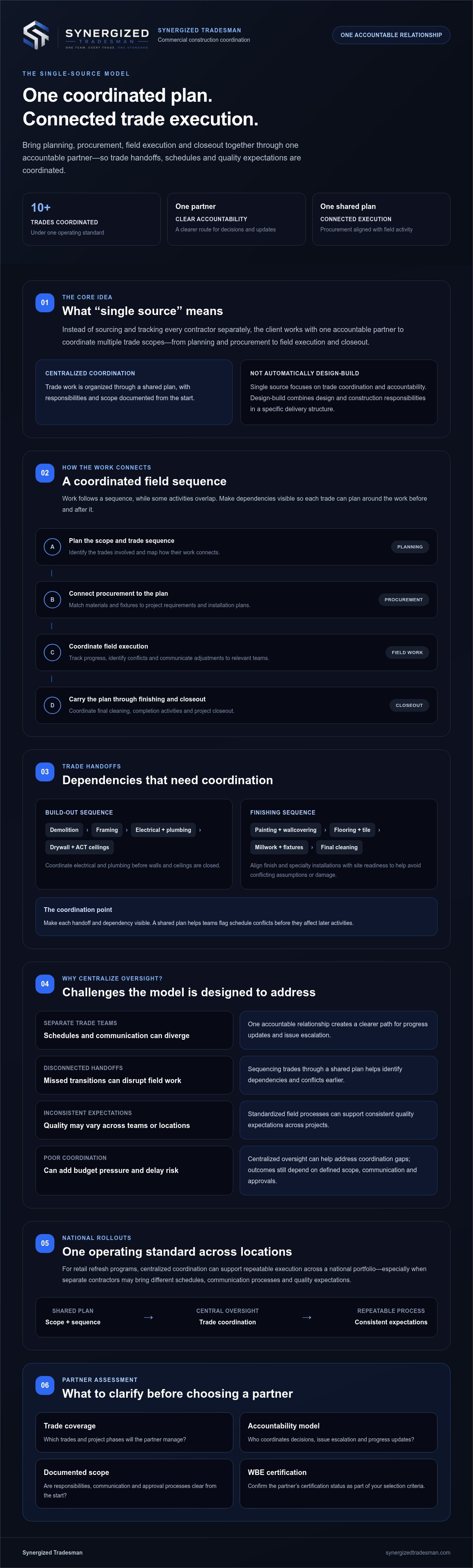
Single source commercial construction brings multiple trade scopes into one coordinated procurement and management relationship. Rather than sourcing and tracking each contractor separately, the client works with one accountable partner to organize planning, procurement, field execution, and closeout. The partner coordinates work across trades, while the project scope and responsibilities should be documented clearly from the start.
The model is related to, but not automatically the same as, design-build. Design-build combines design and construction responsibilities in a particular delivery structure. A single-source construction arrangement focuses on consolidating trade coordination and accountability. A neutral overview of the design-build project delivery system helps clarify that delivery models can vary. Confirm which project phases and trades a partner will manage.
That distinction matters in commercial construction. A traditional general contractor may coordinate subcontractors, but communication can still pass through separate trade teams with their own scopes and schedules. A multi-trade accountability model puts coordination under one relationship, creating a clearer route for decisions, issue escalation, and progress updates. The goal is not simply to reduce the number of vendors to contact. It is to work from a shared plan and apply consistent quality expectations across the project.
The Single Accountable Relationship Explained
One point of contact can connect project requirements with procurement and field activity, then track how each trade’s work affects the next. For example, demolition must be coordinated with metal stud framing and drywall, followed by finishes such as painting, flooring, or ACT ceilings. Centralized oversight helps identify handoffs early and gives business leaders a clearer route for managing logistical questions. Accountability still depends on defined scope, communication, and approval processes.
Beyond General Contracting: The Accountability Framework
The shift is from managing separate subcontractor relationships to coordinating a multi-trade strategy. Standardized field processes can help teams work to consistent expectations and flag schedule conflicts before they affect later activities. For corporate brands, that approach supports repeatable execution across national projects. Synergized Tradesman coordinates more than 10 trades, including demolition, framing and drywall, millwork, electrical, plumbing, and final cleaning, under one standard. This framework connects planning with field work and project closeout.
The Logistics of Multi-Trade Coordination and Field Execution
A coordinated project follows a sequence, but its activities overlap. Demolition clears the space for new construction. Framing establishes walls and openings, while electrical and plumbing work must be coordinated before those walls are closed. Drywall and ACT ceilings follow in relation to that work, and finishes and specialty installations depend on site readiness. A single source commercial construction partner can manage these dependencies as one field workflow instead of leaving each trade to arrange its own handoffs.
Phases of Execution: From Planning to Procurement
Execution begins with planning. The team defines the project scope, identifies the trades involved, and maps how their work connects. That trade sequence informs procurement, since materials and fixtures need to match project requirements and installation plans. In the field, centralized oversight tracks progress, identifies coordination issues, and communicates adjustments to the relevant teams. This keeps procurement and field decisions connected without assuming that every project follows the same schedule.
Managing the Interior Trade Stack
Interior sequencing makes coordination especially visible. Metal stud framing and drywall establish the surfaces and enclosures that later work depends on. Electrical and plumbing activities need to be coordinated with those assemblies before walls and ceilings are closed. ACT ceilings are then installed in relation to completed overhead work. Clear handoffs help limit rework caused by trades relying on conflicting assumptions.
Finishes and specialty installations require their own coordination. Flooring and tile, painting and wallcovering, and millwork or fixture installation must be planned around site readiness and work sequence. For example, installing a fixture before nearby finish work is complete may expose it to damage or require additional coordination. The project manager’s role is to make dependencies visible and align each activity with the overall plan.
Electrical and plumbing belong in the same workflow, not in separate communication channels. Coordinating their progress with framing, drywall, ceilings, and finish installation helps the team address access and sequencing needs before they become field conflicts. Final cleaning and project closeout provide a defined endpoint, with completion checked against the client’s stated requirements.
For an overview of design-build delivery as a distinct project structure, the Design-Build Institute of America is a useful reference. To see how a coordinated trade scope may apply to a commercial project, review multi-trade commercial construction capabilities.
Mitigating Budget Risks Through Centralized Oversight
A fragmented trade stack can make a project budget harder to manage. When vendors work from separate scopes and schedules, a missed handoff may lead to idle time, duplicated work, or a disputed change request. For example, if one trade’s work is incomplete when the next is scheduled to begin, the client may face added coordination and schedule pressure, even if no single vendor can see the full sequence.
Centralized oversight can help close that gap. One accountable manager can connect scope, procurement, schedule, and field updates so potential conflicts are visible and can be addressed through the project’s decision process. This won’t prevent every change or remove the need to document approvals. It can make clear who is coordinating an issue, what work is affected, and how a proposed adjustment may affect other trades.
Reducing the Friction of Fragmented Procurement
Separate procurement streams can create inconsistent assumptions about materials, specifications, and delivery timing. If a product or finish changes, each affected trade needs current information. Without a coordinated process, teams may rely on different versions of the scope, increasing the risk of rework or avoidable purchasing adjustments.
A multi-trade commercial construction approach connects decisions across the trade stack. A commercial general trades contractor can provide a central coordination structure. The client should still review how proposals define inclusions, exclusions, allowances, approvals, and change documentation. Consistent quality expectations across projects also help teams identify deviations early, before corrective work affects later activities.
The “Shield” Concept: Protecting the Client’s Bottom Line
Assess the value of management against the cost of coordination problems, rather than as an isolated line item. A proposed management fee may be clear upfront, while the effects of delayed decisions, repeated mobilization, rework, or unresolved trade questions can be harder to forecast. Centralized management is not always less expensive. Compare bids on a like-for-like basis, including scope, coordination responsibility, and change processes.
In single source commercial construction, the coordinating partner acts as a “shield” by managing logistical exchanges and making cost implications easier to track. Transparent procurement records, clear scope ownership, and documented approvals give business leaders better information for decisions. The Design-Build Institute of America describes a related delivery model as a single source for design and construction. Trade-management arrangements may differ, so confirm which services and responsibilities are included. Consistent execution can also support repeatable planning and fewer avoidable corrections across a portfolio, without guaranteeing a particular return.
Scaling for Success: National Retail Rollout and Refresh Programs
Retail refresh programs multiply coordination demands. Each location has its own site conditions, work sequence, and readiness requirements, while the brand expects a consistent customer-facing result. Across 50 or more locations, small differences in scope interpretation or installation can become visible across the portfolio. A single source commercial construction model gives program leaders one relationship for coordinating trade execution under a shared standard.
This structure supports planning at two levels: the overall rollout and each individual site. Teams can establish common scope expectations and quality criteria, then track local progress against the program plan. Site-specific conditions still need review. Standardization means applying consistent requirements, not assuming every location is identical.
Consistency Across the Portfolio
Customers should encounter the same intended look and feel from location to location. Millwork and fixture installation contribute directly to that experience, so clear specifications, coordinated procurement, and consistent installation expectations matter. When site teams use the same approved scope and quality checks, project leaders can identify deviations and resolve them through a consistent process.
Active store refreshes also require careful sequencing to limit disruption to operations. The project team should confirm site readiness, define work boundaries, and coordinate trade activity with the retailer’s operating requirements. Work-hour and access arrangements should be agreed with the client, not assumed. Clear communication helps store teams understand what is happening and when key areas may be affected.
High-Volume Logistics and Speed to Market
National programs need a reliable way to coordinate work across multiple territories while maintaining visibility at each site. A central program lead can align schedules, procurement status, field updates, and issue escalation. Location-level reporting can show where action is needed. This gives teams a clearer operating picture than separate vendor updates that may use different formats or milestones.
Procurement must stay connected to the rollout schedule. Review material requirements, fixture details, and delivery timing against each site’s planned sequence. If a shipment or site-readiness issue affects an installation, the team can assess the impact on related work and communicate a documented adjustment. Speed should come from planning and coordinated decisions, not from skipping quality checks.
Closeout is part of portfolio control. Standardized records for completed scope, outstanding items, and final cleaning help corporate teams compare project status across locations and maintain a consistent handoff. Synergized Tradesman manages national projects under one standard, from trade coordination through final cleaning and project closeout. Explore national retail rollout construction support to assess how a centralized approach may fit your program.
Selecting the Right Partner for Single Source Construction
A strong partner must do more than combine trade scopes under one contract. For single source commercial construction, evaluate how the firm connects procurement decisions with field execution, maintains consistent oversight, and reports progress across projects. The right fit depends on documented capabilities and clear responsibilities, not just the number of trades listed in a proposal.
Use the RFP process to test the operating model. Ask how the partner will move from scope review and trade identification to procurement, scheduling, field coordination, issue escalation, and closeout. Request clear descriptions of inclusions, exclusions, approval steps, and project reporting. Then assess whether the proposed approach can support your expected project volume and national portfolio without relying on vague assurances.
The Value of WBE Certification in Construction
For procurement teams with supplier-diversity objectives, working with a certified Women-Owned Business Enterprise (WBE) may support their sourcing goals. Synergized Tradesman is a certified women-owned commercial construction firm. Certification alone doesn’t establish project fit or satisfy every organization’s reporting requirements. Confirm which documentation your procurement process requires and how supplier status should be reported.
Evaluate the firm’s delivery capacity as well as its certification. Ask who will manage the relationship, how progress and documentation will be tracked, and how the partner handles changes from the RFP scope through field execution. This keeps procurement considerations connected to project accountability.
Establishing the Single Source of Truth
Before selecting a partner, confirm trade coverage and management responsibilities in writing. Synergized Tradesman coordinates more than 10 trades, including demolition, metal stud framing and drywall, ACT ceilings, painting and wallcovering, flooring and tile, millwork and fixture installation, electrical, plumbing, final cleaning, and project closeout. Ask how those scopes will be coordinated, where the partner’s responsibility begins and ends, and which decisions require client approval.
Vetting should also cover field execution and closeout. Look for a defined process for tracking site progress, communicating issues, documenting decisions, and confirming completed work against agreed requirements. For national programs, ask how one standard will be applied across locations while accounting for differences in site conditions.
A more accountable model starts with a precise RFP and continues through a clearly managed handoff to the field. If your next commercial project requires coordinated trade execution, define the outcomes you need and assess partners against the scope, reporting approach, and capacity to deliver consistently.
Build Your Next Project on Clear Accountability
Successful commercial construction depends on more than completing individual trade scopes. One accountable relationship can connect procurement, field coordination, and closeout, helping teams manage handoffs and apply consistent standards across projects. For national retail programs, a coordinated model can also give leaders a clearer view of execution from location to location.
Synergized Tradesman provides end-to-end management across more than 10 commercial trades and manages national execution for high-volume retail rollouts. As a certified Women-Owned Business Enterprise (WBE), the firm can also support procurement teams pursuing supplier-diversity goals. Consider your project’s trade scope, reporting needs, and expectations for consistent delivery, then take the next step toward a more accountable model.
Partner with Synergized Tradesman for your next multi-trade commercial project. A clearer path from planning through closeout can help your team coordinate work with confidence.
Frequently Asked Questions
What is the main difference between a general contractor and a single-source construction partner?
A single-source partner provides one accountable relationship for coordinating multiple trade scopes, while a general contractor’s responsibilities depend on the contract and delivery model. The distinction isn’t simply the job title: some general contractors also manage several trades. Ask who handles planning, procurement, field coordination, issue escalation, and closeout. Synergized Tradesman coordinates those project phases across commercial trades under one relationship and one operating standard.
How does a single-source model reduce commercial construction costs?
A single-source model can help control avoidable costs by coordinating trade schedules, procurement, and scope changes through a central process. For example, clear handoffs between demolition, framing, and finishing can help reduce the risk of rework or delays caused by missed information. It doesn’t guarantee a lower project price. Compare proposals by scope, exclusions, approvals, and change procedures, as well as the management responsibilities included.
Can a single-source provider manage specialized trades like electrical and plumbing?
Yes, if those trades are included in the provider’s documented scope and the firm has the capacity to coordinate them. Synergized Tradesman manages electrical and plumbing along with commercial trades such as demolition, metal stud framing and drywall, ACT ceilings, millwork, and flooring. Before award, confirm how trade sequencing, procurement, field communication, and responsibility for decisions will be handled for your specific project.
What are the benefits of using a WBE-certified firm for commercial construction?
A WBE-certified firm may support corporate supplier-diversity and procurement objectives when its certification meets the buyer’s program requirements. Synergized Tradesman is a certified women-owned commercial construction firm. Certification is one consideration, not a substitute for evaluating scope, capacity, and accountability. Procurement teams should verify the documentation they require and confirm how the firm’s status fits their supplier reporting process.
How does single-source construction improve retail rollout speed?
Single-source coordination can support rollout pace by aligning procurement, schedules, field updates, and issue escalation through one relationship. A central view of the program helps teams identify site-readiness or material issues and assess their effect on upcoming work. It can’t remove every delay, and each location may have different conditions. Set clear milestones, reporting expectations, and quality checks before work begins to balance pace with consistent execution.
What trades are typically included in a commercial multi-trade renovation?
Trade scopes vary by project, but a commercial renovation may include general trades and commercial construction; demolition; metal stud framing and drywall; ACT ceilings; painting and wallcovering; flooring and tile; millwork, fixtures, and specialty installation; electrical; plumbing; and final cleaning and project closeout. Synergized Tradesman offers these commercial construction and trade scopes. Confirm which are included, excluded, or dependent on client-provided work in each proposal.
How is quality controlled across multiple national project sites?
Quality consistency starts with shared project requirements and a defined standard that applies across locations. A client should establish acceptance criteria, reporting expectations, and a process for documenting and resolving work that doesn’t meet the agreed scope. Synergized Tradesman operates under one standard across national projects. Site conditions can still differ, so confirm how local issues will be recorded while portfolio-wide expectations remain consistent.
What documentation should I expect during project close-out?
Agree on closeout documentation before construction starts, since requirements depend on the contract, scope, and client process. A practical closeout package may track completed work, outstanding items, approvals, and final cleaning status, with supporting records specified by the client. Ask who prepares and reviews each item, how open issues are resolved, and what constitutes acceptance. Synergized Tradesman includes final cleaning and project closeout in its commercial trade offerings.


