

Did you know that incomplete punch list items and delayed submittals account for over 70% of stalled retainage releases between contractors and owners? You've spent months managing complex logistics; however, the final weeks of a project often introduce the most risk. Many firms struggle with compressed schedules and vendors who fail to meet safety standards during the project closeout and final cleaning phase. This creates a high-stakes environment where any delay leads to liquidated damages and strained client relationships. It's a period that requires absolute accountability and organized oversight to protect your bottom line.
We understand the pressure of the "last mile" in commercial construction. You need a reliable system to ensure the building is safe, clean, and ready for a seamless owner walkthrough. This article helps you master the transition from field execution to turnover by providing a comprehensive management checklist tailored for 2026. You'll learn how to navigate the 3-phase cleaning protocol, manage updated 5% retainage caps, and organize the essential AIA documentation required for final payment. Follow this structured approach to achieve a zero-delay transition to operational status and secure your final payout without unnecessary friction.
Key Takeaways
- Identify the specific operational bottlenecks in the final 10% of the project schedule to mitigate common turnover delays.
- Execute a standardized three-phase protocol for project closeout and final cleaning to ensure site safety and compliance with inspection standards.
- Organize administrative submittals, including O&M manuals and as-built drawings, to prevent stalled retainage and secure final payment.
- Coordinate trade schedules and manpower scaling effectively to protect finished surfaces and maintain a zero-delay transition to operational status.
- Adopt a single-accountability model to consolidate multi-trade logistics and ensure standardized quality across national portfolios.
Defining the Critical Path of Project Closeout and Turnover
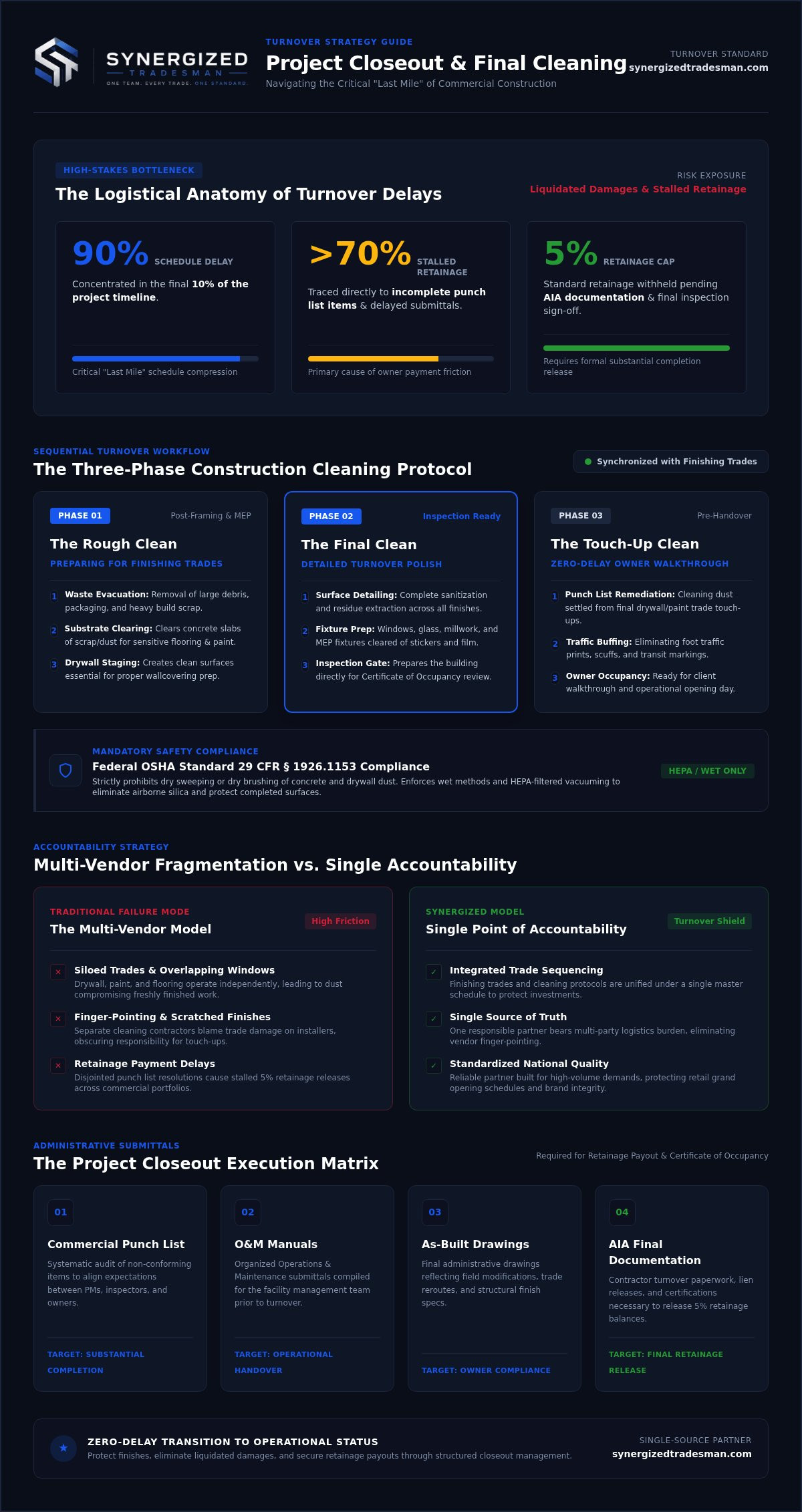
Project closeout is the formal transition from active construction to owner occupancy. It represents the final bridge between field execution and operational status. Most project managers are familiar with the "Last Mile" problem. This is the reality where 90% of project delays occur during the final 10% of the schedule. During this window, project closeout and final cleaning must be synchronized to avoid costly bottlenecks. Success depends on moving from high-volume construction to detailed finish work without losing momentum.
The timing of finishing trades directly dictates the cleaning schedule. Drywall, painting, and flooring installers often work in overlapping windows. If these trades don't coordinate with the cleaning crew, dust and debris will compromise new finishes. This requires a master coordinator who understands how to sequence trade repairs alongside the turnover protocol. It's about protecting the investment made during the earlier phases of the build. When trade work and cleaning are siloed, the risk of surface damage increases significantly.
Stakeholders in this phase include project managers, building inspectors, and the end-user. Each group has a different definition of "finished." The commercial punch list process provides the necessary structure to align these expectations. It documents non-conforming items and establishes a clear path to substantial completion. Managing this list effectively is the only way to ensure the final walkthrough goes smoothly and that all parties agree the site is ready for turnover.
The Logistical Stakes of Delayed Turnover
Delays at the end of a project carry heavy financial penalties. Liquidated damages can drain the profitability of a contract in a matter of days. Beyond the direct costs, inadequate site preparation leads to failed inspections. A site that isn't clean and safe won't receive a Certificate of Occupancy. For retail rollouts, these delays disrupt grand opening schedules and damage brand reputation across national portfolios. Incomplete documentation and messy sites also contribute to the 70% of cases where final retainage payments are stalled, creating cash flow issues for everyone involved.
Establishing a Single Point of Accountability
The multi-vendor model often collapses during compressed timelines. When separate companies handle drywall, paint, and cleaning, finger-pointing becomes inevitable. A single-source partner acts as a shield for the client. They take on the burden of multi-party logistics with total responsibility. This unified approach integrates trade work with the project closeout and final cleaning process. It creates a "single source of truth" for the project's last mile. You gain standardized quality and a reliable partner built for high-volume demands. This model ensures that no detail is overlooked as the project moves toward completion.
The Three-Phase Construction Cleaning Protocol
Executing a successful project closeout and final cleaning requires a tiered approach that mirrors the construction lifecycle. Cleaning isn't a single event; it's a sequence of interventions designed to protect finishes and ensure safety. This protocol is divided into three distinct phases: the rough clean, the final clean, and the touch-up clean. Each phase serves a specific logistical purpose, moving the site from a raw construction zone to a polished, operational facility.
Safety compliance remains a top priority during these transitions. Federal OSHA standard 29 CFR § 1926.1153 strictly prohibits dry sweeping or dry brushing of concrete and drywall dust. We utilize wet methods or HEPA-filtered vacuuming to maintain air quality and site safety. This rigorous adherence to standards prevents the cross-contamination of finished surfaces and protects the health of all personnel on-site during the high-pressure turnover window.
Rough Clean: Preparing for Finishing Trades
The rough clean occurs immediately after framing, MEP rough-in, and drywall installation. The primary goal is the removal of large debris, packaging, and trade-specific waste that accumulates during the heavy build phase. Crews clear the concrete slabs of scrap and dust to create a stable environment for sensitive installations. This stage is critical for successful commercial painting and wallcovering project management. If walls aren't properly prepped and the surrounding area remains dusty, paint adhesion and finish quality will suffer. We focus on removing stickers, excess caulking, and overspray to ensure the site is safe for high-detail millwork and fixture placement.
Final Clean: Meeting the White-Glove Standard
The final clean begins once all prime trades achieve substantial completion. This is a floor-to-ceiling operation that targets every horizontal and vertical surface. Crews clean HVAC vents, lighting fixtures, and ceiling grids to remove micro-dust that settled during construction. Specialized treatments are applied to flooring, while windows are detailed to remove adhesives and paint flecks. This phase aligns with industry commissioning and closeout documentation guidelines by ensuring all systems are visible and accessible for final inspection. Sanitization of restrooms and breakrooms is performed last to prepare the space for immediate occupancy. For national portfolios, utilizing a single-accountability partner ensures this white-glove standard is met consistently across every location.
The final step is the touch-up, or "fluff" clean. This occurs 24 to 48 hours before the owner walkthrough. It removes smudges left by inspectors and any dust that settled after the final clean. This ensures the building is in peak condition for the turnover ceremony.
Administrative Closeout and Documentation Checklist
Administrative finality is the process of translating field execution into a verifiable record for the owner. It serves as the critical link between the physical project closeout and final cleaning and the financial release of the contract. Without a structured documentation package, the transition to operational status remains incomplete. This phase requires the compilation of Operation and Maintenance (O&M) manuals, which act as the primary resource for facility managers. These manuals must include equipment specifications, maintenance schedules, and emergency contact data for all installed systems.
The punch list process is equally vital. It documents any non-conforming items identified during the final walkthrough. Resolving these deficiencies is a prerequisite for substantial completion. We also prioritize the finalization of as-built drawings. These documents reflect actual field changes made during construction, providing the owner with an accurate map of the building's infrastructure. To ensure long-term protection, all trade warranties must be executed and filed. This documentation confirms that the site meets the EPA post-construction cleanup and dust control standards, verifying that the indoor environment is safe for occupancy.
Documentation Management for Retail Rollouts
Managing multi-location programs demands a standardized approach to closeout packages. Consistency across a national portfolio allows retail owners to integrate new or refreshed sites into their facility management software without delay. Digital turnover has become the industry standard. It provides a single source of truth for all site data, from high-resolution photos of the finished space to digital O&M binders. This level of organization is necessary to meet multi-site renovation program management standards, where speed and accuracy are paramount.
Lien Waivers and Financial Finality
Securing financial finality requires a disciplined approach to trade partner obligations. We collect final lien waivers from all subcontractors to protect the owner from potential mechanic's liens. This step is a prerequisite for the release of retainage. In 2026, more than 30 U.S. states have established statutory limits on retainage, often capping it at 5%. Navigating these regulations requires precise timing. We ensure that all permits are closed out with local jurisdictions, providing the final layer of compliance needed to trigger the final payment cycle. This organized oversight transforms a complex administrative burden into a reliable, repeatable process.
Managing the Final Mile: Coordination and Quality Control
The "final mile" of a commercial project is where coordination either secures the schedule or causes it to collapse. Effective project closeout and final cleaning requires precise synchronization with remaining trade work. Site supervisors must schedule cleaning crews around commercial electrical and plumbing management to ensure that final testing and inspections don't re-contaminate areas that are already polished. For overnight retail refreshes, manpower scaling is a critical lever. We adjust crew sizes dynamically to meet 24-hour turnover windows, ensuring that high-volume demands don't compromise the white-glove standard. This agility is necessary to prevent the delays that lead to liquidated damages.
Quality control during this phase relies on rigorous checklists. Site supervisors use these tools during final walkthroughs to verify that every fixture, surface, and utility meets the owner's specifications. Communication protocols drive this process. Daily reports and formal site turnover sign-offs provide the transparency needed for high-level decision-makers to track progress in real-time. This methodical approach eliminates the ambiguity that often plagues the end of a project. It ensures that the transition to operational status is documented and verifiable.
The Role of the Master Coordinator
A master coordinator acts as a shield for the client, absorbing the friction of multi-party logistics. This role ensures total consistency in commercial construction project coordination across all trades. By serving as the single source of truth, the coordinator proactively solves bottlenecks like material delays or trade overlaps before they impact the turnover date. This level of oversight provides relief to project managers who are often overwhelmed by the complexity of the final weeks. For a partner that manages the entire lifecycle of your project's conclusion, contact our project management team.
Safety and Compliance in High-Pressure Timelines
High-pressure timelines never justify a lapse in safety standards. We maintain strict OSHA compliance throughout the rush to turnover, specifically regarding respirable dust and site hazards. Managing PPE and site access for cleaning crews is essential when multiple trades occupy the same footprint. Fire safety and egress maintenance must remain a priority during final inspections. We ensure that all exit paths are clear and that fire suppression systems are accessible, fulfilling both legal requirements and the ethical obligation to provide a safe working environment. This commitment to discipline protects the project from the liability of last-minute accidents during the project closeout and final cleaning phase.
Synergized Tradesman: The Single Accountability Model for Turnover
Synergized Tradesman positions itself as the single source of truth for the turnover phase. By integrating multiple trades under one proposal and schedule, we eliminate the friction inherent in the multi-vendor model. This approach ensures that project closeout and final cleaning are not treated as separate silos but as a synchronized operation. We prioritize accountability and results, providing a stabilizing force in a fast-moving industry. Our team acts as a strategic planner and a disciplined executor, taking on the burden of multi-party logistics with a sense of total responsibility.
Our model provides end-to-end oversight for the entire project lifecycle. We manage diverse scopes, starting from professional commercial demolition services and continuing through to the final site turnover. As a WBE certified construction firm, we bring a disciplined focus to complex multi-trade requirements. This single accountable relationship reduces the logistical burden on your team. You deal with one contract and one superintendent for all scopes, including metal stud framing, drywall, painting, and flooring. This unity ensures that the final turnover meets the highest standards of quality and compliance.
Built for High-Volume Retail and Commercial Demands
National brands require a renovation process that is both fast and repeatable. We streamline these workflows to reduce the administrative load on corporate project managers. Our operational efficiency allows us to manage nationwide retail refresh programs scaling to hundreds of facilities within tight 12-month delivery windows. We develop customized closeout programs specifically for retail rollouts and refreshes. These programs ensure that every location meets the exact same standards for safety, aesthetics, and documentation. This level of oversight provides the relief needed to focus on operational readiness rather than vendor disputes during the project closeout and final cleaning phase.
Standardized Quality Across All Projects
We operate under a single standard of execution across our national footprint. This consistency is maintained through a master coordinator who manages all procurement and field execution. By centralizing oversight, we ensure that every project meets the same rigorous quality benchmarks regardless of location. This standardized model is built for high-volume demands and adheres to strict compliance and safety regulations. We take total responsibility for the final mile, acting as a shield for your investment. Our commitment to transparency and facts makes us a reliable partner for high-stakes commercial environments. Coordinate your next project closeout with Synergized Tradesman to secure a clean, safe, and zero-delay transition to operational status.
Achieving Operational Readiness through Disciplined Turnover
Successful turnover requires more than a simple broom-sweep. It demands the precise synchronization of physical site finality and administrative accuracy. By following the 3-phase protocol and maintaining a rigorous documentation checklist, you eliminate the common bottlenecks that stall retainage payments. The project closeout and final cleaning phase is the ultimate test of your management structure. It's the period where coordination either secures the grand opening or leads to costly delays. You'll achieve better results by viewing turnover as a single, integrated process rather than a series of disconnected tasks.
Synergized Tradesman provides the organized oversight needed to navigate this high-stakes transition. As a WBE certified construction firm, we offer a single accountable relationship for all trades across national multi-site programs. We act as a strategic shield for your project, coordinating every detail from initial demolition to the final walkthrough. Streamline your project turnover with Synergized Tradesman to ensure your facility is clean, safe, and fully operational on day one. Your next successful rollout begins with disciplined, professional execution.
Frequently Asked Questions
What is included in a professional project closeout and final cleaning service?
A professional service integrates physical site preparation with administrative finality. It covers the three-phase cleaning protocol, starting from debris removal to the final touch-up. Additionally, it includes the compilation of closeout binders containing O&M manuals, as-built drawings, and executed warranties. This comprehensive approach ensures that the facility is safe for occupancy and that the owner has all necessary data for long-term maintenance. It's a structured transition from a construction site to an operational building.
How do rough cleans differ from final cleans in commercial construction?
Rough cleans focus on the transition between heavy construction and finish work. Crews remove large debris, packaging, and drywall scrap to prepare surfaces for painting and flooring. In contrast, final cleans achieve a white-glove standard after all trades finish. This includes detailing windows, sanitizing restrooms, and HEPA-vacuuming HVAC vents. While rough cleaning prioritizes site safety and access, the final clean prepares the space for the official owner walkthrough and immediate occupancy.
Why is a single accountability model better for project turnover?
A single accountability model eliminates the friction of managing multiple vendors during the high-pressure "last mile." You gain a single source of truth for scheduling, procurement, and field execution. This approach prevents trade damage to finished surfaces because one partner manages both the trades and the project closeout and final cleaning. It reduces the administrative burden on corporate project managers and ensures standardized quality across every location in a national portfolio.
What documentation is required for a successful construction closeout?
Successful closeout requires a complete administrative package to release final retainage. This includes Operation and Maintenance (O&M) manuals, finalized as-built drawings, and all trade-specific warranties. You also need final lien waivers from every trade partner and proof that all permits are closed with local jurisdictions. Digital turnover dashboards are now the industry standard, providing owners with a cloud-hosted repository for all site data, inspection reports, and equipment specifications.
How do you manage final cleaning for multi-site retail rollouts?
Managing national rollouts requires a standardized execution model that prioritizes speed and consistency. We utilize a master coordinator to oversee logistics across multiple states, ensuring each site meets identical quality benchmarks. Manpower scaling is essential for overnight retail refreshes where turnover windows are extremely tight. This structured approach allows national brands to integrate new facilities into their operations without the delays caused by siloed vendor management or inconsistent field execution.
What happens if a project fails the final turnover inspection?
Failing a final turnover inspection leads to immediate logistical and financial consequences. It prevents the issuance of a Certificate of Occupancy, which can trigger liquidated damages and delay grand openings. The project manager must then oversee rapid punch list remediation to resolve non-conforming items. These delays also stall the release of retainage payments, which are often capped at 5% by state law. Organized oversight during the project closeout and final cleaning minimizes these risks.
How does Synergized Tradesman ensure safety compliance during the final clean?
We enforce strict adherence to OSHA standards, particularly regarding 29 CFR § 1926.1153 for silica dust management. Our crews utilize wet methods and HEPA-filtered vacuums to prevent respirable dust from compromising air quality. We also manage PPE requirements and maintain clear egress paths during the high-activity turnover window. As a WBE certified firm, we bring a disciplined focus to safety protocols, protecting the project from last-minute liability and ensuring a safe environment for all personnel.
When should a final cleaning crew be scheduled in the project lifecycle?
Final cleaning should be scheduled immediately after the finishing trades achieve substantial completion but before the owner walkthrough. This window allows the crew to remove construction dust and detailing without interference from heavy trade work. Rough cleaning occurs much earlier, typically after drywall installation. Touch-up cleaning is performed 24 to 48 hours before turnover to remove smudges. Proper sequencing ensures that cleaning efforts aren't wasted and that the building remains in peak condition for inspection.


