

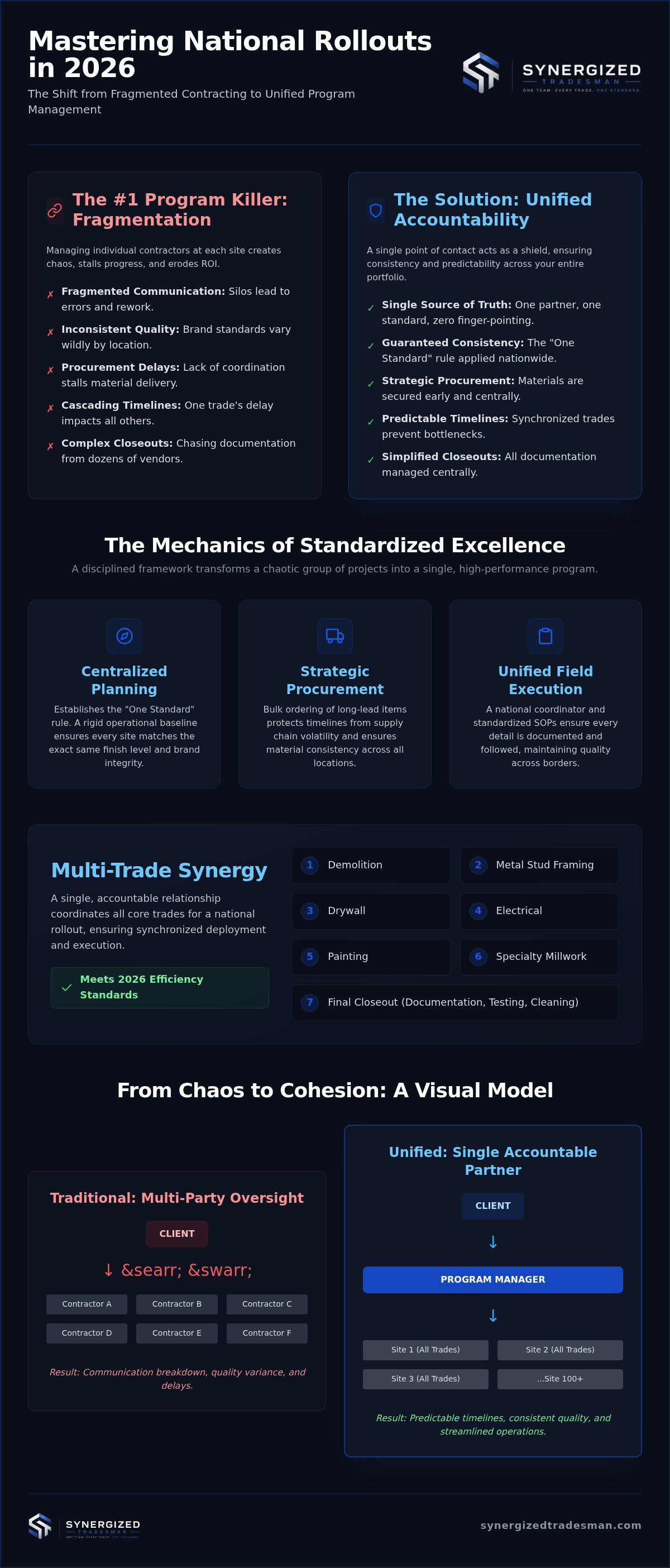
Most commercial rollouts fail because leaders manage individual contractors instead of the overarching program. You likely recognize the frustration of fragmented communication and procurement delays that stall your speed to market. It's difficult to reconcile inconsistent quality when your portfolio spans the country and every site feels like a new experiment. Effective multi-site renovation program management requires a shift toward a unified accountability model that acts as a shield for your national operations.
This article provides the framework to master national rollouts while meeting 2026 efficiency standards like the 2024 IECC and updated energy monitoring requirements. You'll learn how to secure a single point of contact for all trades, from demolition and metal stud framing to electrical and final closeout. We'll examine the strategies that deliver standardized results across your entire portfolio and ensure predictable timelines for every project phase. By moving toward a single source of truth, you can eliminate the logistical burden of multi-party oversight and focus on your core business objectives.
Key Takeaways
- Learn why a centralized oversight model is replacing traditional contractor management to handle high-volume commercial upgrades in 2026.
- Implement the "One Standard" rule to maintain consistent quality across your national portfolio and eliminate local site deviations.
- Discover how a multi-trade synergy model improves multi-site renovation program management by providing a single accountable relationship for all trades.
- Master strategic procurement techniques to secure long-lead materials early and prevent rollout delays across multiple geographic locations.
- Leverage a unified methodology to achieve predictable closeouts and meet 2026 energy efficiency standards through data-driven building management.
The Shifting Landscape of Multi-Site Renovation Program Management in 2026
Effective multi-site renovation program management functions as a centralized oversight model designed to execute high-volume upgrades across a national footprint. In 2026, the commercial sector has pivoted toward a "refresh over rebuild" strategy. High real estate costs and new regulatory standards, such as the 2024 IECC energy monitoring requirements, make retrofitting existing assets more financially viable than new construction. Traditional general contracting often fails when applied to 100 or more simultaneous locations. Local contractors lack the centralized data structures needed to maintain brand standards at scale. This gap has introduced the "single accountable relationship" as the modern construction standard, acting as a shield for clients against logistical chaos.
The Rise of the Retail Refresh and Brand Rollout
A national brand rollout differs fundamentally from a one-off renovation. While a single-site project focuses on local permits and specific site conditions, a rollout prioritizes absolute consistency across diverse geographic markets. Your customers expect the same aesthetic and functional experience in every location. Execution requires a synchronized deployment of core trades. Standard refreshes typically involve demolition, metal stud framing, drywall, painting, and specialty millwork installation. Managing these trades individually at each site creates a logistical bottleneck that slows your speed to market. By centralizing these services, you ensure that a site in one region matches the quality of a site thousands of miles away.
Why Fragmentation is the #1 Program Killer
Managing multiple trade partners per site introduces hidden costs that erode your project ROI. Communication silos between disparate teams lead to procurement errors and cascading project delays. When a flooring contractor isn't synced with the plumbing or electrical teams, timelines collapse. Fragmented management also complicates project closeout documentation. Without a single source of truth, gathering warranties, air leakage testing results, and final cleaning certificates from dozens of different vendors becomes a manual, error-prone task. A unified multi-site renovation program management model eliminates this "finger-pointing" culture. It ensures that every site meets the same rigorous standards for final delivery and compliance, providing the reliability required for high-volume demands.
Standardizing Excellence: The Mechanics of National Program Management
National scale requires a "One Standard" rule. Without a unified operational baseline, quality varies by region. Centralized planning acts as the anchor for multi-site renovation program management, ensuring that a store in the Northeast matches the finish level of a facility in the Southwest. Site-specific deviations often stem from local subcontractors interpreting plans differently. By establishing a rigid framework from the start, you eliminate these variables and maintain the integrity of your brand rollout. This organized oversight transforms a chaotic group of projects into a single, disciplined program.
Centralized Procurement and Logistics
Bulk procurement is a strategic necessity for 2026. Ordering long-lead items like specialty flooring or millwork early protects your timeline from supply chain volatility. Centralizing these orders ensures material consistency across all sites. You don't want three different shades of paint across fifty locations. Staging materials for multi-site delivery requires precise coordination between the warehouse and the field. For a deeper look at managing these moving parts, review our commercial procurement and field execution guide. This approach reduces overall costs and ensures that every trade has the exact specifications required to begin work on day one.
Field Execution: Maintaining Quality Across Borders
A national coordinator serves as the single source of truth for all field operations. This role bridges the gap between corporate headquarters and local project sites. Success depends on standardized Standard Operating Procedures (SOPs) for every trade involved. Whether it's the specific height of an ACT ceiling or the installation pattern of tile, every detail must be documented and followed. When site-specific anomalies occur, the national coordinator manages the fix without breaking the program standard. This ensures that field teams operate with speed and precision across every geographic market.
Uniform closeout procedures are the final step in maintaining standardized excellence. Corporate reporting demands clean, consistent data for every location. You need a streamlined package that includes final cleaning certificates, electrical inspections, and plumbing sign-offs. Fragmented documentation delays capital capitalization and prevents you from closing the books on a rollout. Working with a single accountable construction partner simplifies this process. It provides the transparency and facts needed to verify that every site meets your rigorous standards and complies with the latest efficiency regulations.
Accountability Models: Single-Trade vs. Multi-Trade Program Management
Choosing the right organizational structure is the most critical decision in multi-site renovation program management. The traditional "Siloed Trade" model relies on managing individual contractors for every phase of construction. This approach forces the client to act as the primary coordinator, reconciling schedules between demolition, drywall, and electrical teams. In contrast, the "Multi-Trade Synergy" model consolidates these responsibilities under a single firm. This shift eliminates the finger-pointing common in construction. When one entity is responsible for the entire scope, there's no ambiguity regarding who owns a delay or a quality deviation. You gain a single source of truth for project data, timelines, and reporting across your entire national portfolio.
The Cost of Fragmented Accountability
Fragmentation creates operational friction that local contractors can't solve. Consider the scenario where an electrical team arrives at a site only to find the metal stud framing is incomplete. If these trades are managed by different firms, the electrician bills for wait time or leaves the site, causing a cascading delay. The client absorbs these costs. Processing invoices from dozens of separate vendors also creates a massive administrative burden for your accounting department. Beyond the logistics, siloed models often result in inconsistent finishes. Different painting or flooring crews might use slightly different techniques, leading to a patchwork appearance across your locations. These small variations undermine your brand's visual identity and increase long-term maintenance costs.
The Multi-Trade Advantage
Adopting a multi-trade commercial construction model simplifies the entire project lifecycle. Synergized Tradesman manages the full sequence of work, from initial demolition and ACT ceilings to final cleaning and project closeout. This unified oversight acts as a shield for the client. We take on the burden of multi-party logistics, procurement, and field coordination so your team doesn't have to. You manage one contract and one point of contact for every trade involved in the rollout. This model ensures that project data flows seamlessly from the planning phase to execution. It provides the transparency needed to verify that every site meets the 2026 efficiency standards and remains on schedule. By centralizing accountability, you convert complex logistics into a predictable, repeatable process.
Strategic Execution: Navigating Procurement and Field Logistics at Scale
Successful multi-site renovation program management depends on a structured transition from procurement to field execution. Many national rollouts stall because logistical planning isn't synchronized with the specific trade sequence required at each site. To maintain a predictable rollout speed, your program must follow a disciplined execution lifecycle that prioritizes material readiness and real-time field data. This process transforms a series of isolated construction tasks into a repeatable manufacturing-style deployment.
- Step 1: Planning and Specification Alignment – Establish a master bill of materials to ensure all sites use identical fixtures, finishes, and hardware.
- Step 2: Strategic Procurement – Order long-lead items, such as specialty flooring and custom millwork, at least 12 to 16 weeks before the first site launch.
- Step 3: Phased Field Execution – Roll out sites in logical geographic waves or priority tiers to optimize labor resources and management oversight.
- Step 4: Real-Time Reporting – Capture daily field data to identify bottlenecks and adjust schedules across the entire program before they impact the critical path.
- Step 5: Standardized Closeout – Deliver a uniform package of warranties, photos, and compliance certificates for every location in the portfolio.
Managing Complex Multi-Trade Requirements
Execution at scale requires the precise coordination of interior trades. Metal stud framing and drywall must be completed and inspected before ACT ceilings or painting can begin. When these trades aren't managed by a single entity, the gaps between phases create dead time that extends the project duration. Integrating specialized scopes like commercial electrical and plumbing management into the primary schedule prevents the "re-work" cycles that often plague national rollouts. This synergy ensures that every trade is ready to perform as soon as the preceding phase is signed off.
The Final 10%: Closeout and Cleaning
The closeout phase is where most national programs lose momentum. Without a standardized process, gathering the necessary documentation for dozens of sites becomes a manual administrative burden. For retail environments, the final impression is defined by professional post-construction cleaning. This step is a trade requirement, not an afterthought. A comprehensive closeout package must include final cleaning certificates, manufacturer warranties, and high-resolution completion photos. This data provides the transparency needed for corporate reporting and asset capitalization. If you're ready to stabilize your rollout schedule, contact a national multi-site renovation specialist to discuss your 2026 program goals.
Unified Program Delivery: The Synergized Tradesman Methodology
The Synergized Tradesman methodology centers on a single accountable relationship for the entire project lifecycle. This approach provides a stabilizing force for organizations managing high-volume, national rollouts. By functioning as a single source of truth, the firm eliminates the coordination gaps that typically occur between disparate trade partners. Our multi-site renovation program management model is built to protect your brand integrity through a "one standard" rule. This ensures that every facility in your portfolio reflects the same level of finish and operational compliance, regardless of its geographic location.
A strategic advantage of our model is our status as a certified women-owned commercial construction firm (WBE). This certification allows procurement departments to meet diversity spend goals while securing high-level construction expertise. We deliver end-to-end phases including planning, procurement, execution, and closeout. Our core trade offerings are integrated into a single workflow to maintain momentum:
- Demolition and site preparation
- Metal stud framing and drywall
- ACT ceilings and specialty installations
- Painting, wallcovering, and flooring
- Electrical and plumbing systems
- Millwork and fixture installation
- Final cleaning and project closeout
Pragmatic Management for High-Volume Demands
Our management style is fundamentally pragmatic. We don't rely on marketing fluff; we focus on tangible outputs and disciplined execution. The firm acts as a direct extension of your internal team, taking on the logistical burden of multi-party oversight. Transparency is a core requirement for national programs. We provide factual, data-driven reporting that allows your leadership to track progress across the entire program. This organized oversight offers a sense of relief for clients who are often overwhelmed by the complexity of managing 100 or more simultaneous sites. We operate under a rigorous set of standards to ensure that every trade performs to your exact specifications.
Getting Started: Scaling Your Renovation Program
Scaling a renovation program requires a customized roadmap. Our initial consultation process focuses on identifying the specific needs of your rollout, from material lead times to geographic priority waves. We build a comprehensive plan that aligns with 2026 efficiency standards and your internal capital timelines. This strategic planning phase ensures that once the program begins, the field execution moves with a deliberate, controlled rhythm. We handle the burden of logistics so you can focus on your core business objectives. If you're ready to move away from fragmented management and toward a unified accountability model, it's time to streamline your national rollout with Synergized Tradesman.
Stabilize Your National Rollout Strategy
National expansion requires more than just speed; it demands a disciplined framework that eliminates logistical friction. Success in 2026 hinges on your ability to maintain absolute consistency across every geographic market while meeting new energy and monitoring standards. By adopting a "One Standard" rule, you prevent the local site deviations that typically erode project ROI. This unified approach to multi-site renovation program management transforms complex construction into a predictable, repeatable lifecycle.
Consolidating your trade partners into a single accountable relationship simplifies billing and ensures that project data flows seamlessly from planning to final closeout. As a certified women-owned business (WBE), Synergized Tradesman provides the nationwide multi-trade execution needed to shield your team from the burdens of procurement and field coordination. You don't have to manage dozens of vendors to achieve a high-quality finish across your entire portfolio.
Partner with Synergized Tradesman for your next national rollout and secure a single source of truth for your renovation goals. We're built for high-volume demands and committed to delivering standardized results every time. Let's build a rollout plan that meets your 2026 objectives.
Frequently Asked Questions
What is multi-site renovation program management?
It's a centralized oversight model for high-volume upgrades across multiple locations. It treats a series of renovations as a single program rather than isolated projects. This approach ensures brand consistency and operational efficiency by using a unified management structure. It's built for national rollouts where speed and standardized quality are the primary objectives. By centralizing leadership, organizations can maintain control over their entire portfolio from a single hub.
How does a single accountable relationship improve rollout speed?
A single accountable relationship eliminates the communication gaps between disparate trade partners. When one firm manages the entire scope, they coordinate the transition between phases like demolition, framing, and electrical. This prevents the wait time common when managing multiple contractors. Decisions happen faster because there's only one point of contact for the client. This model reduces the administrative burden and accelerates the project lifecycle, ensuring faster speed to market for national rollouts.
Why is multi-trade coordination important for retail refreshes?
Retail refreshes often require simultaneous work from several trades in a condensed timeline. Multi-trade coordination ensures that the flooring team isn't waiting for the painting crew to finish. It prevents re-work and scheduling conflicts that lead to site downtime. By synchronizing trades like millwork, fixtures, and specialty installations, the program manager can guarantee a faster return to normal business operations. This synchronization is essential for maintaining brand integrity during high-speed deployments.
What is included in a standard project closeout package?
A comprehensive closeout package provides the documentation needed for corporate reporting and asset capitalization. It typically includes manufacturer warranties, final inspection reports, and high-resolution completion photos. For 2026, it also includes air leakage testing results and final cleaning certificates. This uniform package ensures that every site in the portfolio meets the same rigorous standards for final delivery and compliance. It allows the client to close the books on the program with complete transparency.
Can multi-site programs be managed nationally without local offices?
Yes, multi-site renovation program management is designed for national execution through a centralized hub. A national coordinator manages field teams across the country using standardized SOPs and real-time reporting. This model ensures that brand standards are upheld without the overhead of physical local offices. It relies on a "One Standard" approach to quality control that applies to every site regardless of its geographic market. This centralized oversight acts as a stabilizing force for national operations.
How do you ensure consistent quality across different geographic sites?
Consistency is maintained through a rigid framework of centralized planning and standardized SOPs. Every field team follows the same specifications for materials and installation techniques. Centralized procurement ensures that all sites use identical finishes, such as paint colors and tile patterns. Regular field data reporting allows the national manager to verify quality in real-time. This prevents local site deviations from the established brand guidelines and ensures a uniform customer experience across the entire national footprint.
What trades are typically included in a multi-trade renovation?
Multi-trade renovations cover the full sequence of interior construction. Standard programs include demolition, metal stud framing, drywall, and ACT ceilings. They also integrate painting, wallcovering, flooring, and tile work. More complex rollouts incorporate electrical and plumbing systems along with millwork and specialty fixture installation. The process concludes with professional post-construction cleaning to prepare the environment for immediate occupancy. Consolidating these trades under one manager eliminates the finger-pointing common in fragmented construction models.
How does centralized procurement affect project timelines?
Centralizing procurement protects the project timeline from supply chain volatility. By ordering long-lead items like specialty flooring or custom millwork 12 to 16 weeks in advance, the manager ensures materials are staged and ready for delivery. This prevents the delays that occur when local contractors struggle to source specific brand-standard materials. It stabilizes the schedule across all locations, ensuring every site launches on time and meets the strategic goals of the national rollout.


