

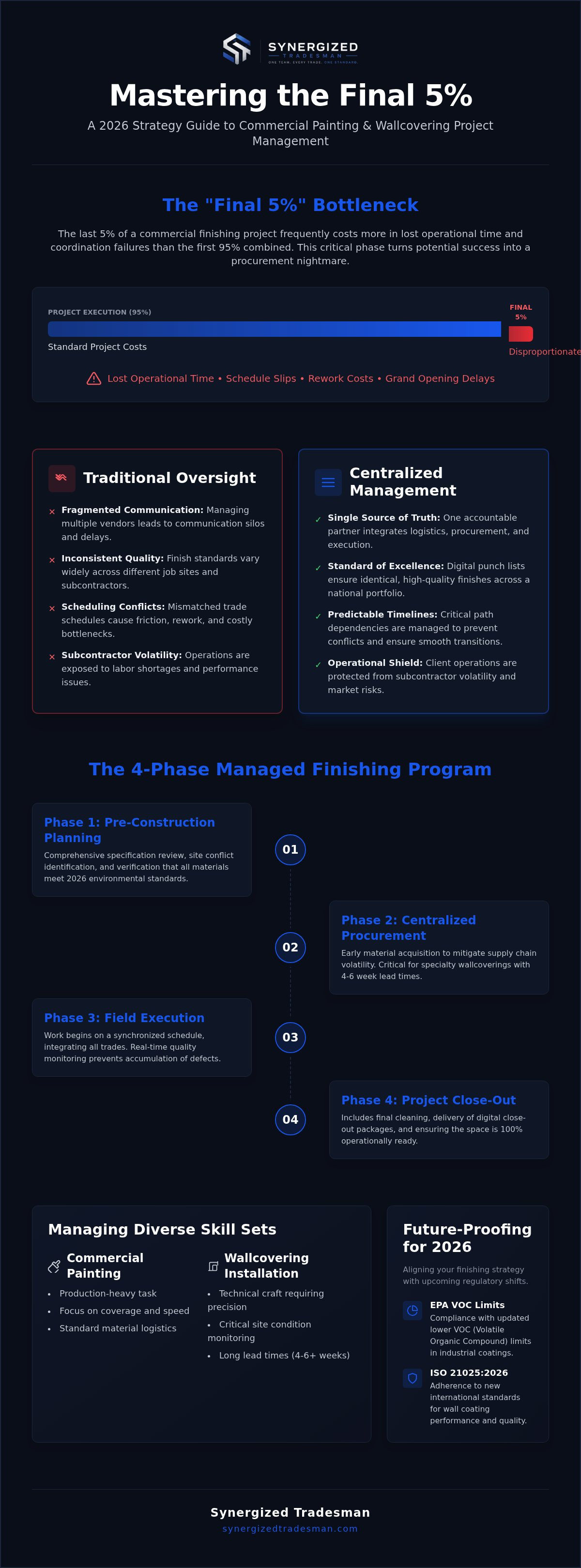
The final 5% of a commercial finish often costs more in lost operational time than the previous 95% combined. You've likely experienced the frustration of managing mismatched schedules between drywallers and electricians while watching a retail grand opening date slip away. It's a logistical bottleneck that turns a standard refresh into a procurement nightmare. Effective commercial painting and wallcovering project management ensures that inconsistent finish quality across different job sites isn't the accepted price of doing business at scale.
This 2026 strategy guide provides a framework for centralized accountability to eliminate coordination headaches and ensure standardized quality across your national portfolio. We examine how a single source of truth model simplifies multi-party logistics and prepares your operations for new EPA VOC regulations and ISO standards. Master the final stages of your project through a disciplined, management-focused architecture that delivers predictable timelines and reliable results every time.
Key Takeaways
- Transition from trade-level oversight to a centralized management framework to eliminate the common "final 5%" project delays.
- Identify critical path dependencies between metal stud framing, drywall, and finishing to prevent costly rework and scheduling conflicts.
- Establish a universal "Standard of Excellence" using digital punch lists to ensure identical finish quality across a national portfolio.
- Utilize commercial painting and wallcovering project management as a single source of truth to shield your operations from subcontractor volatility.
- Align your finishing strategy with 2026 regulatory shifts, including updated EPA VOC limits and new ISO standards for interior coatings.
Defining the Scope of Commercial Painting and Wallcovering Project Management
A painting contractor executes a specific scope of work; a project management firm engineers the delivery of that scope within a complex construction environment. Understanding commercial painting and wallcovering project management requires looking past the application of coatings to the logistics that support them. This discipline serves as the stabilization of multi-trade logistics. It transforms finishing from a series of isolated tasks into a controlled, predictable phase of construction.
The master coordinator acts as the single source of truth for the project. They integrate procurement, site logistics, and field execution into a unified workflow. This model eliminates the communication silos that typically occur when trades work in isolation. Instead of managing multiple vendors across various job sites, clients rely on a single accountable relationship to maintain standards. This "shield" concept protects the client from subcontractor volatility and ensures that the final 5% of the project doesn't become a bottleneck for the grand opening.
The Strategic Value of Integrated Management
Facility managers often face the burden of micro-managing individual trade schedules. Integrated management centralizes this oversight to reduce administrative strain. It ensures that material procurement aligns with the broader construction timeline, preventing delays caused by late deliveries or out-of-stock specifications. By managing painting alongside drywall and flooring, the project manager creates a seamless transition between trades. This oversight reduces friction and protects the final finish from damage by subsequent contractors. It also ensures compliance with 2026 standards, such as the new EPA regulations for lower VOC limits in industrial coatings and ISO 21025:2026 for wall coating performance.
Wallcovering vs. Painting: Managing Different Skill Sets
Commercial finishing programs often require both high-volume painting and specialized wallcoverings. Painting is a production-heavy task focused on coverage and speed. Wallcovering installation is a technical craft requiring precision with vinyl, fabric, or acoustic materials. Managing these different skill sets requires distinct logistical approaches. The project manager must coordinate specialized installers within the general painting schedule to avoid labor overlaps.
Success depends on monitoring critical site conditions. Project managers track humidity levels and surface temperatures to ensure optimal adhesion for commercial-grade materials. Wallcoverings often have longer lead times and higher material costs than standard paint. Rigorous oversight during the procurement phase prevents installation delays. It ensures that specialized labor is on-site exactly when the environment meets the technical requirements for a permanent, high-quality bond.
The Lifecycle of a Managed Commercial Finishing Program
Success in large-scale finishing depends on a repeatable, phase-based framework. A managed program moves beyond the reactive "bid and paint" model. It uses a structured lifecycle to maintain control over budgets and timelines. Effective commercial painting and wallcovering project management breaks the process into four distinct phases. This ensures that every stakeholder understands the critical path from pre-construction to the final punch list.
- Phase 1: Pre-construction planning. This involves a comprehensive specification review. We verify that all materials meet 2026 environmental standards, such as the lower VOC limits mandated by the EPA.
- Phase 2: Centralized procurement. Logistics teams secure materials early to mitigate supply chain volatility. This is critical for specialty wallcoverings with extended lead times.
- Phase 3: Field execution. Crews begin work according to a synchronized schedule. Real-time quality monitoring prevents the accumulation of defects.
- Phase 4: Project close-out. This phase includes final cleaning and the delivery of digital close-out packages. It ensures the space is operationally ready for its intended use.
Planning and Procurement Standards
The pre-construction phase identifies potential site conflicts before crews arrive. We review brand standards to ensure paint specifications are consistent across your entire national portfolio. Procurement teams verify material lead times for specialty wallcoverings, which often require four to six weeks for delivery. Standardizing these inputs allows for a predictable rollout. If you are managing a high-volume refresh, centralizing your procurement through a single partner eliminates the risk of local stock shortages stalling your timeline. This phase establishes the "single source of truth" that guides the project through every subsequent milestone.
Field Execution and Oversight
Field oversight requires more than site visits. It demands daily reporting protocols and rigorous progress tracking. We manage crew scaling to meet the aggressive demands of retail grand openings. This involves adjusting labor levels in real-time based on site readiness. The Synergized Tradesman standard for field execution prioritizes accountability. Every crew follows a uniform protocol for surface preparation and application. This consistency ensures that the quality delivered at one facility matches the results across every other site in the program. Digital punch lists allow for real-time deficiency correction, ensuring that commercial painting and wallcovering project management remains focused on finishing the final 5% of the project without delay.
Navigating Multi-Trade Coordination and Site Logistics
Effective commercial painting and wallcovering project management requires a deep understanding of the construction sequence. Finishing isn't a standalone event. It's the culmination of multiple preceding trades. The critical path for any high-quality finish begins with metal stud framing and drywall contractors. If the substrate isn't perfectly level or the joints aren't seamless, the final coating or wallcovering will highlight every imperfection. We act as the oversight layer that verifies substrate readiness before our crews mobilize.
Coordination extends to mechanical, electrical, and plumbing (MEP) systems. We synchronize our schedules with commercial electrical and plumbing management teams to ensure wall plates and fixtures are timed correctly. Painting before electrical rough-ins often leads to rework. Painting after final trim-out risks damaging expensive hardware. Managing vertical mobility is another logistical hurdle. We coordinate the use of scissor lifts, boom lifts, and scaffolding to ensure finishing crews have access without blocking the movement of other trades. This oversight prevents site congestion that often leads to safety incidents and timeline slippage.
Avoiding Trade Interference
Strategic sequencing is the only way to prevent trade interference. We ensure finishing begins only after professional commercial demolition services have cleared the site and structural work is stable. Protecting the client's investment means shielding newly installed flooring and millwork from overspray or adhesive spills. We implement strict protection protocols, using heavy-duty floor coverings and precise masking techniques. These barriers remain in place until the final cleaning phase to ensure the space is pristine for the grand opening. This proactive coordination avoids the friction where trades often damage each other's work during the final push.
Site Preparation and Protection Protocols
Standardizing surface preparation is a core component of commercial painting and wallcovering project management. We verify whether the project requires a Level 4 or Level 5 drywall finish based on the specified wallcovering or lighting conditions. High-sheen finishes and direct sunlight demand a Level 5 skim coat to prevent "photographing" of seams. Dust control is a non-negotiable requirement, especially in active retail or office environments. We use HEPA-filtered sanding equipment and temporary containment barriers to maintain air quality and site safety. This disciplined approach ensures compliance with national safety standards while keeping the project on its projected timeline without compromising the health of other on-site personnel.
Quality Assurance and Standardization Across National Portfolios
National retail rollouts require more than local oversight. They demand a universal "Standard of Excellence" that transcends geographic boundaries. We establish this through a centralized commercial painting and wallcovering project management model. Every project site follows identical protocols for substrate preparation and finish application. This ensures brand-accurate color matching and perfect wallcovering alignment regardless of the local labor market. We utilize digital punch lists to identify and correct deficiencies in real-time. This technological oversight allows project managers to verify work quality remotely and provide immediate feedback to field crews. It prevents the accumulation of minor errors that can delay a grand opening.
The project manager is the critical link in commercial construction project coordination. They verify that site-specific conditions don't compromise the national standard. For example, they monitor environmental factors like temperature and humidity which can affect paint cure times or wallpaper adhesive. By maintaining a single source of truth, we ensure that every technician on-site understands the exact specifications for the project. This level of oversight is particularly important when managing high-volume rollouts where consistency is the primary metric of success.
Standardizing the Close-out Process
Project completion involves more than applying the final coat. We develop comprehensive close-out packages for all stakeholders. These documents include color schedules, maintenance guides, and digital copies of all warranties. Our process also integrates final cleaning requirements to ensure immediate occupancy. We coordinate the removal of all construction debris and the deep cleaning of finished surfaces. Managing warranties and post-project support centrally provides a streamlined path for facility managers to address future needs. This disciplined approach guarantees that the project is operationally ready on day one.
KPIs for Commercial Painting Management
Data-driven oversight is essential for maintaining portfolio-wide quality. We track schedule variance and budget adherence as primary indicators of project health within our commercial painting and wallcovering project management framework. Monitoring safety incident rates and compliance ensures that every site operates under strict national standards. We also measure the accuracy of material usage against initial estimates to refine future procurement strategies. Partnering with a WBE-certified firm like Synergized Tradesman allows corporations to meet diversity spending goals while maintaining the highest levels of operational excellence.
Contact us today to standardize your national finishing program.
Streamlining Rollouts with a Single Accountable Partner
Transitioning from a fragmented vendor list to a single source of truth simplifies the most complex variables of a renovation. This is the "Shield" concept. It protects clients from the volatility of local labor markets and subcontractor disputes. By utilizing commercial painting and wallcovering project management as a centralized service, you eliminate the risk of trade-on-trade conflict. This single accountable relationship replaces the chaos of managing dozens of individual contracts across different time zones. It provides a stabilizing force that ensures your project remains on track regardless of local site conditions.
Adopting a multi-trade commercial construction model saves significant time during the transition from rough-in to finish. When one partner manages drywall, painting, and flooring, the handoff between phases is instantaneous. This coordination leverages national procurement power to ensure material cost stability. We secure bulk pricing and guaranteed availability for premium paints and vinyl wallcoverings, shielding your budget from the sudden price spikes often seen in local procurement. This management-first architecture ensures that your capital is deployed efficiently across the entire project lifecycle.
Efficiency in Retail Refresh Programs
High-volume rollouts demand a strategy that respects your operational hours. We specialize in managing overnight or after-hours execution to ensure zero business disruption. Our framework is built to scale resources for 50+ store rollouts simultaneously. We maintain identical standards from the first flagship store to the final regional location. This ensures that your brand identity remains cohesive across the entire national portfolio. By centralizing the communication flow, we provide real-time updates that allow your team to focus on operations rather than vendor management.
The Synergized Tradesman Advantage
We provide pragmatic, results-oriented management for complex renovations. Our team prioritizes operational transparency and factual reporting over vague progress updates. We act as your strategic partner, ensuring that every trade remains aligned with your 2026 project goals. This disciplined approach delivers a predictable outcome for every site we touch. We're built for high-volume demands and committed to rigorous standards and compliance across every trade we manage.
Schedule a briefing for your 2026 rollout program to see how centralized oversight stabilizes your finishing timeline.
Stabilizing Your 2026 Finishing Strategy
Mastering the final phase of a commercial renovation requires a shift from vendor management to strategic oversight. Successful programs prioritize the critical path between drywall readiness and coating application to eliminate the "final 5%" project delay. By centralizing commercial painting and wallcovering project management, you ensure that every site in your national portfolio meets a universal standard of excellence. This framework provides the predictability needed for aggressive retail grand openings and facility refreshes. It moves beyond a reactive bidding model into a disciplined, proactive lifecycle that accounts for current ISO standards and EPA regulations.
Streamline your next multi-trade project with Synergized Tradesman. Our model provides WBE-certified accountability and national rollout expertise to protect your timelines from subcontractor volatility. We handle the complexities of single-source project coordination so your team can focus on operational success. Transition your 2026 rollout program into a controlled, repeatable process that delivers standardized quality across every square foot. We look forward to helping you master your next large-scale project.
Frequently Asked Questions
What is the difference between a commercial painter and a painting project manager?
A commercial painter focuses strictly on the application of coatings to surfaces. In contrast, a project manager engineers the entire logistics chain. The manager handles procurement, manages site access, and aligns the finishing schedule with other trades. They act as a single source of truth for the client. This oversight eliminates the communication silos that often occur when dealing with individual trade contractors and prevents administrative delays.
How do you coordinate painting with other trades like electrical and flooring?
Coordination relies on a synchronized master schedule that accounts for trade dependencies. We sequence painting after electrical and plumbing rough-ins are complete but before final trim-out or flooring installation. This prevents damage to new fixtures and finishes. We manage the critical path between metal stud framing, drywall, and finishing to ensure no trade interferes with the progress of another. This disciplined sequencing protects the client's investment.
Can you manage wallcovering installations for national retail rollouts?
Yes, we provide end-to-end management for high-volume wallcovering rollouts across the United States. Our commercial painting and wallcovering project management model ensures that every facility follows identical standards for substrate preparation and adhesion. We coordinate specialized labor and manage lead times for branded materials centrally. This ensures that your brand identity remains consistent across every store in the rollout program regardless of the number of locations.
How is quality controlled across multiple locations in different states?
Quality is controlled through a centralized management framework and a universal Standard of Excellence. We utilize digital punch lists to identify and correct deficiencies in real-time across all project sites. This oversight ensures that every facility in your national portfolio meets identical brand specifications regardless of the local labor pool. By maintaining a single source of truth, we ensure uniform execution and finish quality for every location.
What documentation is included in the project close-out package?
A project close-out package includes all essential documentation for long-term facility management. This typically consists of digital copies of warranties, color schedules, maintenance guides, and final inspection reports. We also provide photo documentation of the completed surfaces. This package ensures that stakeholders have factual data for future upkeep and confirms that the project meets all 2026 regulatory and brand standards. It provides a permanent record of compliance.
How do you handle procurement for specialized or branded wallcoverings?
We leverage national procurement power to secure specialized materials and stabilize costs. Our team tracks lead times for branded or specialty wallcoverings, often securing materials weeks in advance to mitigate supply chain issues. By centralizing procurement, we ensure that the correct specifications are on-site when technical conditions are optimal for installation. This prevents local stock shortages from impacting your national rollout timeline and ensures your materials meet the project schedule.
What are the benefits of working with a WBE-certified construction management firm?
Working with a WBE-certified firm like Synergized Tradesman helps corporations meet diversity spending goals while ensuring operational excellence. We provide a single accountable relationship for multi-trade projects, which simplifies the procurement process. You receive the benefit of national service coverage and a centralized management model. Our certification reflects a commitment to rigorous standards and disciplined project execution across all trades. This partnership supports both corporate responsibility and project quality.
How do you minimize business disruption during a commercial refresh?
We minimize disruption by focusing on overnight or after-hours execution. This allows your business to remain operational during a refresh without impacting the customer experience. Our commercial painting and wallcovering project management includes strict containment protocols to manage dust and odors effectively. This disciplined approach ensures the site remains pristine and safe for employees and patrons throughout the duration of the project. We prioritize speed and cleanliness to return your space to full use quickly.


