

What if every location could meet the same brand standard without following the exact same project plan? Finding commercial retail refresh contractors that coordinate multiple trades and maintain consistent finishes across stores is essential when work must also fit each location’s operating realities.
Coordinating demolition, construction, finishes, fixtures, and building systems across multiple sites can create gaps in communication and accountability. Store conditions differ, too. A practical approach sets shared quality expectations, then adapts the field plan to each location. That means documenting site constraints and sequencing work around store operations before crews begin.
Synergized Tradesman manages retail refreshes and rollout programs through one accountable relationship, coordinating planning, procurement, field execution, and close-out. This guide explains how to organize each project phase, align trade work with brand standards, and account for site-specific needs. You’ll also find examples of project oversight and close-out information that can help keep a multi-location refresh on track.
Key Takeaways
- Separate portfolio-wide standards from store-level decisions so consistent finishes can accommodate each location’s conditions.
- Use scope documentation to connect deliverables, trade interfaces, and site-specific requirements before field work begins.
- Prepare for coordinated execution by defining program objectives, locations, priorities, approvals, and close-out needs.
- Commercial retail refresh contractors can organize work from scope and procurement through inspections and close-out.
- Align finishes, fixtures, electrical, plumbing, and cleaning requirements with the refresh plan so each location’s needs are clear.
What Commercial Retail Refresh Contractors Coordinate, and Why Accountability Matters
A commercial retail refresh updates an existing store and its customer-facing elements through planned construction work. The scope might include replacing flooring, repainting walls, updating ceilings, installing millwork or fixtures, adjusting electrical or plumbing elements, and completing final cleaning. Because the work takes place in an existing commercial building, the plan must account for current conditions as well as the intended updates.
A retail refresh is a coordinated update to an operating portfolio or individual store, managed across trades and project phases with clear ownership of the work. That coordination distinguishes it from new-store construction, which starts with a new space, and from a one-off renovation, which addresses a single location without necessarily following a broader rollout standard.
When does a retail refresh become a multi-trade project?
A refresh becomes multi-trade when different kinds of work share a space or depend on one another. Replacing a sales-floor fixture, for example, may require demolition, flooring repairs, electrical adjustments, and finish touch-ups. A ceiling update may also affect lighting or other utilities. Even a modest scope needs a clear sequence when tasks overlap.
Sequencing clarifies where one trade’s work ends and another’s begins. Flooring may need to be completed before fixtures are installed, while painting may follow wall repairs. Without a planned handoff, crews can obstruct each other or completed work may need to be revisited. Commercial retail refresh contractors coordinate both the individual tasks and the points where they connect.
A recurring portfolio program differs from a single-store improvement because it applies a shared project framework across locations. A one-off project may focus on a specific store need. A rollout also requires repeatable expectations, while allowing each site’s existing conditions and scope to shape its plan.
What does one accountable relationship change?
Centralized coordination gives decision-makers a clearer route for information from planning and procurement through field execution and close-out. Rather than managing disconnected conversations for each phase, the client has one relationship responsible for coordinating the work and explaining how trades and deliverables fit together. This makes it easier to understand who is managing questions about scope, handoffs, or completion records.
Accountability means defined responsibility, not a promise that every location will have identical conditions or that project outcomes are guaranteed. It means coordination has an owner who can track decisions, align trade interfaces, and keep project requirements visible through close-out. Store-level planning can still reflect differences in existing finishes, fixtures, utilities, and approved scope.
For a wider view of how retail construction fits into planning and delivery decisions, consult this retail store construction strategic guide. The broader context helps clarify where a refresh program sits alongside other construction work. For a foundational overview of the building type itself, see Commercial Building.
How Commercial Retail Refresh Contractors Move from Scope to Store Close-Out
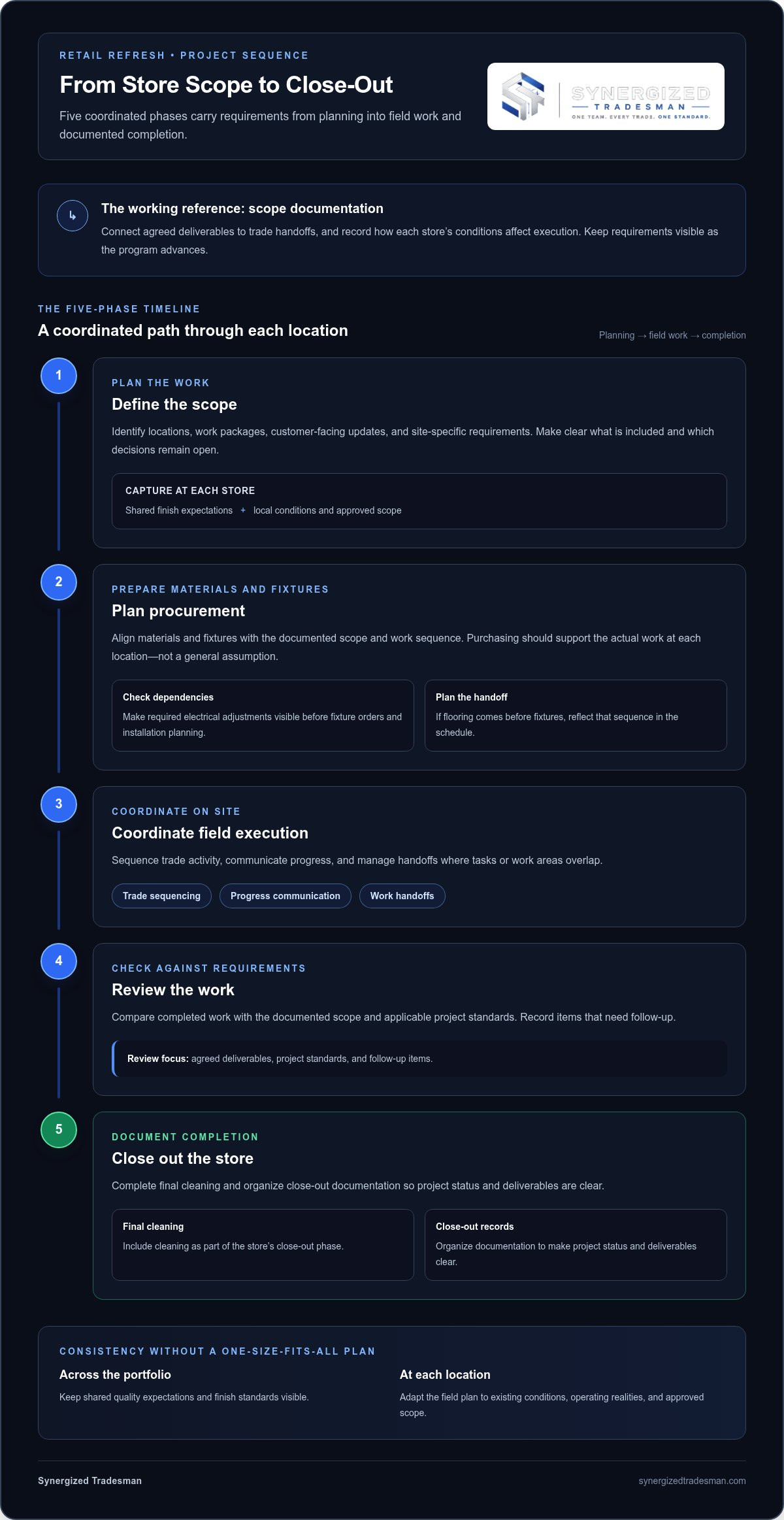
A coordinated refresh follows a defined sequence so planning decisions carry through to field work and completion. Scope documentation is the working reference: it connects agreed deliverables to trade handoffs and records how each location’s conditions affect execution. Commercial retail refresh contractors use this foundation to organize project phases and keep requirements visible as the program advances.
- Define the scope. Identify the locations, work packages, customer-facing updates, and site-specific requirements. Record what is included and which decisions remain open.
- Plan procurement. Align materials and fixtures with the scope and work sequence. This connects purchasing decisions to installation dependencies.
- Coordinate field execution. Sequence trade activity, communicate progress, and manage handoffs where work areas or tasks overlap.
- Review the work. Compare completed work with the documented scope and applicable project standards. Record items that need follow-up.
- Close out the store. Complete final cleaning and organize close-out documentation so project status and deliverables are clear.
How should scope and procurement connect?
Translate program-level requirements into defined work packages, then record what changes at each location. A shared finish expectation may apply across stores, while the amount of flooring, fixture installation, or electrical work varies by site. Capture both in the scope so procurement supports the actual work rather than a general assumption.
Dependencies should inform the purchasing sequence. If new fixtures rely on electrical adjustments, make those requirements visible before materials are ordered and installation is planned. If flooring must be completed before fixtures are set, reflect that handoff in the schedule. Flag open selections, site conditions, and unresolved trade interfaces early. This gives the team a clear basis for planning and reduces avoidable uncertainty in the field.
What belongs in field execution and close-out?
Field execution turns the documented plan into coordinated trade activity. The project team aligns work areas, tracks progress, communicates relevant changes, and manages the sequence of demolition, finishes, fixtures, electrical, plumbing, and other scoped tasks. Clear handoffs matter: crews need to know when preceding work is ready and what must be completed before the next activity begins.
Quality review should use the defined scope and project standard as its reference, rather than an informal impression of whether the store looks finished. Close-out brings the work to a documented endpoint. Final cleaning prepares the space after construction activity, while close-out records capture completion status and any remaining items for resolution. Together, these steps give decision-makers a clearer view of what was delivered at each location.
Synergized Tradesman coordinates retail refresh programs from planning through procurement, field execution, and close-out. To see how this coordination approach connects project phases, explore Synergized Tradesman’s project coordination approach.
How Refresh Contractors Balance Portfolio Consistency with Store-Level Conditions
A multi-location refresh needs shared expectations, but stores rarely begin in identical condition. One location may need new flooring and fixtures, while another requires additional wall or ceiling work before the same finish standard can be applied. Commercial retail refresh contractors can maintain portfolio consistency by documenting what must remain uniform and planning separately for the conditions that vary.
Consistent standards define the expected result; they don’t require every store to have identical conditions or an identical scope. This distinction gives teams a common basis for quality reviews without forcing a one-size-fits-all work plan.
| Program-wide standards | Location-level conditions and decisions |
|---|---|
| Approved finish and fixture expectations | Existing finishes, fixtures, and surfaces that affect installation |
| Shared scope definitions and deliverable requirements | Work needed at that store to meet the defined scope |
| Common installation expectations and review points | Trade sequencing shaped by site conditions and work interfaces |
| Consistent criteria for documenting completion | Location-specific items requiring resolution or close-out notes |
Which controls help keep refresh work consistent?
Start with shared scope definitions, written finish and installation expectations, and agreed review points. These controls show project teams what the work should include and how completed items will be assessed. For example, documenting the expected flooring transition or fixture placement makes the review less dependent on informal interpretation.
Clear records also support repeatable execution across locations. They help distinguish an intentional site-specific adjustment from a departure from the program standard. That distinction matters when teams review work at different stores or hand off responsibilities between project phases.
How should a program handle site-specific differences?
Separate fixed requirements, such as approved finishes or fixture expectations, from decisions shaped by existing conditions. A store with a different ceiling layout may need a distinct field plan, even when the intended customer-facing standard matches other locations. Document the reason for the variation and how it affects the scoped work.
Field coordination can surface conflicts before they disrupt planned work. A fixture installation, for instance, may intersect with existing electrical or plumbing elements. Identifying that interface early helps the team clarify sequencing and site-level decisions. This makes adaptation visible instead of allowing differences to emerge as undocumented changes during execution. For broader context on ownership and coordination across trades, see the multi-trade commercial construction accountability model.
Applied consistently, these controls create a practical balance: portfolio standards guide quality reviews, while site-specific planning reflects what each store requires. Teams can compare work against a shared reference without mistaking different conditions for inconsistent execution.
How to Prepare a Retail Refresh Program for Coordinated Contractor Execution
A useful refresh brief gives the project team a clear starting point before scope moves into procurement and field planning. It identifies what the program is intended to change, which locations are involved, what needs to stay consistent, and where stores require different plans. This preparation helps commercial retail refresh contractors turn business priorities into defined work instead of relying on assumptions to fill gaps.
What information should a refresh brief contain?
Record the program’s goals and intended work, then describe each location and known site constraints. Identify customer-facing finishes and fixtures, along with any electrical or plumbing work in scope. State which requirements apply across the portfolio and which depend on an individual store’s existing conditions.
- Program objectives and the locations included
- Planned work by location, including finishes, fixtures, and utilities
- Sequencing priorities based on each store’s operating requirements
- Known site conditions that may affect trade work or installation
- Approvals required and decisions that still need internal alignment
- Close-out needs, including the completion information the team expects to receive
Separate confirmed scope from open decisions. A finish may be selected across the program while a location’s fixture requirements still need internal review. Marking that distinction helps the team understand what can be planned and what remains unresolved, without treating assumptions as approved direction.
How can teams prepare for clear project oversight?
Assign a decision-maker for each key area: scope, procurement, field questions, and acceptance of completed work. These roles can sit with different people, but ownership should be explicit. A defined communication path also helps route project updates and bring issues to the person who can make or obtain a decision.
Sequencing priorities should reflect each location’s operating requirements. Clarify which areas or customer-facing elements take priority, what site constraints affect access to the work, and which tasks depend on others. That context helps shape a location-level plan while the program’s core requirements remain consistent.
- Name the person responsible for each project decision area.
- Set a clear route for updates, questions, and issue escalation.
- Use a shared close-out checklist to define required completion documentation.
Planning summary: define the goal, list the stores, document the scope, identify priorities and constraints, assign decision-makers, and specify close-out needs. This concise brief gives internal stakeholders and the project team a shared reference before work advances.
Synergized Tradesman coordinates retail refresh programs from planning through procurement, field execution, and close-out. Explore coordinated retail refresh execution to see how this project approach can support a clearly prepared program.
How Synergized Tradesman Delivers Commercial Retail Refresh Projects
Synergized Tradesman manages commercial retail refreshes and rollout programs through one accountable relationship. That relationship connects planning, procurement, field execution, and close-out, giving the client a coordinated path through the project rather than separate conversations for each phase. As commercial retail refresh contractors, the team aligns the work with the defined scope and conditions at each location.
This approach brings related decisions together. Procurement can follow the work sequence, trade handoffs can be coordinated against the scope, and close-out can address the project’s completion needs. Each location receives execution planning suited to its requirements. A shared standard guides the work, while the actual scope determines which trades are involved.
How does multi-trade coordination support refresh delivery?
Retail refresh work can bring several construction and finish activities together. Coordinating them under one relationship helps organize interfaces, such as the handoff between flooring work and fixture installation, or between electrical adjustments and customer-facing finishes. The specific package is shaped by the project, so not every refresh requires every trade.
Synergized Tradesman’s capabilities connect to common work packages, including:
- Space preparation: demolition, metal stud framing, and drywall.
- Interior finishes: painting and wallcovering, ACT ceilings, flooring, and tile.
- Store elements: millwork, fixtures, and specialty installation.
- Building systems: electrical and plumbing work within the project scope.
- Completion: final cleaning and project close-out.
Organizing these capabilities around the approved scope gives the project team a clearer view of dependencies and responsibilities. It connects planning decisions to field execution and completion requirements.
What does a consistent standard mean across projects?
A consistent standard means applying clear expectations for coordination and quality across projects. It gives teams a common reference for how scoped work should be carried out and reviewed. It does not mean treating every store as if its existing finishes, utilities, layout, or required work were identical.
Synergized Tradesman plans execution around project conditions while maintaining a consistent approach to coordination from planning through close-out. This balance supports portfolio-level alignment without overlooking location-specific needs. Synergized Tradesman is a certified women-owned commercial construction firm.
For coordinated planning, procurement, field execution, and close-out for a retail refresh program, discuss a commercial retail refresh program with Synergized Tradesman.
Set Your Retail Refresh Program Up for Its Next Phase
Your next step is to turn portfolio priorities into a clear execution brief. Bring together the location list, the work each store needs, the standards that should carry across the program, and the decisions that still require internal alignment. This gives project planning a practical starting point and keeps site-specific needs visible as the scope develops.
Synergized Tradesman is a certified women-owned commercial construction firm that provides one accountable relationship from planning through close-out, with multi-trade coordination across commercial construction and renovation work. When evaluating commercial retail refresh contractors, focus on clear ownership and a workable path from program objectives to store-level execution.
Define the priorities for your locations, then set the coordination in motion. Discuss your commercial retail refresh program with Synergized Tradesman and take a clear next step toward planning your rollout.
Frequently Asked Questions
What does a commercial retail refresh contractor do?
A commercial retail refresh contractor coordinates construction updates to existing retail spaces, with the specific work shaped by each project’s scope. Updating a sales area, for example, may involve removing an existing fixture, preparing the surrounding surfaces, and installing replacement finishes or fixtures. Commercial retail refresh contractors also organize related decisions and trade handoffs, helping the team understand how individual tasks fit into the broader project.
How is a retail refresh contractor different from a general commercial contractor?
The difference is mainly the project focus and coordination needs. Retail refresh work centers on updating existing customer-facing spaces, while commercial construction can span a wider range of project types and building work. A retailer planning updates across a portfolio may need shared expectations alongside store-specific plans. The key is whether the delivery approach fits the work, locations, and coordination requirements the program involves.
Can retail refresh work be completed while a store remains open?
It may be possible, depending on the scope, existing conditions, operating requirements, and work sequence. For example, work affecting an entrance, sales floor, or customer route may require specific planning around store activity. Identify affected areas and operational constraints before organizing field work. Don’t assume every refresh can proceed without interruptions; the plan needs to reflect the store’s actual needs.
How do contractors maintain consistent quality across multiple retail locations?
Contractors support consistency by giving teams clear, shared criteria for evaluating completed work. For example, document how a finish should meet an adjacent surface or how a fixture should align with the approved layout. Those criteria create a common reference during reviews. The project plan can still account for different existing conditions at each store, keeping quality expectations clear without assuming identical work at every location.
What trades may be involved in a commercial retail refresh?
The trades depend on what each location needs. A project focused on customer-facing updates may include painting, wallcovering, flooring, tile, millwork, or fixture installation. If the scope affects building systems, electrical or plumbing work may also be involved. Demolition, framing, drywall, ceiling work, and final cleaning can form part of other work packages. Defining the scope first helps distinguish required trades from work that isn’t part of the project.
What information should I prepare before starting a retail refresh program?
Prepare the business objective, location list, intended work, known site constraints, and priorities for customer-facing elements. Also identify who can approve scope changes and how field questions should reach the right decision-maker. Record unresolved selections or location details so the team can distinguish approved direction from pending decisions. This gives project planning a clearer foundation without treating assumptions as final instructions.


