

Most commercial renovation punch lists don't fail because individual trades produce poor craftsmanship. They fail at the handoffs between them. When fast-tracked schedules force trade stacking, fragmented accountability quickly turns minor rough-in oversights into cascading rework. Enforcing dependable commercial renovation quality control requires shifting your oversight from isolated trade inspections to the critical transitions where trades intersect.
You already know the operational friction this creates on site. Managing disconnected contractors who trade blame while schedules slip drains project momentum, while inconsistent finish standards across phased multi-site rollouts jeopardize portfolio quality and trigger unplanned change orders.
You don't have to accept trade finger-pointing as the cost of doing business. By reading this guide, you'll master the standards, workflows, and multi-trade oversight systems required to maintain rigorous quality control across every commercial project. We examine the complete 2026 management framework, detailing the repeatable checkpoints and single-point accountability structures that eliminate punch list bottlenecks and keep your renovations on schedule.
Key Takeaways
- Establish mandatory hold points across all build phases to transform commercial renovation quality control from reactive punch list firefighting into systematic milestone verification.
- Implement formal trade-to-trade handoff agreements at critical interface boundaries to prevent finish damage and eliminate cross-contractor disputes before work proceeds.
- Separate upfront quality assurance protocols from active on-site inspections to intercept rough-in defects before closing walls and ceilings.
- Replace fragmented multi-contractor management with single-point accountability to streamline project execution, reduce schedule slippage, and maintain uniform standards across phased rollouts.
What Defines Commercial Renovation Quality Control in 2026?
In fast-paced interior fit-outs, commercial renovation quality control isn't a late-stage punch list walkthrough. It is a proactive verification protocol integrated into every trade scope from day one. Compressed delivery schedules frequently force overlapping trade sequences. Electricians, drywall installers, and mechanical contractors often operate inside the same square footage simultaneously. Without structured oversight, this trade density turns minor framing deviations into expensive downstream finish damage.
Punch-list-only models consistently fail modern corporate brand standards because they treat defects after finishes are already in place. Catching an out-of-square wall after tile installation wastes critical capital and time. Standardized quality metrics resolve this risk. By establishing clear benchmarks at every project milestone, facility managers protect project handover dates and reduce expensive operational downtime.
Quality Assurance (QA) vs. Quality Control (QC) on Active Jobsites
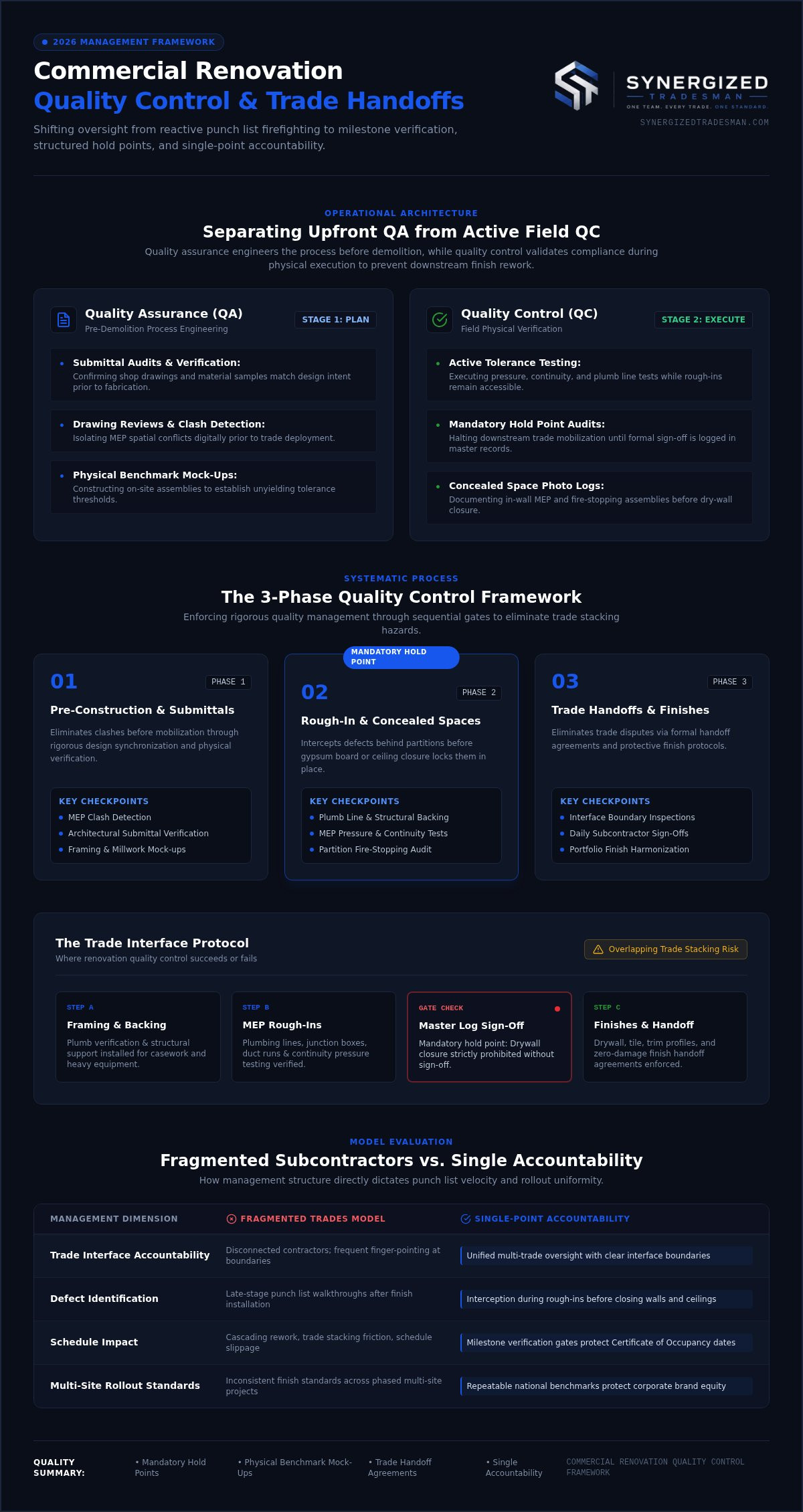
Maintaining high standards requires separating quality assurance from quality control. Quality assurance focuses on process engineering before field demolition begins. It establishes baseline protocols, audits project scopes, and manages the construction submittal process to confirm shop drawings and architectural samples match design intent prior to fabrication. Quality control operates directly in the field. It provides continuous, physical verification against those specifications during active installation. This dual-track system produces an unyielding documentation trail, verifying commercial building code compliance and confirming every assembly meets exact engineering tolerances before the next trade mobilizes.
The True Cost of Quality Failures in Fast-Track Fit-Outs
Defects in fast-track commercial projects trigger compounding costs. When rough-in inspections fail due to misaligned plumbing lines or uncoordinated electrical boxes, crews must demolish fresh drywall and re-sequence mechanical work. That rework immediately threatens scheduled turnover milestones. A delayed certificate of occupancy postpones tenant operations, generating direct revenue loss for commercial property owners. For corporate operators running phased multi-site rollouts, uncoordinated trade execution also degrades brand equity. Customers quickly notice mismatched trim profiles, uneven flooring transitions, and substandard wall finishes across locations. Systematic quality control prevents these avoidable failures.
The 3-Phase Commercial Renovation Quality Control Framework
Executing dependable commercial renovation quality control demands a structured operational sequence rather than informal site walks. Software dashboards provide data tracking, but physical builds require strict milestone gates. By incorporating established construction quality management steps, project leaders enforce accountability before small errors escalate. This 3-phase framework relies on mandatory hold points, halts downstream trade mobilization until formal inspections pass, and mandates daily subcontractor sign-offs inside the master project log.
Phase 1: Pre-Construction Alignment and Submittal Verification
Initial alignment prevents jobsite discord. Teams conduct drawing reviews and clash detection to isolate MEP conflicts before selective demolition starts. Every submittal undergoes verification against owner design criteria. Crews then construct physical on-site mock-ups for metal framing, millwork assemblies, and critical wall finishes. These physical mock-ups establish an unyielding benchmark, locking all incoming contractors to identical tolerance thresholds before field work begins.
Phase 2: Rough-In Inspections and Concealed Space Verification
Phase 2 manages the structural and mechanical assemblies that finishes will soon conceal. Inspectors evaluate framing plumb lines and structural backing prior to hanging gypsum board. Electricians and plumbers execute pressure and continuity testing while rough-ins remain accessible.
- Comprehensive photographic documentation logs every MEP run before insulation placement.
- Superintendents audit fire-stopping assemblies at all partition penetrations.
- A mandatory hold point stops drywall hanging until the master rough-in sign-off is logged.
Securing documented approvals at this gate guarantees concealed systems perform reliably long after tenant occupancy.
Phase 3: Pre-Finish Protection and Architectural Closeout
Phase 3 safeguards architectural surfaces against jobsite wear. Drywall finishers verify Level 4 and Level 5 surfaces under artificial directional lighting to expose joint imperfections before paint application. Dedicated floor protection covers newly installed commercial tile and luxury vinyl planks, shielding finished surfaces from foot traffic and heavy rolling equipment.
Two weeks prior to substantial completion, management initiates rolling pre-punch inspections. This resolves cosmetic defects continuously instead of overwhelming turnover dates. Teams compile warranties, operations manuals, and field sign-offs through systematic construction closeout documentation services. If your portfolio requires seamless oversight through turnover, partnering with Synergized Tradesman secures disciplined execution across all project phases.
Managing Trade Handoffs: Where Quality Control Succeeds or Fails
Trade boundaries represent the most vulnerable touchpoints on any commercial jobsite. Individual trades rarely fail inside their isolated scopes. Friction surfaces when one crew completes work, vacates the floor, and leaves downstream contractors to inherit defective or damaged substrates. Effective commercial renovation quality control eliminates this gap by implementing mandatory chain-of-custody handoffs. Before an incoming trade begins installation, both foremen inspect the workspace alongside the superintendent, signing a mutual acceptance form that confirms preceding surfaces meet specification tolerances.
This protocol eradicates cross-trade finger-pointing immediately. If an incoming crew signs off on substrate conditions, they take legal ownership of their working surface. If deficiencies exist, the departing trade remediates them before the next crew expends labor.
Demolition to Framing: Substrate Preparation Standards
Transitioning from selective interior demolition to structural layout requires rigorous substrate clearance. Crews must verify concrete slab moisture levels, profile flatness, and structural anchor integrity before releasing layout carpenters. Technicians inspect perimeter exterior walls and structural columns for hidden spalling or anchor degradation caused by demolition equipment. Superintendents confirm clear pathways for in-wall electrical conduits and plumbing waste lines before metal stud framing anchors into the slab.
Drywall, ACT Ceilings, and MEP Coordination
Overhead coordination prevents costly ceiling and wall revisions. Mechanical ducts, junction boxes, and plumbing runs must pass code inspection before ceiling grid wires drop. Acoustic ceiling tile installers coordinate grid layouts directly with electrical teams to center light troffers and HVAC diffusers cleanly within ceiling panels.
- Technicians check drywall cutouts around electrical boxes to maintain tight 1/8-inch margins, eliminating draft bridging and acoustical flanking paths.
- Installers verify fire-rated drywall seals around MEP sleeve penetrations before ceiling grids close off access.
- Superintendents audit ceiling tile drops to protect grids from displacement during mechanical balancing.
Millwork, Flooring, and Finish Protection Protocols
Delivering high-end finishes into an uncontrolled jobsite invites disaster. Architectural wood casework requires 72 hours of environmental conditioning in climate-controlled spaces before hanging. Integrating specialized retail fixture and millwork installation guarantees cabinetry aligns with rough utility stubs without uncoordinated site carving. Crews apply rigid, impact-resistant floor protection across newly installed commercial tile and resilient flooring immediately after curing. Finally, painting and wallcovering trades perform final surface touch-ups only after mobile scissor lifts, staging ladders, and heavy tools leave the building envelope.
Evaluating Oversight Models: Fragmented Trades vs. Single Accountability
Managing commercial renovation quality control through disconnected trade contractors forces project owners to absorb massive administrative friction. When individual trades hold separate agreements, every transition boundary becomes an operational risk. Field conflicts quickly generate corrective change orders stacked with layered subcontractor markups, inflating budgets while schedules slip. Securing reliable delivery requires comparing the true operational impact of fragmented oversight against a unified accountability model.
The Operational Pitfalls of Fragmented Trade Contracting
Direct multi-trade subcontracting inevitably fractures jobsite communication. Because each contractor focuses strictly on their distinct contract scope, unassigned scope gaps routinely open between trades. No independent crew assumes legal or financial responsibility for protecting adjacent finished surfaces. When an electrician scuffs a newly finished wall or a plumber damages ceiling framing, neither party admits liability. Client project managers become default dispute arbiters, spending vital hours sorting out conflicting claims rather than driving forward progress.
The Single Accountability Advantage for Commercial Quality
Unified oversight eliminates this operational drag. Engaging a dedicated commercial general trades contractor consolidates metal stud framing, drywall, ACT ceilings, flooring, and final finishes under one standard of field execution. This integrated delivery model guarantees that commercial renovation quality control remains continuous rather than disjointed across independent teams.
- Single-entity leadership governs procurement schedules, jobsite staging, and trade handoffs from initial demolition through final turnover.
- Subcontractor markup stacking disappears because the management team resolves inter-trade adjustments internally without competing change claims.
- Centralized field logging gives corporate executives consistent, objective quality metrics and milestone tracking across regional or national property portfolios.
Single accountability removes the operational cracks where quality typically fails. To protect your completion timeline and enforce unyielding standards on active jobsites, coordinate your next renovation with Synergized Tradesman.
How Synergized Tradesman Standardizes National Renovation Quality
Executing predictable rollouts across nationwide commercial portfolios requires more than localized trade contracting. It demands centralized construction oversight that standardizes craftsmanship across every property. Synergized Tradesman delivers end-to-end commercial renovation management, directing operations under a single accountable standard from early pre-planning through final turnover. As a Certified Women-Owned Business Enterprise (WBE), Synergized Tradesman also enables corporate procurement teams to fulfill strategic supplier diversity benchmarks without compromising operational rigor or schedule adherence.
Centralized project directors insulate your internal facilities team from jobsite complexity. By acting as the sole accountable partner, Synergized Tradesman manages procurement logistics, trade staging, and multi-trade field execution across the United States. This disciplined structure establishes uniform commercial renovation quality control across every asset in your portfolio.
Integrated Trade Coordination Under One Master Agreement
Consolidating scopes under a unified agreement eliminates the administrative silos that disrupt project momentum. Synergized Tradesman aligns selective demolition, metal stud framing, drywall, ACT ceilings, electrical, plumbing, flooring, and decorative finishes under one master umbrella. Dedicated field supervision monitors every trade handoff, eradicating boundary disputes and holding crews to identical tolerance metrics.
This integrated framework scales across regional and national refresh initiatives. By applying proven methodologies established in retail store construction, our management model delivers repeatable, brand-compliant spaces that open on time across every target market.
Rigorous Closeout Delivery and Turnover Standards
Turnover represents the final benchmark of project quality. Synergized Tradesman enforces stringent pre-turnover protocols to ensure spaces are fully operational from day one:
- Internal multi-point punch list audits resolve all cosmetic and structural discrepancies before client walk-through inspections occur.
- Operations manuals, warranties, and as-built drawings are compiled into an organized digital closeout package for immediate facilities handoff.
- Final post-construction cleaning removes all jobsite debris, fine dust, and surface marks, delivering pristine, turn-key interiors ready for immediate business operations.
Eliminate the schedule slippage and finger-pointing common to multi-contractor models. Partner with Synergized Tradesman to bring single-point accountability and standardized quality to your upcoming commercial renovation programs.
Enforce Predictable Renovation Quality Across Your Commercial Portfolio
Protecting your schedule and capital investments requires treating quality as an operational discipline rather than an afterthought. Establishing mandatory hold points, formalizing trade handoff agreements, and inspecting concealed MEP systems before wall closure intercepts costly rough-in defects before they escalate. Modern commercial renovation quality control succeeds when unified oversight bridges the vulnerable gap between disconnected trade scopes.
You don't need to absorb trade finger-pointing, punch list bottlenecks, or inconsistent finishes across phased rollouts. Synergized Tradesman provides a single accountable relationship from initial planning through final closeout, deploying standardized quality control systems across multi-trade portfolios nationwide. As a Certified Women-Owned Business Enterprise (WBE), our management framework helps corporate teams achieve vital supplier diversity targets while maintaining total command of project schedules and craftsmanship.
Take command of your build schedule and protect tenant turnover dates. Contact Synergized Tradesman to Streamline Your Renovation and secure dependable multi-trade execution on your next project.
Frequently Asked Questions
What is the difference between quality assurance and quality control in commercial renovation?
Quality assurance establishes the proactive management systems, engineering reviews, and submittal approvals before field labor begins, while quality control is the active, physical inspection of workmanship on site. In commercial renovation quality control, QA prevents procedural conflicts through clash detection and drawing audits. QC verifies that real-time trade installations, from metal framing to electrical conduit, strictly adhere to project drawings and code tolerances.
How do general contractors prevent trade damage to finished surfaces during renovations?
Contractors prevent trade damage by enforcing formal custody transfer sign-offs and deploying heavy-duty surface protection immediately after installation. When high-value surfaces like commercial tile or architectural millwork are complete, crews cover them with impact-resistant boards and flame-retardant barriers. Additionally, strict sequencing rules restrict heavy equipment, rolling scaffolding, and high-impact trades from entering sensitive zones until all adjacent installations are verified and protected.
What are mandatory hold points in a commercial construction schedule?
Mandatory hold points are scheduled milestones where physical work stops until a documented inspection verifies that preceding installations meet contract specifications. Downstream trades cannot proceed past a hold point without formal superintendent sign-off. Common commercial hold points include pre-drywall in-wall utility checks, ceiling grid closures before MEP approvals, and substrate moisture verification before flooring placement. These gates stop concealed errors from compounding into structural punch list failures.
Why is single-source multi-trade accountability more reliable than hiring separate trade contractors?
Single-source accountability establishes one responsible partner for all interior trades, completely eliminating the cross-contractor finger-pointing common to fragmented project models. When a single firm manages framing, MEP, and architectural finishes under one agreement, trade interfaces are coordinated internally. The project owner avoids stacked subcontractor markups on corrective change orders, protects baseline handover milestones, and maintains consistent commercial renovation quality control across the entire jobsite.
How does standardized quality control benefit multi-location retail rollout programs?
Standardized quality control ensures that corporate brand standards, fixture layouts, and finish tolerances remain identical across every property in a portfolio. Rollout programs face severe schedule risk when regional subcontractors interpret construction documents differently. Deploying unified oversight with standardized inspection checklists eliminates localized deviations. It provides executive teams with repeatable delivery timelines, predictable turnover dates, and uniform visual branding across all national retail locations.
What documentation is required to verify quality control during project closeout?
Verifying quality control at turnover requires a fully consolidated closeout documentation package delivered before final occupancy. This package contains signed daily superintendent inspection logs, photographic records of concealed MEP rough-ins, and manufacturer warranty certificates. It also includes comprehensive operations and maintenance manuals, approved test-and-balance reports, stamped regulatory inspection approvals, and final as-built drawings that confirm the completed facility matches all specified engineering standards.


