

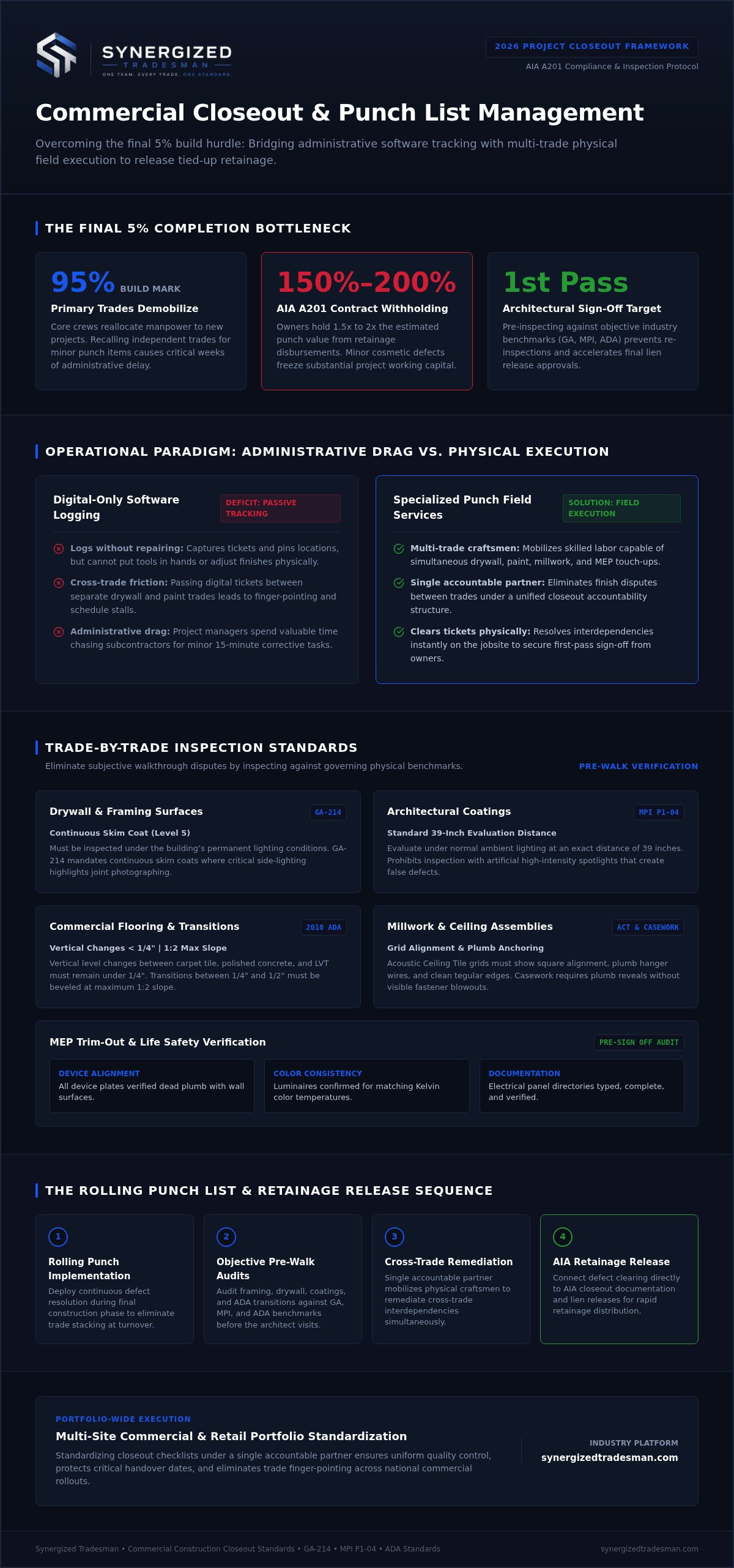
Your project management software doesn't resolve punch lists; it simply catalogs why your retainage remains tied up. While mobile platforms log defects with precision, a digital ticket doesn't put tools in hands or bring demobilized trades back to the jobsite. When finish disputes and unfinished punch items stall substantial completion, specialized commercial construction punch list services bridge the critical gap between administrative tracking and physical field execution.
You know how punishing the final five percent of a build can be. Subcontractors move on to other jobs, finger-pointing between drywall and paint crews delays reinspections, and owners enforce contract holdbacks equal to 150% to 200% of remaining punch values. You don't have to let minor defects stall your pipeline. Master commercial construction punch list management with an operational checklist that accelerates trade closeout and releases final retainage.
This 2026 project closeout framework outlines the physical inspection standards, sequential trade handoffs, and AIA contract milestones required to secure first-pass architectural sign-offs and achieve clean turnover.
Key Takeaways
- Separate software tracking from trade execution by deploying commercial construction punch list services that provide the physical labor needed to clear punch items after primary trades demobilize.
- Establish objective trade-by-trade inspection criteria across framing, drywall, architectural coatings, and MEP systems to secure sign-off on your initial architectural walk.
- Implement a sequential rolling punch list strategy during the final phase of construction to resolve defects early and eliminate trade stacking at turnover.
- Connect physical defect resolution directly to the required AIA closeout documentation and lien releases to secure swift retainage distribution.
- Standardize closeout checklists across multi-site retail and commercial portfolios to maintain uniform quality control under a single accountable partner.
Commercial Construction Punch List Services: Tracking vs. Field Execution
Commercial project closeout stalls when teams confuse documentation with completion. Construction management platforms log defects, tag locations, and assign notifications, but software doesn't repair an uneven drywall seam or replace a damaged acoustic ceiling tile. True commercial construction punch list services move beyond passive digital audits to deliver targeted, multi-trade field execution.
By the time a project reaches 95% completion, primary trade contractors have already demobilized their core crews and reallocated manpower to new jobsites. Mobilizing a drywall finisher, commercial painter, and electrician to rectify a handful of aesthetic discrepancies takes weeks of administrative chasing. Meanwhile, owners exercise their contractual right under AIA A201 guidelines to withhold 150% to 200% of the estimated punch list value from retainage disbursements. Leaving punch items open directly ties up substantial working capital.
The Limitations of Digital-Only Punch List Software
Digital platforms excel at recording punch defects, but they create administrative drag when project managers must coordinate multiple independent subcontractors for minor touch-ups. A photo ticket doesn't resolve physical field interdependencies. When an electrical trim adjustment damages surrounding wall finishes, passing digital tickets between separate trades stalls momentum. Specialized field execution teams step onto the jobsite to physically remediate cross-trade punch items simultaneously, clearing tickets instead of simply generating them.
The Single Accountable Relationship Advantage
Fragmented trade responsibility guarantees finger-pointing during final walkthroughs. Operating under a unified delivery model consolidates drywall, paint, flooring, MEP touch-ups, and final cleaning under one responsible partner. Aligning your closeout process with structured multi-trade commercial construction practices eliminates disputes between adjacent finishes. A single accountable point of contact mobilizes cross-functional craftsmen, verifies punch list execution against architectural specifications, and protects handover schedules across nationwide commercial portfolios.
The Commercial Closeout Checklist: Trade-by-Trade Inspection Standards
Architectural sign-off delays rarely stem from catastrophic structural errors. Re-inspections happen when field teams fail to evaluate finishes against objective trade benchmarks. Engaging specialized commercial construction punch list services ensures that physical work meets governing industry standards before the architect's formal walkthrough, eliminating subjective disputes between site superintendents and design teams.
Architectural Finishes: Framing, Drywall, Paint, and Ceilings
Inspect drywall surfaces under the building's permanent lighting. The Gypsum Association GA-214 standard mandates a continuous skim coat for Level 5 finishes where critical side-lighting highlights joint photographing. Evaluate painted surfaces according to MPI P1-04 guidelines from a standard distance of 39 inches under normal ambient lighting rather than inspecting with high-intensity spotlights. Check acoustic ceiling tile (ACT) grids for square alignment, plumb hanger wires, and unblemished tegular edges.
Flooring, Fixtures, and Specialty Commercial Installations
Audit transitional detailing across commercial carpet tile, polished concrete, and luxury vinyl tile. The 2010 ADA Standards require vertical surface level changes to remain under 1/4 inch, with transitions between 1/4 and 1/2 inch beveled at a maximum 1:2 slope. Apply proven commercial millwork and specialty installation procedures to check casework plumbness, reveal alignments, and secure substrate anchoring without visible fastener blowouts.
MEP Trim-Out, Fixtures, and Life Safety Verification
Confirm functional performance across mechanical, electrical, and plumbing scopes before scheduling life-safety sign-offs:
- Electrical: Align device plates plumb, confirm matching luminaire color temperatures, and ensure panel directories are typed and complete.
- Plumbing: Inspect silicone seals around commercial fixtures, verify backflow certification tags, and confirm unobstructed emergency shutoff valves.
- Life Safety: Test battery back-up egress signage, confirm fire caulking integrity at wall penetrations, and verify interior door closing pressure remains under the 5.0-pound ADA limit.
Coordinating these multi-trade punch activities through experienced commercial construction punch list services prevents last-minute schedule slips and gets trade checklists completed right the first time.
Executing the Rolling Punch List Strategy to Accelerate Turnover
Waiting until substantial completion to generate a massive, terminal punch list creates chaos. Rushing 200 items in the final two weeks leads to stacked trades, trade damage, and missed turnover deadlines. Modern commercial construction punch list services rely on a rolling punch list methodology. By initiating continuous quality audits during the final 15% to 20% of the build schedule, project managers inspect, log, and resolve defects phase by phase as rough-ins and finishes close out.
Pre-Punch Walkthroughs and Quality Assurance Audits
Internal pre-punch audits eliminate the vast majority of items before the design team walks the site. Field data shows that an internal contractor pre-inspection eliminates 60% to 70% of defects before the architect or client ever sees them. Documenting pre-existing substrate conditions also protects your scope from damage caused by owner-direct fixture vendors or IT equipment installers. Tie subcontractor milestone sign-offs to these rolling walks before approving intermediate progress billings.
Managing Trade Interdependencies During Remediation
Remediation without strict sequencing causes circular rework. A plumber opening a finished chase wall to adjust a valve destroys newly applied wallcoverings. Working with an experienced commercial general trades contractor ensures that dry trades precede wet trades. Finish crews follow this operational order:
- Execute mechanical, electrical, and plumbing fixture trim adjustments first.
- Complete drywall framing alignments, patching, and sanding before rolling primer.
- Apply finish paint coats and wallcoverings only after above-ceiling MEP testing completes.
- Install finish flooring and base trim last, keeping temporary floor protection intact until final sign-off.
Final Cleaning and White-Glove Turnover Protocol
Construction debris masks defects and fails inspections. Professional commercial construction punch list services pair physical defect correction with structured multi-stage final cleaning. Clearing fine particulate dust protects freshly painted surfaces, prevents false triggers on optical fire sensors, and keeps HVAC diffusers clean. Once surfaces pass inspection, secure high-traffic corridors with heavy-duty surface protection until official building turnover.
Aligning Physical Punch Resolution with Closeout Documentation
Physical completion means nothing without legal closeout. An architect won't countersign final payment applications if administrative deliverables remain outstanding, regardless of how clean the paint lines look. Resolving field defects and assembling contract documentation must occur in parallel. Comprehensive commercial construction punch list services align trade-level repairs directly with required contract filings, removing administrative friction and expediting capital release.
Certificate of Substantial Completion Protocols
Executing the AIA Document G704 Certificate of Substantial Completion marks the formal handover where the owner legally occupies the facility. This executed milestone establishes utility transfers, halts liquidated damage liabilities, and activates the standard one-year correction period under AIA A201 guidelines. The inspection punch list appended to G704 establishes the remaining scope. Resolving these items promptly ensures final local building official sign-offs match the issued Certificate of Occupancy.
Operations, Maintenance, and Warranty Package Deliverables
Closeout approval frequently stalls because trade contractors fail to provide physical turnover assets alongside completed work. Comprehensive handover protocols require systematic assembly of digital O&M manuals, certified as-built drawings reflecting actual field routing, and manufacturer warranty certificates. Facilities teams also enforce contractual attic stock requirements. Securing final sign-off requires documented delivery receipts for specified extra stock, typically 2% to 5% of extra acoustic ceiling tiles, flooring dye lots, and labeled architectural paint formulas.
Retainage Recovery and Final Payment Release
Converting open retainage into released cash requires absolute document alignment across financial and architectural checkpoints:
- AIA G706 and G706A: Submit sworn contractor affidavits confirming payment of all project debts along with conditional and unconditional lien releases across all trade tiers.
- AIA G707 Consent of Surety: Secure formal surety authorization for final payment and retainage reduction on bonded commercial projects.
- Architectural Closeout Sign-Off: Obtain verified sign-offs from the owner and architect confirming zero outstanding deficiencies.
Don't let open punch tickets tie up project profits. Partner with proven commercial construction punch list services to streamline trade completion and finalize closeout packages. Connect with Synergized Tradesman to accelerate your project closeout and recover your retainage without administrative delays.
Managing Multi-Site Commercial and Retail Portfolio Punch Lists
Managing closeouts across nationwide commercial portfolios multiplies operational risk. Disparate regional crews produce inconsistent finish quality, fragmented documentation, and delayed turnover milestones. Utilizing dedicated commercial construction punch list services under centralized management turns decentralized field chaos into predictable, synchronized completions across all corporate locations.
Standardizing Brand Specifications Across Multi-Site Rollouts
Retail chains and corporate rollouts require exact visual repeatability. An uneven millwork reveal or an mismatched paint sheen disrupts brand identity across a facility portfolio. Aligning trade checklists with standardized retail store construction criteria guarantees that metal framing, architectural coatings, and fixture placement meet identical tolerances at every property. Unified oversight ensures every location reflects uniform brand standards before turnover walks begin.
Streamlining Closeouts with Certified Trade Leadership
Juggling dozens of independent regional trade contractors overwhelms corporate procurement and project management teams. Consolidating closeout responsibilities under a single multi-trade partner establishes direct field accountability across your entire rollout schedule. Leveraging a certified Women-Owned Business Enterprise (WBE) commercial construction firm fulfills corporate supplier diversity commitments while maintaining strict multi-trade quality controls across simultaneous facility handovers.
Executing Predictable Turnovers with Synergized Tradesman
Predictable project completions require complete coordination between physical labor and administrative compliance. Synergized Tradesman provides comprehensive commercial construction punch list services, directing self-performing teams and specialty trades from preliminary rolling inspections through final cleaning and lien waiver assembly. Eliminate trade finger-pointing and take control of your turnover schedule. Partner with Synergized Tradesman to execute predictable, zero-defect handovers across your commercial facilities.
Secure First-Pass Sign-Offs and Protect Your Retainage Capital
Closing out commercial builds shouldn't turn into an administrative stalemate or an endless cycle of trade repairs. Shifting from reactive defect logging to proactive, rolling field execution preserves your turnover schedule and safeguards project margins. When you establish objective trade inspection standards and align physical punch remediation with AIA closeout documentation, first-pass architectural sign-offs become your standard operating procedure.
Executing predictable facility handovers across nationwide retail rollouts and multi-trade programs requires boots-on-the-ground coordination. Dedicated commercial construction punch list services ensure your drywall, paint, flooring, millwork, and MEP scopes cross the finish line without cross-trade friction. As a certified Women-Owned Business Enterprise (WBE), Synergized Tradesman delivers a single accountable relationship for all commercial trades from preliminary rolling audits to final owner turnover.
Partner with Synergized Tradesman for unified closeout management to streamline trade sign-offs and release your contract retainage on time.
Frequently Asked Questions
What is included in commercial construction punch list services?
Comprehensive commercial construction punch list services combine physical multi-trade labor with administrative verification. This scope includes active remediation across drywall, architectural coatings, ceiling grid adjustments, flooring transitions, casework alignment, and minor MEP fixture trim-outs. Beyond trade repairs, execution services coordinate internal pre-punch audits, surface protection, multi-stage final construction cleaning, and closeout documentation alignment to secure prompt architectural sign-offs.
How does a rolling punch list differ from a traditional closeout walkthrough?
A rolling punch list initiates quality audits continuously during the final 15% to 20% of the project rather than waiting for a single walkthrough at the end. Traditional terminal walks often reveal hundreds of stacked defects when primary trades have already left the site. In contrast, the rolling strategy inspects and resolves items trade-by-trade as areas reach completion, preventing trade stacking and protecting finished work.
Who is responsible for verifying that commercial punch list items are complete?
The verification process follows a strict chain of accountability. The general contractor or specialized closeout partner conducts an initial pre-walk inspection to clear internal defects. Once trades remediate their assigned scopes, the project architect, MEP engineers, and the owner or client representative conduct the formal reinspection. Final verification requires signed sign-off sheets from the architect and owner confirming that every documented defect satisfies contract specifications.
How does an incomplete punch list impact the release of retainage funds?
Open punch items directly stall retainage capital recovery. Standard commercial contracts permit owners to withhold between 150% and 200% of the estimated financial value of unresolved punch items from the final retainage disbursement. Even minor cosmetic defects can tie up hundreds of thousands of dollars in retainage. Clearing every item on the punch list is the mandatory contractual prerequisite for submitting final payment applications.
What is the relationship between substantial completion and the punch list?
Substantial completion occurs when an owner can legally occupy and use the facility for its intended commercial purpose. The formal Certificate of Substantial Completion (such as AIA Document G704) explicitly appends the remaining punch list as an exhibit. Issuing this document transfers operational responsibilities and starts statutory warranty periods, while establishing a contractual timeline for the contractor to resolve all remaining punch items for final turnover.
Can commercial punch list services be managed across multiple national retail locations?
Yes. Leading commercial construction punch list services operate on a national scale to support retail rollouts, healthcare programs, and corporate refreshes. Deploying a single multi-trade partner eliminates the quality variance caused by hiring unvetted regional subcontractors. Standardized inspection playbooks and centralized management enforce uniform brand standards, millwork detailing, and paint sheens across dozens of simultaneous property turnovers nationwide.
What documentation is required alongside punch list completion for full closeout?
Full legal and financial closeout requires pairing physical punch sign-offs with a comprehensive administrative turnover package. This package includes AIA G706 and G706A affidavits of payment and lien releases, AIA G707 surety consents for bonded projects, certified as-built redline drawings, manufacturer warranty binders, and structured operations and maintenance (O&M) manuals. Facilities teams also require verified receipts for all specified trade attic stock materials.


