

Many of the most important commercial build-out decisions happen before the first trade starts work. A commercial build-out checklist for tenants turns those decisions into clear gates, from defining lease scope and assigning responsibilities to coordinating approvals, procurement, and handover.
If a scope gap or late decision could affect your opening plan, focus on coordination early. Tenant, landlord, and project-team responsibilities can overlap, and multiple trades depend on timely information. A documented sequence makes ownership, approvals, and dependencies easier to track.
This checklist follows project milestones so you can settle key decisions before they disrupt the next phase. It covers lease and scope alignment, planning and approvals, construction coordination, quality checks, and closeout. It also explains how one accountable relationship can coordinate planning, procurement, field execution, and final cleaning across trades, supporting consistent standards through handover.
Key Takeaways
- Use a commercial build-out checklist for tenants to separate landlord work, tenant improvements, existing conditions, and separately purchased equipment.
- Track each document and approval by owner, reviewer, revision, status, and required decision date.
- Compare delivery approaches by accountability, communication, and reporting, then identify the records that show decisions are controlled.
- Connect dated field observations to decisions and corrective actions so construction progress and quality checks stay traceable.
- Build a closeout register to track open items, approvals, operating information, warranties, and required handover records.
Commercial Build-Out Checklist for Tenants: Define Scope Before Work Starts
Start with one goal: align the space, lease obligations, construction scope, and intended opening. A commercial build-out checklist for tenants turns lease terms and design decisions into assigned work. Before construction begins, document what the landlord provides, what the tenant funds, what the project team delivers, and what sits outside the construction contract.
A leasehold estate describes a tenant’s right to occupy property for a defined term. The lease and project documents determine how improvements are handled. Connect those responsibilities to the commercial construction accountability model so decisions have clear owners across the work.
Which build-out decisions should the lease and scope documents clarify?
For every improvement, record who funds, approves, procures, installs, and accepts it. Review the lease for tenant improvement allowance terms, supporting-document requirements, and submission deadlines. Then separate construction from items that may need separate purchasing or coordination, such as furniture, equipment, signage, and technology.
Classify each line item as landlord work, tenant improvement, existing condition, or separately purchased equipment. For example, a new partition may be part of the tenant’s construction scope, while desks and computers may be separate purchases. Record interfaces too: who coordinates power or data requirements for equipment, and what must be ready before installation?
Create a scope register with these fields:
- Item: Describe the improvement or requirement.
- Owner: Identify who funds, approves, procures, installs, and accepts it.
- Approval status: Track the decision and any required revision.
- Dependency: Note what must happen first, such as approval before procurement.
- Record location: Link to the lease clause, drawing, submittal, or decision record.
How can tenants document existing conditions before construction?
Create a dated record before demolition or material delivery. Photograph existing finishes and visible damage, and note utility locations and access constraints. Organize evidence by room or area so the project team can compare site conditions with drawings and planned work.
If records and plans differ, log the discrepancy and route it to the appropriate project decision-maker before releasing affected work. Document the decision and update the relevant scope or project record. This gives trades a consistent reference and reduces the risk of work proceeding on conflicting assumptions.
Preconstruction Checklist: Documents, Approvals, and Trade Coordination
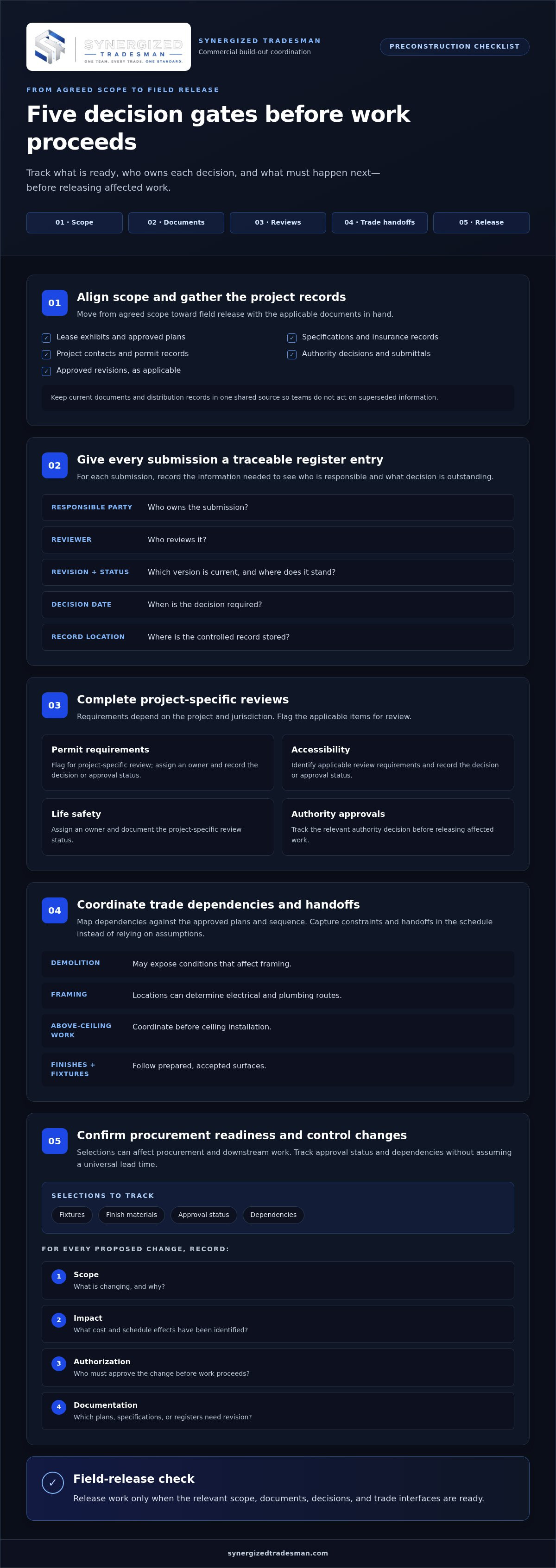
Move from agreed scope to field release through clear decision gates: align scope, collect documents, complete reviews, confirm procurement readiness, then authorize work to proceed. A commercial build-out checklist for tenants should show not only what is complete, but who owns each decision and what needs to happen next.
What should a tenant include in the preconstruction document register?
Maintain a controlled register for lease exhibits, approved plans, specifications, insurance records, project contacts, permit records, authority decisions, submittals, and approved revisions, as applicable. For each submission, track the responsible party, reviewer, revision, current status, required decision date, and record location. Keep current documents and distribution records in one shared source so teams do not act on superseded information.
Permit, accessibility, life-safety, and authority approval requirements depend on the project and jurisdiction. Flag them for project-specific review, assign an owner, and record the decision or approval status before releasing affected work. The commercial construction coordination guide can help support consistent communication across the project team.
How should tenants prepare multi-trade work for release?
Map trade dependencies against the approved plans and sequence. Demolition may expose conditions that affect framing. Framing locations can determine electrical and plumbing routes. Above-ceiling work may need coordination before ceiling installation, while finishes and fixtures follow prepared, accepted surfaces. The sequence depends on the project, so capture constraints and handoffs in the schedule instead of relying on assumptions.
Identify selections that could affect procurement or downstream work, such as fixtures or finish materials. Track their approval status and dependencies without assuming a universal lead time. Release work only when the relevant scope, documents, decisions, and trade interfaces are ready.
Set a written change process before field work begins. For each proposed change, record:
- Scope: What is changing and why?
- Impact: What cost and schedule effects have been identified?
- Authorization: Who must approve the change before work proceeds?
- Documentation: Which plans, specifications, or registers need revision?
This process creates a traceable path from decisions to execution. Synergized Tradesman coordinates commercial construction from planning and procurement through field delivery. Review Synergized Tradesman’s commercial construction approach.
Compare Build-Out Delivery Approaches: Accountability, Control, and Visibility
Tenants can contract with trades separately or use coordinated multi-trade management. The difference is not simply how many companies perform the work. It is how sequencing, procurement, communication, quality checks, changes, and closeout are managed and recorded. The right approach depends on project scope and how responsibilities are allocated.
| Decision criterion | Separate trade contracting | Coordinated multi-trade management | Records that demonstrate control |
|---|---|---|---|
| Accountability | The tenant coordinates multiple direct trade relationships and tracks each trade’s scope. | A central relationship coordinates trades while defined scopes and owners remain visible. | Responsibility matrix, trade scopes, and named decision owners. |
| Sequencing and procurement | The tenant aligns schedules, selections, and dependencies across separate parties. | Procurement and trade sequencing are coordinated against shared project milestones. | Schedule, procurement log, and dependency register. |
| Communication and changes | Updates and change decisions may pass through several separate channels. | Progress, open decisions, and escalations can be managed through a shared process. | Meeting notes, decision log, change register, and distribution records. |
| Quality and closeout | The tenant tracks trade-specific checks and closeout deliverables across contracts. | Quality checks and closeout records can follow a consistent project standard. | Inspection records, punch lists, completion documents, and acceptance records. |
What should tenants compare when reviewing a project delivery model?
Look beyond contract structure. Identify who coordinates procurement, trade sequencing, field communication, quality checks, and closeout. Then review how the process records dependencies, open decisions, changes, and escalations. A schedule alone will not show who owns a delayed approval or how a revised decision reaches affected trades.
One accountable relationship should clarify ownership, not obscure it. The coordinator provides a central point for communication and oversight, while individual scopes, approvals, and responsibilities remain documented. Look for visibility in defined records, not just verbal progress updates.
With coordinated multi-trade management, planning, procurement, and field execution can be aligned through one relationship under a consistent project standard. This connects work across areas, from demolition and framing to electrical, plumbing, ceilings, finishes, and fixtures. The interior commercial construction management guide covers related coordination principles.
Use the commercial build-out checklist for tenants to compare the delivery model with your project’s scope, decision paths, and reporting needs. The aim is clear accountability and enough documentation to see what is assigned, decided, and ready to proceed.
Construction-Phase Checklist: Track Field Work, Changes, and Quality
Once work starts, keep field records aligned with the approved scope and current project documents. Organize checks around key milestones: mobilization, work that will be concealed, finish installation, inspections, and punch-list resolution. At each stage, record what is complete, what remains open, and who owns the next action.
Which field checkpoints help prevent avoidable rework?
Before mobilization, confirm the relevant team has access to current approved drawings and specifications. During construction, document trade interfaces before later work hides them. For example, record completed electrical and plumbing work in a wall or ceiling area before drywall or ceiling installation limits visibility. Use dated notes and photographs tied to a specific room or work area.
During finish installation, inspections, and punch-list reviews, log each observation, responsible party, required correction, and resolution record. Keep inspection outcomes with the applicable project documents. This makes deficiencies and follow-up traceable instead of relying on informal updates.
How should tenants manage changes and progress reporting?
Track field updates against agreed milestones and unresolved dependencies. A useful site record connects the date and location to completed work, observations, decisions, and corrective actions. A decision log should identify the request, owner, approval, and implementation status. If a decision affects another trade, record the dependency and communicate the approved direction to the teams involved.
Control changes before they become field assumptions. Document the revised scope, required authorization, procurement effects, schedule impacts, and records that need updating. Once approved, align revised drawings or specifications with site instructions and change records. Clearly identify superseded documents so the team can distinguish current direction from earlier revisions.
Use this construction-phase checklist within your commercial build-out checklist for tenants to maintain visibility from mobilization through punch-list resolution:
- Mobilization: Confirm current documents, work areas, and trade handoffs.
- Concealed work: Record completed interfaces before they are covered.
- Finishes and inspections: Log observations, outcomes, and assigned corrections.
- Changes: Track authorization, procurement and schedule effects, and document updates.
- Punch list: Assign each open item and record its resolution.
Consistent site records make progress and accountability easier to review across trades. Synergized Tradesman coordinates commercial build-outs across multiple trades. Learn about coordinating a commercial build-out with Synergized Tradesman.
Tenant Build-Out Handover Checklist: Close Out the Space with Clear Records
Handover should be an evidence-based process, not a single final walkthrough. Move through five steps: resolve open items, inspect completed work, document results, transfer agreed records, and record tenant acceptance. Define acceptance criteria before closeout so everyone understands what must be complete and how remaining work will be handled.
What should a commercial build-out closeout checklist track?
Maintain one closeout register that connects each requirement to its status and supporting evidence. For every punch-list item, record its location, description, responsible party, target date, and resolution evidence. Include required approvals and inspection records, as applicable, along with available as-built information, product documentation, operating instructions, and warranties.
Track the transfer itself. Note which project records were provided, who received them, and when. Include agreed access information and identify any outstanding records. This gives the tenant’s operational team a clear reference and keeps closeout information from being scattered across emails, site notes, and separate trade files.
How can tenants make the move from construction to operations clearer?
Before accepting the space, walk it with the closeout register and compare observed conditions with the agreed scope and acceptance criteria. Confirm that the operational team understands relevant installed systems and has the maintenance information and operating instructions needed for routine use. Keep the record focused on what was demonstrated, transferred, or remains to be completed.
If the tenant accepts an exception or work remains open, document it explicitly. Record the item, agreed status, responsible party, follow-up action, and target date. Acceptance should not make unresolved work invisible. It should establish how that work will be tracked after handover.
Use this final stage of the commercial build-out checklist for tenants to connect field completion with operational readiness. A closeout register can bring together punch-list resolution, approvals, operating information, warranties, and transferred records under a consistent project standard.
Synergized Tradesman coordinates commercial construction from planning and procurement through field execution and project closeout, bringing multiple trades together through one accountable relationship. See how Synergized Tradesman can coordinate your commercial build-out.
Move from Build-Out Decisions to a Confident Handover
A commercial build-out runs more clearly when responsibilities are assigned before work begins, documents and approvals are tracked through defined milestones, and field changes are recorded before they affect other trades. Use the commercial build-out checklist for tenants to connect lease scope, construction decisions, quality checks, and closeout records to a shared delivery plan.
Consistent oversight matters from early procurement decisions through final handover. Synergized Tradesman coordinates planning, procurement, field execution, and closeout through one accountable relationship, managing multiple trades under a consistent project standard. As a certified women-owned commercial construction firm, Synergized Tradesman brings this coordinated approach to commercial construction and renovation.
Put that approach to work on your project. Plan your commercial build-out with Synergized Tradesman and establish a clear path from defined scope to documented handover. With owners, decisions, and records aligned, your team can move forward with greater clarity.
Frequently Asked Questions
What should be included in a commercial build-out checklist for tenants?
A commercial build-out checklist for tenants should track scope, responsibilities, approvals, documents, trade coordination, field checks, changes, and handover records. Start by separating landlord work, tenant improvements, existing conditions, and separately purchased equipment. Then assign owners and approval status to each item. Include trade dependencies, document revisions, inspection outcomes, change authorizations, open punch-list items, and the records the tenant expects to receive at handover.
Who is responsible for tenant improvements, the landlord or the tenant?
Responsibility depends on the lease terms, negotiated scope, and written approvals. The lease may define landlord work, tenant improvements, funding arrangements, allowance documentation, and deadlines, while project documents clarify who procures, installs, and accepts each item. Record ownership item by item rather than relying on broad labels. A responsibility register can show the decision-maker, work owner, approval status, and supporting lease clause or project record.
When should a tenant start planning a commercial build-out?
Begin during lease and scope discussions, before procurement or field work. Early planning gives the tenant and project team time to align the intended space, lease obligations, improvement scope, required decisions, and opening objectives. It also helps identify approvals and trade dependencies before they affect purchasing or sequencing. The schedule depends on the project, so organize planning around decisions and readiness milestones rather than assuming a universal lead time.
Do tenants need permits for a commercial build-out?
Permit requirements depend on the planned work and applicable jurisdiction. Changes to a space may also require project-specific review of accessibility provisions, life-safety matters, or other authority approvals. Include these items in the preconstruction document register, assign responsibility for each submission, and track review status and decisions. Confirm requirements with the relevant authorities for the project. This is practical planning guidance, not legal advice.
How can tenants keep a commercial build-out on schedule?
Keep decisions moving by assigning an owner and required decision date to each open item. Make sure trades are working from current approved documents, and track procurement approvals and dependencies against the project schedule. Coordinate sequencing so one trade’s work is ready for the next. Record proposed changes, authorization, and identified schedule effects before implementation. Regular progress reporting should highlight completed milestones, unresolved dependencies, and the next required decisions.
What is the difference between managing separate trades and using a multi-trade construction partner?
With separate trade contracts, the tenant coordinates communication, sequencing, procurement interfaces, and reporting across distinct scopes. A multi-trade construction partner coordinates planning, procurement, and field execution through one accountable relationship, while keeping trade responsibilities and scope visible. Compare who manages dependencies, documents changes, tracks quality, and handles closeout. Either approach requires clear records. Project scope and responsibility allocation help determine which delivery structure fits.
What documents should tenants receive at commercial build-out handover?
Tenants should receive the agreed closeout records for the project, including applicable approvals, inspection outcomes, as-built information, product documentation, warranties, and operating instructions. The handover register should also show open items, their owners, target dates, and resolution evidence. Record what information and access details were transferred, to whom, and when. Document agreed acceptance criteria and any accepted exceptions so remaining responsibilities stay clear after the space moves into operations.


