

What does WBE certification tell you about project qualification, and what does it say about delivery? A certified WBE construction company can support a commercial buyer’s supplier-diversity objectives, but the credential alone does not show how the project will be coordinated or completed.
Procurement teams are right to value certification and ask how the work will be managed. WBE certification generally documents that a business meets ownership and control criteria set by its certifying program. It does not explain how trades will be coordinated, decisions tracked, or close-out managed.
This article explains what certification can establish, where its limits lie, and how to assess it alongside project-delivery capability. You’ll see why single-point accountability matters across planning, procurement, field execution, and close-out, especially when multiple trades or repeatable rollout work are involved.
Synergized Tradesman is a certified women-owned commercial construction firm that manages multi-trade work through one accountable relationship and a consistent standard across projects.
Key Takeaways
- Start with the procurement program’s rules. Accepted credentials and documentation can vary.
- Evaluate a certified WBE construction company on separate factors: credential, scope fit, coordination model, and close-out responsibility.
- Follow a clear qualification sequence: identify program requirements, review the credential, assess project scope, then document participation.
- Map trade dependencies and communication in one project plan to keep work aligned from procurement through field execution.
- For repeat commercial projects, look for consistent standards and clear ownership across renovations, retail refreshes, and rollout programs.
What a Certified WBE Construction Company Means for Commercial Buyers
For commercial buyers, a WBE credential can help identify women-owned businesses for supplier-diversity sourcing and procurement plans. It answers a specific question about ownership under a certifier’s criteria. It does not answer every question about the construction work. Buyers still need to assess whether a firm’s scope and delivery model align with the assignment.
WBE certification documents qualifying women’s ownership under a certifying organization’s criteria. It is not a construction qualification or a measure of project performance. This distinction lets procurement teams consider certification without treating it as a substitute for reviewing delivery capability. For a foundational overview, see What is a Woman-Owned Business Enterprise (WBE)?
What WBE certification does, and does not, signal
WBE is a women-owned business designation. Certification documents that a business meets the ownership requirements defined by the certifying organization or program. Because requirements and accepted credentials can differ, use the wording on the firm’s current credential when recording its status. Do not assume that one certification automatically meets every buyer’s program rules.
Certification speaks to ownership, not the full construction profile. It does not establish that a firm’s scope matches a project or replace the buyer’s review of safety, insurance, capacity, coordination, and performance. Treat these as separate qualification areas. Assess a certified WBE construction company against the same project requirements and delivery expectations that apply to other prospective vendors.
Why commercial construction buyers seek WBE partners
Supplier-diversity goals can shape an organization’s vendor pool, sourcing plan, and procurement records. Including qualified women-owned firms gives buyers more potential partners to consider alongside project scope and commercial requirements. The practical aim is to connect procurement objectives with capable firms, rather than making certification a stand-alone selection criterion.
A sourcing objective is not a promise of award or program credit. Eligibility, documentation, and participation rules depend on the relevant program. A buyer’s process may require specific records or define which types of work count toward an objective. Apply the relevant requirements in the procurement process, then evaluate each firm’s fit for the work.
For a commercial construction assignment, separate the review into clear questions:
- Credential: What designation does the firm hold, and what does its documentation state?
- Scope: Does its construction capability match the trades and work package required?
- Delivery: Can it coordinate the project phases, parties, and close-out responsibilities?
This structure recognizes the value of certification without confusing it with delivery evidence. Synergized Tradesman brings its certified women-owned status together with commercial construction coordination from planning and procurement through field execution and close-out. That combination matters when a project requires both procurement alignment and clear ownership of execution.
How WBE Certification Fits Into Procurement and Vendor Qualification
Procurement teams get clearer results when they treat certification review and vendor qualification as connected but separate workstreams. WBE recognition and project qualification answer different questions: one concerns whether a business meets a program’s ownership criteria; the other concerns whether the firm can perform the contracted work under the buyer’s requirements.
Public and private programs may set different eligibility rules and accept different records. Federal contracting is a distinct example: the U.S. Small Business Administration explains its Women-Owned Small Business program and related contracting opportunities in its guidance on the federal Women-Owned Small Business program. Do not treat that program’s status as interchangeable with a private-sector WBE credential or another procurement designation.
A practical sequence for reviewing WBE status
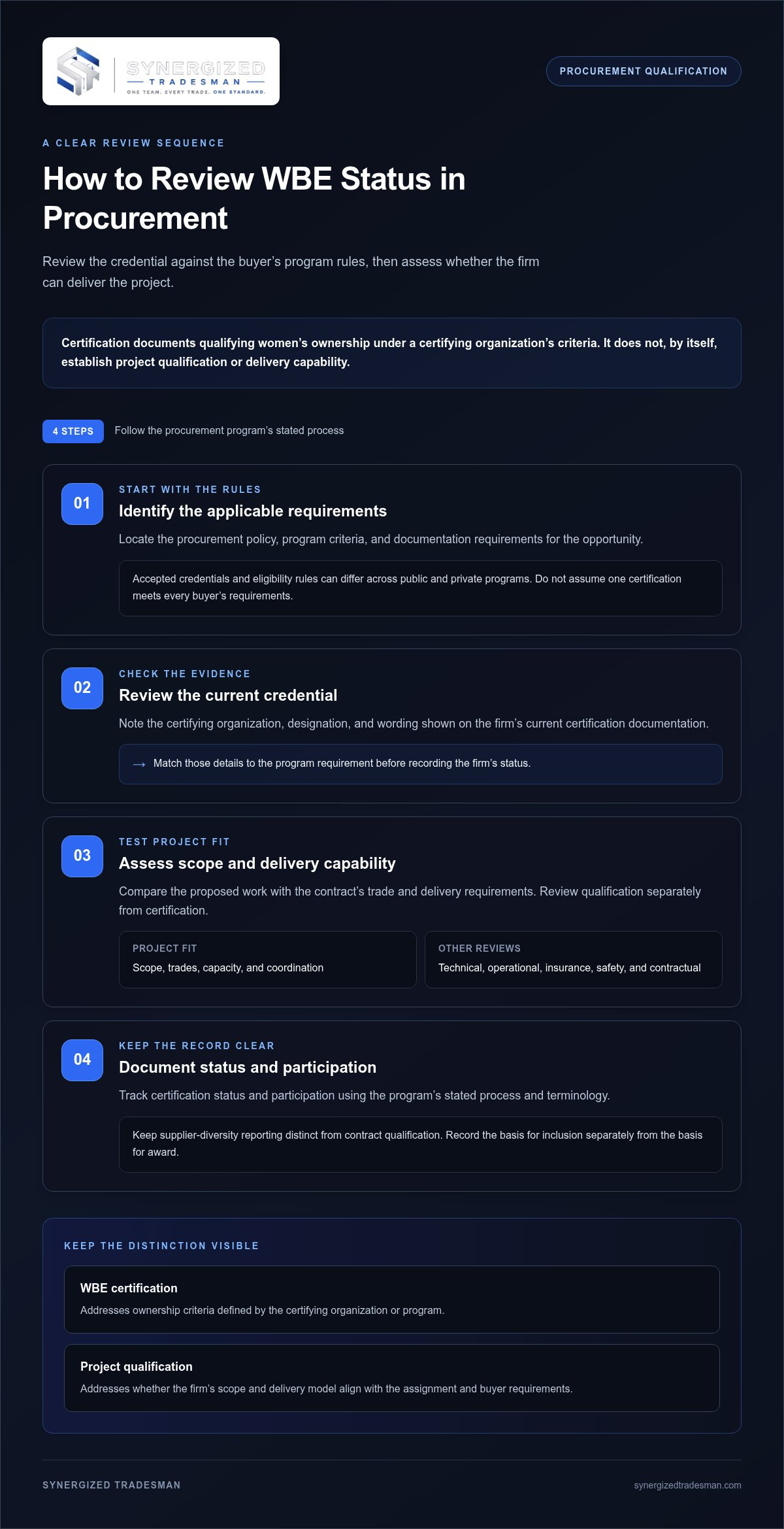
Start with the buyer’s procurement policy and the specific program connected to the opportunity. Review the firm’s current certification documentation, noting the certifying organization and credential wording. Match those details to the stated requirement before recording the status. This sequence supports accurate supplier-diversity tracking without implying that a credential establishes eligibility across all programs.
- Identify the rules. Locate the applicable procurement policy, program criteria, and documentation requirements.
- Review the credential. Record the designation and details shown on the current documentation.
- Assess the scope. Compare the proposed work with the contract’s trade and delivery requirements.
- Document participation. Track status and participation using the program’s stated process and terminology.
This recordkeeping matters because supplier-diversity reporting and contract qualification serve different purposes. A firm may be recorded as meeting a procurement category while still undergoing technical, operational, insurance, safety, and contractual review. Keep each evaluation visible in the procurement file so the basis for inclusion and the basis for award remain clear.
How to align certification with project qualification
After reviewing the credential, map the contract’s requirements to the proposed scope and responsibilities. For a multi-trade commercial project, identify which work is included, who coordinates dependencies, how progress and decisions are managed, and who owns documentation and close-out. Assess these controls directly rather than inferring them from certification status.
A certified WBE construction company can be part of a well-structured vendor pool, but award decisions still depend on the procurement’s applicable criteria. Connect the supplier-diversity record to the contract precisely: identify the relevant participation, define the assigned scope, and document how delivery responsibilities are organized. A commercial general trades contractor accountability model can help clarify how coordination ownership fits within a project’s delivery structure.
For commercial work spanning planning, procurement, field execution, and close-out, Synergized Tradesman brings those phases together through one accountable relationship. The accountable commercial construction delivery approach connects procurement alignment with clearly assigned project responsibilities.
How to Evaluate a WBE Construction Company's Delivery Capability
Certification is one part of vendor qualification. To assess delivery capability, compare the firm’s operating model with the scope, project phases, and close-out requirements. A credential does not establish capacity, safety outcomes, or past performance. Review those areas separately against the project’s stated criteria.
Use certification evidence to assess ownership status, and delivery evidence to assess how the work will be planned, coordinated, and completed. This distinction keeps procurement decisions grounded in relevant information. WBENC describes its credential and related recognition on its Benefits of WBENC Certification page, while project capability must be evaluated against the commercial work itself.
Compare the operating model, not just the credential
Map responsibility across the project lifecycle. Identify who connects trade sequencing with procurement dependencies, coordinates field activity, manages decisions, and assembles close-out documentation. A clear operating model shows where updates go and who follows through when an issue crosses trade or phase boundaries. One accountable relationship can reduce coordination fragmentation by giving the client a consistent point of ownership across those handoffs.
| Evaluation area | What to assess |
|---|---|
| Certification | Current credential wording and the procurement requirement it may address. |
| Scope fit | Alignment between the requested commercial work and the firm’s construction capabilities. |
| Coordination model | Ownership of planning, procurement dependencies, trade sequencing, field communication, and decisions. |
| Close-out responsibility | Who tracks completion items and organizes required project documentation through close-out. |
Use the table to structure a consistent review, not to assume that one category proves another. A firm may hold a relevant credential, for example, while the proposed work still needs a defined coordination plan, clear decision paths, and assigned responsibility for project records.
Match the firm's scope to the commercial project
Translate the project brief into a scope review. For a renovation, align demolition, framing, finishes, electrical, plumbing, and final cleaning with the work package and sequence. Look beyond a list of trade names: review how the work fits together, who owns planning and procurement, and how field execution and completion records will be managed.
For phased or repeated work, assess how standards, communication, and close-out records will remain consistent from one project to the next. Synergized Tradesman coordinates multi-trade commercial construction, renovations, retail refreshes, and rollout programs from planning and procurement through field execution and close-out. Its single accountable relationship supports continuity across project phases. More detail is available in the multi-trade commercial construction accountability model.
How a WBE Partner Can Coordinate Multi-Trade Commercial Work
Multi-trade commercial work depends on handoffs between tasks as much as on the individual trades. A commercial renovation or retail refresh may bring framing, flooring, electrical, and plumbing into a shared schedule. If the sequence does not account for dependencies, teams can lose alignment as plans move from procurement to the field. A unified project plan makes handoffs visible and assigns responsibility for coordinating them.
Coordinate trades across planning, procurement, and field execution
Coordination starts with the scope. During planning, the project team identifies work packages, relationships between trades, and the information needed for procurement. Those decisions shape how materials and work are sequenced in the field. For example, framing may need to align with electrical and plumbing requirements before later finishes such as flooring can proceed. The project plan should make these dependencies clear instead of leaving each trade to manage its own piece in isolation.
A certified WBE construction company can pair its procurement role with project coordination, creating one accountable relationship for organizing information across participating trades. That structure gives the client a clear path for communicating changes, tracking decisions, and understanding how an adjustment may affect other tasks. It also keeps procurement assumptions connected to field needs as execution progresses.
In a retail refresh, for instance, the sequence may involve demolition, framing, electrical or plumbing work, finishes, and final cleaning. The exact plan depends on the project scope. The coordination task is to define dependencies, align trade handoffs, and keep responsibilities clear as the work moves forward.
Maintain consistent oversight through close-out
Field execution needs an ongoing communication rhythm. The accountable project relationship should organize updates, surface coordination issues, and clarify who owns the next decision or action. If a field condition affects the planned sequence, the relevant trades and project stakeholders need a shared understanding of the adjustment and its effect on subsequent work. This keeps issue ownership connected to the project plan.
Close-out is part of delivery, not an afterthought. Final cleaning and project close-out bring the work toward completion, while documentation and outstanding items are tracked to resolution. Maintaining the same coordination structure through this stage preserves continuity between field activity and handover. A commercial construction coordination guide can help frame how communication, sequencing, and ownership fit together across project phases.
Synergized Tradesman coordinates multi-trade construction, renovations, retail refreshes, and rollout programs from planning and procurement through field execution and close-out. Its single accountable relationship and consistent project standards support coordination across trades and phases. Its multi-trade commercial construction services connect project planning with close-out.
Partner With Synergized Tradesman for Accountable WBE Construction Delivery
A WBE credential can support procurement goals. For commercial buyers, its value is strongest when paired with a defined delivery relationship. Synergized Tradesman is a certified women-owned commercial construction firm serving clients nationally, with one accountable relationship for coordinating work across project phases and trades.
What Synergized Tradesman brings to commercial projects
Synergized Tradesman manages commercial construction, renovations, retail refreshes, and rollout programs. The work can bring together general trades, demolition, metal stud framing and drywall, ACT ceilings, painting and wallcovering, flooring and tile, millwork and specialty installation, electrical, plumbing, final cleaning, and project close-out. Coordination connects these requirements rather than treating each trade as a separate project.
The delivery lifecycle runs from planning and procurement through field execution and close-out. A single accountable relationship helps organize project information and maintain continuity as responsibilities pass between phases. Synergized Tradesman applies a consistent standard across projects, supporting commercial programs that require repeatable coordination. Certification is part of that broader procurement and delivery relationship, not a substitute for project planning or a definition of delivery on its own.
Start a project conversation with a clear scope
Give the project discussion a practical starting point. Outline the work type, locations, phases, and trade requirements. For a renovation, describe the areas to be updated and the trades involved. For a retail refresh or rollout, explain how work is grouped across phases or repeated locations. These details help frame planning, procurement, field coordination, and close-out responsibilities around the project’s needs.
A focused scope also makes it easier to identify dependencies between trades and clarify how communication and decisions will be managed. The goal is a shared view of the work, its phases, and the ownership needed to carry it through completion. That structure supports an organized project discussion without assuming outcomes before the scope is understood.
- Project type: Commercial construction, renovation, retail refresh, or rollout program.
- Locations and phases: Where work is planned and how the program is staged.
- Trade requirements: The work packages and coordination needs within the scope.
- Close-out needs: Final cleaning and project completion responsibilities.
When evaluating a certified WBE construction company for commercial work, consider both procurement fit and who will own coordination from planning through close-out. Synergized Tradesman brings those considerations together through commercial construction management, multi-trade coordination, and one accountable project relationship.
Discuss your commercial project with Synergized Tradesman. Share the scope, phases, and trade requirements to begin a focused conversation about accountable WBE construction delivery.
Set Your Commercial Project Up for Clear Ownership
Turn procurement priorities into a project brief that connects the required work with clear coordination responsibilities. Identify what the project must accomplish, which trades are involved, and how decisions and close-out will be managed. This gives your team a practical basis for aligning supplier-diversity objectives with delivery expectations.
A certified WBE construction company can be a strong procurement fit when its project responsibilities are equally clear. Synergized Tradesman brings certified women-owned commercial construction, national project coverage, one accountable relationship from planning through close-out, and consistent standards across projects. That combination supports commercial construction, renovations, retail refreshes, and rollout programs while connecting procurement alignment with execution planning.
Bring your project scope, phases, and trade requirements into the conversation. Discuss your commercial construction project with Synergized Tradesman and take the next step toward a coordinated delivery plan.
Frequently Asked Questions
Does WBE certification automatically qualify a contractor for every supplier-diversity program?
No. A credential accepted by one program may not satisfy another program’s eligibility or documentation rules. A private-sector buyer and a public contracting program, for example, may use different categories or require different records. Match the contractor’s current credential to the specific opportunity, and record the status using the program’s own terms. This avoids treating certification as universal approval or assuming it guarantees eligibility for a contract.
Can a WBE construction company work on privately funded commercial projects?
Yes. WBE certification does not restrict a contractor to publicly funded work. A privately funded commercial project may include a certified firm in its sourcing process, whether the scope is a renovation, tenant improvement, or retail refresh. A certified WBE construction company still needs to meet the project’s scope and contract requirements. Consider the credential alongside technical fit, coordination responsibilities, and proposed commercial terms.
Can a buyer count WBE participation if subcontractors perform some field work?
Possibly, but subcontractor involvement alone does not determine whether participation qualifies for a program objective. The answer depends on the buyer’s rules, contract structure, the certified firm’s role, and how participation is documented. A buyer should distinguish work performed by the WBE prime from work assigned to subcontractors. Define scopes and responsibilities in the contract, then track participation according to the applicable program’s criteria.
What records help document WBE participation after a construction contract is awarded?
Maintain a clear project file that connects the firm’s credential, awarded scope, and actual participation. Depending on the program’s requirements, useful records may include the contract and approved changes, subcontract or purchase documentation, invoices, payment records, and progress reports. Keep records current as scope or trade assignments change. A consistent file helps procurement teams support reporting and reconcile planned participation with the work and payments recorded during delivery.
Does WBE certification replace a contractor's safety, insurance, or technical qualification review?
No. Certification addresses the ownership criteria of the relevant certifier or program. It does not replace the buyer’s review of safety documentation, insurance, technical qualifications, project controls, or ability to perform the required scope. Keep these checks distinct in the vendor review. For example, a procurement file can record certification status separately from insurance documentation and the project team’s assessment of trade coordination and close-out responsibilities.
Can WBE certification help a company meet a supplier-diversity goal on a private project?
It can support a buyer’s supplier-diversity strategy if the company’s credential and participation meet that organization’s rules. Private buyers may set their own goals, accepted certifications, and reporting methods, so certification does not automatically establish credit. Record how the program treats the firm’s role and scope, then retain supporting documentation. This makes the contribution easier to track while keeping the award decision tied to project requirements.


