

Most retail rollout delays aren't caused by material shortages; they're caused by a failure of trade synchronization. You've likely managed the chaos when a flooring crew arrives at a site only to find the drywallers are still finishing or the millwork is already obstructing the layout. It's a logistical bottleneck that eats your margin and pushes back opening dates. Managing commercial flooring and tile services across a national footprint requires more than a vendor list. It demands a single point of accountability to oversee the entire interior lifecycle.
This guide provides a framework to master high-volume procurement and multi-trade execution in 2026. You'll learn how to establish a single source of truth for quality standards and synchronize schedules to protect your critical path. We'll outline how a unified management model reduces project lifecycles and eliminates the common friction points between trades. By the end of this briefing, you'll have the tools to transform flooring from a recurring headache into a predictable, standardized component of your construction strategy. We focus on the operational efficiency required to deliver consistent results across every site in your portfolio.
Key Takeaways
- Integrate flooring as a critical phase between subfloor preparation and fixture installation to prevent common critical path delays.
- Select high-performance materials like Luxury Vinyl Tile (LVT) and porcelain based on 2026 durability metrics for high-traffic retail environments.
- Optimize national rollouts by utilizing centralized procurement and logistics for your commercial flooring and tile services.
- Execute standardized field protocols, including ASTM-compliant moisture testing, to ensure long-term installation quality across all sites.
- Consolidate multi-trade oversight under a single point of accountability to maintain brand integrity and reduce the total project lifecycle.
The Strategic Role of Commercial Flooring and Tile Services in 2026
Effective commercial flooring and tile services are no longer viewed as a simple material installation. In 2026, these services represent a critical integration point between subfloor remediation and the final placement of fixtures. This phase is often the most vulnerable period in a retail refresh timeline. It's the moment where structural preparation must meet precise aesthetic requirements while allowing subsequent trades to begin their work. Success requires a transition from fragmented, local installer models to a single source of accountability that manages the entire lifecycle of the floor.
Beyond Aesthetics: Flooring as a Critical Path Element
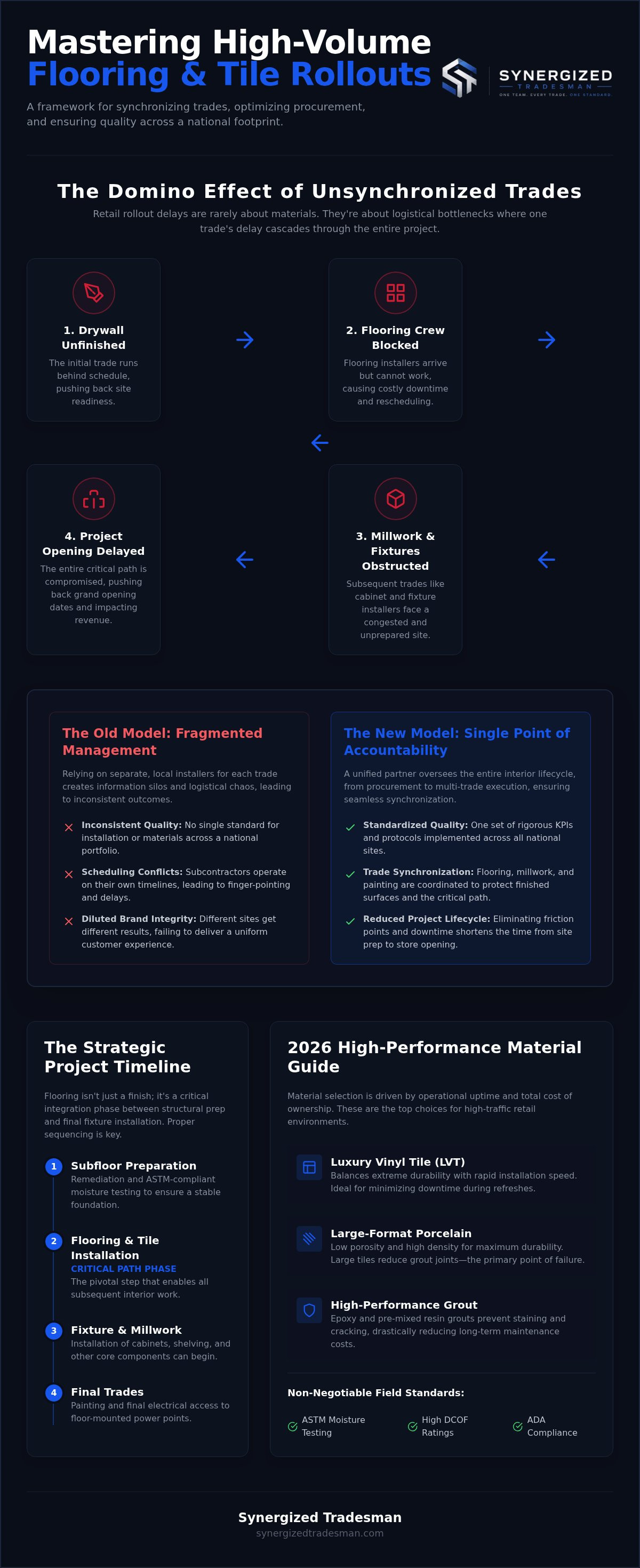
Flooring delays create a domino effect that compromises the entire project schedule. When the floor isn't ready, millwork teams cannot install cabinets, and electrical crews lose access to floor-mounted power points. These scheduling conflicts frequently stem from unmanaged material lead times. Selecting specific flooring materials requires a procurement strategy that accounts for logistics well before the site is cleared. A single accountable relationship allows for real-time troubleshooting. If a site issue arises, you have one point of contact to resolve the conflict rather than a web of finger-pointing subcontractors. This oversight ensures that project close-out dates remain firm despite the complexities of high-volume rollouts.
The Risks of Fragmented Trade Management
Relying on a local installer model often leads to inconsistent quality across a national portfolio. These silos prevent the standardization necessary for brand integrity. Common failure points occur when flooring is managed without regard for adjacent trades; for example, failing to coordinate with demolition crews or millwork installers. A managed rollout model eliminates these gaps. By utilizing commercial flooring and tile services within a multi-trade framework, you ensure that every site follows the same rigorous standards. This approach provides several operational advantages:
- Trade Synchronization: Coordinating flooring with metal stud framing and painting to prevent damage to new surfaces.
- Standardized Quality: Implementing one set of KPIs across all national sites to ensure a uniform customer experience.
- Operational Continuity: Choosing high-performance materials that support 24/7 facility operations and reduce long-term maintenance burdens.
Moving toward a unified management structure provides the stability required in a fast-moving industry. It protects your investment by treating the floor as a strategic asset rather than a commodity purchase. High-performance materials like luxury vinyl and porcelain are now the standard for facilities that can't afford downtime for frequent repairs.
Evaluating Commercial Flooring Materials for High-Traffic Environments
Material selection in 2026 is driven by the necessity for operational uptime. Procurement teams must weigh initial installation speed against the total cost of ownership. High-traffic environments like retail hubs and corporate offices require materials that meet rigorous sustainable flooring standards while maintaining brand integrity across a national footprint. Choosing the right commercial flooring and tile services involves a technical assessment of durability, maintenance requirements, and trade synchronization capability.
Performance Standards for Retail and Commercial Tile
Technical specifications like PEI ratings and Dynamic Coefficient of Friction (DCOF) are non-negotiable for safety compliance. For high-traffic commercial zones, porcelain is the preferred choice over traditional ceramic due to its lower porosity and higher density. Large-format porcelain tile offers a distinct operational advantage by significantly reducing the number of grout joints. This reduction minimizes the primary failure points in any tile installation. Utilizing high-performance grout technologies, such as epoxy or pre-mixed resins, further decreases long-term maintenance costs by preventing staining and cracking. These materials ensure that surfaces remain slip-resistant and stable, satisfying Section 302 of the ADA Standards for Accessible Design.
LVT and Carpet Tile: Balancing Durability with Speed of Install
Luxury Vinyl Tile (LVT) remains the industry standard for rapid retail refreshes. Its ability to mimic natural materials while offering high moisture resistance and immediate foot traffic capacity makes it ideal for the critical path. For open-plan corporate offices, modular carpet tile provides essential acoustic benefits. This modular format allows for localized repairs without disrupting the entire facility. When evaluating these options, consider the following framework for 2026:
- Installation Speed: LVT and carpet tile allow for faster trade turnover compared to wet-set tile.
- Slip Resistance: Ensure all materials meet the minimum DCOF of 0.42 for wet surfaces to maintain safety standards.
- Maintenance: Prioritize non-porous surfaces in high-spill areas to reduce recurring cleaning cycles.
Aligning material choice with your specific site conditions prevents premature wear and costly remediations. If you're managing a national rollout, partnering with a single accountable manager helps standardize these material choices across every location to ensure brand consistency and operational reliability.
The Commercial Flooring Procurement Guide: Volume and Logistics
National rollout programs in 2026 require a shift from reactive buying to strategic volume management. Fragmented sourcing frequently leads to inconsistent dye lots and scheduling gaps that compromise brand integrity. Centralized procurement ensures that every site receives the same material specifications simultaneously. This oversight maintains a uniform aesthetic across a national footprint. Synergized Tradesman manages the entire chain of custody, from initial warehouse orders to final field execution. This model eliminates the "out of stock" risks that often derail local contractors who lack the capacity for high-volume inventory management.
Centralized Procurement vs. Local Sourcing
Large-scale projects benefit significantly from bulk purchasing power. Centralizing your commercial flooring and tile services allows for better inventory control and provides a buffer against market fluctuations. It also supports specific corporate procurement goals. As a certified women-owned business (WBE), Synergized Tradesman helps organizations meet diversity requirements while maintaining rigorous operational standards. This centralized approach reduces the administrative burden of managing dozens of local vendors. It provides a single source of truth for reporting and accountability, ensuring that procurement data is transparent and actionable for high-level decision-makers.
Managing Lead Times for National Rollout Programs
The 2026 global supply chain remains complex, requiring proactive planning to avoid critical path delays. Lead times for high-performance porcelain or specialty LVT typically range from 8 to 14 weeks depending on the manufacturing origin. A "just-in-time" delivery model is essential for urban retail environments where site storage is limited. Proper coordination prevents site congestion and trade interference. Consider this standard timeline for a synchronized rollout:
- Phase 1: Material selection and submittal approval (Weeks 1-2).
- Phase 2: Bulk order placement and warehouse staging (Weeks 3-11).
- Phase 3: Site readiness assessment and trade synchronization (Week 12).
- Phase 4: Site delivery and immediate installation (Week 13-14).
Synchronizing material arrival with field readiness is a requirement for project success. It ensures that flooring crews aren't waiting for deliveries and that materials aren't obstructing other interior trades like electrical or millwork teams. This logistical precision protects the project's critical path and ensures that retail refreshes stay on schedule. By managing the logistics in-house, we remove the burden of multi-party coordination from the client, acting as a shield against site-level delivery conflicts.
Field Execution and Site Preparation: Ensuring Installation Excellence
Field execution transforms a procurement strategy into a tangible asset. Installation excellence depends on a strictly sequenced protocol that begins long before the first tile is set. Failure to prepare the substrate is the most common cause of flooring failure in high-traffic environments. We utilize a five-step execution model to ensure consistency across every national site:
- Step 1: Conduct moisture testing and subfloor assessment according to ASTM standards.
- Step 2: Execute demolition and site clearing in synchronization with other trades to maintain a clean environment.
- Step 3: Implement precision leveling and substrate preparation to meet industry flatness tolerances.
- Step 4: Coordinate tile layout with millwork and fixture installers to ensure seamless transitions and centered aesthetics.
- Step 5: Execute final cleaning and project close-out for immediate occupancy.
This systematic approach ensures that commercial flooring and tile services are delivered on time and within the specified quality parameters. It removes the guesswork from the field and replaces it with a disciplined management framework.
Moisture Mitigation and Subfloor Preparation Standards
Vapor emission from concrete slabs is a primary risk factor for adhesive failure. In 2026, we utilize ASTM F1869 and F2170 standards to quantify moisture levels before beginning any installation. If levels exceed manufacturer specifications, we implement advanced moisture barriers and high-performance self-leveling underlayments. These materials create a stable foundation that prevents bubbling, delamination, and mold growth. Proper substrate preparation doesn't just ensure a level finish; it extends the warranty of the materials by meeting the rigorous compliance standards required by global manufacturers.
Coordinating Flooring with Electrical and Millwork Trades
Trade sequencing is the most critical variable in field execution. Tile layout must be synchronized with floor-mounted electrical outlets and plumbing penetrations to avoid awkward cuts or structural interference. This level of coordination is a core component of interior commercial construction management. By managing the sequencing in-house, we ensure that transitions between different materials, such as tile to carpet, are flush and trip-free. This trade synchronization prevents the damage that often occurs when subsequent crews move heavy equipment over newly installed surfaces. To ensure your next project follows this rigorous execution model, request a site readiness assessment from our project management team.
Optimizing Your Flooring Program with a Single Accountable Partner
Managing national rollouts requires a transition from simple vendor management to a strategic partnership model. The Synergized Tradesman accountability model addresses the friction inherent in large-scale refreshes by providing a single point of oversight. This structure ensures that brand integrity isn't diluted by local variations in installation quality across different regions. In 2026, the implementation of digital field execution tracking provides real-time transparency into every site's progress. It allows facility managers to verify site readiness and material arrival through automated reporting. We act as a shield for the client, taking on the burden of multi-party logistics with a sense of total responsibility.
The Single Source of Truth Model for Flooring Services
Facility managers face a significant administrative burden when coordinating separate trades for commercial flooring and tile services. A single contact point streamlines communication and eliminates the risks of misaligned schedules that often lead to project drift. This efficiency is maximized when flooring is integrated into a broader multi-trade commercial construction strategy. Centralized project management platforms serve as the single source of truth for all interior trades. They provide documented evidence of moisture testing, substrate preparation, and layout approvals. This level of transparency ensures that every stakeholder has access to the same factual data, which reduces disputes and accelerates the approval process for high-volume programs.
Quality Control and Project Closeout Deliverables
A successful project ends with a punch-list-free close-out. Achieving this result requires rigorous quality control during the installation process rather than relying on a final inspection at the end. We provide comprehensive closeout packages that include final cleaning documentation and manufacturer warranty activations. These deliverables ensure that the facility is ready for immediate occupancy without any operational delay. For organizations planning high-volume retail or commercial renovations, standardized reporting is essential for maintaining brand consistency across a national footprint. Our WBE certification also ensures that your commercial flooring and tile services procurement strategy meets corporate diversity and inclusion targets. It simplifies the path to operational efficiency by combining expert execution with strategic oversight. Contact our project management team to begin planning your 2026 refresh cycle.
Securing Operational Continuity for Your 2026 National Rollouts
Standardizing commercial flooring and tile services across a national portfolio requires more than a material vendor. It demands a logistical framework that synchronizes subfloor preparation with millwork and electrical schedules to prevent site-level delays. You've seen how centralized procurement and ASTM-compliant field execution protect your investment from premature failure. Relying on a single source of truth for reporting ensures that every site meets the same rigorous standards of quality. This disciplined approach eliminates the friction of managing fragmented trade partners while providing the organized oversight needed to hit your opening dates.
Our team brings national multi-trade project management expertise to every engagement. Accountability drives results. We maintain a single standard of quality across all 2026 projects to ensure your brand integrity remains intact. As a certified women-owned business (WBE), we act as a shield for your organization. We take on the burden of complex logistics so you can focus on broader strategy. Achieve predictable results through a partnership built on facts. Experience the relief of organized oversight. We're ready to help you build with confidence.
Streamline your next rollout with Synergized Tradesman’s accountable flooring management
Frequently Asked Questions
What are the most durable commercial flooring options for 2026?
High-performance porcelain and Luxury Vinyl Tile (LVT) are the industry standards for durability in 2026. Porcelain offers superior resistance to heavy foot traffic and moisture; while modern LVT provides a resilient surface that's easy to repair. These materials are selected for their ability to withstand 24/7 facility operations with minimal maintenance. Choosing the right material ensures that your interior environment remains functional and aesthetically consistent throughout its lifecycle.
How do you manage moisture issues in commercial tile installation?
Moisture mitigation begins with ASTM-compliant testing to quantify vapor emission levels in the concrete slab. If levels exceed manufacturer specifications, we implement high-performance moisture barriers and self-leveling underlayments to create a stable substrate. This process prevents adhesive failure and delamination, which are common causes of project delays. Proper mitigation is a core part of our commercial flooring and tile services, ensuring that warranties remain valid and the installation remains stable.
Why is a single accountable relationship better than hiring multiple trade contractors?
A single accountable relationship eliminates the scheduling conflicts and finger-pointing common with multiple trade partners. By consolidating oversight, you gain a single source of truth for project data and reporting. This model streamlines communication for facility managers and reduces the administrative burden of managing disjointed contracts. It ensures that every trade is synchronized, which protects the project's critical path and reduces the total lifecycle of the renovation.
What is the typical lead time for commercial flooring procurement in national rollouts?
Lead times for commercial flooring in 2026 typically range from 8 to 14 weeks. This duration accounts for material selection, bulk procurement, and warehouse staging before site delivery. For national rollouts, we utilize a just-in-time delivery model to coordinate material arrival with site readiness. Early planning is essential to secure inventory and avoid the out of stock delays that frequently derail high-volume retail refresh programs.
How does Synergized Tradesman coordinate flooring with other trades like electrical or millwork?
We utilize a multi-trade construction model to synchronize flooring with electrical and millwork installations. Our project managers coordinate the placement of floor-mounted outlets and plumbing penetrations before the tile is set. This sequencing prevents damage to new surfaces and ensures seamless transitions between different materials. By managing these trades under one contract, we eliminate the gaps in communication that often lead to awkward cuts or structural interference during the build-out.
Can you provide commercial flooring and tile services for national retail refreshes?
Yes, Synergized Tradesman specializes in providing end-to-end management for national retail refreshes and high-volume rollout programs. We deliver commercial flooring and tile services as part of a comprehensive interior package that includes demolition, painting, and fixture installation. Our national footprint allows us to execute consistent refreshes across every location in your portfolio. This unified approach ensures that your brand integrity is maintained through a single standard of quality.
What are the benefits of working with a WBE-certified construction management firm?
Partnering with a WBE-certified firm like Synergized Tradesman helps organizations meet corporate diversity and inclusion targets while ensuring operational excellence. Beyond compliance, we offer a pragmatic, results-oriented approach to construction management. Our certification reflects a commitment to rigorous standards and disciplined execution. Clients benefit from a partner that understands the complexities of national logistics and provides the organized oversight required to manage multi-trade requirements efficiently.
How do you ensure consistent quality across multiple geographic locations?
Consistency is achieved through a centralized management model that applies one standard of quality to every project. We utilize digital reporting and field execution tracking to monitor progress across all geographic locations in real-time. This oversight ensures that every site follows the same ASTM-compliant protocols and material specifications. By removing the reliance on local vendor variations, we provide a uniform customer experience and maintain brand integrity throughout your entire national portfolio.


