

Consistency across a store portfolio doesn’t come from treating every site as identical. National account retail construction works when shared standards guide execution while leaving room for each location’s conditions. That balance can be difficult to maintain when separate site teams, trade relationships, and schedules create different paths from planning to closeout.
Unclear handoffs can disrupt a rollout. The challenge is to preserve brand requirements without overlooking site-specific constraints. A repeatable delivery framework brings standards, procurement, trade coordination, and accountability into one managed process. It clarifies what must remain consistent and what needs to be coordinated for each location.
This guide explains how to structure that approach across a portfolio. It covers aligning project standards, coordinating multiple trades through one accountable relationship, connecting planning and procurement with field execution, and managing closeout consistently. The goal is clear oversight and consistent finishes from site to site, without assuming every store presents the same conditions.
Key Takeaways
- Define which requirements apply portfolio-wide and which decisions depend on each store’s scope and conditions.
- Use national account retail construction to set shared expectations for scope, quality, and project communication.
- Organize location data and portfolio priorities before field execution to support practical project planning.
- Assign decision ownership early so site-level questions can be resolved within the program’s standards.
- Connect procurement, trade coordination, field execution, and closeout through one accountable project relationship.
What National Account Retail Construction Means for Multi-Location Brands
National account retail construction is the coordinated planning and delivery of construction work across multiple store locations under shared program controls. These controls establish common expectations for scope, brand standards, communication, and reporting. They don’t require every store to have the same layout, scope, or construction conditions.
That distinction matters. A portfolio may include new construction, renovations, and retail refreshes, each with different site requirements. Shared standards provide a consistent reference point, while project-level decisions account for the actual building and work at each location. A national program therefore does more than group separate jobs: it organizes them within a common delivery framework.
The model connects stakeholders who might otherwise manage different parts of the work independently. Retail real estate teams contribute location and property context. Facilities teams bring operational requirements. Procurement teams coordinate purchasing, while construction teams translate approved scope and standards into field execution. Clear ownership helps these groups work from aligned project information.
Construction involves coordinated activities and decisions, as outlined in the broad overview of Construction. For retail portfolios, the added challenge is applying the work consistently across locations without treating different sites as interchangeable.
How a national account differs from a single-store project
A single-store project is usually planned around one location’s scope, schedule, and execution. A national account adds portfolio-level planning: teams can establish shared requirements and reporting practices across concurrent projects, then coordinate each site against them. This reduces repeated setup, but each location still needs a plan based on its conditions.
Consistent reporting also clarifies project status, open decisions, and accountability across the portfolio. Teams can review progress using a common reference instead of relying on disconnected updates. This makes it easier to understand how individual projects fit the broader program.
Which retail projects can fit a national account model?
The model can support new construction, renovations, and retail refreshes when multiple locations need coordinated oversight. Work may include demolition, framing and drywall, ceilings, painting, flooring, tile, millwork, fixture installation, electrical, plumbing, final cleaning, and project closeout. The scope at each site depends on the project.
A national account is a delivery structure, not a public-facing directory of construction services. It defines how projects are organized, communicated, and held to shared standards. For example, a common finish expectation can guide work across stores, while the specific finish scope and site coordination remain tied to each location.
Before work begins, clarify:
- Which standards apply across the portfolio.
- Which decisions belong to each site’s project team.
- Who owns communication and issue resolution across stakeholders.
With those boundaries clear, retail brands can coordinate multiple projects through one program while preserving the flexibility needed for site-level execution.
How National Account Retail Construction Maintains Control from Plan to Closeout
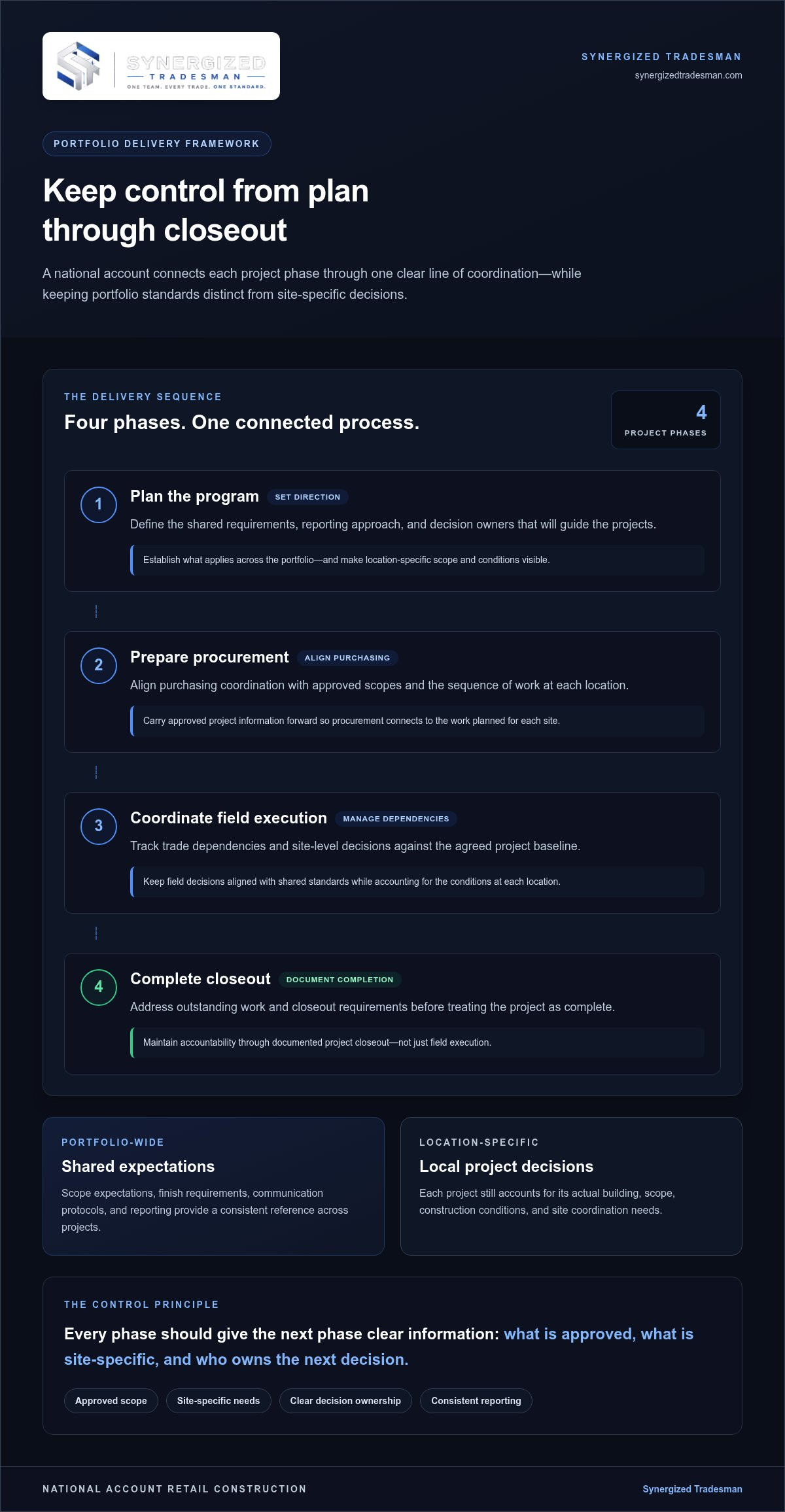
Control depends on carrying decisions forward through every project phase. A portfolio standard only helps if it informs procurement, guides field execution, and remains visible through closeout. In a national account retail construction program, each phase should provide clear information for the next. Teams need to know what is approved, what is site-specific, and who owns the next decision.
Accountability means one clear line of coordination from program planning through procurement, field execution, and documented project closeout. That line connects work across trades and gives stakeholders a consistent route for progress updates, issues, and decisions.
- Plan the program. Define the shared requirements, reporting approach, and decision owners that will guide the projects.
- Prepare procurement. Align purchasing coordination with approved scopes and the sequence of work at each location.
- Coordinate field execution. Track trade dependencies and site-level decisions against the agreed project baseline.
- Complete closeout. Address outstanding work and closeout requirements before treating the project as complete.
Set program standards before projects enter the field
Document scope expectations, finish requirements, and communication protocols in a format teams can use across projects. Separate portfolio-wide requirements from location-specific information, such as the scope and conditions of an individual site. This gives each project a consistent baseline while making local decisions visible. Early alignment helps teams surface gaps before they affect field coordination.
A shared standard also gives reviewers a common reference for evaluating scope and quality. It can clarify which finish expectations apply across stores and how exceptions or changes should be communicated. The Retail Contractors Association identifies ethics, safety, quality, and professionalism as key areas in retail construction, reinforcing the value of clear expectations and disciplined project communication.
Coordinate trades and closeout through one accountable relationship
Trade scopes connect in the field. Demolition can affect framing; framing and drywall can determine when ceilings and finishes proceed; electrical and plumbing work must be coordinated with related construction activities. Procurement and field planning need to account for those dependencies rather than treating each trade as an isolated task. One accountable relationship can coordinate the moving parts and route issues to the right decision owner.
Closeout is part of delivery, not an administrative step to leave until the end. Track remaining work, final cleaning, and project closeout requirements as defined tasks. This keeps teams informed through completion and gives stakeholders a clear status for each location. Synergized Tradesman coordinates planning, procurement, field execution, and closeout through one accountable relationship. Retail brands planning a coordinated rollout can explore managed retail construction to connect those phases.
Standardization vs. Site Flexibility in National Retail Construction
A national construction model can sound rigid if standardization is mistaken for identical work at every store. The purpose is different: set consistent expectations for brand-facing results and project communication, then coordinate each site’s scope around its actual conditions. In national account retail construction, consistency means controlled outcomes, not identical methods or scopes.
This distinction helps teams make practical decisions. A shared standard gives project teams a clear reference, while site-level documentation explains where a location needs a different approach and why. The comparison below separates the two:
| Portfolio standard | Location-specific decision |
|---|---|
| Finish expectations for customer-facing areas | How existing surfaces at a particular store affect preparation and installation |
| Common communication and status reporting | Which site conditions, scope details, or trade dependencies need escalation |
| Shared expectations for completed work | How the work sequence is coordinated with the location’s existing conditions |
| Consistent documentation of decisions | The project-level reason for a scope variation and its approval path |
A national model doesn’t have to override site realities. It should make them visible within a consistent program, so a variation is understood as a managed project decision rather than an undocumented departure from the brand standard.
What should remain consistent across locations?
Keep brand-facing finish expectations and communication processes consistent. Teams should understand the expected result, how project information is shared, and how a question or change is recorded. Common expectations give stakeholders a shared basis for discussing work across different project teams, without relying on an invented score or inspection system.
Consistency also supports clearer handoffs. When teams describe scope changes and finish decisions in a common way, portfolio stakeholders can compare project updates more easily. The standard should state the expected outcome, not prescribe a single execution method when site conditions differ.
What should adapt to each retail site?
Site scope, existing conditions, and trade coordination call for project-level review. A store refresh may include flooring and fixture work, while another location may require additional demolition or coordination with electrical and plumbing scopes. Those differences affect the work plan, but they don’t automatically change the brand-facing expectation.
For example, a portfolio may set one shared expectation for a finished flooring transition. At one site, existing floor conditions may allow a direct installation approach; at another, the team may need to coordinate additional preparation. Document the reason for the variation, the decision owner, and how the final result relates to the shared requirement.
This structure addresses the concern that a national program is too rigid. Teams retain flexibility where the site requires it, while recording decisions in a way that preserves portfolio oversight. The standard remains stable; the project plan adapts.
Prepare a Retail Portfolio for National Account Construction
Preparation gives a construction program a usable starting point. Before field execution, align portfolio goals, location information, anticipated scope, and decision ownership. This helps teams distinguish shared requirements from site-level details, then coordinate procurement and trade work against a clear baseline.
For broader context on planning retail projects, use this retail store construction reference guide alongside your portfolio planning.
Build readiness in sequence:
- Set portfolio goals. Identify the purpose of the rollout or refresh and establish project priorities, such as which locations or types of work need attention first.
- Organize location data. Create a shared record of locations, project types, known site conditions, and relevant project information. Mark gaps so teams can address them during planning.
- Outline anticipated scope. Note the work expected at each site and distinguish confirmed requirements from items that need project-level review.
- Assign decision ownership. Identify who provides direction, approves scope changes, and resolves questions that affect individual locations or portfolio standards.
Organize scope, locations, and decision ownership
Use a consistent format for each location so teams can compare project needs without assuming the work is identical. Include the site identifier, project type, known scope, relevant existing conditions, and open questions. Clarify who owns each decision and how approvals are recorded. This shared information gives procurement and field teams a common reference as planning advances.
Align trade requirements and delivery expectations
Group anticipated work by trade, but keep the scope specific to each store. A portfolio may include demolition, framing and drywall, ceilings, painting, flooring and tile, millwork and fixtures, electrical, plumbing, or project closeout. Not every location will need every scope. Define how procurement information, field updates, quality expectations, and closeout requirements will be communicated so handoffs remain clear.
Trade coordination depends on clear ownership across scopes. For more detail on organizing responsibilities, review the multi-trade construction accountability model. A prepared portfolio makes it easier to identify dependencies, route decisions, and track location-specific variations without losing sight of program priorities.
Use this readiness work to establish a practical starting point, not to lock every site into an identical plan. Synergized Tradesman coordinates planning, procurement, field execution, and closeout through one accountable relationship. Coordinate your retail construction portfolio with a managed approach from planning through closeout.
How Synergized Tradesman Manages National Retail Construction Programs
Synergized Tradesman manages commercial construction, renovations, retail refreshes, and rollout work from planning through closeout. For a retail portfolio, that means connecting program requirements with the practical work at each location. Planning and procurement inform field execution, while project closeout remains part of delivery rather than a separate handoff.
The model centers on one accountable relationship for procurement coordination and multiple trade scopes. This gives stakeholders a clear point of coordination across work that might otherwise involve separate conversations. It supports a consistent standard across projects without assuming each store has the same scope or site conditions.
One accountable relationship across multiple trade scopes
Synergized Tradesman coordinates trade requirements as part of an integrated commercial construction process. Depending on project needs, work may involve general trades, demolition, metal stud framing and drywall, ceilings, painting, wallcovering, flooring, tile, millwork, fixtures, specialty installation, electrical, plumbing, and final cleaning or closeout. Each scope is coordinated according to the location’s requirements.
Centralized coordination gives stakeholders one accountable relationship for procurement and trade coordination, helping reduce fragmented communication. It also provides a clear path for project information to move between planning and field execution, without implying that every project uses every trade.
Consistent standards from planning through closeout
Synergized Tradesman applies a consistent standard across projects while coordinating site-level requirements. At the planning stage, portfolio expectations can inform procurement and project preparation. During field execution, teams coordinate the work around each location’s needs. Closeout completes that sequence, keeping final cleaning and project completion within the managed lifecycle.
Synergized Tradesman is a certified women-owned commercial construction firm. Its planning-to-closeout model connects project phases under one accountable relationship, giving retail teams a structured way to coordinate portfolio work while allowing each project’s scope to reflect its site.
For retail leaders organizing multi-location work, national account retail construction requires both consistent program oversight and practical coordination at each store. Discuss a national retail construction program with Synergized Tradesman.
Turn Portfolio Priorities into a Clear Next Step
Start by identifying where a coordinated construction approach can make the greatest difference to your retail portfolio. Select an upcoming rollout, renovation, or refresh and define the decisions that need to be made before work begins. A focused starting point can help your team clarify priorities and establish how program standards will guide project-level planning.
Use that first scope to align stakeholders around the outcomes they need, the information they’ll rely on, and how decisions will be handled as site conditions emerge. This gives national account retail construction a practical foundation: a clear program direction, with room to adapt execution to each location.
Synergized Tradesman manages multi-trade commercial construction and renovation work through one accountable relationship. Discuss your national retail construction program and define a delivery approach that fits your portfolio’s priorities.
With a clear starting point and coordinated ownership, your next project can help move the wider program forward with confidence.
Frequently Asked Questions
Is national account retail construction only for large retail chains?
No. National account retail construction describes how work across multiple locations is coordinated, not a required company size or minimum store count. A retailer with a smaller portfolio may still benefit if projects share standards or need centralized oversight. For example, a brand planning several refreshes may need common reporting and finish expectations even if its locations differ. Assess the project mix, shared requirements, and coordination effort to determine whether a program approach fits.
Can a national account construction program handle both remodels and new stores?
Yes. A program can include new construction, renovations, and refreshes, with scope and coordination tailored to each project. A new store may require broad construction work, while a remodel may focus on selected finishes or fixtures. Synergized Tradesman manages commercial construction and renovation work, organizing delivery around each project’s requirements. Grouping different project types under one program can help teams plan shared expectations without treating every location as the same job.
How should a retail brand measure consistency across construction locations?
Measure consistency against requirements the brand has defined, not the assumption that every site should have identical construction details. For example, teams can review whether approved finish expectations were followed, project updates used agreed communication practices, and required closeout items were addressed. Record site-specific decisions alongside those checks. This lets portfolio leaders distinguish a justified variation from a missed requirement and identify where standards or project inputs need clarification.
What information should a national retail construction brief include?
Include the portfolio objective, project types, location identifiers, known scope, brand or finish expectations, and the people responsible for direction and approvals. Separate confirmed details from open questions. For example, note whether a location’s flooring replacement is part of the approved scope or still needs a decision. This helps teams avoid treating assumptions as instructions and gives procurement and trade coordination a more reliable basis for planning.
How does one accountable construction relationship help manage multiple trades?
It gives the client a central route for coordinating trade-related questions and decisions. For example, if fixture installation depends on finish work being completed first, the relationship can connect the relevant scope information and clarify ownership of the next action. Trade expertise remains essential; centralized coordination organizes how requirements and decisions move between parties. This can make responsibilities easier to follow than managing each trade through disconnected communication paths.
Does national account retail construction require identical scopes at every location?
No. Shared program expectations can coexist with different scopes and execution plans. A store in need of a fixture update may not require the same work as a location undergoing a broader renovation. Document the reason for each variation, who approved it, and how it relates to the brand’s common requirements. That record helps portfolio teams maintain oversight while giving project teams room to respond to actual site needs.
What does project closeout contribute to a retail construction program?
Closeout gives each project a defined completion point and records whether agreed final requirements have been addressed. For a retail location, teams might track remaining work, final cleaning, and the documentation or handoff items established for that project. Setting those expectations early makes closeout part of the delivery plan rather than a last-minute task. The applicable items depend on scope, so the closeout record should match the project’s agreed requirements.


