

A fixture package can be consistent across stores and still create a different installation challenge at every location. Retail fixture rollout contractors turn that standardized package into site-ready execution by coordinating schedules, trade dependencies, installation, and quality checks before small gaps become field delays.
Stores rarely share identical conditions. Fixture deliveries may arrive without a clear installation sequence, while site readiness, access, and surrounding construction work vary by location. Internal retail and construction teams need repeatable standards that still account for those differences.
This guide explains what retail fixture rollout contractors manage across planning, procurement coordination, field execution, and closeout. It covers how to document site-specific conditions, coordinate trades such as electrical, painting, millwork, and specialty installation, and use consistent inspections and closeout records to support accountability across a rollout. Synergized Tradesman brings these commercial construction activities together under one accountable relationship, helping teams coordinate execution without treating every store as if it were the same.
Key Takeaways
- Retail fixture rollout contractors coordinate site readiness, trade sequencing, installation, and closeout. Fixture design and manufacturing are separate responsibilities.
- Use a consistent workflow to identify each store’s access, layout, existing-condition, and work-area constraints before installation begins.
- Clarify ownership among fixture manufacturers, installation crews, and multi-trade rollout contractors to prevent gaps in site coordination.
- Standardize scopes, schedules, inspection records, and closeout checklists, then document each store’s conditions to maintain quality across locations.
- Connect fixture and millwork installation with surrounding construction trades through coordinated planning, field execution, and project closeout.
What Retail Fixture Rollout Contractors Manage Across Multiple Stores
A retail fixture rollout contractor coordinates store-site readiness, trade sequencing, fixture installation, quality checks, and closeout across multiple locations. The work focuses on field execution: translating the program plan into organized activity at each store and tracking what is complete, outstanding, or affected by site conditions.
This responsibility connects the retailer’s rollout plan with the work happening in each location. The retailer sets program requirements and operating priorities. Fixture suppliers handle the design or manufacture of the fixture package, while the project team aligns scope, procurement, schedules, and site information. Field crews perform their assigned installation and related construction work. The contractor coordinates these handoffs so crews have a defined sequence and store-specific constraints are visible before work begins.
Where the contractor fits in the fixture rollout
Fixture production and commercial construction coordination are distinct activities. A supplier may produce the fixtures, and warehousing or delivery may be managed separately. The rollout contractor prepares and coordinates site work by aligning installation with surrounding trades, tracking field progress, documenting quality checks, and organizing closeout. These responsibilities reflect construction management principles, where planning, coordination, and control connect project participants and work phases.
Retail operations remain the retailer’s responsibility. The contractor coordinates construction activity around the operating requirements provided for each store, rather than setting merchandising plans or managing store staff. Clear handoffs establish who supplies the package, who prepares the site, who installs each component, and who records completion or open items.
Why multi-store fixture work needs a consistent operating model
A shared fixture package doesn’t make every store identical. Common scope documents and work sequences create a repeatable baseline, while a store review identifies conditions that may change how that baseline is delivered. Field teams can document access routes, layout differences, existing finishes or services, and work-area restrictions before mobilization. The schedule and installation sequence can then reflect those conditions without losing alignment with the broader program.
- Standardize: Use consistent scope descriptions, work sequences, inspection records, and closeout requirements.
- Validate: Record store access, existing conditions, and operational constraints as location-specific inputs.
- Coordinate: Align fixture installation with related construction work so trade dependencies are clear.
This balance supports consistent execution without assuming every site can follow an identical field plan. For broader context on coordinating construction work in retail environments, see the retail store construction guide. Retail fixture rollout contractors connect program standards with the documented realities of each store.
How Retail Fixture Rollout Contractors Coordinate Site Readiness and Trades
Site readiness is a sequence of checks, not a box to tick on installation day. Fixtures should be installed only after the site, preceding work, and trade handoffs are ready. Retail fixture rollout contractors use a location-by-location workflow to identify constraints early and coordinate the work required by the project scope.
Prepare each location before fixtures arrive
Before mobilization, the project team reviews the scope documents, available site information, delivery assumptions, and planned installation sequence. Field teams then compare the plan with actual store conditions. They document access routes, layout differences, existing conditions, available work areas, and constraints that could affect staging or installation. Store access and work windows are coordinated around the retailer’s operating requirements.
Record each variance and define a clear process for review and resolution. This gives the retailer, project team, and field crews a shared reference instead of leaving changes to informal conversations at the store. Include enough detail to show what differs from the plan, where it affects the work, and which activities or handoffs may need to change.
Sequence fixture installation with other trades
Fixture placement often depends on nearby work. Demolition may need to clear the area first; framing or utility work may need to finish before the surrounding surfaces; and millwork or fixtures may follow those activities. Coordinate electrical, plumbing, painting, flooring, and other trades when they are part of the project scope. A shared schedule makes dependencies visible and helps prevent different crews from being assigned to the same work area at the same time.
Make the handoff explicit. The team completing each preceding task should communicate its status and any outstanding items before the next activity begins. Synergized Tradesman’s multi-trade construction accountability model connects these work phases through coordinated responsibilities.
A practical field workflow includes:
- 1. Align scope: Confirm the work package, responsibilities, and expected deliverables for each location.
- 2. Review the site: Document access, layout, existing conditions, work areas, and store operating constraints.
- 3. Resolve variances: Record differences from the plan and assign a review path before mobilization.
- 4. Sequence trades: Set the order of demolition, framing, utilities, finishes, millwork, and fixture placement as applicable.
- 5. Install and inspect: Coordinate field work, check the installation against project requirements, and record open items.
- 6. Close out: Track outstanding work and compile completion records for the location.
For retail programs that need coordinated commercial construction and fixture installation, Synergized Tradesman’s rollout execution services connect planning, trade coordination, field work, and closeout.
Fixture Manufacturer, Installer, or Rollout Contractor: Who Owns What?
Fixture supply, installation, and site coordination are related responsibilities, but they aren’t interchangeable. A manufacturer may provide the fixture package, an installation crew may assemble and place it, and a rollout contractor may coordinate that work with store readiness and surrounding construction. The project scope and documented handoffs define the boundaries.
| Role | Typical responsibility | Key handoff |
|---|---|---|
| Fixture manufacturer or supplier | Designs or manufactures fixtures when included in its scope, and provides product information for the package. | Provides delivery and product details needed to plan site installation. |
| Installation crew | Performs the field activity of assembling or placing fixtures according to the project requirements. | Coordinates its work area and sequence with site readiness and other scheduled activities. |
| Multi-trade rollout contractor | Coordinates site preparation, applicable construction trades, fixture installation, inspections, and closeout across locations. | Connects project requirements with field execution and records progress, issues, and completion. |
Separate fixture production, delivery, and field execution
Fixture design and manufacturing belong to the supplier’s scope when assigned there. Delivery or warehousing may also be managed separately, so project documents should distinguish those responsibilities from construction work. Installation is a field activity: crews need an appropriate work area and a clear sequence that accounts for preceding work and site conditions.
Synergized Tradesman serves as an execution partner, coordinating fixture and millwork installation with relevant commercial construction work, including finishes, electrical, plumbing, and other trades required by the project. This makes construction interfaces visible while keeping specialist responsibilities distinct.
Resolve the single-accountability question
One accountable relationship provides a central point for organizing scope, procurement, trade coordination, field execution, and closeout. It doesn’t mean every task is completed by the same crew. Specialist work can remain distinct while schedules, responsibilities, and handoffs are managed as part of a coordinated program.
For retail fixture rollout contractors, that distinction matters: fixture delivery or installation alone doesn’t automatically include site coordination. The project scope should show who owns each activity, what information passes between parties, and how completion or open items are documented. Synergized Tradesman manages commercial construction and rollout programs through planning, procurement, field execution, and closeout under one accountable relationship. See the commercial construction coordination guide for broader context on aligning project responsibilities.
How to Standardize Fixture Rollouts Without Ignoring Store Differences
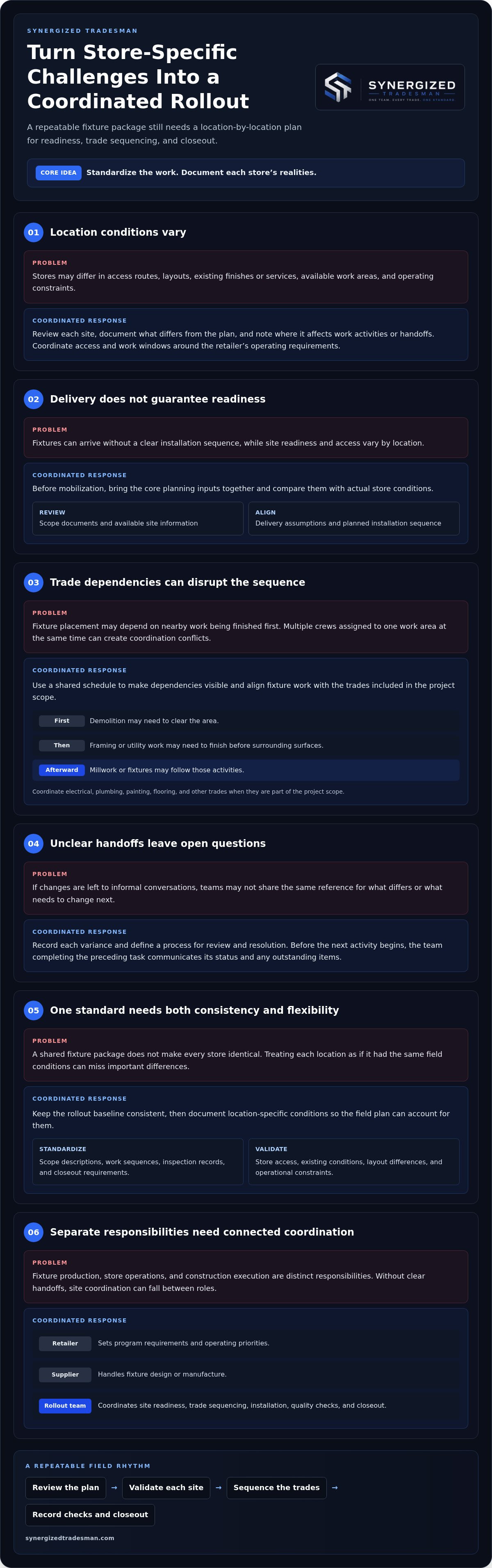
Consistency comes from applying the same controls, not assuming every store has the same conditions. Documented site variations let teams adapt the field plan while keeping rollout standards consistent. Retail fixture rollout contractors can support that consistency by separating program-wide requirements from location-specific information and recording how each difference affects execution.
Build a repeatable field standard
Create a shared scope and schedule structure for every location. Define the installation sequence, trade handoffs, quality checkpoints, communication channels, and records required to mark work complete. Use the same reporting fields across stores so portfolio teams can review status and open items consistently.
- Scope: Record the work included at each location and identify approved variations.
- Schedule: Track planned activities, dependencies, and handoffs using a common structure.
- Inspection: Use consistent checkpoints to record completed work, deficiencies, and follow-up items.
- Closeout: Apply a shared checklist for completion records and unresolved items.
When an exception arises, log what differs, which location it affects, who owns the next action, and whether a change has been approved. Keep the decision and its effect on sequencing visible to the project team. This creates a traceable record without relying on a particular software platform or reporting capability.
Adapt execution to location-level conditions
Validate each store against the common standard. Record access conditions, existing finishes or construction, operational constraints, and scope differences that could affect the work area or sequence. For example, a documented finish condition may change when fixture placement can proceed or require an approved adjustment to the planned handoff.
Route deviations through an agreed decision path before changing field work. Assign responsibility for review, communicate the approved direction to affected teams, and update the location record and schedule as needed. Where the scope requires it, coordinate fixture placement with adjacent finishes and specialty installation so one activity doesn’t obstruct another.
This approach keeps the baseline stable while making exceptions manageable: the standard defines how work is planned and recorded, and the site record shows what must be adapted. It also gives internal teams a clearer view of which conditions are common across the rollout and which require location-level decisions.
Synergized Tradesman coordinates commercial construction and rollout work through planning, procurement, field execution, and closeout, with one accountable relationship across applicable trades. Read about coordinated retail rollout execution and how repeatable controls can work alongside store-specific planning.
What Synergized Tradesman Coordinates in a Retail Fixture Rollout
A retail fixture rollout involves more than placing fixtures in stores. Installation may affect finishes, utilities, and other construction activities, so each location needs a coordinated execution plan. Synergized Tradesman manages commercial rollout programs from planning and procurement through field execution and closeout, connecting fixture and millwork installation with the surrounding project scope.
Coordinate fixtures with the wider commercial scope
Synergized Tradesman coordinates the construction work that supports fixture installation. Depending on the project scope, that work may include millwork and specialty installation, electrical, plumbing, finishes, general trades, and final cleaning.
Planning establishes scope, responsibilities, and the work sequence. Procurement coordination connects project requirements to the materials and activities needed for execution. In the field, trade handoffs align fixture placement with adjacent work, such as completed flooring or electrical tasks. Closeout records completion and outstanding items, giving the project team a consistent view of each location’s status.
This integrated approach doesn’t mean one crew performs every specialist task. It means the work is coordinated under one accountable relationship, with responsibilities and handoffs organized across the project.
Move from rollout requirements to an accountable execution plan
Synergized Tradesman translates program goals into coordinated scope, procurement steps, schedules, and field controls. A common project standard gives locations a consistent framework. Store-specific conditions and approved decisions are documented within that framework, so teams can adapt execution without losing track of program requirements.
For retail fixture rollout contractors, that balance is central to multi-location work. Fixture installation must fit the construction sequence at each store, while project oversight keeps responsibilities, progress, and closeout records aligned. Synergized Tradesman coordinates relevant trades and documents location-level requirements as part of its broader commercial construction, renovation, retail refresh, and rollout work.
One accountable execution relationship connects planning, procurement, field coordination, and closeout across the program. Learn more about Synergized Tradesman’s retail fixture rollout services.
Build a More Coordinated Fixture Rollout
A successful multi-store rollout depends on clear ownership, repeatable field controls, and documented store-specific conditions. Fixture supply and installation are distinct from coordinating the surrounding construction work. Shared scopes, schedules, inspections, and closeout records help teams maintain a consistent standard while adapting execution to each location.
Retail fixture rollout contractors connect those requirements across planning, procurement, field execution, and closeout. Synergized Tradesman brings these phases together under one accountable relationship, coordinating millwork, fixtures, specialty installation, and related commercial trades such as finishes, electrical, and plumbing. As a certified women-owned commercial construction firm, Synergized Tradesman supports retail programs with integrated trade coordination and project oversight.
Start building an execution plan around your program’s requirements and store conditions. Discuss your retail fixture rollout with Synergized Tradesman and create a clearer path from planning to closeout.
Frequently Asked Questions
What does a retail fixture rollout contractor do?
A retail fixture rollout contractor coordinates the construction and installation work needed to execute a fixture program across store locations. Responsibilities can include reviewing site readiness, aligning trade schedules, coordinating fixture and millwork installation, checking completed work, and organizing closeout records. Retail fixture rollout contractors manage execution and handoffs, while fixture design or manufacturing may sit within a separate supplier’s scope. Project documents define these boundaries.
How is a fixture rollout contractor different from a fixture installer?
A fixture installer performs field installation, while a rollout contractor coordinates that work with the wider project. The contractor may align installation with site access, store requirements, preceding construction, and other trades included in the scope. Installation can be one part of the overall plan. The distinction is coordination and accountability across activities, not an assumption that one crew performs every specialist task.
When should a contractor be involved in a retail fixture rollout?
Involve the contractor during planning, before procurement and field schedules are fixed. Early coordination connects program requirements with site information, trade dependencies, store access, and installation sequencing. The project team can document location-level differences and assign a review path before crews mobilize. Planning execution early also clarifies handoffs among the retailer, fixture supplier, project team, and field crews.
How do contractors keep fixture quality consistent across multiple stores?
Contractors use common installation requirements, inspection checkpoints, and closeout records across locations. Field teams document whether work meets the project scope and record deficiencies or open items for resolution. Consistency doesn’t require identical site conditions. Teams can follow the same quality process while recording store-specific variations, approved changes, and decisions that affect installation. Shared records help project teams compare completion status across the rollout.
Can a retail fixture rollout contractor coordinate other trades?
Yes. A rollout contractor can coordinate other trades when they’re included in the project scope. Fixture installation may need to align with demolition, electrical or plumbing work, flooring, painting, or millwork activities. Synergized Tradesman coordinates multi-trade commercial construction, including fixture and specialty installation, electrical, plumbing, and finishes. Clear scopes and handoffs establish which activities are included and how they fit into the field sequence.
What should a retail fixture rollout plan include?
A retail fixture rollout plan should define the shared scope, responsibilities, procurement steps, schedule structure, installation sequence, and trade dependencies. It should also record each store’s access conditions, existing conditions, operational constraints, and approved scope differences. Include consistent inspection fields, a process for assigning and resolving exceptions, and a closeout checklist for completion records and open items. Together, these controls provide a repeatable framework for execution across locations.


