

A finished build can still leave a store unready. Retail project closeout services connect final trade activities, cleaning, and operational handoff so a renovated location can move from field completion to a clear, operations-ready status. When these responsibilities sit in separate workflows, unresolved field items can surface late, and completed tasks can be mistaken for readiness.
Retail teams must meet a common standard across locations even when schedules, trades, and open items vary from site to site. Closeout needs more than a checklist marked complete. Teams need clear ownership, visible status, and a defined path for resolving remaining work before turnover. That makes it easier to see what is done, what still needs attention, and whether the store is ready for operations.
This guide explains what coordinated retail closeout covers, how to track readiness without confusing task completion with a true handoff, and how accountability works across multi-location programs. It also shows how one accountable partner can connect trade execution, final cleaning, and project closeout under a repeatable standard, giving teams a clearer view of each store’s transition to operations.
Key Takeaways
- Retail project closeout services coordinate completion, verification, final cleaning, and handoff rather than treating cleaning as the entire process.
- Use a clear sequence: confirm scope, coordinate remaining work, verify completion, clean the space, and prepare the handoff.
- Track readiness by whether an area has been verified for handoff, not only whether individual tasks are marked complete.
- Set handoff expectations, ownership, communication cadence, and status tracking early to support consistency across locations.
- A single accountable relationship can connect planning, procurement, trade execution, final cleaning, and closeout under one repeatable standard.
What retail project closeout services cover beyond final cleaning
Retail project closeout is the coordinated process of completing and verifying construction work, resolving outstanding items, cleaning the space, and handing it over in line with the owner’s operational needs.
Closeout is not simply a cleaning visit after construction. It connects field execution to the point where the owner takes responsibility for the renovated store. In the broader project management lifecycle, closing follows execution. For retail work, an organized closeout keeps trade status, open items, and readiness visible as the project moves toward handoff.
What is included in retail project closeout?
Retail project closeout services coordinate final trade work and verify that completed areas align with the agreed project scope. A team might track whether flooring, electrical work, or fixture installation is complete, record the area involved, and assign follow-up for any remaining work. The specific checks and handoff steps depend on the project scope and the owner’s procedures.
Final cleaning contributes to readiness, but it does not replace trade completion. Cleaning can prepare surfaces and areas for turnover; it cannot resolve an incomplete installation or an open field item. Keep these activities connected in the status process so teams can see what is finished, what remains, and what needs to happen before handoff.
Why closeout affects store readiness
Unresolved work can affect how an owner prepares a store for operations. An incomplete fixture installation, an unfinished area, or unclear responsibility for a remaining item can complicate turnover. The question is not just whether someone has marked a task complete. Teams need to know whether the work has been checked and whether any open activity affects handoff.
Clear ownership and status visibility give project stakeholders a shared view of progress. A central coordinator can connect trade updates, follow up on open items, and align final cleaning with the work happening in the space. This helps manage the transition from construction to operations without assuming a specific opening date or outcome.
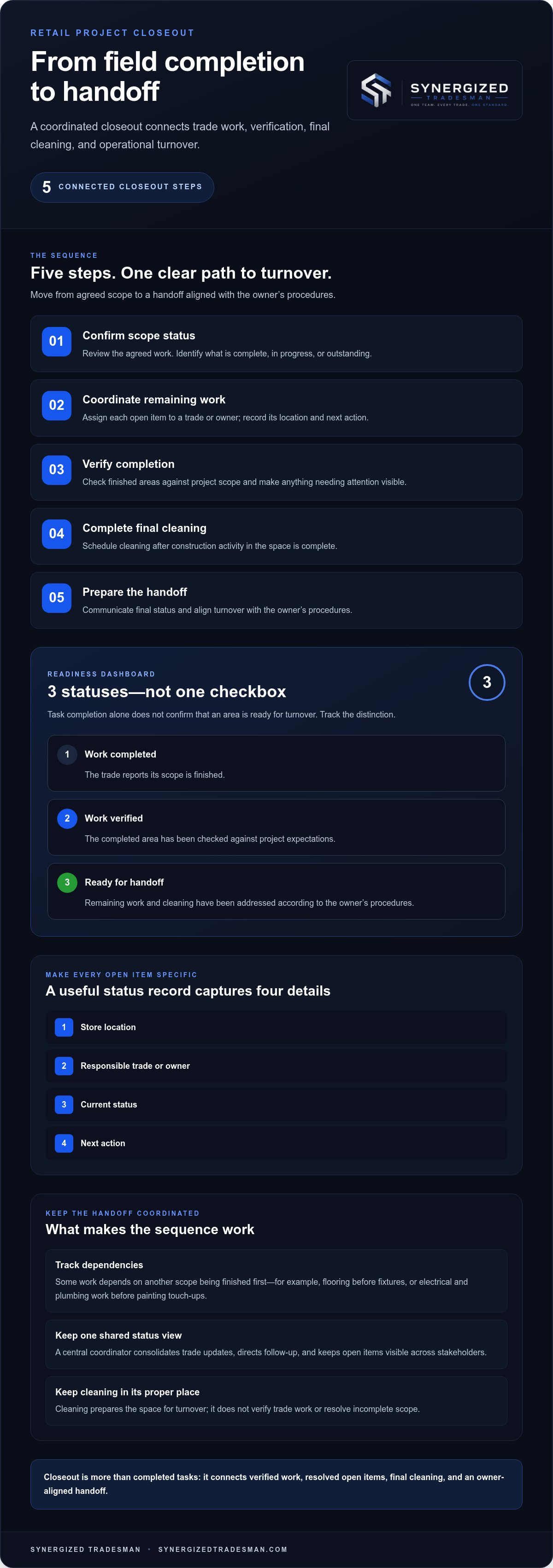
In practice, a useful closeout view distinguishes three conditions:
- Work completed: The trade reports its scope is finished.
- Work verified: The completed area has been checked against project expectations.
- Ready for handoff: Remaining work and cleaning have been addressed according to the owner’s procedures.
This distinction makes closeout an active part of project execution, not just paperwork at the end. It connects construction completion with the practical requirements of store turnover.
How retail project closeout moves from field completion to handoff
A coordinated closeout turns field updates into a clear sequence of decisions. A central coordinator gathers status from trades and project stakeholders, identifies dependencies, and keeps open items visible across locations. This is the management logic behind Retail Project Management Training, where organized planning and execution support delivery in a retail environment.
Confirm the scope, coordinate remaining work, verify completion, clean the space, then prepare the handoff. This sequence is a practical management framework, not a code requirement or a substitute for project-specific contract terms. It gives teams a shared way to move from field completion toward turnover.
- Confirm scope status. Review the agreed work and identify what is complete, in progress, or outstanding.
- Coordinate remaining work. Assign each open item to a trade or owner, and record its location and next action.
- Verify completion. Review finished areas against the project scope and record anything that still needs attention.
- Complete final cleaning. Schedule cleaning after construction activity in the space is complete.
- Prepare the handoff. Align turnover with the owner’s procedures and communicate the final status.
Coordinate remaining trade work before final verification
Make every open item specific. Record the store location, responsible trade or owner, current status, and next action. For example, flooring may need to be completed before fixtures are placed, while painting touch-ups may depend on electrical or plumbing work being finished first. Tracking these dependencies helps prevent unfinished work in one scope from disrupting another activity.
A central coordinator consolidates updates instead of leaving each stakeholder to manage a separate view. A shared status makes it easier to direct follow-up, identify work that can proceed, and see which items remain open before final review.
Verify completion, clean, and prepare the handoff
Once remaining work is addressed, review completed areas against the agreed scope. Distinguish reported completion from verified completion, and make unresolved items visible. Then coordinate final cleaning as a separate readiness activity after construction work in the space is complete. Cleaning prepares the store; it does not verify trade work or resolve outstanding scope.
The owner’s procedures shape the final turnover and may define what status information or project records should accompany the handoff. A clear coordinator aligns those needs with field updates so stakeholders understand what has been completed and what, if anything, remains. For teams managing commercial construction and retail refresh projects, connecting these steps keeps closeout part of execution rather than an isolated final task.
How to judge retail closeout readiness: not just task completion
A task marked complete tells you that work has been reported as finished. It does not necessarily show that the area has been checked, outstanding items are accounted for, or the space meets the owner’s handoff expectations. Retail closeout readiness connects field status to operational requirements.
| Task marked complete | Area verified and ready for handoff |
|---|---|
| A trade reports its assigned work is finished. | Completed scope has been reviewed against project expectations. |
| Open items may be unclear or have no assigned next step. | Remaining items are resolved or clearly assigned and tracked. |
| Cleaning may be recorded as a standalone task. | Final cleaning is complete after construction activity, in line with turnover needs. |
| Status may vary by trade or location. | Stakeholders share a clear view of readiness and exceptions. |
Closeout is more than paperwork or a cleaning visit. Records support the handoff, and cleaning prepares the space, but neither alone verifies that the work is complete. Unresolved items, unclear ownership, or inconsistent reviews can leave stakeholders uncertain about what is ready and what still needs attention.
What does ready for handoff mean on a retail project?
Readiness means the agreed scope has been completed and reviewed, outstanding items are resolved or assigned with clear next steps, and the space has been cleaned for turnover. The owner’s operational requirements and project-specific acceptance process determine how that status is assessed. A shared checklist can help teams track progress, but it does not replace contractual terms or applicable jurisdictional requirements.
How can a rollout maintain consistent closeout standards?
Use common status categories across locations, such as “in progress,” “complete,” “verified,” and “open item.” Set shared expectations for reporting, ownership, and next actions, then record site-specific exceptions separately. This keeps coordination consistent without assuming that every store has identical conditions, scope, or handoff needs.
For example, one location may have an outstanding fixture item while another needs follow-up on a different part of the scope. A consistent reporting structure makes both visible without obscuring the difference. That portfolio view helps teams compare readiness using the same definitions and focus follow-up where it is needed. For broader planning context, see this retail store construction reference guide.
Well-defined retail project closeout services help owners distinguish task completion from a verified handoff. The practical test is whether stakeholders can see what has been completed, what has been checked, and what remains before the store is accepted into operations.
A practical retail project closeout plan for owners and program teams
Build closeout into the project plan before field work nears completion. A practical framework for owners and program teams has four parts: define handoff needs, assign ownership, track status, and review readiness. This gives retail project closeout services a clear operating structure and helps teams surface gaps before they become last-minute turnover issues.
- Define handoff needs: Set scope boundaries and clarify the owner’s project-specific acceptance expectations.
- Assign ownership: Name who coordinates trade updates, tracks open items, and communicates changes.
- Track status: Use shared categories for work in progress, complete, verified, and requiring follow-up.
- Review readiness: Check progress at agreed points and align final cleaning and turnover activities with the work remaining.
Keep supporting project information organized as work progresses rather than treating documentation as a last-day task. The focus is on maintaining clear status and accountability, not prescribing a universal document checklist. For a broader view of how trades and project activity connect, see this commercial construction coordination guide.
Set closeout ownership and expectations early
Identify one coordinating owner for trade status, communication, and escalation. Define how incomplete work will be recorded, reviewed, assigned, and tracked through resolution. Align expectations for final cleaning and turnover before field work concludes. These decisions help each stakeholder understand who acts next and how progress will be reported.
Agree on communication cadence and scope boundaries early. A shared approach can reduce confusion when a field item affects more than one trade or when the owner’s acceptance process requires a specific review. Requirements vary by project, so establish them with the project team rather than assuming one process fits every store.
Use repeatable controls across multiple retail locations
Apply the same core reporting categories and ownership expectations across a rollout, while recording each site’s scope, constraints, and exceptions separately. Review status at defined points throughout execution, not only at the end. That rhythm makes emerging issues easier to see and gives program teams a comparable view without implying that every location has identical conditions.
Clear accountability is central to coordinating multiple trades and locations. This multi-trade construction accountability model offers additional context for structuring responsibility across a commercial project.
Synergized Tradesman connects planning, trade execution, final cleaning, and closeout through one accountable relationship. Learn more about retail project closeout support.
How Synergized Tradesman coordinates retail project closeout
Synergized Tradesman connects retail project closeout to the work that comes before it. The team coordinates planning, procurement, field execution, final cleaning, and closeout through one accountable relationship. That structure gives owners a coordinated path across project phases instead of treating turnover as an isolated task after the trades leave the site.
One accountable relationship from execution through closeout
Retail refreshes can involve several types of work, from demolition and framing to ceilings, painting, flooring, fixtures, electrical, and plumbing. When those scopes intersect, an unfinished item in one area can affect the next activity. Synergized Tradesman coordinates the work and closeout across these phases, keeping responsibilities and project status connected.
This approach gives the owner a central point of accountability for coordinating trade activity and carrying closeout forward. Planning and procurement inform field execution; field status informs final cleaning and turnover. The result is a clear line of coordination, with closeout managed as part of commercial project delivery rather than left as a separate final assignment.
Apply a consistent approach across retail projects
For a national portfolio, common coordination standards can make status easier to follow from project to project. Teams can use consistent expectations for ownership, communication, and closeout while adapting execution to each store’s scope and site conditions. One standard means a repeatable coordination approach, not a claim that every location has the same work or produces identical results.
This balance matters in multi-location programs. Owners need a reliable way to see where each project stands, while site teams need flexibility to address the work and conditions specific to each location. Synergized Tradesman brings those needs together by coordinating planning, procurement, multiple trades, final cleaning, and project closeout under a single accountable relationship.
That is the practical role of coordinated retail project closeout services: connecting trade execution to a visible, managed handoff. Synergized Tradesman applies one coordination standard across projects while aligning the work with each project’s scope.
Planning a retail refresh or rollout program? Discuss your project with Synergized Tradesman to explore coordinated commercial construction and closeout support.
Move every retail project toward a clearer handoff
Store readiness depends on more than finished trade tasks. Retail project closeout services connect scope completion, verification, final cleaning, and handoff so owners can see what is ready and what still needs attention. A shared status framework supports consistency across locations, while project-specific requirements and site conditions shape each turnover.
Synergized Tradesman coordinates planning, procurement, field execution, final cleaning, and closeout through a single accountable relationship. This connects multiple trades and project phases under one coordination standard. As a certified women-owned commercial construction firm, Synergized Tradesman brings that approach to retail refreshes and multi-location programs.
Set clear ownership early, track open work through resolution, and assess readiness against the owner’s handoff needs. These practices help teams manage closeout as part of project delivery, not simply as paperwork or a final cleaning visit.
Planning a retail refresh or rollout? Discuss your retail project closeout needs with Synergized Tradesman. With a clear process and accountable coordination, your team can move each project toward an organized handoff.
Frequently Asked Questions
What do retail project closeout services include?
Retail project closeout services coordinate final trade work, review completed areas, track outstanding items, arrange final cleaning, and prepare the store for handoff. The exact activities depend on the project scope and the owner’s procedures. For example, a team may confirm that flooring and fixture work is complete, record remaining items with clear ownership, and align cleaning with the final stage of construction activity.
When does closeout begin on a retail construction project?
Closeout planning should begin early, while active coordination continues as field work approaches completion. Owners and project teams can define handoff expectations, responsibilities, and status reporting before the final work phase. This gives trades and stakeholders a shared understanding of how incomplete items will be tracked and resolved. Waiting until construction is nearly finished to organize closeout can leave less time to coordinate remaining work and turnover needs.
Is final cleaning the same as retail project closeout?
No. Final cleaning is one part of retail project closeout, not the entire process. Cleaning prepares the space after construction activity, while closeout also coordinates trade completion, reviews work against the agreed scope, and tracks outstanding items through resolution or assignment. A clean store may still have incomplete or unverified work. Assess cleaning and construction readiness as related but distinct parts of preparing for handoff.
How do project teams track incomplete work before store handoff?
Record each open item with its location, responsible trade or owner, current status, and next action. For example, a remaining electrical task in a particular area should have a named owner and a defined follow-up step. A shared tracker or status report can help stakeholders see what is open, what is complete, and what has been verified. Review updates at agreed intervals rather than waiting until turnover to identify unresolved work.
Can one closeout process work across multiple retail locations?
Yes. A common coordination framework can support consistent reporting across locations while allowing for different scopes, site conditions, and owner requirements. Use shared status categories and expectations for ownership, updates, and readiness reviews. Track each location’s exceptions separately so a standard process does not imply identical work at every store. This gives program teams a clearer portfolio view and helps them compare project status using consistent terms.
Who coordinates trades during retail project closeout?
A designated central coordinator can consolidate trade updates, track open items, clarify ownership, and align final cleaning with the remaining work. Synergized Tradesman provides a single accountable relationship across planning, procurement, field execution, and closeout for commercial construction and retail refresh projects. Connecting these phases helps stakeholders follow progress without treating each trade’s completion as a separate handoff process.
What should owners define before a retail project reaches closeout?
Owners should define handoff requirements, scope boundaries, acceptance expectations, communication cadence, and responsibility for tracking unresolved work. They should also align the team on final cleaning and how project status will be reported. Setting these expectations early gives trades and stakeholders a shared process to follow. Requirements vary by project, so the framework should reflect the owner’s procedures and the agreed project scope.


