

A rebrand can be approved everywhere and still look different at every store. The challenge for retail store rebranding contractors is not simply installing new finishes. It is translating brand requirements into repeatable scopes, coordinating trades and procurement, and planning work around store operations. When teams interpret details differently or site schedules drift, brand consistency and store operations can both suffer.
Choosing a contractor means looking beyond a polished proposal. You need a partner that carries one standard from planning through field execution and closeout, with clear ownership across locations. This guide explains how to scope and evaluate retail store rebranding contractors for a single location or a multi-site rollout, so responsibilities and expectations are clear before work begins.
We’ll cover how to turn brand standards into site-level work packages, align trades and materials, sequence work in operating stores, and build quality reviews and accountability into the project lifecycle. The goal is a coordinated field plan that helps each location reflect the approved brand while limiting avoidable demands on store teams.
Key Takeaways
- Translate approved brand documents into clear, location-specific work scopes that support consistent execution.
- Evaluate retail store rebranding contractors by how they manage scope ownership, trade coordination, procurement, field oversight, and closeout.
- Map dependencies between demolition, utilities, finishes, fixtures, and cleaning to reduce fragmented handoffs.
- Use store access, customer and staff movement, deliveries, noise, and work windows to shape project sequencing.
- Apply one accountable project relationship across planning, procurement, field execution, and closeout for coordinated work across locations.
What Retail Store Rebranding Contractors Coordinate Beyond the New Look
A retail rebrand is visible in its finishes, fixtures, and customer-facing details. Delivering it takes more than installing a new look: the approved brand direction must become physical work that fits each store. Rebranding can change how a business presents itself, while construction execution implements the physical requirements of that change.
Retail store rebranding contractors coordinate construction and renovation work that brings approved plans into the built environment. Their role can include managing trades, procurement, site work, and closeout. Brand strategy, creative design, marketing, and brand asset development may be handled by the retailer or other project participants. Signage is often coordinated with the wider scope, even when its design or production is managed separately. Clear boundaries establish who supplies decisions, materials, approvals, and installation instructions.
What work typically sits inside a retail rebranding scope?
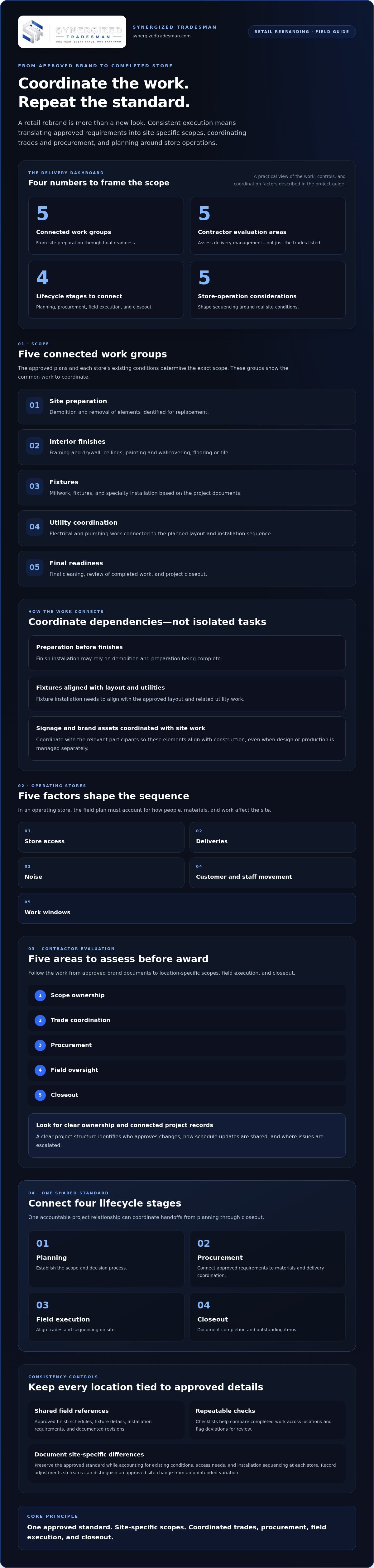
The scope depends on the store, its existing conditions, and the approved plans. Common work can be organized into five connected groups:
- Site preparation: Demolition and removal of elements identified for replacement.
- Interior finishes: Framing and drywall, ceilings, painting and wallcovering, and flooring or tile.
- Fixtures: Millwork, fixtures, and specialty installation, based on the project documents.
- Utility coordination: Electrical and plumbing work connected to the planned layout and installation sequence.
- Final readiness: Final cleaning, review of completed work, and project closeout.
These activities depend on one another. Finish installation, for example, may rely on completed demolition and preparation. Fixtures may need to align with both the approved layout and utility work. In an operating store, access, deliveries, noise, and customer or staff movement also affect sequencing. The project team coordinates signage and brand assets with the relevant participants so those elements align with site work.
How does rebranding differ from a standard store renovation?
A renovation may address repairs, layout changes, or finish upgrades. A rebrand adds a consistency requirement: construction details must carry approved visual and operational standards into the store. Repeatable fixture specifications, finish schedules, and installation instructions help teams apply those standards across locations. Site-specific scopes account for differences in existing conditions.
A single-store refresh may focus on a limited set of changes at one site. A multi-location rollout must also manage repeatable documentation and coordination without assuming every store needs identical work. The approved design and conditions at each location determine the right scope.
A retail rebranding contractor coordinates the physical work that turns approved brand standards into a completed store, aligning trades and site-specific requirements without taking the place of teams responsible for brand strategy or design.
How to Evaluate Retail Store Rebranding Contractors Before Award
Compare retail store rebranding contractors by how they manage delivery, not only by the trades listed in a proposal. Follow the work from approved brand documents to location-specific scopes, field execution, and closeout. For broader project context, see this retail store construction reference guide.
Review five areas: scope ownership, trade coordination, procurement, field oversight, and closeout. Look for defined responsibilities and project records that connect decisions to the work at each location. A clear project structure identifies who approves changes, how schedule updates are shared, and where issues are escalated. This gives the retailer a consistent view of progress without requiring store teams to coordinate separate trade conversations.
Which project controls help protect brand consistency?
Brand documents become useful in the field when they translate into clear, controlled instructions. Approved finish schedules, fixture details, installation requirements, and documented revisions give teams a shared reference. Repeatable checklists help compare completed work across locations and flag deviations for review. Set review and sign-off points for key stages, including when a scope change affects approved details. Synergized Tradesman coordinates planning, procurement, field execution, and closeout around one standard across projects.
Site-specific work packages should preserve the approved standard while accounting for each store’s existing conditions. A finish or fixture detail may repeat across locations, while access needs or installation sequencing may differ. Documenting those differences helps teams distinguish an approved site adjustment from an unintended variation.
How should accountability and trade coordination be assessed?
Map ownership across the full project lifecycle. Planning establishes the scope and decision process. Procurement connects approved requirements to materials and delivery coordination. Field execution aligns trades and sequencing. Closeout documents completion and outstanding items. Synergized Tradesman manages these stages through one accountable relationship, coordinating multiple trades rather than leaving the retailer to bridge every handoff.
- Scope: Location-specific work packages reflect approved requirements.
- Coordination: Trade responsibilities, dependencies, and escalation paths are defined.
- Procurement: Material decisions and revisions are traceable to the scope.
- Field oversight: Progress and schedule changes have a clear reporting path.
- Closeout: Completion, review, and remaining items are documented.
These controls make accountability visible. Explore Synergized Tradesman’s commercial construction approach to see how coordinated project delivery connects planning, procurement, field execution, and closeout.
How Retail Rebranding Contractors Coordinate Trades, Procurement, and Sites
Trade coordination connects each work package to the next. Demolition may expose conditions that affect utility work. Electrical and plumbing tasks may need to be completed before walls are closed. Finishes then prepare surfaces and areas for fixture installation, followed by final cleaning and closeout. If a handoff is unclear, the next trade may arrive before the site or materials are ready.
Retail store rebranding contractors can manage these dependencies with shared scopes, a sequencing plan, field communication, and clear ownership of open items. Procurement needs to follow the same plan: select materials against approved requirements and coordinate them with site readiness and installation sequence. Details vary by location, so the program plan should guide coordination without assuming identical conditions or fixed schedules.
| Disconnected trade handoffs | Coordinated workflow |
|---|---|
| Each trade works from separate instructions, with gaps between scopes. | Shared work packages connect trade responsibilities to approved project requirements. |
| Material ordering and delivery are managed apart from site readiness. | Procurement and delivery planning align with the sequence and conditions at each site. |
| Open items move between parties without clear ownership. | A defined lead tracks decisions, dependencies, and unresolved work through closeout. |
| Completed work is reviewed differently from one location to another. | Common review points support consistent documentation across sites. |
How do trades stay aligned across a rebranding project?
Start with a shared scope and sequence that show what must be complete before the next activity begins. For example, electrical or plumbing work tied to a planned layout may need coordination before framing or finish work limits access. Fixture installation then depends on the relevant areas being ready and required materials being on site. Field communication surfaces changes, while an assigned owner tracks each open item through resolution. For more on this approach, see the multi-trade commercial construction accountability model.
What changes when the program covers multiple locations?
A multi-site plan separates common standards from local conditions. Repeatable work packages carry approved finishes, fixture requirements, and review steps across stores. Each location’s documented adjustments can account for existing conditions, access, or other project constraints without obscuring the shared standard.
Standardized scopes improve visibility by making shared requirements and site-specific changes easier to compare across locations. That comparison helps project teams track where execution aligns with the program and where a documented adjustment needs review.
How to Plan Store Rebranding Work Around Operations and Quality
Store work must fit the realities of each location. Access routes, customer and staff movement, delivery points, noise sensitivities, and available work windows can affect scope and sequencing. Retail store rebranding contractors use these details to shape a practical plan and document changes as site conditions or decisions evolve. For broader coordination principles, see the commercial construction coordination guide.
What should be established before field work begins?
Build the plan from verified site information and approved project documents. Capture existing conditions, drawings, finish requirements, access rules, and decision contacts. Then align procurement with storage limits and the planned installation sequence. Confirm project-level requirements for permits, applicable codes, and safety procedures with the responsible parties before work proceeds.
A five-step sequence keeps planning connected to execution:
- Document operating constraints. Record access, customer and staff routes, delivery arrangements, noise considerations, and available work windows for each location.
- Confirm the scope. Align site conditions with approved drawings, finish requirements, fixture details, and responsibilities. Resolve open decisions before they become field assumptions.
- Coordinate procurement. Match material ordering and delivery timing to storage capacity, site readiness, and installation needs.
- Sequence field work. Plan trade activities around dependencies and the store’s operating constraints. Adjust the sequence when site conditions require a documented change.
- Verify and close out. Review completed work, assign corrective actions, record acceptance points, and assemble closeout information.
How can field teams document quality and completion?
Use scheduled walkthroughs to compare installed work with approved requirements. Log each issue with its location, responsible party, and next action, then track corrective work through review. Planned sign-off points record decisions and completion status. These controls support oversight but do not replace project-specific review.
Closeout can include final cleaning, fixture checks, completion records, and applicable handoff materials. The records should reflect the project scope and the retailer’s requirements. Documented closeout gives program teams a consistent view of what was completed, what was corrected, and what was handed over at each location.
Plan coordinated retail construction with Synergized Tradesman, from project planning through field execution and closeout.
What to Expect When Synergized Tradesman Manages Retail Rebranding
Synergized Tradesman manages commercial retail refresh and rollout work through one accountable relationship, connecting planning, procurement, field execution, and closeout. For retailers coordinating multiple locations or trades, this structure provides a clear path for decisions and project information to move from planning into the field and through handoff. The project scope is tailored to approved requirements and conditions at each location.
As a certified women-owned commercial construction firm, Synergized Tradesman coordinates the trades needed for the defined work. Depending on the project, that may include demolition, metal stud framing and drywall, ceilings, painting and wallcovering, flooring and tile, millwork and fixture installation, electrical, plumbing, final cleaning, and closeout. A refresh may use only some of these trades. The work package should identify applicable activities and explain how they connect to the overall program.
How does one accountable relationship simplify delivery?
Each project phase depends on decisions and handoffs. Planning turns requirements into a workable scope. Procurement connects that scope to materials and delivery needs. Field execution coordinates trades and site activity. Closeout records completion and handoff details. Synergized Tradesman brings those phases into one coordination structure, giving the retailer a central point for managing project information and open items across the work.
This approach also supports the company’s practice of applying one standard across projects. Shared requirements guide the work, while documented site-specific conditions shape how each location is delivered. The focus is coordinated oversight and accountability, not a promise of a particular schedule, savings, or disruption-free work.
What information helps start a project discussion?
A clear project brief helps establish priorities. Prepare the number of locations, scope objectives, available brand documents, known operating constraints, and target milestones. Include existing drawings or finish and fixture requirements that describe the work. These inputs give the team a basis for discussing scope, site conditions, procurement, trade coordination, and the project lifecycle.
Plans are tailored to site conditions and program requirements. A multi-location rollout may use shared standards and repeatable work packages, with documented adjustments for individual stores. A single-location refresh may have a narrower scope and different operating considerations. In either case, clear priorities and decision ownership help shape an organized project plan.
Discuss your scope and delivery needs with the team: Discuss a retail rebranding project with Synergized Tradesman.
Set Your Retail Rebrand Up for Coordinated Execution
Consistent store rebranding depends on more than matching finishes. Clear site-level scopes, coordinated trade and procurement plans, and documented quality reviews help translate approved brand standards into field work while accounting for each location’s conditions and operations.
When evaluating retail store rebranding contractors, look for clear ownership from planning through closeout. Synergized Tradesman is a certified women-owned commercial construction firm that coordinates multiple trades through one accountable relationship and applies one standard across projects. The work is tailored to each program’s requirements, bringing structure to individual refreshes and multi-location rollouts.
Start a conversation about your project scope, locations, brand documents, and delivery needs. Discuss your retail rebranding project with Synergized Tradesman, and take the next step toward a coordinated plan.
Frequently Asked Questions
What does a retail store rebranding contractor do?
A retail store rebranding contractor coordinates construction and trade work that implements an approved brand direction in a physical store. Typical responsibilities include translating drawings and finish requirements into location-level scopes, coordinating procurement and trade sequencing, overseeing field activity, and documenting closeout. The role is distinct from brand strategy, creative design, or marketing, which may be managed by the retailer or other project participants. Scope varies by site and program.
How do retail rebranding contractors keep multiple stores consistent?
Retail store rebranding contractors keep multiple stores aligned by separating common standards from local conditions. Shared finish schedules, fixture details, installation instructions, and review points give teams consistent references. Each location’s work package can record differences such as existing conditions, access needs, or approved adjustments. Documented revisions and repeatable checklists help project teams compare progress and identify deviations for review without treating every store as identical.
Can a store be rebranded while it remains open?
A store may undergo rebranding while remaining open, depending on the scope, site conditions, and operational constraints. Planning should account for customer and staff movement, access, deliveries, noise, and feasible work windows. The project team can use these factors to define sequencing and phased work areas. Continued operation is not guaranteed; the retailer and construction team need a site-specific plan for managing construction alongside store activity.
What should a retail rebranding contractor proposal include?
A useful proposal should define the work scope, locations covered, trade responsibilities, and key assumptions about site conditions. It should also explain how procurement, field coordination, schedule updates, decision ownership, changes, quality reviews, and closeout will be managed. For a multi-site program, look for a clear distinction between shared brand standards and location-specific work. These details make handoffs and accountability easier to understand before the project begins.
How are retail rebranding projects coordinated across locations?
Teams coordinate a multi-location rebrand by establishing shared requirements, then translating them into work packages for each store. A program plan can align procurement, trade sequencing, communication, and review points while documenting site-specific conditions and approved adjustments. A central coordination structure helps track decisions and open items across locations. Each site still needs its own planning for access, existing conditions, deliveries, and operational constraints.
Which trades may be involved in a retail store rebrand?
The trades depend on the approved scope and each store’s existing conditions. Work may involve demolition; metal stud framing and drywall; ceilings; painting and wallcovering; flooring and tile; millwork, fixtures, and specialty installation; electrical; plumbing; and final cleaning. Not every project requires every trade. The work package should identify applicable scopes and sequence dependencies, such as coordinating utilities before related finishes or fixture installation.
What information should I prepare before discussing a retail rebrand?
Prepare the number of locations, project objectives, available brand documents, known operating constraints, and target milestones. Drawings, finish schedules, fixture details, and notes about existing conditions can also help clarify the physical scope. For each store, capture relevant access, delivery, storage, and work-window considerations. This information gives the project team a practical starting point for discussing site-specific needs and coordinating a plan around program requirements.


