

Scale comes from repeating a controlled execution standard, not treating every store as identical. High-volume retail rollouts put that principle to the test: different locations must meet brand and project standards while trades, schedules, and site conditions vary. Without clear oversight, small differences can lead to inconsistent results and issues that surface too late.
Consistency doesn’t mean forcing every site into the same plan. It means setting repeatable standards, adapting the work to each location, and keeping progress and exceptions visible across the portfolio. This article explains how to coordinate retail projects from planning and procurement through field execution and closeout, with clear quality controls and one accountable project relationship across trades. You’ll learn how a structured rollout approach helps maintain brand standards, track issues across locations, and bring each project to completion with greater control.
Key Takeaways
- Build high-volume retail rollouts around shared standards, while adapting plans to each location’s conditions.
- Use a repeatable sequence from scope definition and site validation to execution, inspection, and closeout.
- Pair schedule tracking with milestone checks and clear ownership of unresolved issues to protect quality.
- Use a readiness checklist to identify which locations can move forward and organize work into practical waves.
- Coordinate trades through one accountable project relationship to improve visibility from planning through closeout.
High-Volume Retail Rollouts: Why Scale Makes Store Execution Harder
A high-volume retail rollout is construction or refresh work coordinated across multiple store locations under a shared program. The work may repeat, but the sites rarely do. One location may need updated finishes around existing fixtures; another may have different access limits, infrastructure, or conditions that affect the work sequence.
A retail rollout program is a coordinated series of store projects managed to a shared standard, with plans adapted to each location. A single-store renovation manages one site as a standalone project. This distinction matters. High-volume retail rollouts require leaders to manage both the standard and the exceptions across a portfolio. That calls for disciplined project management, with clear scope, ownership, and controls that connect planning to field delivery.
What changes when a retail project becomes a rollout program?
At one store, a project team can focus on a single schedule, site, and set of trade activities. A rollout adds multiple locations, overlapping trade requirements, and approvals that may progress at different rates. A shared finish standard can define the expected result, but each location still needs its own review of site conditions, access, existing infrastructure, and readiness.
Consistency starts with a clear scope and deliverables for every location. Procurement planning connects required materials and fixtures to the work sequence, while field-readiness checks identify site-specific constraints before crews begin. For example, a repeated fixture installation may use the same quality criteria at each store, but the installation plan still needs to reflect actual conditions at each site.
Where do consistency and accountability commonly break down?
Breakdowns often begin when ownership is divided. If schedule tracking sits with one party, quality checks with another, and issue follow-up with someone else, no one has a complete view of project status. A site exception can go undocumented or unresolved, leaving the next location to repeat the same discovery or receive a different interpretation of the standard.
Maintain a visible record for each location that captures its status, open issues, decisions, and responsible owner. Define an escalation path so field teams know who can resolve conflicts and how exceptions are approved and shared across the program. These management controls help teams distinguish a planned site adjustment from a missed requirement and keep portfolio reporting grounded in current project information.
Build a Repeatable Retail Rollout Model Around Work Packages and Standards
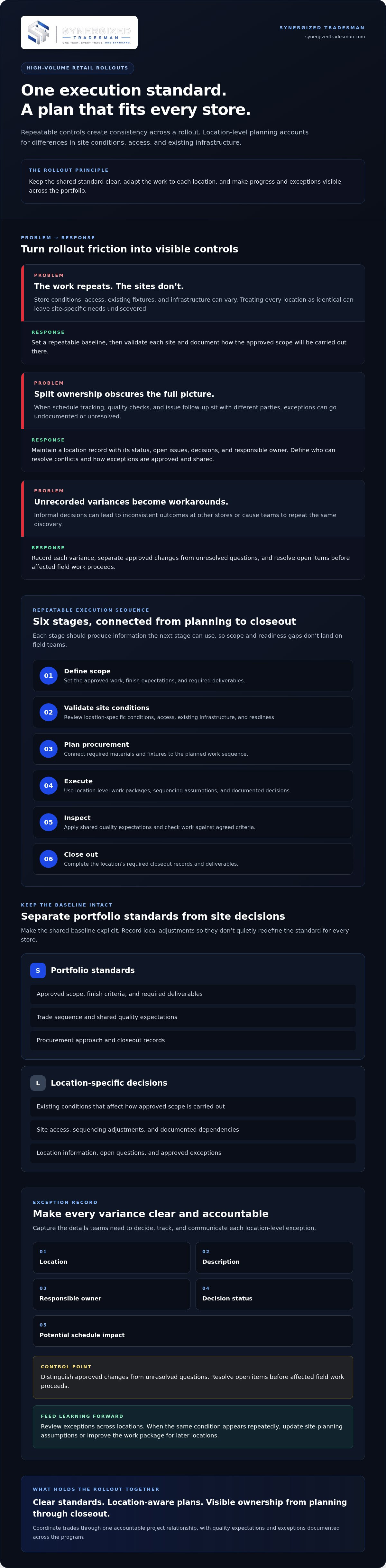
A repeatable model gives each location the same execution baseline without assuming every site is identical. For high-volume retail rollouts, organize the work in sequence: define scope, validate site conditions, plan procurement, execute, inspect, and close out. Each stage should produce information the next stage can use, so field teams aren’t left to resolve scope or readiness gaps on site.
A work package turns the program standard into location-level direction. It should identify the defined scope, sequencing assumptions, finish expectations, and required deliverables. Depending on the project, coordinated work may span demolition, framing, finishes, fixture installation, and final cleaning or closeout. Establish project requirements and specifications for each program, then document how each location will apply them. For broader context on retail priorities shaping execution, see Kearney's discussion of how leaders conquer six challenges.
Separate portfolio standards from location decisions
Make the baseline explicit, then record which decisions belong to individual sites. This keeps a local adjustment from quietly changing the standard for every store.
| Portfolio standards | Location-specific decisions |
|---|---|
| Approved scope, finish criteria, and required deliverables | Existing conditions that affect how the approved scope is carried out |
| Trade sequence and shared quality expectations | Site access, work sequencing adjustments, and documented dependencies |
| Procurement approach and closeout records | Location-level information, open questions, and approved exceptions |
For a deeper planning reference, review this retail store construction strategic reference guide.
Manage exceptions before they become workarounds
Record each variance with its location, description, owner, decision status, and potential schedule impact. Separate approved changes from unresolved questions, and resolve open items before affected field work proceeds. This gives teams a clear basis for execution and prevents informal decisions from becoming inconsistent outcomes at other stores.
Then review exceptions across locations. If the same condition appears repeatedly, update site-planning assumptions or improve the work package for later locations. Synergized Tradesman coordinates planning, procurement, field execution, and closeout through one accountable relationship. Learn more about multi-location construction coordination.
Protect Retail Rollout Quality Without Treating Speed as the Only Measure
Standardization doesn’t mean making every store identical, and it shouldn’t mean rushing work to keep a schedule looking intact. It means applying the same quality expectations while documenting and managing site-specific differences. For high-volume retail rollouts, speed is useful only when teams can verify progress, resolve issues, and confirm that the work meets the agreed criteria.
Rollout consistency comes from repeatable controls and documented exceptions, not identical sites or compressed field work. Three controls work together: schedule tracking shows whether activities are progressing as planned; milestone verification confirms that defined work is ready to move forward; and unresolved-issue management makes open decisions visible, with an owner responsible for follow-up. A schedule can appear on track while a quality concern remains open, so no single measure provides a complete view.
Use quality gates at key project stages
Set review points at scope readiness, material readiness, active work, and completion. Each gate should connect to documented acceptance criteria and identify who reviews the work and who owns follow-up. For example, a material-readiness review can confirm that required items are accounted for before the related work is scheduled to proceed. An active-work review can capture a deficiency and assign responsibility for resolving it. Completion checks should record outstanding items rather than treating an unfinished task as closed.
Manage dependencies and field issues directly
Trade activities depend on one another. Demolition may need to finish before framing proceeds; finish work may depend on earlier installation activities being complete. If a predecessor task or required decision is unresolved, compressing the next activity can create rework or conceal a readiness problem. Coordinating trades helps teams identify these dependencies and sequence work based on actual conditions, without assuming that every location will follow an identical schedule.
Maintain an issue log that records the location, issue, responsible owner, decision, and resolution status. Escalate blockers early, while there is still an opportunity to make a decision and adjust the plan. This is different from shortening field activities to recover time: escalation surfaces what needs attention, while compression may leave the cause unresolved.
Review schedule status, completed quality gates, and open issues together. That combined view helps program leaders distinguish a location progressing with verified work from one that appears on schedule but still has unresolved exceptions. It also gives field teams and decision-makers a shared basis for the next action.
Use a Rollout Readiness Checklist Before Releasing Locations to the Field
A location should enter a rollout wave only when the information and dependencies needed to start are visible. For high-volume retail rollouts, a readiness checklist helps teams distinguish confirmed conditions from open questions before field work begins. It also gives program leaders a consistent basis for grouping locations without assuming that every store is ready at the same time.
Confirm readiness before assigning a location to a wave
Review each location against the same core checklist. Record the status and owner for every item, and flag unresolved decisions rather than treating missing information as approval.
- Scope: Is the location’s approved work defined, with the expected deliverables and acceptance criteria documented?
- Site information: Are existing conditions, access assumptions, and known site constraints recorded?
- Procurement: Are required materials and fixtures planned in relation to the work sequence?
- Trade dependencies: Are sequencing needs between activities identified, including work that must be completed before another trade can proceed?
- Ownership: Is a decision owner assigned for open questions, changes, and field issues?
Use the results to form manageable waves. Group locations with comparable readiness and dependencies, and hold locations with unresolved prerequisites out of a wave until their status is clear. This keeps an individual site’s open decision from becoming an unplanned constraint for other locations.
Use portfolio reporting to guide decisions
A practical dashboard can provide one shared view without obscuring location-level detail. Track each store against agreed milestones and completion criteria, alongside its current status, open exceptions, assigned owners, and closeout state. A location-level record shows where action is needed; portfolio summaries reveal patterns that may call for a planning adjustment across later waves.
Keep program-wide trends separate from individual site exceptions. For example, repeated procurement dependencies may point to a planning issue across the program, while a single access constraint may require a site-specific response. At closeout, capture unresolved items and lessons that can inform preparation for subsequent locations. Use those findings to refine planning, not to assume future projects will follow the same path.
Synergized Tradesman coordinates multi-location commercial construction from planning through procurement, field execution, and closeout, with one accountable relationship across project phases. Learn about retail rollout coordination.
Coordinate High-Volume Retail Rollouts from Planning Through Closeout
High-volume retail rollouts need oversight that connects each project phase instead of treating planning, procurement, field work, and closeout as separate efforts. Scope decisions inform procurement. Procurement readiness affects trade sequencing. Field updates and inspection findings shape what remains to be completed at each location. Coordinated handoffs help portfolio leaders see how individual sites are progressing against a consistent project standard.
Coordinate trade scopes and field delivery
Multi-trade delivery means aligning work packages, procurement needs, sequencing, and field communication under clear ownership. A store refresh may involve demolition, framing, ceilings, painting and wallcovering, flooring and tile, fixtures, electrical, plumbing, and final cleaning. The order and requirements depend on each project, so teams need coordinated scopes and a shared way to track decisions, dependencies, and field issues.
One accountable relationship across project phases gives the client a clear point of coordination as work moves from planning into the field. It also helps connect trade-level activity to program standards, so site teams understand the expected work and project leaders can identify where a decision or follow-up is needed. For a closer look at this approach, read about the multi-trade construction accountability model.
Make closeout part of the delivery plan
Closeout should capture what was completed, what remains open, the status of outstanding items, relevant project documentation, and final cleaning. Assign responsibility for follow-up and record the status of each item. A clear closeout record gives portfolio leaders a more complete view of the location and helps determine what information is needed before subsequent work proceeds.
Use findings from completed locations to inform planning for the next sites. Recurring questions or handoff gaps can be documented and addressed in later project preparation, while site-specific exceptions remain tied to the locations where they occurred. This keeps lessons useful without assuming that every store will present the same conditions.
Synergized Tradesman manages multi-location commercial construction and retail refresh programs from planning through closeout, coordinating multiple trades through one accountable relationship. As a certified women-owned commercial construction firm, Synergized Tradesman brings a consistent project standard to this work. Discuss your retail program’s scope and trade coordination requirements with Synergized Tradesman to establish a clear approach from planning through closeout.
Bring Every Location Under One Clear Execution Plan
Successful high-volume retail rollouts depend on a repeatable standard that leaves room for location-specific conditions. Clear work packages, readiness checks, and documented exceptions help teams maintain consistent quality without treating every store as identical. Shared visibility into milestones, open issues, and closeout status keeps decisions connected across the portfolio.
Coordination matters from planning and procurement through field execution and closeout. With one accountable relationship across these phases, Synergized Tradesman coordinates multiple trades and applies consistent standards across projects. The firm is also a certified women-owned commercial construction firm.
Bring structure to your next retail program. Discuss your retail rollout program with Synergized Tradesman to align scope, trade coordination, and project oversight. A clear execution framework can help your team move forward with greater visibility and control at every location.
Frequently Asked Questions
What is a high-volume retail rollout?
A high-volume retail rollout is a coordinated program of construction or refresh work delivered across multiple store locations. The projects share a program scope or standard, but each site may have different conditions, access constraints, and existing infrastructure. Teams manage locations simultaneously or in a planned sequence, coordinating trade work, procurement, schedules, approvals, and closeout across the portfolio rather than treating each store as an isolated renovation.
How do you maintain consistent quality across multiple retail locations?
Maintain quality by defining shared scope, finish expectations, and acceptance criteria, then applying them at each location. Review work at key milestones and document results, open issues, and approved site-specific exceptions. Assign an owner to each follow-up item so decisions don’t disappear between teams. Consistency comes from applying the same controls across stores while adapting execution to recorded site conditions, rather than assuming every location is identical.
How can a retail rollout move quickly without sacrificing quality?
Keep work moving by resolving dependencies and readiness questions before they hold up field activity. Align procurement with the sequence of trade work, confirm site information, and escalate open decisions early. Track schedule milestones alongside quality checks and unresolved issues. Simply compressing field activities can hide problems or create rework. For high-volume retail rollouts, coordinated planning supports pace while preserving the time and oversight needed to verify completed work.
What should be included in a retail rollout project plan?
A retail rollout project plan should define the scope, location-level site information, procurement needs, trade sequencing, milestones, decision owners, quality criteria, and closeout deliverables. It should also show how the team will record exceptions, track unresolved questions, and communicate field updates. A clear plan connects these elements across locations, giving project leaders a consistent way to understand readiness and progress without overlooking site-specific requirements or dependencies.
How should retail companies group stores into rollout waves?
Group stores according to readiness and dependencies, not simply their place on a location list. Before assigning a site to a wave, review whether its scope, site conditions, access assumptions, procurement needs, and decision ownership are documented. Locations with similar readiness can be coordinated together, while stores with unresolved prerequisites can be held for a later wave. This approach makes constraints visible and supports more informed sequencing.
Who coordinates the trades during a multi-location retail rollout?
A project management team or commercial construction partner can coordinate trade scopes, procurement, sequencing, field communication, and closeout. Synergized Tradesman provides one accountable relationship across project phases and coordinates multiple trades under a consistent standard. That structure gives the client a clear point of oversight for activities such as demolition, framing, finishes, fixtures, electrical, and plumbing, while keeping ownership and project status connected across locations.
What does retail rollout project closeout include?
Retail rollout closeout records completed work, outstanding items and their owners, relevant project documentation, and final cleaning status. It should make clear what is complete and what still needs follow-up, rather than treating open items as resolved. Consistent closeout records help leaders review status across locations and carry useful findings into planning for subsequent stores. The specific documentation and acceptance criteria should reflect the requirements established for the program.


