

Can a women-owned commercial construction firm support procurement goals and manage a complex project? A women owned commercial construction partner may align with supplier-diversity objectives, but its designation alone doesn’t explain how it coordinates trades, manages execution, or maintains accountability. Buyers need to assess procurement alignment and delivery capability together.
That distinction matters when a project involves multiple stakeholders, trade handoffs, and consistent oversight. This guide explains what women-owned designations mean, where their limits are, and how to evaluate a firm’s delivery approach alongside procurement criteria.
You’ll also see how Synergized Tradesman coordinates commercial work through one accountable relationship, from planning and procurement to field execution and close-out. The goal is to help you select a partner model that aligns with supplier-diversity objectives while keeping project responsibilities clear.
Key Takeaways
- Separate a firm’s ownership designation from its construction scope and ability to manage the work.
- Align procurement objectives with solicitation requirements, documentation, and project needs before evaluating partners.
- Assess women owned commercial construction firms on scope coverage, coordination, quality controls, and close-out, not ownership status alone.
- Use a five-step framework to define outcomes, map scope, align procurement, assess coordination, and set reporting expectations.
- See how one accountable relationship can coordinate commercial work from planning and procurement through field execution and close-out.
What Women-Owned Commercial Construction Means for Business Buyers
Women-owned commercial construction describes commercial building work delivered by a company identified as woman-owned. The phrase combines two separate considerations: who owns the business and what construction services it performs. Ownership is relevant to procurement; the firm’s scope, coordination, and project controls determine how its work fits a buyer’s needs.
Quotable definition: A women-owned commercial construction firm is a commercial contractor whose ownership designation may support procurement objectives, while its trades, scope, and delivery model define its operational capability.
What does women-owned mean in a commercial construction context?
“Women-owned” describes business ownership. It is not a construction method or trade, and it does not indicate which work a company performs. A firm might manage commercial renovations or retail refreshes, for example, but those capabilities come from its services and project-delivery approach, not its ownership status.
The phrase can also refer to different levels of substantiation. A general ownership description identifies the business as woman-owned. A third-party certification or program designation indicates that the business has been reviewed under a particular organization’s or program’s criteria. These terms aren’t automatically interchangeable, and their meaning depends on the procurement context. The overview of Woman-owned business offers background on how government agencies and industry groups use the concept.
For buyers, the distinction is practical. A designation can help describe a supplier’s ownership status, but it doesn’t establish the firm’s trades, capacity for a specific scope, or approach to field execution. Evaluate those capabilities separately.
Why buyers consider women-owned construction partners
Commercial buyers may include women-owned businesses in supplier-diversity planning or pursue procurement objectives tied to a specific solicitation. Those objectives work alongside the project’s operational requirements. Buyers still need to define the work, identify required documentation, and assess how the contractor will coordinate delivery.
The search often starts with a practical need: renovate a commercial space, refresh a retail location, or deliver consistent work across multiple sites. Each project can involve overlapping trades, stakeholders, procurement steps, and close-out responsibilities. A designation may make a firm relevant to the procurement discussion; a clear coordination model shows how the work will be managed.
Consider ownership status in context. Distinguish procurement documentation from evidence of scope and execution, then assess who coordinates trades, tracks responsibilities, and maintains communication throughout the work. A multi-trade commercial construction accountability model can help clarify how those responsibilities fit together under one accountable relationship.
For a single renovation, that structure supports coordination across the defined scope. For repeatable retail refreshes or multi-location programs, it can also establish a consistent approach from site to site. The buyer’s task is to connect procurement fit with delivery fit, rather than treating one as proof of the other.
How Ownership Credentials Fit Commercial Construction Procurement
Procurement works best when buyers separate two questions: does a firm meet the solicitation’s ownership-related requirements, and can it deliver the defined construction scope? A designation may address the first question. By itself, it doesn’t establish trade coverage, coordination responsibilities, or how project progress will be managed.
Ownership credentials and project qualifications answer different procurement questions: one addresses supplier eligibility or designation, while the other addresses the firm’s fit for the work.
How do certification and ownership descriptions differ?
A business may describe itself as women-owned, while a formal certification applies criteria set by a particular program. SBA programs and WBENC certification are examples of distinct frameworks, not interchangeable labels. Requirements and accepted documentation can differ by program and solicitation. Before describing a designation as meeting a specific requirement, use the current rules and exact terminology relevant to the procurement.
Keep the distinction clear in evaluation records. A certification document may support an ownership review, but it doesn’t replace project-specific information about scope, coordination, or execution. Industry organizations such as the National Association of Women in Construction (NAWIC) support women in construction, while a buyer’s review of a contractor’s project qualifications serves a different purpose.
What procurement teams can organize before evaluation
Start with the solicitation and organize its requirements into separate review areas. This helps prevent procurement eligibility from becoming a proxy for delivery capability, and reduces the chance of overlooking required documentation while comparing technical approaches.
- Procurement objectives: Record the supplier-diversity goals the project is intended to address.
- Solicitation requirements: Identify required forms, ownership documentation, submission instructions, and program-specific terms.
- Project scope: Define locations, trades, deliverables, interfaces, and responsibilities included in the construction work.
- Schedule and reporting: Set out schedule expectations, progress updates, and communication requirements.
- Delivery evaluation: Review how the firm will coordinate trades, track decisions, manage field execution, and complete close-out.
Apply the same project criteria to each submission. For example, a retail refresh solicitation may require ownership documentation for procurement review and separately evaluate how the proposed team will coordinate demolition, finishes, electrical work, and close-out. The documentation supports one review; the delivery plan supports another.
A clear accountability model also helps buyers distinguish the contractor’s role from the individual tasks in the scope. The commercial general trades contractor accountability model connects that distinction to responsibility for coordinating commercial work. For buyers assessing women owned commercial construction, separating procurement fit from delivery evidence makes comparisons more consistent and decisions easier to explain.
Synergized Tradesman is a nationally serving, certified women-owned commercial construction firm, with project management spanning planning, procurement, field execution, and close-out. Buyers can review Synergized Tradesman’s commercial construction delivery approach when aligning procurement objectives with their project requirements.
How to Evaluate Delivery Capability Beyond Women-Owned Status
Ownership status can inform procurement, but it doesn’t establish whether a contractor can coordinate the work, manage project controls, or deliver the required scope. Evaluate those capabilities directly. The right fit depends on the project’s trades, stakeholders, reporting needs, and close-out requirements, not on a designation alone.
Start with the handoffs. A commercial renovation may involve demolition, framing, ceilings, finishes, electrical work, and final cleaning. The sequence matters: one trade’s completion can affect the next trade’s access and start. Understand who plans those interfaces, communicates decisions, tracks open items, and owns follow-through.
Which delivery questions matter on a complex commercial project?
Assess how the proposed model connects planning, procurement, field sequencing, and close-out. Identify who coordinates trade interfaces and communicates with the buyer when scope decisions or site conditions affect the work. For repeat projects, look for a defined standard for documentation and oversight. A consistent process can make expectations clearer across sites, though it can’t guarantee a particular project outcome.
Useful evaluation prompts include:
- Who coordinates the sequence and dependencies between trades?
- How are responsibilities and decisions communicated to project stakeholders?
- What quality review and issue-tracking processes support the work?
- How are outstanding items documented and carried through close-out?
How do multi-trade and single-trade models compare?
Neither model is automatically right for every project. A single-trade contractor may be a direct fit for a clearly bounded scope. A project with several interacting trades may require more coordination across contracts and schedules. Compare the models against the work’s actual interfaces and your team’s capacity to manage them.
For example, if flooring depends on preceding finish work, separately managed trades may require the buyer to coordinate readiness and resolve gaps between responsibilities. A multi-trade arrangement can centralize that coordination, while the buyer still defines scope, review criteria, and reporting expectations. The commercial construction coordination guide provides further context on managing those project interfaces.
Apply the same measures to any women owned commercial construction partner: scope coverage, coordination ownership, quality controls, and close-out discipline. Synergized Tradesman manages commercial work across planning, procurement, field execution, and close-out through one accountable relationship, supporting coordination across multiple trades.
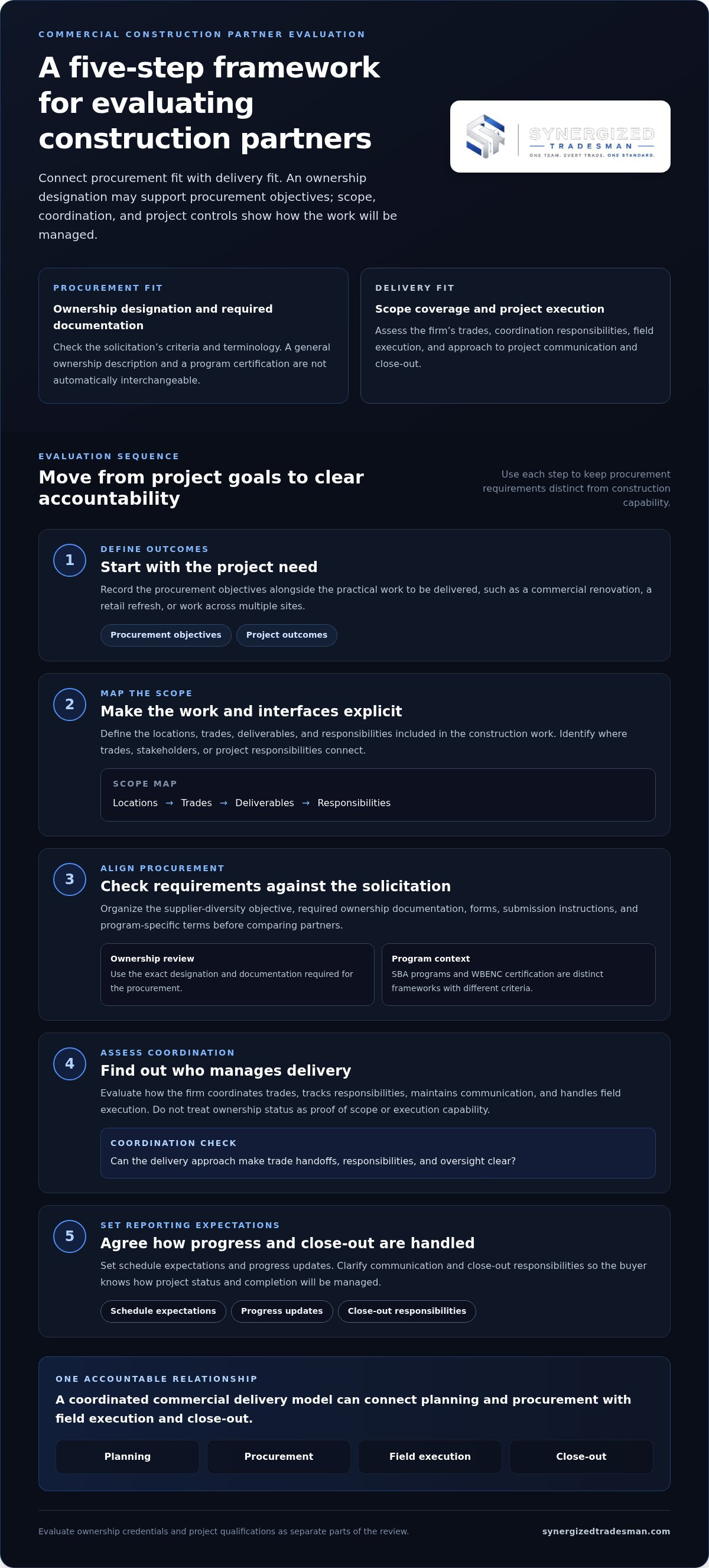
A Practical Evaluation Framework for Commercial Construction Partners
Use a consistent sequence to move from project need to delivery plan. This helps procurement, operations, and construction stakeholders evaluate the same requirements, whether the work is one renovation or a repeatable program across multiple locations.
- Define project outcomes. State the business purpose, required end condition, locations in scope, and operating constraints. Clarify what must be ready for the space to serve its intended use.
- Map the scope. Identify relevant trades, site interfaces, deliverables, and responsibilities. Note where one trade’s work depends on another, such as ceiling installation following above-ceiling coordination.
- Align procurement. List required forms and documentation, procurement milestones, decision owners, and approval steps. Keep supplier objectives clear while matching the solicitation to the project scope.
- Assess coordination. Define who manages trade sequencing, stakeholder communication, field updates, and issue escalation. Establish how site-specific constraints fit into the overall delivery approach.
- Set reporting and close-out. Agree on progress reporting, quality review, open-item tracking, and close-out deliverables. Treat documentation and final cleaning as planned scope elements, not tasks left to the last stage.
What should a project brief make clear?
A useful brief records the business objective, locations, operating constraints, required outcomes, trades, procurement responsibilities, decision owners, and communication expectations. For a single-site renovation, detail the local interfaces and approvals. For a multi-location program, establish common requirements while documenting each site’s distinct conditions. Retail teams can use this retail store construction strategic guide to frame planning around the demands of store work.
Keep the brief practical. If a location must remain operational during work, describe the access, sequencing, and stakeholder coordination constraints that affect delivery. Replace broad objectives such as “complete the refresh” with the condition that will indicate completion and the information stakeholders need to track progress.
How can teams maintain consistent oversight?
Assign ownership for decisions, issue escalation, progress updates, and quality review before field work begins. Set a reporting format that makes scope status, pending decisions, and open items visible. For multiple sites, apply common project standards, then record local requirements separately so consistency doesn’t erase important differences.
Build close-out into the project plan. Identify the records, outstanding work, and completion information the buyer expects, and define who coordinates their collection. This gives the project team a clear path from field execution to handover.
For buyers evaluating women owned commercial construction, this framework connects procurement alignment to practical execution criteria. Synergized Tradesman manages commercial work from planning and procurement through field execution and close-out, coordinating multiple trades through one accountable relationship. Explore Synergized Tradesman’s commercial construction approach to see how that model aligns with your project requirements.
How Synergized Tradesman Delivers Women-Owned Commercial Construction
Synergized Tradesman is a nationally serving, certified women-owned commercial construction firm. Its delivery model brings project phases and multiple trades into one accountable relationship. Ownership status provides procurement context; coordinated execution connects the firm’s capabilities to the work buyers need completed.
For commercial renovations, retail refreshes, and rollout programs, the firm manages work from planning and procurement through field execution and close-out. This sequence gives buyers a clear point of accountability as scope moves from preparation into active construction and final handover.
One accountable relationship across project phases
Synergized Tradesman coordinates multi-trade requirements through a consistent project standard. Planning clarifies scope and responsibilities. Procurement organizes requirements for the work. Field execution brings trade activities into the project sequence, while close-out addresses completion and final deliverables. Each phase connects to the outcomes the buyer has defined.
A consistent standard supports shared oversight across projects without assuming every site has the same conditions. Locations may differ in scope, constraints, or trade interfaces. The delivery approach provides a common structure, while project planning accounts for those differences. Buyers have one accountable relationship for coordinating the work rather than managing disconnected handoffs among every included trade.
Where the delivery model fits commercial work
The model supports commercial construction, renovations, retail refreshes, and rollout work. Relevant scopes can include general trades, demolition, metal stud framing and drywall, ACT ceilings, painting and wallcovering, flooring and tile, millwork, fixtures and specialty installation, electrical, plumbing, final cleaning, and project close-out.
These scopes often depend on one another. Demolition prepares areas for subsequent construction; framing and drywall establish surfaces for finishes; electrical and plumbing work must be coordinated with surrounding activities. Synergized Tradesman’s multi-trade approach organizes these relationships within the broader project, connecting procurement and field execution to the buyer’s stated scope and outcomes.
For repeat work, a common standard can help organize reporting, trade coordination, and close-out across locations. Site-specific requirements still matter. The project plan can account for differences in scope and conditions while maintaining a consistent framework for communication and accountability. That balance helps buyers manage rollout work without treating every location as identical.
Women owned commercial construction should be evaluated through both procurement relevance and delivery fit. Synergized Tradesman brings its certified women-owned status together with commercial trade coordination and project management spanning planning through close-out. The result is a delivery model that connects ownership context with clear responsibility for execution.
Discuss your project scope and delivery coordination with Synergized Tradesman to align the work, trade interfaces, and project phases around your commercial construction requirements.
Turn Your Project Requirements Into a Clear Next Step
Turn procurement priorities into a practical project brief. Define the outcome the space must support, the work included, and how decisions and updates should flow. That gives every stakeholder a shared reference point before coordination begins.
For buyers considering women owned commercial construction, the strongest fit brings procurement relevance and delivery accountability together. Synergized Tradesman is a certified women-owned commercial construction firm serving projects nationally, with one accountable relationship across planning, procurement, field execution, and close-out. This structure gives your team a clear point of coordination as project requirements move into execution.
Bring your scope, locations, and coordination priorities into the next discussion. Discuss your commercial construction project with Synergized Tradesman and identify a practical path from requirements to delivery. A clear starting point helps your team move forward with greater alignment.
Frequently Asked Questions
What qualifies a company as women-owned?
Women-owned generally describes a business based on who owns it, but the criteria depend on the program or procurement using the designation. Distinguish a company’s general ownership description from a formal certification, which follows the certifying program’s rules. For an active solicitation, use its stated definition and documentation requirements rather than assuming every organization applies the same standard.
Is a women-owned commercial construction firm suitable for large projects?
It may be, but ownership status alone doesn’t establish capacity for a project of any size. Evaluate the proposed scope, trade coverage, management structure, procurement plan, and controls against the project’s demands. For a large renovation or rollout, examine how the delivery approach handles multiple locations, dependencies, decision-making, and reporting. The relevant question is whether the firm’s approach fits the specific project requirements.
Can women-owned construction firms manage multiple trades?
Yes. A firm’s ability to coordinate trades depends on its services and delivery model, not its ownership designation. Synergized Tradesman manages multi-trade commercial construction and renovation work, including coordination across scopes such as demolition, framing, finishes, electrical, and plumbing. A useful test is how the project plan assigns responsibility for trade interfaces, sequencing, and communication when one activity affects another.
How can procurement teams verify a women-owned designation?
Begin with the solicitation’s wording and identify what documentation it accepts. Compare the submitted ownership materials or certification records with the stated program and required designation, then use the program’s official verification process or directory when applicable. Record what was reviewed and keep that eligibility check separate from technical evaluation. This creates a clear procurement trail without treating a designation as evidence of project delivery capability.
Does women-owned mean the contractor is WBE-certified?
No. “Women-owned” can be a general description, while WBE usually refers to a formal women’s business enterprise certification under a specific certifying organization’s criteria. The terms shouldn’t be treated as interchangeable without checking the solicitation. Synergized Tradesman is a certified women-owned firm, and buyers should use the exact designation and proof required by the procurement they’re conducting.
What should an RFP include for a commercial construction project?
An effective RFP defines the intended outcome, locations, scope boundaries, site constraints, required trades, and buyer-provided information. It should also set submission requirements, decision responsibilities, schedule expectations, reporting needs, and close-out deliverables. For complex work, identify interfaces between trades and explain how questions, scope assumptions, and proposed changes should be presented. Clear instructions help bidders respond to the same requirements and support a consistent evaluation.
How does a single accountable construction relationship work?
One accountable relationship gives the buyer a central point for coordinating the project’s included trades and phases. The construction partner organizes communication and follow-through across the work, while the buyer retains its own approval and decision responsibilities. For example, a buyer can direct project questions through the agreed channel rather than independently resolving every trade handoff. Defined roles and reporting keep the arrangement clear from planning through close-out.


