

The highest-grade architectural woodwork will fail if the site trades around it are out of sync. Success in commercial millwork and specialty installation isn't determined by carpentry skill alone; it comes down to proactive management integration. You already know the operational friction that occurs when custom fixtures arrive on-site, only to stall because in-wall backing is missing, MEP rough-ins are misaligned, or jobsite environmental controls haven't stabilized.
Coordinating disconnected fabricators and independent installers across multi-site programs inevitably drains internal resources and produces uneven build quality. Juggling fragmented trades shouldn't be your team's full-time job. By establishing a single point of accountability across both preceding structural scopes and final architectural trim, you can eliminate schedule gaps, reduce management overhead, and protect fixed delivery milestones.
This guide provides the operational framework you need to master complex fixture integrations with complete oversight. We'll examine the critical path of multi-trade sequencing, current ANSI/AWI installation benchmarks, and the disciplined coordination models that guarantee standardized execution across every project site.
Key Takeaways
- Expand your scope definition beyond decorative trim to encompass engineered kiosks, architectural wall paneling, and custom commercial fixtures.
- Protect material integrity by aligning procurement timelines with current ANSI/AWI performance standards and strict jobsite environmental controls.
- Eliminate trade sequencing clashes by verifying engineered in-wall blocking and MEP rough-ins well before fabrication reaches the field.
- Streamline commercial millwork and specialty installation across multi-site rollouts by leveraging a single accountable management partner from staging through final closeout.
Scope of Commercial Millwork and Specialty Installation
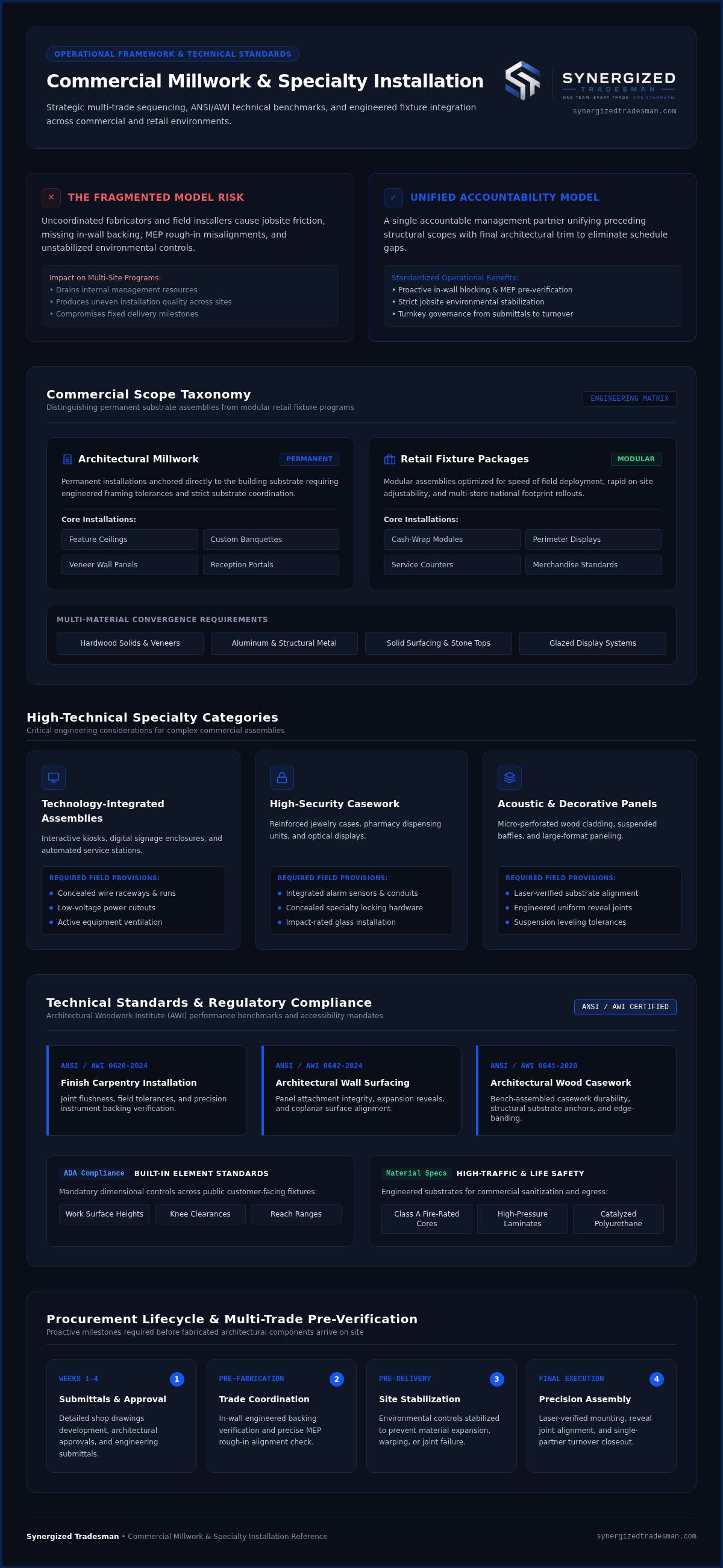
Commercial millwork extends far beyond traditional decorative mouldings and standing trim. In modern commercial construction, it functions as an engineered operational asset. Successful project execution requires managing both shop-fabricated elements and complex on-site assemblies, ranging from high-traffic reception portals to integrated service counters. In high-pace retail store construction, these assemblies directly govern customer navigation, staff workflow, and merchandise security.
Shop-built millwork delivers controlled precision through CNC routing, factory edge-banding, and bench-assembled casework. On-site specialty assembly transforms those standalone units into a cohesive architectural installation. A thorough review of modern architectural millwork materials and scope shows how wood finishes now converge with structural metal, solid surfacing, and glazed displays. Coordinating these mixed-material systems demands active oversight long before crates arrive at the loading dock.
Architectural Millwork vs. Retail Fixtures
Architectural millwork comprises permanent installations anchored directly to the building substrate. Items such as custom feature ceilings, banquettes, and veneer wall paneling require engineered in-wall backing and precise framing tolerances. Conversely, retail fixture packages rely on modular design. These perimeter display standards and cash-wrap modules prioritize speed of deployment, field adjustability, and rapid reconfiguration across national footprints. Both scopes require durable substrates, combining hardwood solids and veneers with aluminum extrusions, stone tops, and impact-resistant composites to withstand heavy commercial traffic.
Specialty Installation Categories
Executing commercial millwork and specialty installation requires managing distinct, highly technical fixture categories:
- Technology-Integrated Assemblies: Interactive kiosks, digital signage enclosures, and automated service stations that demand concealed wire runs, low-voltage power cutouts, and equipment ventilation.
- High-Security Casework: Reinforced jewelry cases, lockable pharmacy dispensing units, and optical displays with integrated alarms, concealed locking hardware, and impact-rated glass.
- Acoustic and Decorative Wall Panels: Engineered micro-perforated wood cladding, suspended architectural baffles, and large-format paneling systems that require laser-verified alignment and uniform reveal joints.
Treating these scopes as separate trades invites coordination errors. Successful delivery requires unifying them under a single management protocol from submittals to turnover.
Technical Standards and Procurement Logistics
Precision execution hinges on strict adherence to current Architectural Woodwork Institute benchmarks. Today, monolithic criteria are replaced by performance-focused guidelines, including ANSI/AWI 0620-2024 for finish carpentry installation, ANSI/AWI 0642-2024 for wall surfacing, and ANSI/AWI 0641-2020 for architectural wood casework. Meeting these standards requires verifying joint flushness, structural backing, and field tolerances with precision instruments rather than visual estimates.
Successful delivery also demands rigorous compliance with federal accessibility codes. Service desks, transactions counters, and interactive terminals must strictly follow the ADA Standards for Built-In Elements, maintaining specific work surface heights, knee clearances, and reach ranges. Managing these details across multi-site programs requires unified technical oversight.
Material Durability in High-Traffic Zones
Public commercial environments subject finishes to severe physical wear and aggressive sanitation chemicals. Casework surfaces demand high-pressure laminates, impact-resistant solid surfaces, or factory-applied catalyzed polyurethane finishes that resist moisture penetration. Wall panel assemblies in egress corridors must incorporate Class A fire-rated cores, such as fire-retardant treated particleboard or MDF, while meeting low-emitting material thresholds for LEED-certified facilities.
The Procurement Lifecycle
Managing the procurement timeline for commercial millwork and specialty installation requires direct coordination long before field activities start. Production schedules follow strict operational windows:
- Submittals and Verification (Weeks 1 to 4): Developing detailed shop drawings, obtaining architect approvals, and completing 3D point-cloud site scans to verify as-built framing and rough-in coordinates.
- Off-Site Fabrication (Weeks 5 to 16): Producing custom casework, solid-surface fabrications, and specialized metal trims, factoring in 8 to 16 weeks of shop lead time for bespoke assemblies.
- Jobsite Stabilization and Acclimation (Delivery minus 72 hours): Enforcing AWI 200 standards by verifying that permanent HVAC systems hold relative humidity between 25% and 55% at 60°F to 80°F for at least 72 hours before uncrating materials.
Executing a synchronized multi-location retail refresh across regional footprints creates intense logistical pressure. Fabricating hundreds of custom fixtures is useless if local delivery schedules outpace interior site readiness. Partnering with experienced field managers at Synergized Tradesman ensures material deliveries match verified trade progress, eliminating double handling and protecting delicate finishes from on-site damage.
Managing Multi-Trade Coordination for Millwork Integration
Specialty fixtures do not exist in isolation. They sit at the convergence of Division 06 carpentry, Division 09 finishes, Division 22 plumbing, and Division 26 electrical work. When general contractors treat installation as a disconnected task, scope gaps appear immediately. Deploying a single accountability model brings these fragmented trades under one management umbrella. This proactive oversight ensures physical rough-ins, structural framing, and final architectural trim align precisely on the jobsite.
Adhering to rigorous Architectural Woodwork Institute standards requires continuous coordination with the trades building out the wall cavity. Hollow-wall anchors do not satisfy commercial pull-out loads under ANSI/AWI 0620. Metal stud framers must install engineered solid lumber or heavy 16-gauge steel continuous backing at exact elevations before drywall panels go up. Catching missing backing after drywall finish work forces destructive rework, inflates punch lists, and stalls project handover.
The Interdependency of Trades
Precision casework reveals framing defects instantly. A wall that is out of plumb by even a quarter inch creates unsightly wedge gaps along tall retail units, requiring extensive field scribing. Similarly, integrated LED display cases depend on hidden low-voltage drivers and exact conduit stub-outs. If electrical rough-in boxes miss cabinet access chases by two inches, field teams must hack into finished substrates. Commercial beverage stations and food service millwork present equal friction, demanding zero-tolerance alignments between sink penetrations, floor drains, and internal fixture chaseways.
Field Execution Oversight
Achieving predictable commercial millwork and specialty installation across regional or national rollouts demands structured field governance:
- Pre-Drywall Sign-Offs: Conducting mandatory inspections to confirm all structural in-wall blocking, data conduits, and plumbing supplies match approved millwork submittal drawings prior to drywall hanging.
- MEP Interface Control: Assigning a single superintendent to supervise junction box placements, ensuring seamless connections for lighted valances, point-of-sale terminals, and refrigerated display cases.
- Trade Handoff Sequencing: Enforcing clean-floor policies and running operational HVAC equipment before uncrating casework, preventing trade stacking damage from preceding mechanical crews.
Establishing clear accountability prevents trades from pointing fingers when assemblies do not fit. Standardized management checklists and daily field verification maintain uniform build quality across every site.
Selection Criteria for Specialty Installation Partners
Procuring installation services solely on the lowest bid often introduces severe operational risk. Single-trade carpentry outfits rarely possess the management bandwidth or contractual scope to resolve missing wall backing, misaligned floor boxes, or lagging plumbing connections. True risk mitigation requires choosing partners with proven interior commercial construction management expertise capable of coordinating structural, mechanical, and finish scopes simultaneously.
When planning regional or national rollouts, evaluate prospective partners on operational scalability and field consistency. Executing commercial millwork and specialty installation across multiple facilities demands unified project reporting, standardized tooling, and disciplined site supervision to ensure identical quality across every opening.
Key Performance Indicators (KPIs)
Assess specialty installation contractors using objective operational metrics rather than marketing promises:
- Schedule Adherence: Historical performance maintaining critical path milestones, particularly coordinating pre-installation site readiness with dryline and MEP contractors.
- Closeout Velocity: Average days required to clear punch lists. Elite teams identify and resolve joint tolerances and hardware alignments during active installation, achieving zero-item final handoffs.
- Safety and Regulatory Compliance: Documented safety programs, site-specific OSHA compliance records, and strict adherence to dust containment standards in active retail environments.
The WBE Certification Advantage
Working with a certified Women's Business Enterprise (WBE) delivers strategic organizational value beyond basic compliance. Corporate initiatives and institutional clients demand documented supplier diversity spend. Partnering with a qualified WBE general trades firm satisfies diversity quotas directly while securing robust project governance. The operational discipline required to secure and maintain national diversity certifications mirrors the rigorous quality control necessary for defect-free commercial execution.
Eliminate coordination gaps across your next buildout. To secure end-to-end multi-trade oversight for your interior programs, contact Synergized Tradesman to review your upcoming project specifications.
Synergized Tradesman: Streamlining Specialty Installations
Fragmented vendor structures remain the leading cause of finish-phase delays in commercial construction. When general contractors broker independent installers, drywallers, electricians, and millworkers separately across different territories, accountability collapses. Synergized Tradesman eliminates this friction by operating a consolidated single accountable relationship model. We take complete ownership of the envelope, bridging structural trades directly with final architectural finishes under unified project leadership.
Our management framework controls the critical path from initial submittals through staging, sequencing, and final project closeout. By coupling precision installation with preceding metal stud framing, in-wall backing, and MEP rough-in oversight, we prevent the typical scope gaps that derail turnover milestones. Clients gain a predictable execution vehicle that guarantees standardized quality across every commercial site.
A Single Source of Truth
Coordinating complex rollouts requires absolute clarity. Acting as a master coordinator, we centralize all trade communication, shop submittals, and site logistics into one reporting channel. This operational shielding delivers measurable client advantages:
- Consolidated Communications: A single dedicated project manager oversees all trade handoffs, eliminating administrative friction and conflicting site instructions.
- Unified Quality Assurance: Standardized quality checklists enforce identical joinery reveals, fastening standards, and finish tolerances across every regional location.
- Reduced Overhead: Offloading multi-party trade management frees your internal corporate real estate team to focus on strategic program expansion rather than daily jobsite disputes.
Built for High-Volume Demands
Modern national programs demand scalable execution infrastructure. Successfully integrating high-volume retail fixture and millwork installation into broader renovation programs requires precise logistical synchronization. We stage deliveries to match verified site milestones, ensuring crates arrive only when conditioned air is running and backing is verified. As an established, certified women-owned business (WBE), we deliver this institutional-grade oversight while simultaneously fulfilling corporate supplier diversity requirements.
Executing commercial millwork and specialty installation across multi-site initiatives no longer requires managing dozen of competing subcontractors. By relying on a single partner built for operational volume, commercial teams protect project timelines, control overhead costs, and ensure flawless architectural turnover.
Master Your Next Architectural Rollout
High-end architectural finishes define your brand's physical presence, but flawless field execution requires synchronized trade management. Protecting your schedule demands rigorous climate verification under AWI standards, early coordination of in-wall structural blocking, and zero-tolerance alignment across mechanical rough-ins. When these critical paths converge under unified oversight, project friction disappears.
Managing commercial millwork and specialty installation across multiple commercial properties doesn't require juggling disconnected trade partners. Consolidating your finish carpentry, metal framing, MEP interfaces, and final closeout under a single accountable relationship model ensures standardized quality while lowering administrative overhead.
As a certified women-owned business (WBE) offering national project management oversight, we provide the operational discipline required for multi-site rollouts. Take control of your upcoming buildouts by choosing a partner built for high-volume execution. Contact Synergized Tradesman for your multi-trade installation needs, and deliver defect-free spaces on schedule every time.
Frequently Asked Questions
What is included in commercial millwork and specialty installation?
It encompasses functional architectural woodwork, Division 06 custom casework, Division 10 specialties, and Division 12 furnishings. Scope items include reception desks, transaction counters, high-security display vitrines, decorative wall panels, acoustic ceiling baffles, and modular retail fixtures. Scope execution combines precision off-site fabrication with on-site assembly, requiring exact structural anchoring, integrated technology cutouts, and seamless joint alignment across active commercial environments.
How do you coordinate millwork with other trades like electrical and plumbing?
Effective trade coordination begins well before drywall framing finishes. Metal stud framers must place engineered in-wall solid or steel blocking at specified elevations, while electricians and plumbers set rough-ins using approved shop drawings. Unifying commercial millwork and specialty installation under one multi-trade manager ensures rough-in locations align with cabinet chases, preventing destructive wall demolition or field modifications during finish attachment.
What are the lead times for specialty commercial fixtures in 2026?
Standard custom architectural casework currently averages 8 to 16 weeks from approved shop drawings to jobsite delivery. Complex bespoke detailing can stretch from 10 to 20 weeks, whereas modular catalog casework typically requires 4 to 7 weeks. Upfront engineering submittals, finish sampling, and laser field verification add another 2 to 4 weeks, making early procurement scheduling essential to maintain construction milestones.
Does Synergized Tradesman handle national rollout programs for millwork?
Yes. Synergized Tradesman delivers national project management oversight across multi-site commercial programs throughout the United States. We manage complete program rollouts from preconstruction planning through procurement, synchronized field execution, and project closeout. Our centralized management infrastructure enforces uniform installation standards, dependable trade scheduling, and consistent punch-list velocity across every commercial facility in your portfolio.
Why is a single accountable relationship important for specialty installs?
Fragmented trade contracting creates finger-pointing when site conditions don't match shop drawings. A single accountable relationship model places framing, MEP rough-ins, specialty installation, and final clean-up under one responsible contractor. This structure shields the owner from vendor disputes, streamlines communication into a single reporting channel, eliminates costly change orders, and significantly reduces internal corporate project management overhead.
How do you ensure quality consistency across multiple installation sites?
Quality consistency across distributed programs relies on standardized execution checklists aligned with current ANSI/AWI standards. Centralized project managers verify as-built tolerances using digital reporting and field verification before materials leave the shop. Standardized installation procedures govern everything from joint flushness to hardware operation, ensuring the customer experience remains identical regardless of project location.
What certifications should a specialty installation partner hold?
Look for contractors experienced in ANSI/AWI performance benchmarks and commercial life-safety codes. Partnering with a certified Women-Owned Business Enterprise (WBE) also provides critical strategic advantages. Certified WBE contractors like Synergized Tradesman deliver institutional-grade management oversight while helping corporate real estate teams and general contractors fulfill mandatory supplier diversity targets without sacrificing installation quality or operational control.
Can you manage the procurement of specialty materials for my project?
Yes. Synergized Tradesman provides end-to-end procurement and logistics management for commercial millwork and specialty installation programs. We coordinate directly with fabricators and hardware suppliers to secure long-lead materials, review engineering submittals, and stage deliveries. Shipments arrive only when jobsite environmental conditions, permanent HVAC operations, and preceding substrate trades are fully prepared for install.


