

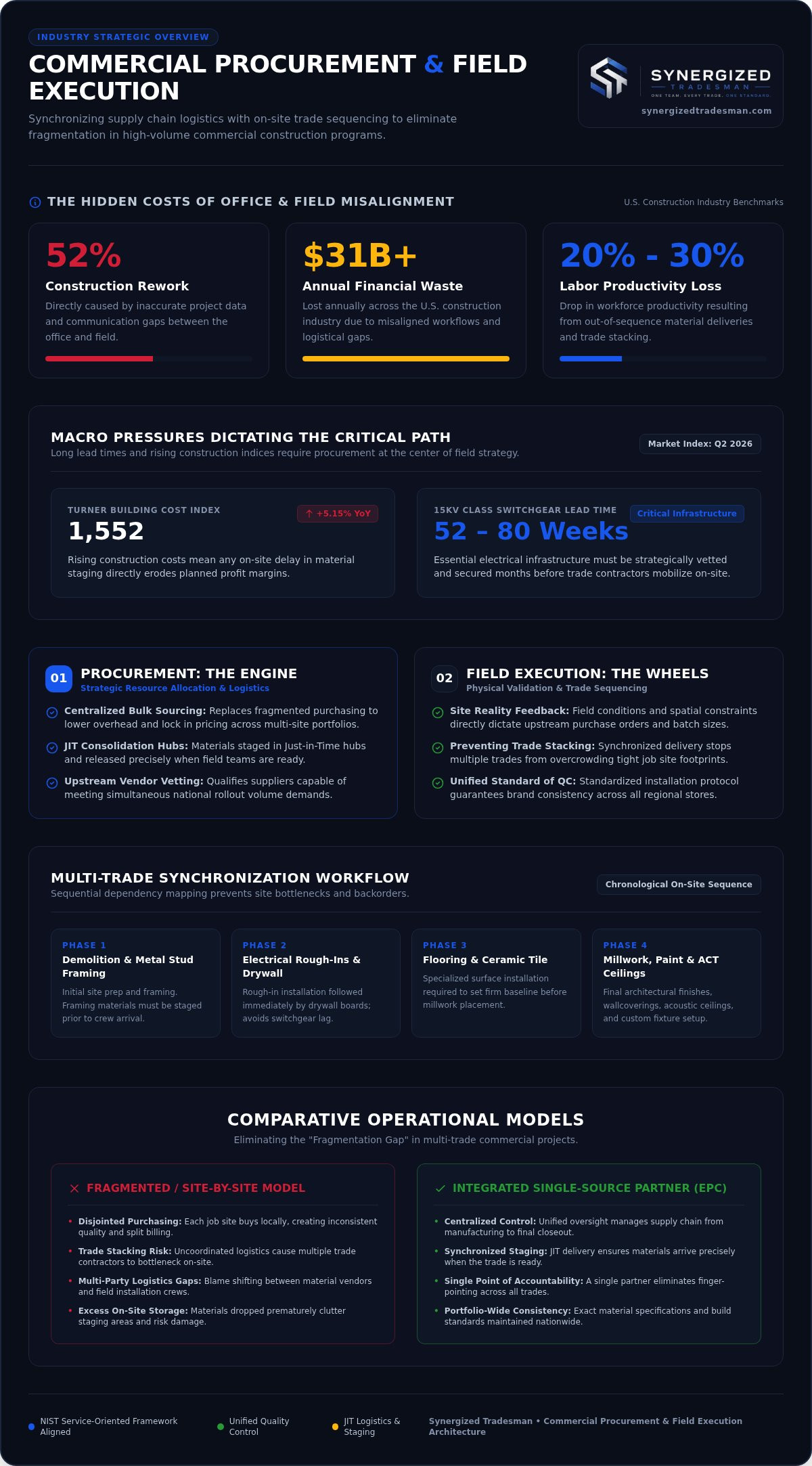
Did you know that 52% of all construction rework results directly from inaccurate project data and communication gaps between the office and the field? This misalignment costs the U.S. construction industry over $31 billion annually. You likely recognize the frustration of waiting for long-lead electrical switchgear or managing trade contractors who are forced to stack on top of each other because materials arrived late. It's a common struggle in high-volume national rollouts where fragmented communication between vendors and field teams creates constant delays.
Successful commercial procurement and field execution requires more than just placing orders. It demands a unified strategy that treats logistics and on-site labor as a single, accountable workflow. In this guide, you'll learn how to bridge the gap between procurement logistics and on-site execution to ensure seamless project delivery. We'll examine how a single-source model reduces overhead, maintains consistent quality across national locations, and eliminates the fragmentation that stalls multi-trade schedules. By centralizing oversight, you can transform your procurement pipeline from a bottleneck into a competitive advantage.
Key Takeaways
- Define the strategic synergy between material sourcing and on-site labor to prevent the logistical bottlenecks that stall multi-trade schedules.
- Analyze the benefits of centralized sourcing models over fragmented, site-by-site purchasing for high-volume national rollout programs.
- Identify how a single accountable relationship eliminates the "fragmentation gap" and serves as a shield against multi-party logistics failures.
- Establish a unified standard for performance and quality control to ensure consistent execution across every location in your portfolio.
- Learn to synchronize commercial procurement and field execution by aligning long-lead material arrivals with precise on-site trade sequencing.
The Strategic Intersection of Commercial Procurement and Field Execution
Integrated project delivery requires total alignment between the supply chain and the job site. Effective commercial procurement and field execution function as a single unit rather than siloed departments. When procurement teams operate without field-level insight, they risk buying materials that don't fit current site conditions or arrive in the wrong sequence. This disconnect leads to trade stacking and stalled progress. Procurement is the engine of the project, while field execution serves as the wheels. If one fails, the entire delivery vehicle stops.
Current market data highlights the pressure on this intersection. The Turner Building Cost Index rose to 1,552 in Q2 2026, marking a 5.15% increase year-over-year. Rising costs mean every delay in material arrival directly erodes project margins. Procurement now dictates the critical path because lead times for essential infrastructure, such as 15kV class switchgear, now range from 52 to 80 weeks. You can't manage a modern schedule without placing procurement at the center of your field strategy.
Defining Procurement in a Multi-Trade Environment
Procurement in a commercial setting is no longer a simple purchasing function. It's a strategic resource allocation process. Managing a national rollout requires vetting vendors for their ability to meet high-volume demands across multiple locations simultaneously. You must secure long-lead items months before a trade partner even steps on site. This requires a deep understanding of the specific requirements for electrical, plumbing, and millwork trades. Strategic sourcing ensures that specialized materials for ACT ceilings or flooring are staged and ready before the field teams arrive, preventing costly labor downtime.
The Role of Field Execution in Project Lifecycles
Field execution represents the physical validation of your procurement strategy. It involves the sequential coordination of demolition, metal stud framing, and electrical rough-ins. If the framing materials arrive but the drywall is backordered, the schedule collapses. This integration mirrors the engineering, procurement, and construction (EPC) model used to streamline delivery through a single partner. Most field execution failures don't start on the job site; they begin as upstream procurement gaps. When materials arrive out of sequence, labor productivity drops by an estimated 20% to 30% due to trade stacking. High-performing programs bridge this gap by ensuring field realities inform every purchase order from day one.
Streamlining Multi-Trade Logistics for High-Volume Programs
Fragmented purchasing models fail in high-volume retail refreshes. When individual sites manage their own procurement, the result is inconsistent material quality and unpredictable delivery dates. Centralizing commercial procurement and field execution allows for bulk purchasing and staged delivery. This model reduces overhead by consolidating freight and minimizing on-site storage requirements. It also ensures that a retail location in one region looks identical to a location a thousand miles away. Consistency is the foundation of brand standards, and it starts with a unified supply chain.
Centralized Sourcing and Material Management
Centralization drives efficiency through standardization. By managing the entire supply chain from a single hub, you eliminate the variability of local vendor performance. This approach speeds up project closeout because the correct fixtures, flooring, and millwork arrive in a single, coordinated shipment. NIST research on construction supply chain integration emphasizes that a service-oriented framework is essential for bridging the gap between trade-specific procurement and on-site labor. Staging materials in Just-in-Time (JIT) consolidation hubs allows you to release packages exactly when the field team is ready. If you're managing high-volume rollouts, this level of oversight is mandatory to protect your timeline and reduce direct project costs.
Coordinating Specialty Trades and Vendor Timelines
Managing the transition between trades requires precise timing. Millwork installation cannot begin until flooring and tile are set. Similarly, painting and wallcovering must wait for the completion of metal stud framing and drywall. A multi-trade commercial construction model prevents vendor overlap by aligning material arrivals with craft labor availability. With lead times for commercial roofing membranes currently ranging from 3 to 10 weeks, your procurement strategy must account for these windows to avoid trade stacking. One accountable partner manages these overlapping timelines. They ensure that each trade has the materials they need the moment they arrive on site. This prevents the "fragmentation gap" where trades wait for materials that were never ordered or arrive in the wrong order. By controlling the bill of materials and the labor schedule simultaneously, you eliminate the finger-pointing that typically occurs when separate trades manage their own supply chains.
Overcoming the Fragmentation Gap in Commercial Construction
Fragmentation is the primary driver of budget overruns in the commercial sector. When procurement and field labor operate as separate silos, the project suffers from an accountability gap. Traditional models often see a general contractor managing dozens of independent trade partners, each responsible for their own supply chain. This structure creates a high risk of handoff failures. If a vendor delivers the wrong materials, the field team stops. The resulting downtime costs aren't just labor hours; they include the soft costs of extended site management and delayed revenue for the client.
Poor communication accounts for a massive portion of project rework. Managing commercial procurement and field execution through a single point of contact eliminates the "not my job" mentality. This integrated approach aligns with McKinsey’s research on integrated capital project delivery, which demonstrates that breaking down silos prevents handoff bottlenecks. A unified partner acts as a shield, absorbing the complexity of multi-party logistics so the client doesn't have to.
The Hidden Costs of Disconnected Procurement
The "cheapest bid" strategy often backfires when applied to complex commercial builds. Selecting a vendor based solely on price frequently ignores their ability to coordinate with other trades. If the electrical rough-in is delayed because the switchgear procurement failed, the framing and drywall teams are stalled. These scheduling conflicts lead to trade stacking, where multiple crews try to work in the same space simultaneously. This reduces productivity by 20% to 30%. Partnering with a commercial general trades contractor mitigates these risks by consolidating responsibility. One partner manages the demolition, framing, and final cleaning, ensuring that every transition is seamless and every cost is accounted for.
Mitigating Delays Through Field-First Planning
Effective integration requires reverse-engineering the project timeline. You must start with the desired closeout date and work backward to determine procurement deadlines. This is especially critical in interior commercial construction management, where sequences are tight and tolerances are low. Establishing clear KPIs is essential. You need to track procurement speed, submittal approval times, and field execution quality in real time. When procurement is informed by field-level construction realities, the project moves faster. It eliminates the friction of missing components and ensures that every material delivery supports the immediate needs of the on-site team.
Best Practices for Field Execution and Quality Control
Field execution is the physical proof of a successful procurement strategy. Without rigorous oversight on the job site, even the most efficient supply chain fails to deliver value. Standardizing these processes across multiple locations requires a methodical approach that eliminates regional variance. High-volume programs succeed when every trade partner follows a unified set of performance metrics. This ensures that a project in one state matches the quality and timeline of a project in another. Reliable commercial procurement and field execution hinges on this consistency.
Success in the field isn't accidental. It's the result of disciplined coordination between trade partners and project managers. When execution is treated as a separate phase from procurement, the risk of miscommunication increases. You need a system that validates material arrivals against the master schedule in real time. This proactive management prevents the trade stacking that often occurs when site conditions aren't communicated back to the procurement team.
Standardizing Performance Across National Portfolios
Establishing a "Project Playbook" is essential for field supervisors. This document serves as the single source of truth for every trade, from demolition to flooring. It defines the exact standards for metal stud framing, electrical rough-ins, and millwork installation. By utilizing a single accountability model, you ensure brand consistency across your entire portfolio. This is particularly critical in retail store construction, where brand identity depends on the precise execution of specialized fixtures. Consistency reduces the need for costly rework and keeps the national rollout on track.
Real-Time Monitoring and Reporting Protocols
Visibility is the antidote to project delays. Daily field execution updates allow project managers to identify bottlenecks before they cascade. If a trade falls behind, real-time reporting triggers immediate corrective actions. This includes managing punch lists throughout the project rather than waiting until the end. Documentation plays a vital role in successful project closeout. Accurate records of material arrivals and trade milestones simplify the transition to the final cleaning phase. It prevents the last-minute scramble for manuals and warranties that often delays store openings. If you need a partner to manage your national field execution, centralization is the only way to maintain these rigorous standards at scale.
Synergizing Procurement and Execution with a Single Partner
Consolidating the lifecycle of a project under one roof transforms the delivery process. Traditional models rely on a complex web of vendors and sub-contractors. This creates gaps where information is lost and responsibility is diffused. By integrating commercial procurement and field execution, you create a direct line of sight from the initial purchase order to the final site inspection. Synergized Tradesman operates as a master coordinator, managing every phase from demolition to project closeout. This model provides the shield necessary to protect your budget from the hidden costs of multi-party failures.
Diversity and reliability are not mutually exclusive. As a certified women-owned commercial construction firm (WBE), Synergized Tradesman helps clients meet corporate social responsibility goals while delivering high-level operational results. This certification signals a commitment to rigorous standards and disciplined project management. It ensures that your national portfolio is managed by a partner built for the complexities of high-volume demands. You gain a reliable partner that values transparency and facts over marketing bravado.
The Efficiency of Single-Source Accountability
Accountability is the primary benefit of the single-partner model. When one entity manages the framing, electrical, and painting, the risk of miscommunication disappears. This structure streamlines communication between the home office and the various job sites. Effective commercial construction project coordination reduces client stress by providing a single point of contact for all trade-related issues. You no longer need to mediate disputes between an electrical contractor and a flooring installer. Instead, you receive a steady stream of results-oriented briefings that confirm your project is on track.
Managing Retail Refreshes and Rollouts at Scale
Scaling a national rollout requires a partner capable of executing with speed and precision across multiple locations. Managing retail refreshes involves the simultaneous coordination of millwork installation, plumbing rough-ins, and final cleaning. Synergized Tradesman manages this entire lifecycle, ensuring that every location meets the exact same quality standard. This integrated approach to commercial procurement and field execution eliminates the variability that often plagues national programs. Ready to streamline your next project? Partner with Synergized Tradesman to gain total oversight of your construction portfolio.
Driving Efficiency Through Unified Construction Management
Success in large-scale commercial programs depends on your ability to eliminate the fragmentation gap. Integrating commercial procurement and field execution ensures that material logistics and trade labor operate as a single, accountable workflow. You reduce project overhead by centralizing sourcing and maintaining consistent quality standards across every location in your national portfolio. This methodical approach protects your schedule from the delays caused by multi-party communication failures.
Synergized Tradesman acts as your single source of truth for all trades, from demolition and framing to final cleaning. As a certified women-owned business (WBE), we provide the oversight and discipline required for high-volume retail rollouts and refreshes. We serve as a shield for our clients, managing complex logistics with total responsibility. It's time to move beyond fragmented delivery models and embrace a system built for scale.
Streamline your commercial project with a single accountable partner. Your next national rollout is an opportunity to prove that organized oversight drives superior outcomes.
Frequently Asked Questions
What is the difference between commercial procurement and field execution?
Commercial procurement involves the strategic sourcing and logistics of materials, while field execution refers to the physical management of on-site labor and trade coordination. Procurement ensures that long-lead items, such as electrical switchgear or specialized millwork, are ordered and staged correctly. Execution involves the sequential implementation of trades like demolition, framing, and final cleaning. Integrating commercial procurement and field execution ensures that material arrivals align perfectly with the labor schedule.
How does a multi-trade contractor improve procurement efficiency?
A multi-trade contractor improves efficiency by consolidating the supply chain under a single accountable relationship. Instead of managing dozens of individual trade vendors, the contractor handles bulk purchasing for framing, drywall, and flooring simultaneously. This centralization reduces freight costs and eliminates the risk of conflicting delivery schedules. It also ensures that material specifications remain consistent across every location in a national portfolio, which simplifies the overall management of the project lifecycle.
Why is field execution critical for retail rollout programs?
Field execution is critical because it dictates the opening date and revenue potential for a retail location. In high-volume rollouts, precise coordination of millwork installation and electrical rough-ins is necessary to maintain brand standards across dozens of sites. Execution errors at one location can cascade into delays for the entire program. Disciplined field management ensures that every trade follows a standardized playbook, resulting in predictable outcomes and faster speed to market for the client.
What are the risks of fragmented procurement in commercial construction?
Fragmented procurement creates an accountability gap where no single entity is responsible for the handoff between sourcing and labor. This often leads to trade stacking, where multiple crews are forced into the same work zone because materials arrived out of sequence. The financial impact is significant; rework and miscommunication can cost the industry billions annually. Fragmentation also obscures visibility into the supply chain, making it difficult to address lead-time bottlenecks before they stall the project.
How can I ensure quality control across multiple national locations?
Ensuring quality control requires a unified performance standard that applies to every location regardless of geography. Utilizing a single accountable partner allows for the implementation of a standardized Project Playbook for all field supervisors. Real-time reporting protocols and digital punch lists provide visibility into the progress of each site. This centralized oversight ensures that plumbing, painting, and flooring meet the same rigorous standards in every state, protecting the integrity of the national brand.
What trades are typically included in a commercial field execution plan?
A comprehensive field execution plan includes all general and specialty trades required for a build-out. This encompasses demolition, metal stud framing, drywall, and ACT ceilings. It also integrates specialized services like electrical rough-ins, plumbing, flooring, and millwork installation. The plan concludes with final cleaning and project closeout. Coordinating these trades under one management structure ensures that the transition from framing to painting happens without the delays common in multi-party logistics.
How does centralized procurement affect the project closeout process?
Centralized procurement accelerates project closeout by ensuring that all documentation, warranties, and manuals are collected during the sourcing phase. When materials are managed from a single hub, the transition to final cleaning and handover is seamless. It eliminates the last-minute scramble for missing components or incorrect fixtures that typically delay store openings. Organized procurement leads to a cleaner punch list, allowing the client to take possession of the site and begin operations on schedule.
Why should I choose a single accountable partner for my retail refresh?
Choosing a single accountable partner provides a shield against the logistical failures of multi-party construction. A partner like Synergized Tradesman manages the entire lifecycle, from procurement to the final walkthrough, under one standard. This model eliminates finger-pointing between trades and reduces the administrative burden on the client. As a certified women-owned business, we offer the reliability and disciplined execution needed for high-volume refreshes, ensuring consistent quality across your entire national portfolio.


