

A successful national rollout is rarely derailed by the quality of the millwork itself, but rather by the failure of trade coordination. You've likely managed the frustration of site unreadiness or the fragmented communication that occurs during a retail fixture and millwork installation when different trades clash on-site. These friction points lead to costly delays and quality variance across your geographic footprint, especially as 55% of construction markets currently face skilled trade shortages. It's a common challenge for project managers who need a stabilizing force to manage complexity.
This guide provides the framework to master these installations with total accountability and precision. You'll learn how to implement a standardized process that ensures every location meets the AWI Standards 2026 and ANSI/AWI 0620-2024 benchmarks. We'll examine the critical path from site readiness to final documentation. This provides a single source of truth for managing high-volume demands throughout 2026. Our approach acts as a shield against multi-party logistics failures, ensuring your portfolio remains consistent and compliant.
Key Takeaways
- Distinguish between modular store elements and custom architectural millwork to align project expectations with the correct trade skill sets.
- Ensure all installations comply with the AWI Standards 2026 and ADA requirements for retail counter heights and reach ranges.
- Reduce operational risk by moving away from fragmented labor toward a single point of accountability for your retail fixture and millwork installation.
- Follow a structured execution model that prioritizes pre-construction site surveys and centralized logistics to prevent site unreadiness delays.
- Leverage the value of a WBE-certified partner to meet 2026 corporate procurement goals while maintaining a unified quality standard across national portfolios.
Understanding Retail Fixture and Millwork Installation
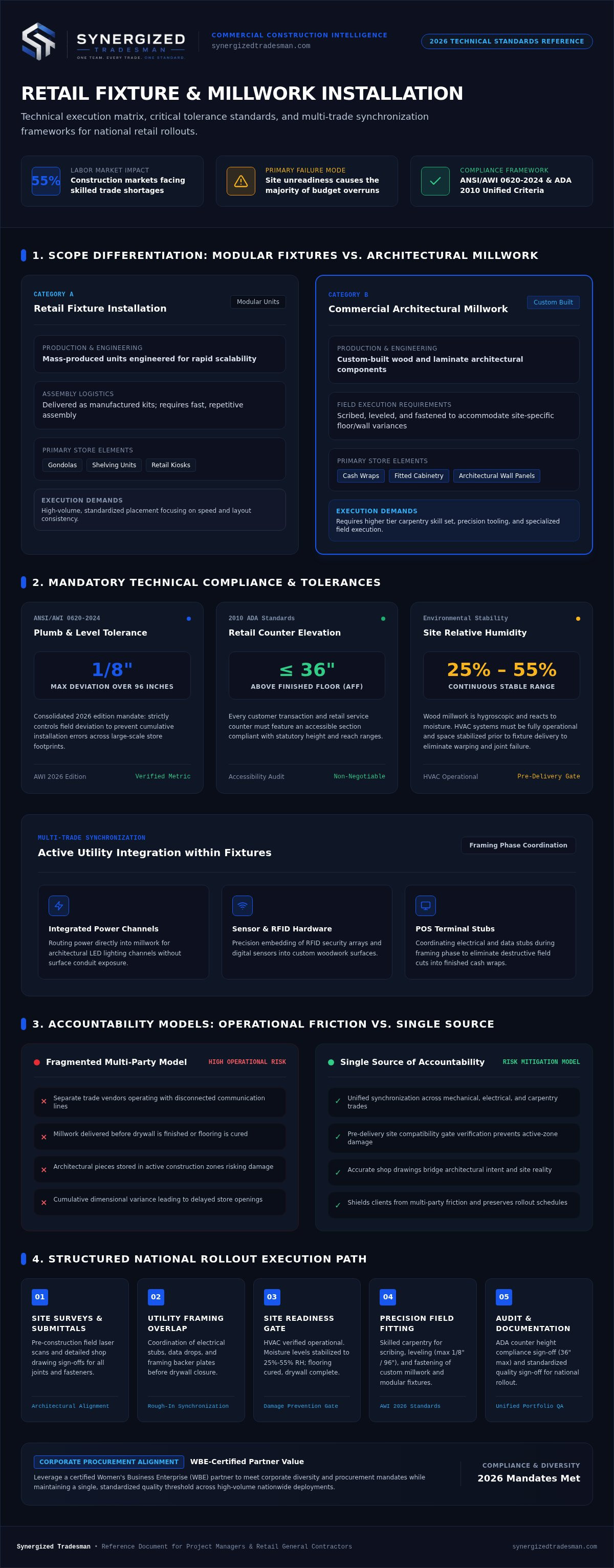
Successful project execution starts with a clear technical definition. Within the scope of commercial shop fitting and fixture installation, two distinct categories exist that require separate management logic. Retail fixture installation refers to the assembly and placement of modular store elements. These are typically mass-produced units designed for scalability. Commercial millwork, however, involves custom-built wood or laminate architectural elements. These are often one-of-a-kind pieces tailored to a specific store footprint.
In 2026, managing these categories as a single generic labor task is a mistake. High-volume retail environments now demand multi-trade synchronization. This ensures that custom elements and modular units integrate perfectly with the building's electrical and mechanical systems. Without this oversight, the risk of site-level failure increases significantly.
The Distinction Between Modular Fixtures and Custom Millwork
Modular fixtures include gondolas, shelving units, and kiosks. Manufacturers design these for rapid assembly. They arrive in kits and require efficient, repetitive execution. Custom millwork is far more complex. This category includes cash wraps, fitted cabinetry, and architectural wall panels. These elements aren't just "placed" in a room. They must be scribed, leveled, and fastened with extreme precision to account for site-specific floor and wall variances. Retail fixture and millwork installation success depends on recognizing that millwork requires a higher tier of carpentry skill and specialized field execution compared to modular assembly.
Why Coordination is the Primary Success Factor
Coordination isn't just a management task; it's a risk mitigation strategy. Site unreadiness is the leading cause of budget overruns. If the flooring isn't cured or the drywall isn't finished, the installation cannot proceed. Fragmented trade management often leads to millwork being delivered to an active construction zone where it's susceptible to damage. This creates a chain reaction of delays. Implementing a multi-trade commercial construction model solves this by providing a single source of truth. It ensures that the site is fully compatible before the first fixture arrives. This approach shields the client from the friction that occurs when separate trade vendors fail to communicate. When every trade is synchronized, the transition from a shell space to a finished retail environment is seamless and documented.
Technical Standards for Commercial Millwork and Specialty Installation
Precision begins with the submittal process. Every retail fixture and millwork installation project relies on accurate shop drawings to bridge the gap between architectural intent and field reality. These documents serve as the primary source of truth for all stakeholders. They must detail every fastener, joint, and interface with existing site conditions. Following the Architectural Woodwork Institute standards, specifically the 2026 consolidated edition, ensures that tolerances remain within professional limits. For instance, the ANSI/AWI 0620-2024 standard mandates a maximum plumb and level deviation of 1/8 inch over 96 inches. Adhering to these metrics prevents the cumulative errors that often derail large-scale rollouts.
Compliance is a non-negotiable technical requirement. Retail service counters must provide an accessible portion no higher than 36 inches above the finished floor to meet 2010 ADA Standards. Beyond geometry, environmental stability is critical. Wood millwork is hygroscopic; it reacts to moisture. Failure to maintain site humidity between 25% and 55% before and during installation can lead to warping or joint failure. Installers must verify that the building's HVAC system is operational and the environment is stabilized before millwork is introduced to the space.
Integration with Site Utilities and Trades
Modern fixtures are rarely passive furniture. They require integrated power for LED lighting channels, RFID sensors, and POS terminals. Coordination of electrical stubs must occur during the framing phase to avoid destructive field modifications later. Managing these trade overlaps requires sophisticated interior commercial construction management to ensure that electrical, flooring, and millwork trades follow a logical sequence. Seamless flooring transitions around fixed units are only possible when the substrate is level and the millwork base is properly scribed. This level of trade synchronization protects the aesthetic integrity of the design.
Quality Standards and Material Durability
Durability in high-traffic retail environments depends on rigorous material selection. Commercial-grade laminates and factory-finished surfaces must meet specific wear resistance ratings to withstand constant public use. During a national rollout, quality control must be standardized across every location. This includes verifying that any factory-finished product cut on-site has its exposed core sealed to prevent moisture ingress. Standardizing these details ensures that a store in one region matches the quality of a flagship in another. If you're looking for a partner who prioritizes these technical details, consider professional millwork oversight for your next project.
Accountability Models: Single Source vs. Fragmented Labor
Managing a national rollout through fragmented labor creates a high risk of project failure. When you hire independent trade contractors for each site, you inherit the burden of coordinating their schedules, quality, and communication. This labor-only model often lacks the management oversight required for a technical retail fixture and millwork installation. It forces your internal team to act as the primary troubleshooter for every site-level conflict. Choosing a single accountable relationship shifts this burden to a partner who acts as a shield against logistics failures and trade clashes.
The total cost of ownership for a retail refresh isn't just the contract price. It includes the administrative hours spent managing vendors and the cost of delays. A commercial general trades contractor reduces this burden by providing a single source of truth for the entire project lifecycle. This model ensures that every trade, from demolition to final cleaning, operates under a unified standard. It eliminates the "finger-pointing" that occurs when a millwork installer arrives to find that the electrical stubs are in the wrong location.
The Hidden Costs of Fragmented Coordination
Fragmented coordination leads to a high volume of change orders. These costs stem from trade communication gaps where one vendor's work interferes with another's progress. Managing 50 or more individual vendor relationships across a national portfolio is a logistical nightmare that drains internal resources. You also risk receiving inconsistent close-out documentation. Without a centralized management layer, verifying that every site meets ADA accessibility standards for sales counters and service fixtures becomes nearly impossible. This inconsistency leaves your brand vulnerable to compliance risks and aesthetic variances that hurt the customer experience.
The Benefits of a National Managed Rollout
A managed rollout ensures total uniformity in brand execution. Whether the site is in a high-cost metropolitan area or a rural market, the quality remains identical. This is achieved through centralized procurement and logistics oversight. A single point of contact manages the entire supply chain, from the factory floor to the retail floor. It's an efficient approach that streamlines communication and accelerates the project timeline. By consolidating retail fixture and millwork installation under one accountable partner, you ensure that every location closes out on time with full, standardized documentation. This discipline is what allows a brand to scale rapidly without sacrificing quality or control.
How to Execute a National Retail Fixture Rollout
Executing a national program throughout 2026 requires a disciplined, five-stage operational framework. This sequence ensures that every retail fixture and millwork installation remains on schedule and within budget across diverse locations. Success is a product of coordination, not just labor. A methodical approach prevents the trade clashes and site unreadiness issues that commonly derail high-volume rollouts. It establishes a single source of truth for the entire project lifecycle.
- Step 1: Pre-construction planning and site survey verification. Confirm site conditions match architectural drawings to avoid fabrication errors.
- Step 2: Centralized procurement and logistics staging. Control the flow of materials to prevent site congestion and damage.
- Step 3: Multi-trade field execution and sequence management. Synchronize general trades, such as electrical and flooring, to maintain the critical path.
- Step 4: Quality control audits and punch list resolution. Inspect work against AWI Standards 2026 during the build phase.
- Step 5: Final cleaning and project close-out documentation. Deliver a "retail-ready" space with comprehensive digital records.
Pre-Construction and Site Readiness
Site readiness is the foundation of execution. Teams must verify field dimensions against shop drawings before fabrication begins. This step prevents costly on-site modifications that delay the schedule. Project managers assess floor levelness and wall plumbness using the tolerances defined in ANSI/AWI 0620-2024. If the substrate is out of spec, the installation will suffer. Additionally, coordinators must manage logistics around landlord or mall restrictions. This includes scheduling night deliveries or securing specific elevator windows to maintain the project timeline. These details act as a shield for the client against unexpected field delays.
Field Execution and Project Close-out
Managing the transition from demolition to installation requires precise timing. Crews must ensure that the space is clear and utilities are stubbed in correctly before fixtures arrive. Once the retail fixture and millwork installation is complete, the focus shifts to final cleaning. A "retail ready" standard means the space is free of construction dust and debris, allowing for immediate merchandising. The final step is compiling a comprehensive close-out package. This package includes as-built drawings, warranty information, and photographic evidence of the completed punch list. If you need a partner to manage your national rollout with total accountability, our single-source model is built for these high-volume demands.
Optimizing Retail Environments with Synergized Tradesman
Synergized Tradesman operates as a master coordinator for high-volume 2026 portfolios. Our approach to retail store construction prioritizes a single accountable relationship that removes the friction of multi-party logistics. In 2026, corporate procurement teams increasingly prioritize WBE-certified partners to meet diversity spend goals while maintaining rigorous technical standards. We provide that strategic balance. By acting as a single source of truth, we improve project ROI through reduced administrative overhead and the total elimination of trade-related delays. This model allows your internal team to focus on brand strategy while we handle the field execution.
Our service scope covers the entire project lifecycle, ensuring no gaps exist between trades. We manage the following core services:
- Professional demolition and site preparation
- Metal stud framing, drywall, and ACT ceilings
- Electrical and plumbing utility integration
- Flooring, tile, and specialized wallcoverings
- Retail fixture and millwork installation
- Final cleaning and project close-out documentation
The Synergized Standard for National Portfolios
Maintaining consistent quality across national portfolios requires a unified operational standard. We execute every project under the same set of protocols, regardless of the geographic location. This commitment to transparent field execution includes real-time reporting and detailed photographic documentation. We function as a shield for your internal project managers, taking total responsibility for field performance and vendor synchronization. This specialized focus makes us the preferred partner for complex retail refreshes that require both high precision and rapid turnaround. We don't just provide labor; we provide a disciplined management framework that protects your brand's physical assets.
Next Steps for Your 2026 Retail Program
Transitioning from the planning phase to field execution requires a partner built for high-volume demands. In 2026, the increasing complexity of electrified fixtures and modular "kit-of-parts" engineering makes trade synchronization more critical than ever. Selecting an expert who understands the technical nuances of retail fixture and millwork installation ensures your program remains on schedule and compliant with all AWI and ADA standards. We are built to handle the burden of multi-party logistics with a sense of total responsibility. Contact Synergized Tradesman today to schedule a project consultation and stabilize your 2026 retail rollout strategy.
Stabilizing Your National Retail Portfolio for 2026
Successful rollouts require a departure from fragmented vendor management. Transitioning to a single accountable relationship ensures that your technical standards remain consistent across every location. Whether you're managing custom cabinetry or modular displays, the integration of trades like electrical and flooring must be synchronized to avoid site failures. Precision in retail fixture and millwork installation is a product of disciplined oversight and rigorous pre-construction verification.
Synergized Tradesman provides the management framework necessary for high-volume demands. As a certified WBE, we offer a single point of accountability that acts as a shield for your internal team. Our standardized quality protocols across national portfolios ensure that every project closes out on time with full documentation. It's time to eliminate trade clashes and secure your project ROI through professional multi-trade coordination. Our model is built to handle the logistical burden so you don't have to.
Streamline your national rollout with Synergized Tradesman today and gain the reliability of a partner built for the complexities of modern retail.
Frequently Asked Questions
What is the difference between fixtures and millwork in retail?
Retail fixtures are modular, mass-produced elements like gondolas and shelving units designed for rapid assembly. Commercial millwork refers to custom-built wood or laminate architectural elements, such as cash wraps and fitted cabinetry. While fixtures are often "plug-and-play" kits, millwork requires high-precision field execution. Distinguishing these helps project managers assign the correct labor tiers for a retail fixture and millwork installation to ensure aesthetic and structural integrity across the store.
How long does a typical retail fixture rollout take per location?
The duration of a rollout depends on the project scope and site complexity. A standard retail refresh involving modular fixtures typically takes 3 to 7 days per location. Full-scale build-outs with custom millwork may require 2 to 4 weeks. These timelines assume the site is ready and trades are synchronized. Using a single accountable partner helps maintain these schedules by eliminating the communication gaps that often cause delays in high-volume national programs.
Why should I use a multi-trade contractor for millwork installation?
Multi-trade contractors provide a single source of truth for the entire project lifecycle. They coordinate the critical overlaps between millwork, electrical, and flooring trades. This model prevents situations where an installer arrives to find missing wall blocking or misplaced electrical stubs. By managing every trade under one standard, you reduce the administrative burden on your internal team and ensure that the installation meets the AWI Standards 2026 for quality and precision.
What are the most common causes of delays in retail installations?
Delays are most commonly caused by site unreadiness and fragmented trade communication. If the flooring isn't cured or the walls aren't plumb, the retail fixture and millwork installation cannot proceed. Other factors include incorrect field dimensions and logistics failures during the procurement phase. A coordinated management approach acts as a shield against these issues by verifying site conditions and delivery windows well before the installation crew arrives on the retail floor.
How do you ensure consistency across multiple national locations?
Consistency is achieved through a centralized management model and a unified operational standard. Synergized Tradesman executes every project under the same protocols, regardless of the geographic location. This includes standardized quality control audits and real-time field reporting. By using cross-trained crews and a single point of accountability, we ensure that a flagship store in one market matches the exact quality and brand specifications of a location thousands of miles away.
Does millwork installation require specific permits or inspections?
Millwork installation is typically covered under the general commercial building permit. However, specific elements like electrified cash wraps or plumbing-integrated kiosks require trade-specific permits and inspections. Compliance with the 2010 ADA Standards is also a mandatory requirement for service counters and reach ranges. It's essential to verify that all custom architectural elements meet local fire codes and seismic requirements, which are often detailed in the initial project shop drawings.
What documentation is included in a retail construction close-out?
A comprehensive close-out package includes all documentation required to transition the space to operations. This typically consists of as-built drawings, material warranties, and a fully resolved punch list with photographic evidence. We also include final cleaning certifications to ensure the store is "retail ready." Providing these digital records through a single source of truth allows your team to verify compliance and quality across your entire national portfolio with total transparency.
Can millwork be installed before electrical and flooring are complete?
Installing millwork before electrical and flooring are finished is not recommended and often leads to damage. Flooring must be installed and cured to provide a level substrate for cabinetry. Electrical stubs and data lines must be correctly positioned to integrate with illuminated displays or POS systems. Attempting to install millwork in an unstable environment risks warping and joint failure. Proper trade sequencing ensures that the site is stabilized and ready for high-precision finishes.


