

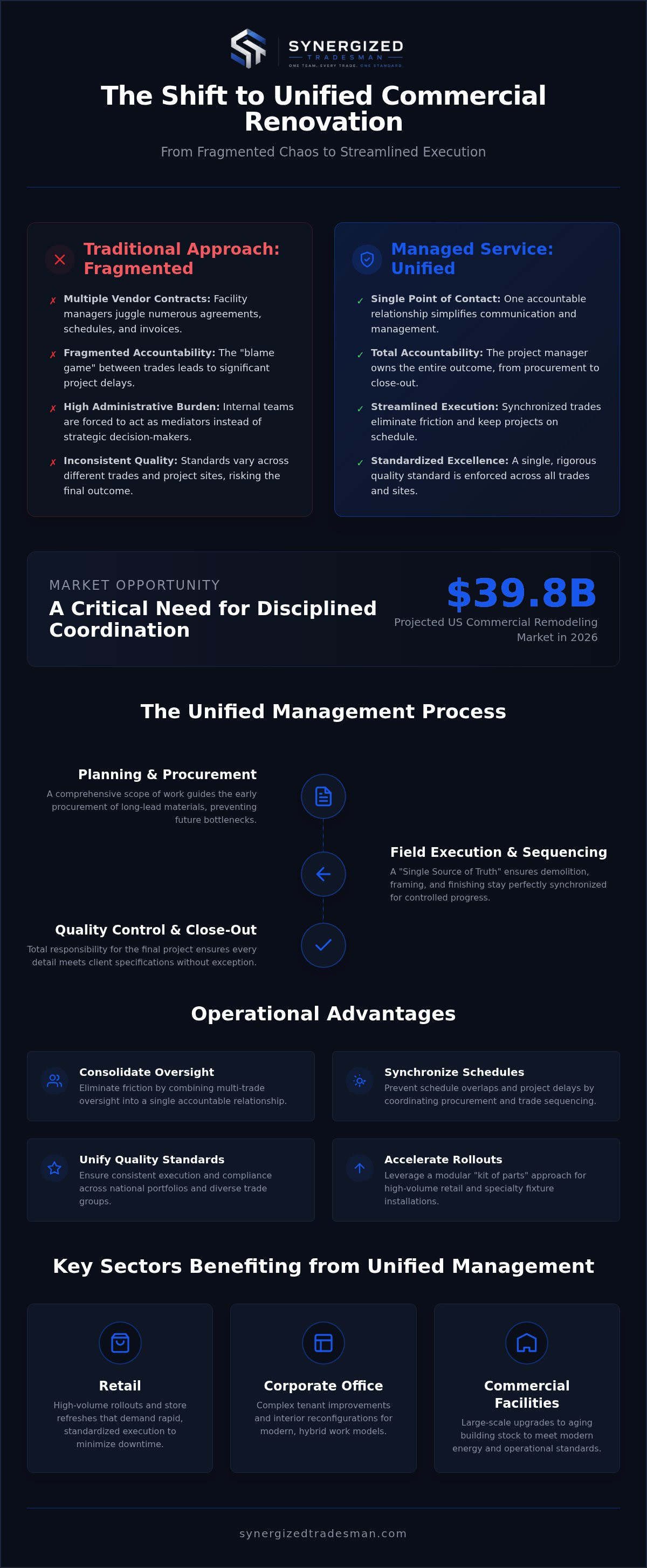
A successful commercial renovation isn't defined by the skill of individual trades, but by the strength of the oversight connecting them. Most facility managers are exhausted by the friction of fragmented accountability across multiple project sites. You shouldn't have to act as the primary mediator between framing, electrical, and flooring teams while navigating procurement delays. When you leverage professional commercial renovation management services, you replace this multi-party chaos with a single, accountable relationship that prioritizes execution over excuses.
This approach provides a stabilizing force for complex projects, ensuring that quality remains standardized across a national portfolio. You'll discover how a unified source of truth streamlines every phase from procurement to final close-out. We'll examine the shift from fragmented logistics to a managed execution model that delivers predictable timelines and budgets. With the US commercial property remodeling market reaching $39.8 billion in 2026, the need for disciplined coordination has never been more critical. This briefing covers the operational advantages of consolidating all trades under one rigorous standard of excellence to protect your project from unnecessary risk.
Key Takeaways
- Consolidate multi-trade oversight into a single accountable relationship to eliminate the friction of managing fragmented vendor contracts.
- Discover how professional commercial renovation management services synchronize procurement and trade sequencing to prevent schedule overlaps and project delays.
- Establish a unified quality standard that ensures consistent execution and compliance across national portfolios and diverse trade groups.
- Leverage a modular "kit of parts" approach to accelerate high-volume retail rollouts and specialty fixture installations.
- Evaluate management partners based on national reach and the strategic value of WBE certification in corporate procurement workflows.
The Role of Commercial Renovation Management Services
Commercial renovation management services represent the strategic oversight of multi-trade projects, acting as the primary engine for execution. While traditional contracting often leaves facility managers juggling separate agreements for demolition, framing, and electrical, this model consolidates those responsibilities. It bridges the critical gap between architectural design and field reality by ensuring that technical plans are translated into physical progress without loss of detail. This approach is essential for high-stakes sectors where downtime translates directly to lost revenue. At its core, the discipline draws from the principles of construction management, but it focuses specifically on the complexities of renovating existing, often active, environments.
The primary sectors that benefit from this consolidated approach include:
- Retail: High-volume rollouts and store refreshes requiring rapid execution.
- Corporate Office: Tenant improvements and interior reconfigurations for hybrid work models.
- Commercial Facilities: Large-scale upgrades to aging building stock to meet modern energy standards.
The Single Point of Contact Advantage
Traditional renovation environments often suffer from a "blame game" when delays occur. If the drywaller can't start because the framing is off, the client usually ends up mediating the dispute. A managed service model eliminates this friction. A dedicated project manager owns the entire outcome, serving as the sole point of contact for the client. This structure significantly reduces the administrative burden on internal procurement and facility teams. Instead of managing ten invoices and ten schedules, the facility manager oversees one accountable relationship. It's a shift from being a referee to being a strategic decision-maker.
Accountability in Multi-Trade Environments
In a multi-trade environment, data fragmentation is a primary risk. Centralized commercial renovation management services create a "Single Source of Truth" for project timelines and field data. This ensures that demolition, framing, and finishing stay perfectly synchronized. When one trade finishes, the next is ready to begin because the manager has already cleared the path. Accountability here is defined as the commitment to a single, rigorous standard of quality across every trade on the site. This means the manager takes total responsibility for the final close-out, ensuring every detail meets the client's specifications without exception. This disciplined coordination is vital in a US market where commercial property remodeling is valued at $39.8 billion in 2026.
Streamlining Multi-Trade Construction Coordination
Effective commercial renovation management services depend on a rigid operational framework that begins long before a hammer hits a wall. The transition from initial planning to active procurement is where most projects fail due to fragmented communication. By centralizing oversight, a project manager ensures that every trade is synchronized with the master schedule. This methodical approach transforms a chaotic job site into a controlled environment where progress is measured in hours rather than weeks. Maintaining this momentum requires a "single source of truth" for all project data, preventing the information silos that typically lead to delays.
Phase 1: Planning and Procurement
Success begins with a comprehensive scope of work. This document must encompass all general trades, from metal stud framing and drywall to electrical and plumbing. Management services prioritize the procurement of long-lead materials early in the lifecycle. For example, specialty millwork or custom flooring must be ordered to align perfectly with the demolition phase. This prevents the "waiting game" that often stalls projects during the transition from rough-in to finish work.
A unified master plan integrates specialty installations like fixtures and ACT ceilings into the primary construction schedule. This level of coordination reflects the professional standards promoted by the Construction Management Association of America. It ensures that procurement logistics don't just happen by accident; they're engineered to support field execution from day one. To see how these phases come together in practice, you can explore our approach to multi-trade project management.
Phase 2: Field Execution and Sequencing
Field execution is a game of critical paths. The manager must strictly control the sequence between metal stud framing, drywall installation, and MEP (Mechanical, Electrical, and Plumbing) rough-ins. Overlapping these trades without rigorous oversight leads to rework and safety hazards. Daily field reports provide the necessary visibility for national clients, documenting progress and identifying potential bottlenecks before they impact the project timeline.
The final phase of a renovation requires the most discipline. Painting, flooring, and tile work are coordinated as a unified sprint toward completion. This leads directly into final cleaning and project closeout, ensuring the space is ready for immediate occupancy. Field managers act as the "shield" for the client, resolving trade conflicts on-site so the facility manager doesn't have to. This disciplined sequencing ensures that quality remains consistent, whether the project is a single corporate office refresh or a high-volume retail rollout.
Standardizing Quality in National Commercial Renovations
National portfolios often suffer from quality drift. A retail site in one region shouldn't look or function differently than a site in another. Professional commercial renovation management services mitigate this risk by implementing a "One Standard" execution model. This approach moves beyond the variable skill of local labor and enforces a centralized set of Standard Operating Procedures (SOPs). By acting as the single source of truth, the management partner ensures that corporate specifications are met at every location, regardless of geographic distance. It's a disciplined method of ensuring that the brand's physical environment remains a constant asset rather than a variable liability.
Consistent Quality Across Every Trade
Quality control begins with the substrate. From metal stud framing to final painting, the manager must enforce a high-performance finishing standard. This involves rigorous auditing of field work against corporate specifications before the next trade begins. For instance, ACT ceiling and flooring installations must follow strict protocols to ensure long-term durability and aesthetic alignment. Centralized oversight identifies deviations early. If a drywall finish doesn't meet the specified level, it's corrected before the painting team arrives. This proactive auditing protects the project from the cascading errors that typically plague multi-trade environments.
National Scale Without Quality Compromise
Managing a national footprint requires a single accountable relationship. Clients often struggle to maintain consistency when dealing with disparate local vendors who may have different interpretations of a scope of work. A management partner solves this by operating under a unified management framework nationwide. This ensures a retail refresh in one state perfectly matches the quality of a refresh in another. The manager serves as the shield for the client, taking on the burden of local logistics while maintaining strict corporate standards. This level of uniformity is essential for maintaining brand integrity across hundreds of locations.
Navigating local requirements is a significant challenge for national rollouts. For example, the 2025 California Building Standards Code (Title 24) went into effect on January 1, 2026. This code introduced strict requirements for energy efficiency and accessibility. Similarly, Pennsylvania's Uniform Construction Code (UCC) adopted 2021 ICC building codes on January 1, 2026. A centralized management lens anticipates these variations. It ensures that while the aesthetic remains consistent, the technical execution complies with specific local mandates. Standardized reporting provides the client with real-time visibility into these efforts, confirming that each site meets both corporate and regulatory benchmarks without the need for constant site visits.
High-Volume Retail Refresh and Rollout Logistics
Retail rollout programs present unique operational hurdles that differ significantly from static office renovations. Success depends on maintaining speed, volume, and extreme consistency across a national footprint. While a single office remodel might focus on unique design elements, a retail rollout demands a "kit of parts" approach to fixture and specialty installation. This modular strategy ensures that branding and functionality remain identical across 50 or more locations simultaneously. Professional commercial renovation management services provide the oversight necessary to prevent local variations from compromising the national brand identity. In a market where retail renovations typically range from $60 to $250 per square foot, managing these logistics with precision is a financial necessity.
Speed to Market: The Rollout Advantage
Retailers lose revenue every hour a store remains closed or under construction. Multi-trade coordination is the only way to accelerate these timelines. By managing millwork and specialty fixture installation alongside general trades like electrical and painting, project managers compress the project lifecycle. This synchronization allows for rapid-fire execution where demolition, rough-in, and finishing occur in a tightly controlled sequence. Minimizing downtime ensures that locations return to revenue-generating status as quickly as possible. This efficiency is critical for meeting the high-volume demands of a $39.8 billion remodeling market where speed is a competitive requirement.
Close-out and Final Deliverables
The final phase of a project often dictates the client's perception of success. In high-volume environments, centralized close-out documentation is mandatory for corporate records. This includes managing post-construction cleaning to ensure spaces are "customer-ready" the moment the trades exit. Comprehensive close-out packages must include all electrical and plumbing certifications, especially with new mandates like the 2025 California Building Standards Code (Title 24) requiring specific electrification infrastructure for commercial kitchens.
Centralizing these deliverables allows the client to verify compliance across their entire portfolio from a single dashboard. It eliminates the need to track down individual trade partners for permits or warranties. This disciplined approach ensures that all technical and aesthetic standards are met before the final hand-off. To streamline your next national program and ensure total accountability, explore our comprehensive commercial renovation management services.
Selecting a Partner for Multi-Trade Project Management
Selecting a partner for commercial renovation management services requires a shift from evaluating individual trade skills to assessing organizational discipline. A management-first firm is better suited for complex interior build-outs because they prioritize the coordination of disparate trades over simple labor provision. Key criteria include a proven national reach, deep multi-trade expertise, and a transparent accountability model. You need a partner that acts as a "shield," managing the friction of multi-party logistics so your internal teams can focus on core operations. This partnership should be built on a foundation of operational efficiency rather than just local availability.
Evaluating a potential partner involves looking at their "single source of truth" framework. They must demonstrate a clear path from procurement to field execution without relying on fragmented trade communication. This level of consolidated accountability is the only way to ensure predictable timelines and budgets in a $567.05 billion commercial construction market. The right partner handles everything from demolition and metal stud framing to final cleaning, ensuring that no detail is lost during trade hand-offs.
The Value of WBE Certification
Partnering with a certified women-owned business (WBE) provides significant strategic value in corporate procurement. Many national organizations have established diversity and inclusion goals that require a percentage of spend to be allocated to certified firms. However, the value of a WBE partner like Synergized Tradesman extends beyond compliance. Maintaining national certification requires rigorous operational standards and a commitment to standardized quality across all trades. This ensures that the firm is built for the high-volume demands of a national portfolio while providing the transparency required by corporate stakeholders. It's a professional advantage that combines social responsibility with operational excellence.
The Final Close-out: Ensuring Project Success
The final 5% of a project often defines the entire client experience. A project isn't truly successful until the space is "customer-ready" and all documentation is centralized. Moving from "done" to "delivered" requires a management partner who prioritizes final cleaning and project closeout as much as the initial demolition. This includes gathering all electrical and plumbing certifications and ensuring every surface meets the finishing standard. A disciplined close-out process prevents the lingering punch-list items that often delay occupancy.
Effective management ensures that all post-construction data is organized and accessible. This is especially important for meeting new regulatory standards, such as the 2025 California Building Standards Code or Pennsylvania's UCC updates. By centralizing these final deliverables, the management partner provides a sense of relief and total oversight. To achieve this level of coordination on your next project, Contact Synergized Tradesman for your next multi-trade renovation.
Advancing Your National Renovation Strategy
The complexity of multi-site commercial construction requires more than just skilled labor; it demands a single source of truth for every trade on the site. Professional commercial renovation management services allow you to move away from the friction of fragmented contracting and toward a model of total accountability. This shift ensures your national portfolio maintains a unified standard of quality while meeting aggressive speed-to-market goals. You gain the operational rigor needed to handle demolition, framing, and finishing as a synchronized sequence rather than a series of isolated events.
Synergized Tradesman provides the stabilized oversight your facility teams need to execute with confidence. As a certified women-owned business (WBE), we offer a single accountable relationship that covers every phase of national field execution. This approach eliminates the administrative burden of managing disparate vendors and ensures your projects remain on schedule and within budget. We're built to act as your strategic partner in an industry that moves fast and demands precision. Streamline your next commercial project with Synergized Tradesman and experience the relief of organized, professional oversight.
Frequently Asked Questions
What are commercial renovation management services?
Commercial renovation management services provide the strategic oversight required to execute complex, multi-trade construction projects. This model replaces fragmented contracting with a single accountable relationship. A management firm handles the coordination of demolition, framing, and finishing to ensure project alignment. It bridges the gap between architectural plans and field reality, providing a stabilizing force for facility managers who need to maintain operational momentum without managing dozens of individual trade contracts.
How does a multi-trade contractor save time on a renovation?
A multi-trade contractor saves time by synchronizing procurement and field execution through a unified master schedule. This eliminates the delays caused by trade overlaps and communication gaps. When one firm manages the critical path between metal stud framing, drywall, and electrical rough-ins, the transition between phases is seamless. This disciplined sequencing prevents the downtime typically associated with waiting for separate vendors to finish their specific scopes of work. It keeps the project moving with deliberate speed.
Can one company manage retail rollouts across the entire United States?
Yes, a firm with a national service scope can manage high-volume retail rollouts across the entire country. Success depends on a centralized management model that utilizes standardized operating procedures to maintain consistency. This ensures that a refresh in one state meets the exact same quality benchmarks as a site in another. Centralized oversight allows for the simultaneous execution of dozens of locations while maintaining a single source of truth for all project data.
What trades are typically included in a commercial interior refresh?
A comprehensive interior refresh typically includes a wide array of general and specialty trades. These often encompass:
- Demolition and site preparation
- Metal stud framing and drywall installation
- ACT ceiling systems
- Painting, wallcovering, flooring, and tile
- Electrical and plumbing upgrades
- Millwork and specialty fixture installation
Consolidating these trades under one management team ensures that finishing standards remain high across every surface.
Why is a single point of contact important for construction coordination?
A single point of contact acts as a shield for the client, taking on the burden of multi-party logistics. It eliminates the blame game common in multi-contractor environments where trades often conflict over delays. This structure streamlines communication through a dedicated project manager who owns the final outcome. It reduces the administrative burden on procurement teams by providing a single accountable relationship for all project inquiries and updates. This ensures total transparency and facts-based reporting.
How do you ensure quality consistency across multiple renovation sites?
Quality consistency is ensured through a One Standard approach to national execution. This involves applying a centralized set of management protocols and auditing field work against corporate specifications at every location. By using standardized reporting, the management team identifies and corrects deviations before they impact the final result. This disciplined oversight guarantees that brand integrity is maintained across a national portfolio, regardless of the local labor market conditions. It provides the client with a predictable outcome.
What is included in a commercial project close-out?
A professional project close-out involves the delivery of comprehensive documentation and a space that is immediately customer-ready. This includes centralized electrical and plumbing certifications, warranty information, and final permit approvals. A critical component is the final cleaning and project closeout, which ensures the site is free of construction debris. Moving from done to delivered requires this level of administrative rigor to provide corporate stakeholders with total project transparency and verified compliance.
How does WBE certification benefit my commercial construction project?
Partnering with a Women-Owned Business Enterprise (WBE) helps your organization meet corporate diversity and inclusion goals while ensuring high operational standards. Certification requires rigorous oversight and a commitment to professional excellence. In the context of commercial renovation management services, a WBE partner provides a strategic advantage by combining social responsibility with a disciplined, results-oriented approach to project execution. It demonstrates a commitment to transparency and standardized quality across all project phases.


