

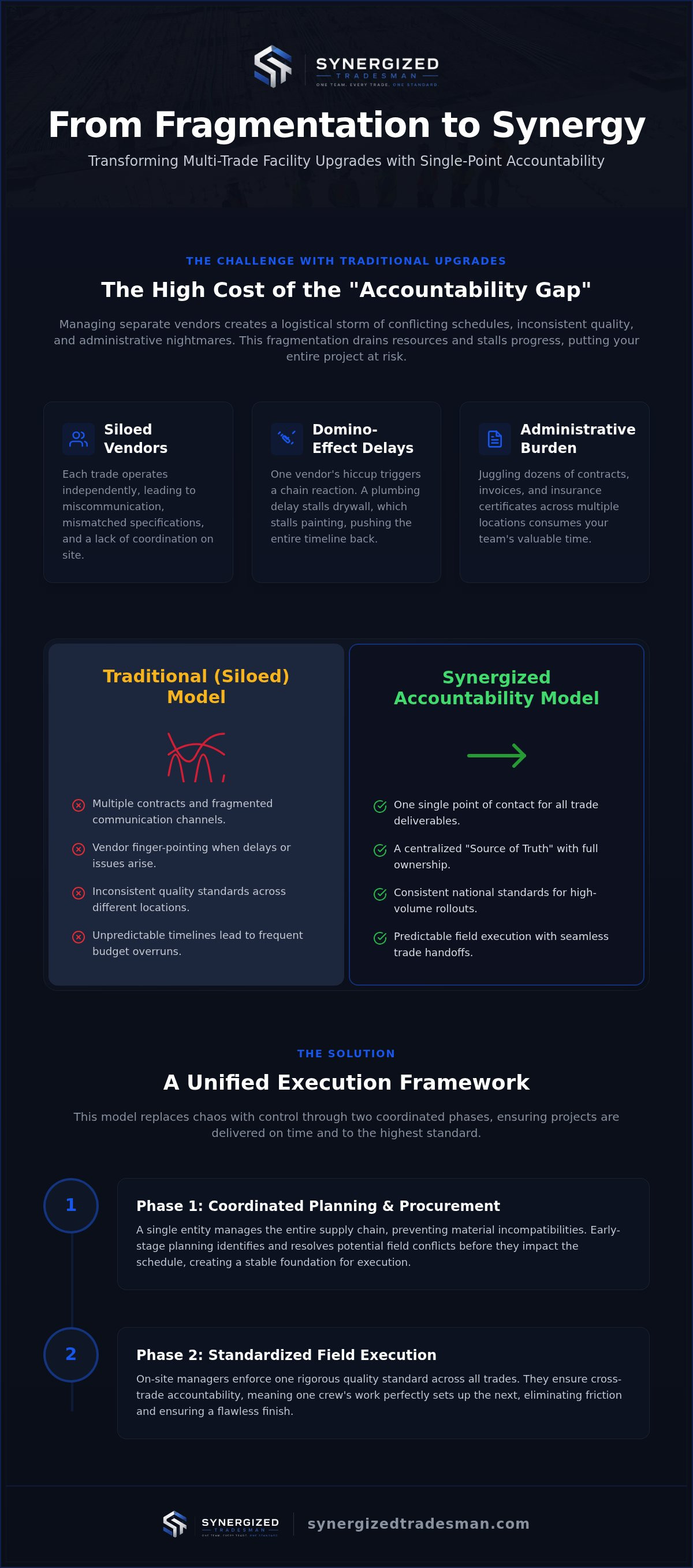
The primary reason for failure in multi-trade facility upgrades isn't trade incompetence; it's the accountability gap created by siloed vendors. When you're managing separate contracts for demolition, framing, electrical, and flooring, you aren't just overseeing construction. You're managing a logistical storm where one vendor's delay triggers a domino effect across your entire project timeline. This fragmentation turns simple refreshes into administrative nightmares that drain your internal resources and stall your progress.
You've likely dealt with the frustration of conflicting schedules and inconsistent quality standards across different locations. It's a common pain point in commercial facility management that leads to budget overruns and procurement friction. This article shows you how to eliminate those bottlenecks by shifting to a single-point accountability model. We'll examine how centralized coordination replaces vendor fragmentation with predictable field execution and a streamlined procurement process. You'll learn how to establish consistent national standards while maintaining a single point of contact for every trade from drywall to final closeout for your 2026 initiatives.
Key Takeaways
- Identify the "accountability gap" created by vendor fragmentation and learn how to close it through a single-source relationship.
- Discover how to streamline multi-trade facility upgrades by consolidating procurement, scheduling, and field execution under one management layer.
- Reduce administrative overhead by replacing multiple contracts and invoices with a single source of truth for all trade deliverables.
- Use a Master Program Schedule to eliminate downtime between trade handoffs and ensure consistent national standards across high-volume rollouts.
- Optimize corporate procurement by leveraging a certified WBE firm that acts as a protective shield for complex commercial construction requirements.
The Logistical Friction of Traditional Facility Upgrades
Multi-trade facility upgrades are complex operations requiring the precise synchronization of five or more distinct construction trades. These projects typically involve a sequence of demolition, metal stud framing, electrical, plumbing, and flooring. When you manage these trades through separate contracts, you create an "Accountability Gap." This is the friction point where vendors blame each other for delays. If the drywall team can't start because the plumbing rough-in isn't finished, the project stalls. You're left to mediate disputes while your timeline slips.
Traditional siloed management places the burden of coordination on your shoulders. You aren't just a facility manager; you become a full-time mediator and scheduler. This approach carries heavy hidden costs. Administrative overhead grows with every new contract you sign. Managing five separate invoices, insurance certificates, and schedules for a single location is inefficient. When you scale this across a national portfolio, the complexity becomes unmanageable. It's a model that invites error and rewards finger-pointing instead of execution.
The Cost of Vendor Fragmentation
Fragmented procurement leads to material delays and mismatched specifications. When multiple vendors manage independent supply chains, the risk of receiving the wrong materials increases. The "Silo Effect" occurs when electrical, plumbing, and drywall teams operate without direct coordination. They focus on their specific scope without considering the project's total lifecycle. This lack of communication often results in scheduling overlaps and site congestion. These inefficiencies don't just increase costs; they create unnecessary stakeholder stress and jeopardize your 2026 delivery goals.
Why High-Volume Rollouts Require Centralized Oversight
High-volume retail refresh programs differ significantly from one-off renovations. They require a level of precision that siloed trades can't provide. Variance is your biggest risk when executing across 50 or more locations. If different trades use different standards in different markets, your brand identity suffers. You need a standardized field execution protocol to ensure every site looks identical. Centralized oversight provides a single source of truth. It ensures that your flooring, painting, and millwork standards remain consistent from the first location to the last. This model transforms a chaotic series of events into a predictable, repeatable process.
Defining the Multi-Trade Accountability Model
The multi-trade accountability model replaces fragmented vendor management with a unified structure for planning, procurement, and field execution. It moves away from the traditional approach where a facility manager balances multiple trade contracts. Instead, you establish a single accountable relationship that oversees every deliverable from demolition to final cleanout. This model creates a "Single Source of Truth." One dedicated manager owns the performance of all trades, ensuring that electrical, plumbing, and drywall teams work as a synchronized unit rather than isolated silos.
Adopting this model shifts your role from a coordinator to an accountable executor. You no longer spend your day chasing updates from five different contractors. The accountability rests with a single partner who manages the trade-to-trade handoffs. This structural change ensures standardized quality control across every trade involved in multi-trade facility upgrades. By centralizing responsibility, you eliminate the gaps where projects typically fail.
Phase 1: Procurement and Planning Coordination
Centralizing material procurement is vital for trade compatibility. When one entity manages the supply chain, you avoid the risk of mismatched fixtures or incompatible flooring materials. Early-stage planning prevents common field execution conflicts, such as plumbing rough-ins interfering with metal stud framing. Procurement coordination is the bedrock of schedule stability. We ensure that specialty millwork and fixtures arrive exactly when the site is ready for installation. This proactive approach identifies potential bottlenecks before they impact your 2026 rollout timeline.
Phase 2: Standardized Field Execution
A successful model applies one rigorous standard across all trades. Whether the task is demolition or final painting, the quality expectations remain identical. The site manager plays a critical role here. They don't just watch the work; they enforce cross-trade accountability. If a framing crew leaves a site in a condition that hinders the drywallers, the manager corrects it immediately. Real-time reporting from the field keeps you informed without requiring your presence on-site. You receive factual, data-driven updates that reflect the actual progress of your project. This level of oversight ensures that national standards are met at every location, every time.
Strategic Efficiency Gains in Multi-Trade Coordination
The transition to a single accountability model delivers measurable efficiency gains that fragmented vendor management cannot match. By unifying the management layer, you eliminate the inherent downtime between trade handoffs. In a traditional model, a delay in metal stud framing often leaves the electrical and drywall teams idle, yet you still pay for the logistical friction. A coordinated approach ensures that as soon as one trade clears a work zone, the next is ready to mobilize. This synchronization is essential for multi-trade facility upgrades where project speed directly impacts your operational uptime.
You also significantly reduce your internal administrative burden. Managing five or more trades for a single project typically requires tracking five separate contracts, insurance certificates, and payment schedules. The single accountability model consolidates this into one invoice, one contract, and one point of contact. This lean structure allows your facility team to focus on high-level strategy rather than chasing lien waivers and certificates of occupancy. Additionally, a master coordinator leverages bulk purchasing power. Buying materials like flooring, paint, and ACT ceilings across an entire national portfolio reduces unit costs and secures priority lead times from manufacturers.
Risk mitigation is another primary driver for this model. When you hire siloed vendors, you absorb the risk of their internal failures. If a plumber fails to show, the schedule collapse is your problem to solve. Under a single-point model, the management firm acts as your shield. They take on the total responsibility for the project lifecycle, absorbing the risk of trade-specific delays and ensuring the final delivery meets your specifications. This shift provides a level of budget and timeline predictability that is otherwise impossible to achieve.
Maximizing ROI Through Trade Synchronization
Strategic trade synchronization can shave weeks off a renovation timeline. By identifying areas where trade schedules can safely overlap, such as simultaneous painting and flooring installation in different zones, you accelerate the path to project closeout. A commercial general trades contractor manages the miscellaneous tasks that often fall between the gaps of specialty trades. This includes final cleaning, millwork adjustments, and hardware installation. Addressing these "in-between" items prevents minor punch-list issues from delaying your grand reopening.
Consistency Across National Portfolios
National rollout programs require a level of uniformity that local, siloed trades cannot provide. A single accountability model ensures your retail refresh looks identical in every state, regardless of local market conditions. You benefit from centralized close-out documentation, which provides a clean and organized record for your facility management database. This systematic approach to data collection makes future maintenance more efficient. When every location follows the same execution protocol, your national standards become a reality rather than a goal.
Planning and Executing High-Volume Facility Rollouts
Successful multi-trade facility upgrades at scale require a Master Program Schedule that accounts for complex multi-site logistics. You cannot manage high-volume rollouts with a site-by-site mentality. Instead, you must view your national portfolio as a single, moving operation. This schedule tracks trade mobilization across various regions, ensuring that specialized crews move efficiently from one location to the next. It also prioritizes procurement lead times for specialty fixtures and millwork. Securing these materials months in advance prevents the supply chain bottlenecks that frequently stall 2026 capital projects.
Executing in high-traffic commercial environments demands a standardized "Retail Refresh" protocol. The goal is to minimize store downtime while maintaining a safe environment for customers and staff. This requires a disciplined approach to field execution where every trade follows a pre-defined sequence. By establishing these rigorous requirements upfront, you ensure that local site conditions don't dictate the project's pace. Centralized oversight keeps the momentum steady, regardless of the geographic distance between sites.
The Retail Refresh Lifecycle
The construction lifecycle begins with precise demolition and debris removal. Speed is a non-negotiable requirement for Metal Stud Framing and Drywall. These trades set the structural foundation for the entire refresh. Once the walls are ready, Painting and Wallcovering services are timed for minimal disruption. We often schedule these finishes during off-peak hours or in phased sections to keep your facility operational. This methodical progression ensures that the interior finishing phase meets your brand standards without extending the construction window.
Managing Complex Multi-Location Logistics
Coordinating flooring, tile, and millwork installation across multiple sites requires centralized procurement. This ensures that every location uses identical materials, maintaining national brand consistency. One manager oversees the delivery and installation of these specialty items to prevent variance. To prepare for a successful rollout, use this readiness checklist:
- Confirm all site-specific permits are secured.
- Verify that specialty millwork and fixtures are in the regional warehouse.
- Ensure the site manager has completed the pre-construction walkthrough.
- Validate that all trade crews are briefed on the site-specific safety protocol.
Managing these variables through a single partner allows you to focus on your core business operations. If you're preparing for a national program, contact us to discuss your rollout logistics and ensure a predictable field execution.
Synergized Tradesman: Streamlining Complex Multi-Trade Requirements
Synergized Tradesman acts as a shield for commercial clients by absorbing the logistical complexity of multi-trade facility upgrades. We take total responsibility for the project lifecycle, managing every trade from initial demolition to final interior finishes. Our status as a certified women-owned (WBE) firm provides a strategic advantage for corporate procurement teams seeking to meet diversity goals without sacrificing operational excellence. We operate with a commitment to one standard, ensuring that every project meets the same rigorous quality benchmarks across your entire national portfolio. This unified approach provides the reliability you need for high-volume 2026 initiatives.
Complete Interior Build-Out Capabilities
Our core competencies cover the full spectrum of interior construction. We manage demolition, metal stud framing, drywall, and ACT ceilings as a single, coordinated phase. By integrating millwork, fixtures, and specialty installation into the primary execution plan, we prevent the common delays associated with third-party installers. We also bring electrical and plumbing requirements under our management umbrella. This eliminates the communication gaps that typically occur when mechanical trades work in isolation. Every trade deliverable, including flooring, tile, painting, and wallcovering, is synchronized to ensure a seamless transition between construction phases.
Project Closeout and Final Delivery
Final cleaning and project closeout are treated as essential deliverables rather than afterthoughts. We understand that your facility can't return to full operation until the site is pristine and the paperwork is finalized. Our team provides standardized closeout documentation for your permanent facility records. This includes detailed material specifications, warranty information, and completion certificates. Centralizing this data ensures your maintenance teams have a single source of truth for future facility management. We close the accountability gap by owning the project until the final inspection is signed and the site is ready for occupancy.
Streamline your multi-trade facility upgrades with Synergized Tradesman and secure a predictable, high-quality result for your next rollout program.
Scaling Your 2026 Facility Strategy with Accountability
Adopting a single accountability model is the most effective way to eliminate the friction of vendor fragmentation. By centralizing procurement and field execution, you replace the traditional "accountability gap" with a streamlined, predictable process. This shift ensures that complex multi-trade facility upgrades move from a source of administrative stress to a repeatable driver of operational uptime. It's a strategic move that protects your budget and your timeline while ensuring your brand standards remain intact across every location.
Maintaining consistent national standards across high-volume rollouts requires a partner capable of executing with precision at scale. As a certified women-owned (WBE) firm with national project execution capability, Synergized Tradesman provides the single accountable relationship model your 2026 initiatives demand. We handle the multi-party logistics so you don't have to manage the fallout of siloed trade failures. Partner with Synergized Tradesman for your next national rollout to experience a construction lifecycle built on transparency and results. Your facility strategy deserves the stability of a master coordinator who acts as your shield in the field.
Frequently Asked Questions
What are the primary benefits of a multi-trade facility upgrade model?
The primary benefits include reduced administrative burden, eliminated vendor friction, and predictable field execution. Instead of managing multiple contracts, you utilize a single accountable relationship to oversee all project phases. This model closes the accountability gap where vendors typically shift blame for delays. You gain a streamlined procurement process and consistent quality across all locations. It transforms multi-trade facility upgrades into manageable, results-oriented programs.
How does a single point of contact improve commercial renovation timelines?
A single point of contact improves timelines by eliminating communication delays and trade-to-trade scheduling conflicts. One manager synchronizes the handoffs between demolition, framing, and mechanical teams to prevent idle site time. They act as the single source of truth, making real-time decisions that keep the project moving. This proactive management prevents the domino effect of delays that often occur when you're coordinating siloed vendors independently.
Can a multi-trade contractor manage national retail rollout programs?
Yes, a multi-trade contractor with national execution capability is built specifically for high-volume retail rollouts. They implement a standardized field execution protocol to ensure every location meets identical brand standards. This centralized oversight allows for the simultaneous management of multiple sites across the United States. You benefit from a Master Program Schedule that coordinates logistics and trade mobilization on a national scale for multi-trade facility upgrades.
What trades are typically included in a commercial facility refresh?
A comprehensive commercial refresh typically includes demolition, metal stud framing, and drywall. It also encompasses ACT ceilings, painting, wallcovering, flooring, and tile installation. Specialized services such as millwork, fixtures, electrical, and plumbing are integrated into the execution plan. The process concludes with final cleaning and project closeout. Managing these trades under one umbrella ensures that each phase supports the next without logistical friction or mismatched specifications.
How does centralized procurement reduce costs in multi-location upgrades?
Centralized procurement reduces costs through bulk purchasing leverage and reduced material variance. By ordering materials like flooring and lighting for an entire national portfolio, you secure priority lead times and volume pricing from manufacturers. This approach also ensures that every site receives the exact same specifications, eliminating the cost of field corrections. It streamlines the supply chain, reducing the administrative hours spent on individual purchase orders.
Why is WBE certification important for commercial construction projects?
WBE certification is important because it helps corporate clients meet diversity procurement goals while ensuring high-level project performance. Many national organizations have specific mandates to include women-owned businesses in their supply chain. Partnering with a certified WBE firm like Synergized Tradesman allows you to fulfill these requirements through a partner with proven national execution capability. It combines strategic diversity compliance with the reliability of a professional trade management firm.
What should be included in a project closeout for a facility upgrade?
A professional project closeout should include standardized documentation such as material warranties, lien waivers, and final inspection reports. It also requires a comprehensive set of as-built records and maintenance manuals for new fixtures or systems. Final cleaning is a critical component, ensuring the site is immediately ready for operational use. Providing this organized data package allows your facility management team to maintain the asset efficiently over its entire lifecycle.
How do you ensure quality consistency across multiple trade teams?
Quality consistency is achieved through a standardized field execution protocol enforced by a single site manager. This manager applies one rigorous set of standards to every trade, from the framing crew to the painters. They perform cross-trade accountability checks to ensure that one team's work doesn't hinder the quality of the next phase. Real-time reporting and centralized quality control audits ensure that national standards are met at every site.


