

Most tenant improvement projects fail long before the first drywall sheet is hung. The real breakdown happens in the gaps between ten different trade partners. A single delay in electrical work often cascades into weeks of lost time for flooring and painting crews. Managing these moving parts requires more than just a schedule; it demands a single source of truth. If you've felt the exhaustion of chasing updates across fragmented teams, you aren't alone.
Effective tenant improvement project management in 2026 relies on a structured framework that prioritizes accountability and speed. We'll show you how to move away from trade-on-trade delays and toward a unified execution model. This guide outlines a repeatable process for managing everything from demolition and metal stud framing to millwork and final cleaning. You'll learn how to reduce project timelines through better trade sequencing and maintain strict quality standards across multiple locations. We'll examine the operational shift from reactive troubleshooting to a disciplined, single-accountable relationship that protects your bottom line.
Key Takeaways
- Replace fragmented contractor models with a single accountable relationship to eliminate coordination fatigue and trade-on-trade delays.
- Optimize site efficiency with a tenant improvement project management framework that sequences demolition, electrical, and plumbing to prevent congestion.
- Protect project timelines by integrating master procurement schedules for long-lead millwork and specialty fixtures during the pre-construction phase.
- Accelerate final delivery through standardized closeout protocols, including professional final cleaning and comprehensive as-built documentation.
- Maintain consistent quality across national rollout programs by applying a repeatable execution model to high-volume retail refreshes.
Defining the Tenant Improvement Accountability Model
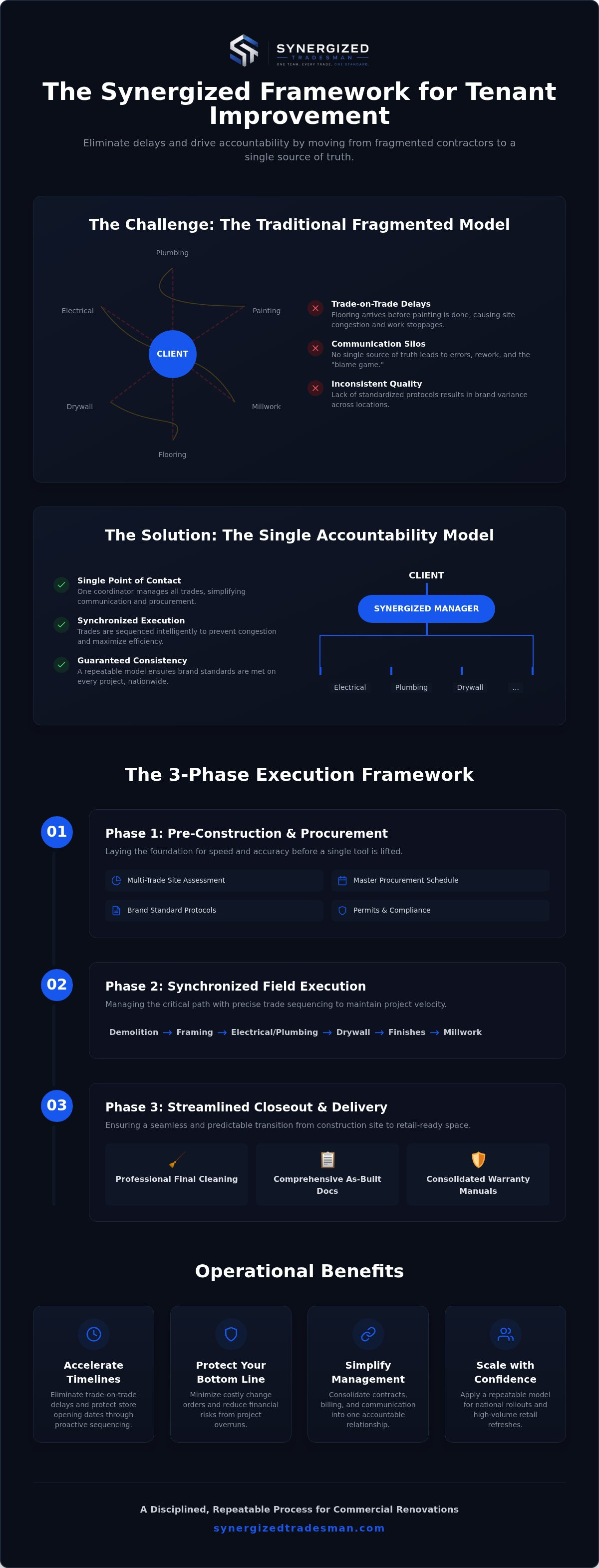
Effective tenant improvement project management is the strategic oversight required to customize a commercial shell into a functional, brand-aligned space. It's not just construction supervision. It's a disciplined application of project management principles to synchronize demolition, metal stud framing, electrical, and finishing trades under a unified framework. Most failures in commercial renovations stem from a lack of accountability between these disparate groups.
The Single Point of Contact Advantage
Managing ten or more separate trade partners creates communication silos that lead to errors. When an electrician and a plumber disagree on wall placement, the project stalls. A single accountable relationship eliminates this friction. By consolidating trades like drywall, flooring, and millwork under one coordinator, you create a single source of truth for every stakeholder. This model offers several operational benefits:
- Simplified procurement through a single contract.
- Consolidated billing that reduces the burden on corporate accounting teams.
- Clear ownership of the timeline, which prevents the "blame game" during trade overlaps.
- Standardized quality across multiple job sites.
Why Traditional General Contracting Often Fails TIs
Traditional general contracting often relies on a loose network of local subcontractors. This fragmentation causes trade-on-trade delays, especially in high-speed retail environments. If the flooring crew arrives before the painting is finished, the site becomes congested and work stops. These delays carry heavy financial consequences, including extended rent periods and missed store opening dates. This structured oversight is particularly critical for national rollout programs where consistency across diverse markets is mandatory for brand integrity.
Fragmented management also complicates the final delivery. When multiple contractors own small pieces of the project, closeout documentation like as-built drawings and warranty manuals becomes a logistical nightmare to collect. A master coordinator solves this by managing the lifecycle from demolition to final cleaning. They act as a shield for the client, taking on the burden of multi-party logistics with a sense of total responsibility. This ensures that the transition from construction site to retail-ready space is seamless and predictable.
Phase 1: Pre-Construction Planning and Procurement Logistics
Success in tenant improvement project management starts with exhaustive pre-construction oversight. This phase determines the project's velocity and budget accuracy. You must first conduct a multi-trade site assessment. This process identifies utility requirements and structural constraints before demolition begins. A comprehensive view of Project Management for Construction suggests that early owner-side planning reduces downstream change orders. It's the only way to avoid the hidden costs of unexpected field conditions that often surface during the customization of commercial shells.
Develop a master procurement schedule immediately following the assessment. This document tracks long-lead items like millwork, specialty lighting, and custom fixtures. Without this, field execution inevitably stalls. Establish field protocols that align with specific brand standards during this time. Finally, secure all permits and compliance documentation. Mobilization should never occur without a full regulatory green light. This discipline ensures the site is ready for high-speed execution from day one and prevents costly work stoppages.
Mastering Commercial Procurement
Managing the supply chain for specialty materials requires centralized oversight rather than local sourcing. Flooring, tile, and wallcoverings often have lead times that conflict with tight retail refresh schedules. Centralized procurement prevents delays by ensuring fixtures arrive before the finishing trades mobilize. Integrating this logistics data into the master timeline creates a reliable forecast for every stakeholder. It transforms procurement from a reactive task into a strategic asset that supports the overall project schedule.
Setting Brand Standards for Execution
National consistency depends on a "one standard" approach across all project sites. You need detailed specifications for metal stud framing, drywall, and ACT ceilings to ensure uniformity across all locations. Every trade partner must understand the multi-trade commercial construction goals to avoid quality variance. This alignment protects the brand's physical identity and ensures a predictable customer experience. If your current planning phase feels fragmented, partnering with an accountable project manager can streamline your pre-construction logistics and ensure brand-standard results.
Phase 2: Synchronizing Multi-Trade Field Execution
Field execution is where tenant improvement project management either delivers value or dissolves into chaos. Precise sequencing is mandatory to avoid site congestion. Start with demolition to clear the footprint, followed immediately by electrical and plumbing rough-ins. This order allows infrastructure to be installed before walls are closed. Referencing state government tenant improvement guidelines provides a clear benchmark for how these phases should be staged and documented for compliance. Real-time field reporting gives stakeholders immediate visibility into progress, allowing for quick adjustments if a trade partner falls behind.
Drywall and finishing represent the most dangerous pivot point in any TI project. Many projects stall here because finishing trades require a controlled, dust-free environment. Coordinating millwork and retail fixtures during active construction requires a disciplined transition. If the drywall isn't finished and sanded on schedule, the painting and flooring crews cannot mobilize. This creates a bottleneck that stops all progress and forces crews to overlap, which inevitably leads to quality issues and safety hazards.
Managing the Critical Path
Identify "blocker" trades early in the schedule. These are the contractors whose specific holdup stops every subsequent task. Electrical and plumbing are the most common blockers in commercial interiors. A master coordinator manages these trade handoffs to ensure zero downtime between phases. By applying established strategies for managing trades for retail rollouts, you maintain high velocity without sacrificing precision. The objective is a seamless flow where one crew exits as the next enters, keeping the site productive for the full duration of the shift.
On-Site Quality Control Protocols
Daily field execution audits are the only way to maintain painting, wallcovering, and flooring standards. Don't wait until the final walkthrough to identify defects. Verify that electrical and plumbing infrastructure meets both local codes and the design intent during the rough-in stage. This active management is the primary tool for preventing punch-list bloat at the end of the project. If you catch a framing error on day five, you don't have to tear down finished drywall on day twenty. This proactive oversight keeps the site on track for a clean transition to the closeout phase.
Phase 3: Streamlining Closeout and Final Delivery
The final phase of tenant improvement project management is often where momentum slows, but it's the most critical for operational readiness. Closeout is not merely a checklist. It's a structured transition from a construction site to a revenue-generating asset. This stage requires a single point of accountability to manage the final walkthrough and ensure all trade-specific obligations are met. Without disciplined oversight, small punch-list items can linger for weeks, delaying store openings and frustrating operations teams. A seamless handoff depends on the master coordinator's ability to unify trade partners for one final push toward completion.
Post-Construction Cleaning and Final Touches
Professional final cleaning serves as the bridge between construction and commerce. It's an essential service that transforms a dusty workspace into a brand-standard retail environment. This process goes beyond basic debris removal. It involves detailed cleaning of all surfaces, including ACT ceilings, millwork, and lighting fixtures. Managing this transition ensures the site is customer-facing from the moment the doors open. These final finishing services define the perceived quality of the entire project. Neglecting this phase risks damaging the brand's physical identity before the first customer even enters the space.
Closeout Documentation Excellence
Compiling a comprehensive closeout package is a mandatory logistical requirement in modern commercial construction. This package must include as-built drawings, warranty manuals, and trade certifications for all mechanical systems. Standardized closeout data is particularly valuable for future multi-location retail refresh programs. It provides a blueprint for maintenance teams and ensures that all equipment is covered by documented warranties. Having a single source for this information prevents future operational gaps and simplifies facility management across a national portfolio.
The value of a unified closeout package cannot be overstated. It protects the client from the "blame game" if equipment fails shortly after opening. By centralizing all trade certifications and as-built data, the project manager provides a complete digital and physical history of the customization. This level of transparency is a hallmark of professional oversight. If your current closeout process is fragmented and slow, contact us for a streamlined delivery framework that prioritizes speed and documentation accuracy.
Scaling Tenant Improvements: National Rollouts and Program Management
Scaling a customization model from a single site to a 50 store refresh program requires a shift from project management to program management. The single accountability model remains the most effective way to maintain control over high-volume demands. When you manage multiple sites concurrently, the risk of quality variance increases. Partnering with a certified women owned (WBE) firm allows corporate entities to meet ESG goals while ensuring every location adheres to a single operational standard. This centralized oversight is the only way to guarantee that a store in one market looks and functions exactly like a store in another.
Execution at this scale depends on a proven retail rollout strategy and execution framework. This approach treats a national portfolio as a single logistical flow rather than a series of isolated events. By applying consistent tenant improvement project management across all regions, you eliminate the need to vet and manage local contractors for every new site. This reduces the administrative burden on your internal team and provides a predictable timeline for store openings across the entire portfolio.
High-Volume Execution Strategies
Managing concurrent projects requires a partner who can maintain oversight without diluting quality. Standardized procurement is the primary tool for lowering costs across a national program. When you buy materials like flooring, ACT ceilings, and millwork for 50 locations at once, you gain significant leverage in the supply chain. A single management partner coordinates these logistics, ensuring that materials arrive at each site exactly when the local trades are ready for installation. This synchronization prevents site congestion and keeps high-volume programs moving at a rapid pace.
Selecting the Right Management Partner
Evaluating a retail environment refresh services provider requires looking beyond basic construction skills. A multi-trade expert is better suited for TIs than a specialized trade contractor because they understand the dependencies between demolition, electrical, and finishing. When hiring a manager for your next program, use this final checklist:
- Does the partner offer a single point of accountability for all trades?
- Can they demonstrate a repeatable framework for national consistency?
- Do they provide real-time field reporting and centralized procurement?
- Are they capable of managing the full lifecycle from demolition to final cleaning?
The right partner acts as a shield for your operations team, taking on the complexities of multi-party logistics. This allows you to focus on retail performance while they handle the disciplined execution of your physical space. Selecting a partner built for high-volume demands ensures that your tenant improvement project management remains a strategic asset rather than a source of coordination fatigue.
Executing Your 2026 Tenant Improvement Strategy
Successful tenant improvement project management isn't a collection of separate tasks. It's a unified system designed for speed and accountability. You've seen how a single source of truth eliminates the friction between demolition, electrical, and finishing trades. By centralizing procurement and field execution, you protect your store opening dates and maintain brand consistency across every location in your portfolio.
The transition from a construction shell to a retail-ready space requires disciplined oversight at every stage. From the initial site assessment to the final documentation package, success depends on a repeatable framework that removes the burden of multi-party logistics from your internal team. If you're managing a national rollout, this structured approach is mandatory for maintaining quality and speed.
We're a certified women-owned business built to provide a single accountable relationship for all trades. Our national rollout expertise ensures that your high-volume programs move forward without coordination fatigue. Streamline your next tenant improvement project with Synergized Tradesman. We're ready to help you master the complexities of your next commercial build-out with precision.
Frequently Asked Questions
What is the difference between a general contractor and a tenant improvement project manager?
A tenant improvement project manager provides a single accountable relationship for the entire customization lifecycle. While a traditional general contractor often relies on a loose network of subcontractors, a TI manager unifies trades like demolition, framing, and electrical under one standard. This model eliminates communication silos. It ensures that procurement and field execution align with the client’s specific brand requirements across every site.
How long does a typical retail tenant improvement project take to complete?
Project timelines depend on the scope of customization and the lead times for long-lead items like millwork or specialty fixtures. Most retail refreshes are scheduled for rapid execution to minimize downtime and rent costs. Effective tenant improvement project management reduces these timelines by sequencing trades to avoid congestion. Proper pre-construction planning ensures that materials arrive before crews mobilize, preventing avoidable field delays.
Why is multi-trade coordination important for commercial renovations?
Coordination prevents trade-on-trade delays where one contractor's holdup stops the entire site. In a commercial environment, electrical, plumbing, and drywall crews must work in a precise sequence to maintain velocity. Without active management, site congestion leads to quality issues and safety hazards. A coordinated approach ensures each trade partner has the space and infrastructure needed to complete their work without interfering with subsequent phases.
What are the common pitfalls in managing national retail rollouts?
The primary pitfalls include coordination fatigue from managing multiple trade partners and a lack of standardized quality across different markets. Fragmented management often leads to inconsistent brand environments and unpredictable delivery dates. Partnering with a single management firm solves these issues by applying one execution standard to every location. This centralized oversight protects the client from the logistical burden of managing local crews in diverse regions.
How does a single accountable relationship reduce construction costs?
Costs are reduced through standardized procurement and the elimination of trade-on-trade delays. A single accountable relationship prevents the "blame game" that often leads to expensive change orders and extended project timelines. By unifying all trades under one contract, clients also reduce administrative expenses in their corporate accounting departments. Faster delivery means businesses can open sooner, reducing the financial impact of non-revenue-generating construction periods.
What documentation is required for a commercial project closeout?
A comprehensive closeout package typically includes as-built drawings, warranty manuals, and trade certifications for all mechanical systems. It also requires proof of final cleaning and a signed-off punch list. These documents are essential for facility management and future maintenance. Standardized documentation ensures that operations teams have a single source of truth for all equipment and installations across their entire national portfolio of locations.
Can tenant improvements be completed while a business is still operating?
Tenant improvements can be phased to allow for ongoing business operations, though this requires meticulous logistics and safety protocols. Managers often schedule high-impact trades during off-peak hours to minimize customer disruption. This approach demands a disciplined execution model where the site is returned to a retail-ready state at the end of every shift. Professional final cleaning is mandatory in these scenarios to maintain brand standards during the refresh.
What are the benefits of working with a WBE-certified construction firm?
Partnering with a certified women-owned (WBE) firm helps corporate clients meet their internal ESG goals and diverse spend requirements. Beyond compliance, these firms often provide a high level of operational discipline and strategic oversight. Working with a WBE-certified partner ensures that your projects are managed under a single national standard. This relationship combines professional accountability with a commitment to rigorous quality and compliance across all commercial construction phases.


