

What if your next national expansion didn't require managing 1,000 different points of contact across 100 sites? Most procurement teams accept administrative bloat as an unavoidable cost of doing business. They spend more time chasing updates from dozens of subcontractors than they do on strategic planning. Effectively managing trades for retail rollouts has historically meant juggling fragmented communication and inconsistent quality across different regions. It's a system built on hope rather than operational control.
You've likely experienced the frustration of field execution that fails to match the procurement vision. We understand that protecting your opening date is the primary metric of success. This article demonstrates how a shift toward single-accountable-relationship models is redefining speed and quality for 2026. You'll learn how to replace chaos with a repeatable playbook for national construction consistency. We preview the operational trends that reduce administrative burdens and provide a single source of truth for every trade from demolition to final millwork installation.
Key Takeaways
- Shifting from fragmented subcontractors to a single point of accountability eliminates communication breakdowns and protects project timelines.
- Discover the operational benefits of managing trades for retail rollouts through a unified model that synchronizes demolition, framing, and electrical work.
- Identify the critical path strategies required to maintain high-volume consistency across national sites without increasing your administrative burden.
- Understand the 2026 trends in "Just-in-Time" procurement that bridge the gap between corporate supply chains and field-level installation.
- Explore how a WBE certified partner acts as a shield for your team, absorbing the complexity of multi-party logistics and diverse trade coordination.
The Evolution of High-Volume Retail Rollout Management
Retail construction in 2026 is moving away from isolated renovations toward integrated brand experiences. Modern rollouts incorporate complex technology, specialized millwork, and precise electrical requirements designed to support omnichannel retail strategies. This shift means a high-volume rollout is now defined as a synchronized multi-site program requiring centralized oversight to maintain brand integrity. Effectively managing trades for retail rollouts at this level is no longer about local coordination; it's about national execution.
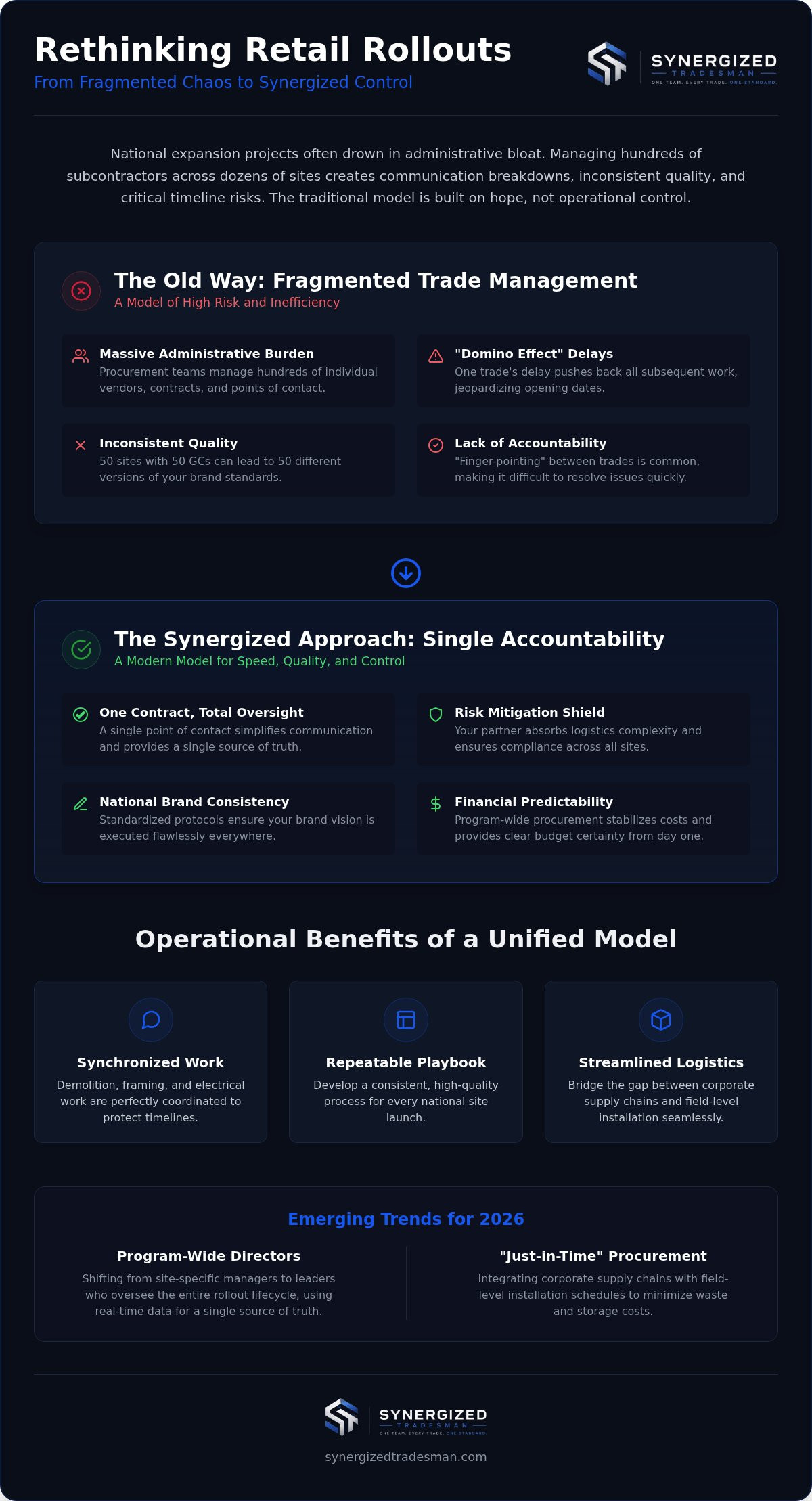
Traditional general contracting models often fail when applied to national programs. Local general contractors focus on individual site success, which creates a "silo" effect. When you manage 50 different GCs across 50 cities, you get 50 different versions of your brand standards. This fragmentation leads to inconsistent quality and communication breakdowns between corporate procurement and field teams. Retailers are increasingly prioritizing "refresh" cycles over new builds to stay relevant, which demands a faster, more disciplined approach to trade management.
Current Challenges in National Retail Construction
A persistent labor shortage remains the primary obstacle for national brands. Finding qualified trades like electricians or flooring specialists in every market is difficult and time-consuming. Fragmented management exacerbates this by creating "domino effect" delays. If the demolition crew finishes late, the framing, electrical, and painting trades are all pushed back, often resulting in missed opening dates. Centralized trade networks solve this by providing a pre-vetted, reliable workforce that understands the specific demands of high-speed retail environments.
The Move Toward Centralized Program Management
Success in 2026 requires shifting from site-specific managers to program-wide directors. These leaders oversee the entire lifecycle of the rollout rather than just one location. This model utilizes real-time reporting to provide a single source of truth for executive teams. Decision-makers don't have to wait for weekly site meetings to understand project status. Instead, they access live data that tracks progress across all trades, from metal stud framing to final cleaning. This level of transparency ensures that managing trades for retail rollouts becomes a predictable, data-driven process rather than a series of logistical gambles.
Accountability Models: Single-Source vs. Fragmented Trade Management
The fragmented subcontractor model presents a significant operational risk for national retailers. Managing 10 or more different trades across 100 sites creates a logistical burden that often leads to communication breakdowns. This traditional approach requires procurement teams to vet, onboard, and manage hundreds of individual entities. Each vendor operates under a separate contract, which complicates the administrative trail and increases the potential for oversight errors. It's a system that prioritizes local availability over national consistency.
A "Single Accountable Relationship" replaces this chaos with one contract and total oversight. This model acts as a shield for the client, absorbing the complexity of multi-party logistics. Managing trades for retail rollouts becomes significantly more efficient when your team tracks one partner instead of a massive network of independent subs. This single point of contact simplifies everything from initial procurement to the final project closeout. It ensures that the vision established at the corporate level actually reaches the field without being diluted by layers of middle management.
Risk Mitigation Through Single Accountability
Centralized management eliminates the "finger-pointing" common on construction sites. In a fragmented model, trades often blame one another for delays or damage. If the electrical installation interferes with the millwork, a single accountable partner resolves the conflict internally. This ensures project timelines remain intact. One partner also guarantees that insurance, licensing, and safety compliance meet your corporate standards across every location. You no longer have to audit 50 different safety plans; you rely on one rigorous, standardized protocol.
Financial Predictability in Rollout Programs
Achieving budget certainty is nearly impossible when managing hundreds of independent quotes. A single-source model allows for program-wide procurement, which stabilizes costs across different geographic regions. Coordination between trades like metal stud framing and plumbing reduces the frequency of expensive change orders. When the same team manages the sequence, they anticipate conflicts before they become financial liabilities. The long-term ROI is found in the drastic reduction of management hours spent on administrative tasks. Many brands find that partnering with a single source of truth for trade management allows their internal teams to focus on strategy rather than damage control.
Optimizing Multi-Trade Synergy for Accelerated Refresh Cycles
Accelerated refresh cycles depend on a compressed critical path. Traditional schedules treat demolition, framing, and finishing as distinct blocks. Modern execution overlaps these phases. Multi-trade synergy reduces site days by overlapping finishing trades with structural work. For example, metal stud framing and electrical rough-ins must occur simultaneously. This synchronization prevents the redundant labor of opening walls after drywall installation. Managing trades for retail rollouts effectively requires this level of tactical foresight at every site.
Flooring and millwork coordination is a common failure point in retail environments. If tile or luxury vinyl plank installation lags, millwork crews cannot set fixtures. This creates a bottleneck that affects every subsequent trade. We solve this by treating flooring and millwork as a single logistical unit. This ensures the floor is prepped, installed, and protected before the first display case arrives on site. This methodical sequencing includes several key handoffs:
- Demolition crews clear the path for immediate metal stud framing.
- Electrical rough-ins follow framing within hours, not days.
- Drywall and painting teams move through the space in a continuous flow.
- Millwork installers arrive as the flooring cures.
Coordinating Interior Finishing and Specialty Trades
Interior finishes represent the brand's visual identity. Managing painting, wallcovering, and ACT ceiling installation requires precise sequencing to avoid rework. We ensure millwork and specialty fixtures are on-site and ready for immediate install as soon as flooring is cured. This prevents site downtime and protects expensive assets from construction dust. Final cleaning acts as the final gatekeeper in the project closeout phase. It transforms a construction site into a retail environment, ensuring the space is ready for inventory and staff.
Streamlining Mechanical, Electrical, and Plumbing (MEP)
Modern retail tech demands robust electrical infrastructure. Integrating these requirements during a store refresh requires specialized knowledge of retail systems. Managing trades for retail rollouts involves coordinating plumbing infrastructure alongside electrical updates, especially when modernizing breakrooms or restroom facilities. Centralized oversight prevents MEP conflicts on site by reviewing utility layouts before the first trade arrives. This proactive management ensures that electrical conduits don't interfere with plumbing lines or HVAC ductwork. It eliminates the "field fixes" that often lead to budget overruns and delayed opening dates.
Logistics and Procurement Trends in 2026 Retail Construction
Logistics in 2026 requires a tighter integration between supply chain movement and field labor. Managing trades for retail rollouts involves more than just supervising labor; it requires precise logistical synchronization. High-volume programs increasingly rely on "Just-in-Time" (JIT) procurement to minimize on-site inventory. This approach reduces the risk of damaged fixtures and keeps the sales floor clear for active retail operations. However, JIT only works if the field execution team is ready the moment the delivery truck arrives. Managing field execution alongside national supply chain shifts demands a partner who can adjust labor schedules in real time as delivery windows fluctuate.
Staging and storage remain essential for high-volume refreshes. Many retail sites lack the backroom space to hold materials for weeks. Centralized staging hubs allow for pre-assembly of millwork or fixtures, which significantly speeds up on-site installation. Navigating permitting and jurisdictional expertise at scale is another critical administrative hurdle. Each municipality has different requirements for electrical or plumbing updates. A national rollout partner handles these filings centrally, preventing local delays from impacting the national timeline. This centralized oversight ensures that managing trades for retail rollouts remains a predictable process despite regional regulatory differences.
Procurement Strategy for Multi-Site Programs
Leveraging bulk purchasing power across a national portfolio provides significant cost advantages. Standardization of materials like flooring, paint, and ACT ceilings ensures brand consistency regardless of the location. This level of coordination is fundamental to an effective retail rollout strategy and execution plan. By centralizing the buy, you eliminate the variability of local sourcing. It allows for better quality control and ensures that every site uses the exact same specifications, which is vital for maintaining brand standards across hundreds of locations.
Execution Logistics: Protecting the Store Opening
Protecting the store opening date requires sequencing deliveries to match specific installation windows. Disruption to active retail operations must be kept to a minimum. We schedule heavy demolition and noisy trades like metal stud framing during off-peak hours or overnight. This ensures that multi-location retail refresh programs stay on schedule without hurting the daily revenue of existing stores. Effective logistics acts as the backbone of every successful program. If you need a partner to bridge the gap between procurement and field execution, contact Synergized Tradesman to discuss your 2026 rollout goals.
Scaling Consistency: The Synergized Approach to National Rollouts
Synergized Tradesman operates under one standard across all projects. This uniformity is the foundation for managing trades for retail rollouts at a national scale. We don't rely on local interpretations of your brand standards. Instead, we implement a repeatable playbook that governs every phase from demolition to final cleaning. This approach ensures that a site in one region looks and functions exactly like a site in another. Consistency is a product of disciplined management rather than luck.
Corporate procurement teams increasingly prioritize diversity goals as part of their environmental, social, and governance (ESG) commitments. As a certified women-owned business (WBE), Synergized Tradesman helps national brands meet these requirements without sacrificing operational quality. we provide the national service coverage required for high-volume programs while strengthening your diversity supply chain. This dual advantage simplifies the vendor selection process for facility executives who need both scale and compliance in their 2026 strategy.
The Single Accountable Relationship in Action
We manage complex multi-trade requirements by acting as the single source of truth for every project. Our field execution team oversees demolition, metal stud framing, electrical, and millwork under a unified schedule. This eliminates the communication gaps that typically stall national rollouts. We streamline the closeout process by standardizing punch lists and documentation across all locations. This focus on the final phase ensures rapid store openings and a clean handoff to your operations team. It's a move from fragmented planning to a single accountable relationship.
Why National Brands Choose Synergized Tradesman
Our commitment to pragmatic, results-oriented management makes us a reliable partner for high-stakes expansions. We act as a "shield" for retail facility executives, taking on the burden of multi-party logistics and trade coordination. Managing trades for retail rollouts is an endeavor where missed dates translate directly to lost revenue. We offer a model that is built for high-volume demands, providing the stability and oversight needed to execute your national strategy with total confidence. We transform construction chaos into a predictable, managed output.
Securing National Execution for 2026
The retail construction landscape is shifting toward integrated refresh cycles. Success in 2026 requires moving beyond the administrative burden of fragmented subcontracting. Consolidate your oversight to eliminate communication breakdowns. This approach ensures every site meets a singular national standard. Managing trades for retail rollouts effectively means synchronizing logistics with field execution to protect your opening dates and your budget.
Synergized Tradesman provides national execution capabilities. We offer a single point of accountability for complex multi-trade projects. As a certified women-owned business (WBE), we act as a shield for your executive team. We absorb the complexity of logistics while delivering predictable results across the United States. Our model is built for high-volume demands and prioritizes operational transparency at every stage of the project lifecycle.
Streamline your next rollout with Synergized Tradesman and experience the operational clarity of a managed program. We're ready to help you scale your portfolio with consistency and confidence.
Frequently Asked Questions
What is the most common cause of delays in high-volume retail rollouts?
Communication breakdowns between fragmented trades are the primary cause of delays. When multiple subcontractors operate without central oversight, a single delay in demolition creates a domino effect across the entire schedule. Managing trades for retail rollouts requires a synchronized approach to prevent these logistical gaps. By centralizing management, you eliminate the finger-pointing that often occurs when site-specific issues arise, ensuring that your national timeline remains intact.
How does a single accountable relationship differ from a traditional general contractor?
A single accountable relationship provides centralized oversight for an entire national program rather than focusing on individual sites. Traditional general contractors often operate in silos, leading to inconsistent quality across different regions. Our model acts as a shield for the client, absorbing the complexity of multi-party logistics. This structure ensures that brand standards are applied uniformly across every location, reducing the administrative burden on your internal procurement team.
Can a national rollout partner manage local permitting and codes effectively?
Yes, a national partner manages local permitting and codes by utilizing centralized jurisdictional expertise. Each municipality has specific requirements for electrical and plumbing updates that can stall a project if not handled proactively. We manage these filings centrally to ensure consistency and prevent regional delays. This proactive approach ensures that managing trades for retail rollouts remains a predictable process, regardless of the local regulatory environment or geographic location.
What trades are typically included in a retail refresh program?
A comprehensive retail refresh program typically includes a full suite of interior trades. This includes demolition, metal stud framing, drywall, and ACT ceilings. Finishing trades such as painting, wallcovering, flooring, and tile installation follow. Finally, the program incorporates electrical and plumbing infrastructure alongside millwork and specialty fixture installation. Coordinating these trades under one contract ensures that every phase of the construction lifecycle is managed with total accountability.
How much time can be saved by using an integrated multi-trade coordination model?
Overlapping finishing trades with structural work can significantly reduce total site days. Traditional models wait for one trade to finish before the next begins, but an integrated coordination model allows for simultaneous execution. For instance, electrical rough-ins can occur immediately after framing is complete. This synchronization prevents site downtime and protects your opening dates. Efficient sequencing ensures that the transition from demolition to final cleaning is as fast as possible.
What role does a WBE certification play in commercial construction procurement?
WBE certification allows national brands to meet corporate diversity and ESG goals within their construction procurement chain. As a certified women-owned business, Synergized Tradesman provides high-level management that aligns with corporate responsibility initiatives. This certification is a signal of disciplined operational standards and transparency. It allows facility executives to fulfill diversity requirements while benefiting from a partner built for high-volume demands and national execution across the United States.
What happens during the project closeout and final cleaning phase?
The project closeout phase transforms a construction site into a retail-ready environment. This process includes the final cleaning of all surfaces, flooring, and fixtures to ensure the space is ready for inventory. We use this phase to finalize punch lists and document project completion across all sites. Effective closeout management ensures that the handoff to your operations team is seamless, allowing your staff to focus on the store opening rather than construction dust.
How do you maintain quality control across 100+ different site locations?
We maintain quality control by implementing a repeatable playbook and centralized reporting across all locations. Every project operates under one standard to ensure that the vision established at the corporate level is executed in the field. Our management team uses real-time data to track progress and verify that each trade meets your specific brand requirements. This standardized approach eliminates regional variability and guarantees a consistent customer experience at every site.


