

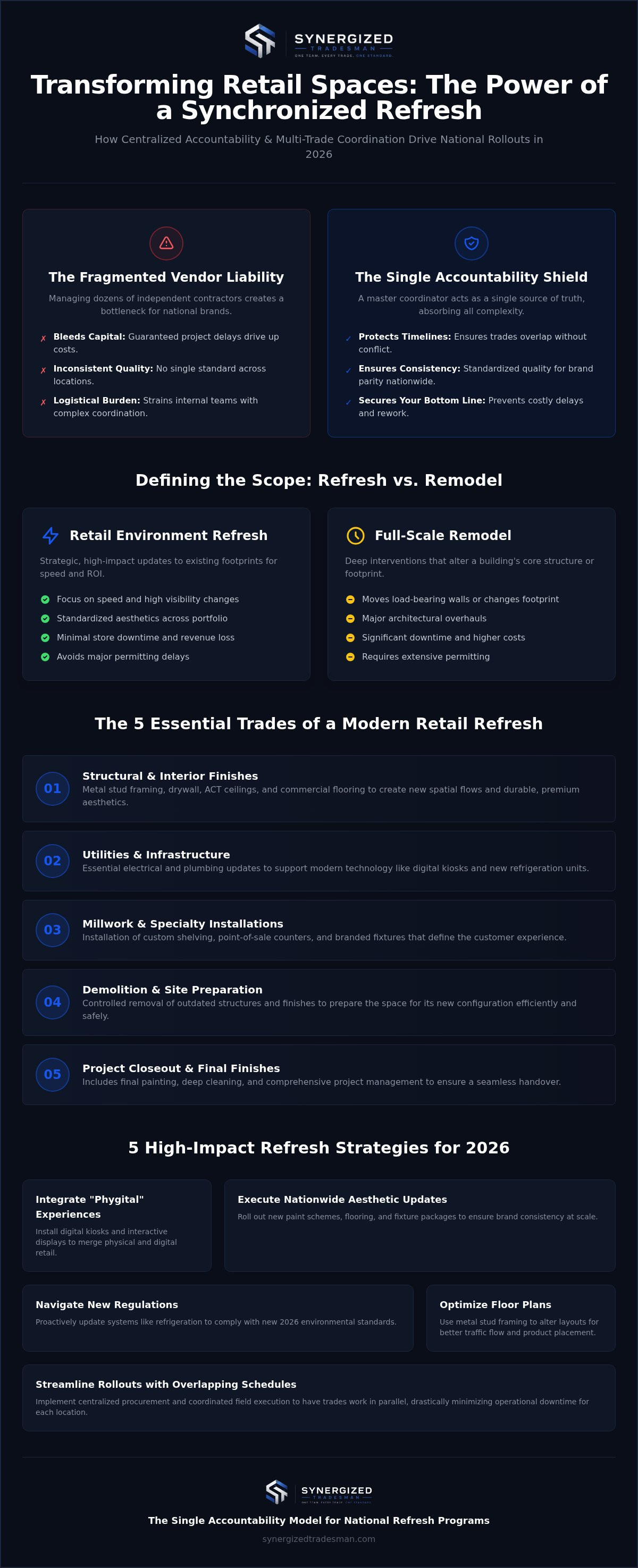
A fragmented vendor list is a liability that national brands can no longer afford in a high-stakes 2026 market. Managing dozens of independent contractors for a single rollout is a guaranteed way to bleed capital through project delays and inconsistent quality. Most facility directors agree that the logistical burden of coordinating trades shouldn't fall on their internal teams. When you invest in retail environment refresh services, you need a partner who acts as a shield, absorbing the complexity of multi-trade execution while maintaining a single source of truth for every location in your portfolio.
This article shows how standardized execution models and centralized accountability transform stagnant spaces into high-performing assets. You'll discover how multi-trade coordination eliminates the friction between demolition, flooring, and specialty millwork installations. We've identified five strategic examples for 2026 that demonstrate how national brands use these services to minimize downtime and ensure brand consistency at scale. From navigating new 2026 refrigerant regulations to optimizing "phygital" floor plans, these strategies provide a clear path to operational excellence. We'll examine how a single accountable relationship for all construction trades secures your timeline and protects your bottom line.
Key Takeaways
- Distinguish between full-scale remodels and high-impact retail environment refresh services to maximize ROI on existing store footprints.
- Identify the five essential construction trades required for a synchronized rollout and how to manage them through a single point of accountability.
- Examine five real-world examples of successful refreshes, from integrating digital kiosks to executing nationwide aesthetic updates.
- Streamline national rollouts by implementing centralized procurement and overlapping field execution schedules to minimize operational downtime.
- Leverage the benefits of a WBE-certified construction partner to meet diversity targets while maintaining a single source of truth for all project data.
Defining Retail Environment Refresh Services in 2026
A retail environment refresh is a strategic, coordinated construction update applied to existing store footprints. It isn't just a cosmetic "face-lift." These services involve precise execution across multiple trades to align physical assets with modern retail design principles. Unlike a full remodel, refreshes focus on high-impact structural and aesthetic changes that don't require total reconstruction or the permitting delays associated with major architectural overhauls. National brands use retail environment refresh services to maintain brand parity across hundreds of locations simultaneously.
Refresh vs. Remodel: Understanding the Scope
The primary distinction between a refresh and a remodel lies in the depth of intervention. Remodels often involve moving load-bearing walls or changing a building's footprint. In contrast, a refresh prioritizes speed and visibility. Common scopes include metal stud framing, drywall repair, updated flooring, and specialized millwork installation. Refreshes operate within high-intensity windows. Execution happens quickly to minimize store downtime and revenue loss.
For national rollout programs, the budget is often allocated toward standardized aesthetics rather than unique architectural changes. This approach allows brands to deploy capital efficiently across a broader portfolio. A refresh ensures that a store in one region looks and functions exactly like a store in another, despite differing ages of the original buildings. It provides a consistent customer experience without the high costs of starting from scratch.
The Role of Multi-Trade Coordination
Project fragmentation is the biggest risk in national rollouts. Managing separate painting, electrical, and flooring contractors individually creates a logistical bottleneck. It leads to communication gaps and inconsistent quality standards. When trades work in silos, the project schedule inevitably slips. In 2026, a single point of accountability is the industry standard for success. A master coordinator acts as a shield for the client, taking on the burden of multi-party logistics with total responsibility.
This coordinator manages all trade requirements from demolition and metal stud framing to final cleaning and project closeout. Centralized oversight ensures that materials arrive on time and trades overlap without conflict. It eliminates the friction between vendors. Coordinated procurement prevents site-level delays, ensuring that fixture installers aren't waiting on flooring teams to finish their work. This model provides the transparency and standardized quality needed for high-volume demands.
The Multi-Trade Anatomy of a Modern Retail Refresh
High-precision retail environment refresh services require the synchronized execution of at least five distinct construction trades. Accountability isn't limited to a single phase. It begins with the controlled demolition of outdated structures and continues through to final project closeout. Standardized quality across these trades ensures that brand identity remains consistent nationwide, regardless of location. This unified approach eliminates the "quality gap" often found when brands hire local contractors for individual sites. A master coordinator oversees every trade, ensuring that the transition from demolition to finish work is seamless and efficient.
Structural and Interior Finishes
Metal stud framing and drywall form the backbone of any interior reconfiguration. These trades allow brands to create new spatial flows within existing footprints without the cost of structural expansion. Modernizing overhead environments often involves Acoustic Ceiling Tile (ACT) systems. These systems improve acoustics and conceal updated utility runs. For high-traffic retail zones, commercial flooring and tile solutions provide the necessary durability to withstand heavy foot traffic while maintaining a premium aesthetic. Every surface must meet the same rigorous standard to protect the brand's reputation and ensure longevity across the portfolio.
Utilities and Specialty Installations
Infrastructure updates are mandatory for 2026 technology integrations. Electrical and plumbing trades manage the hidden systems that support digital kiosks and updated refrigeration units. Once the utilities are set, millwork and specialty fixtures provide the final layer of the brand experience. This includes custom shelving, point-of-sale counters, and branded displays that require expert installation. Precision at this stage is vital because fixtures are the primary touchpoint for consumers. If the millwork isn't leveled and secured correctly, the entire refresh loses its professional impact.
Managing trades for retail rollouts ensures quality control by establishing a single point of oversight for every technician on site. This methodical approach prevents the fragmentation that often plagues national programs. By consolidating these requirements under one partner, you secure a "shield" against logistical delays. If you're planning a multi-site update, choosing a national construction partner with specialized retail experience is the most reliable way to maintain standards and minimize downtime.
5 Real-World Examples of High-Impact Environment Refreshes
Executing retail environment refresh services effectively requires a clear understanding of the project's strategic intent. National brands utilize these updates to solve specific operational or branding challenges without the disruption of a total remodel. The following five examples represent the most common and effective refresh strategies currently deployed by high-volume retailers.
- The "Tech-Forward" Upgrade: This involves integrating digital kiosks and self-service stations. It requires precise coordination between electrical trades and millwork installers to ensure power and data infrastructure are seamlessly hidden within custom-built fixtures.
- The "Brand Pivot": When a brand identity changes, a nationwide update of painting, wallcovering, and millwork is essential. This refresh ensures that every location reflects the new color palette and material standards simultaneously.
- The "Efficiency Rollout": Focusing on overhead environments, this strategy standardizes ACT ceilings and LED lighting across 100+ sites. It reduces energy costs and improves store-level illumination using a uniform material list.
- The "Boutique-in-Boutique": Using metal stud framing and drywall, retailers create specialized zones or "shop-in-shop" concepts within an existing footprint. This allows for new product launches or brand partnerships without altering the store's exterior.
- The "Surface Refresh": This is a rapid intervention targeting high-wear areas. It typically includes flooring replacement and a full paint cycle. It's the fastest way to modernize an aging portfolio and protect the physical asset from deterioration.
High-Volume Rollouts: Consistency at Scale
Managing a multi-location retail refresh program demands a rigorous field execution protocol. Quality control shouldn't vary between sites. A standardized approach ensures the 50th store looks identical to the flagship location. By using a single source of accountability, brands eliminate the variables that lead to inconsistent finishes. This model provides the oversight needed to maintain brand parity across diverse geographic regions, ensuring that every customer experiences the same environment regardless of the building's original age.
Tenant Improvements for Modern Retailers
Adapting existing shells for new retail concepts requires a disciplined transition from demolition to final clean-out. It isn't enough to just install new fixtures; the underlying environment must be prepared correctly. Procurement strategies for specialty materials are centralized to prevent site-level delays. This ensures that flooring, tile, and millwork arrive in a logical sequence. Managing these trade logistics as a unified operation allows retailers to adapt existing spaces quickly. It turns vacant or outdated shells into revenue-generating assets with minimal downtime.
Coordinating National Rollouts: Procurement and Field Execution
Scaling retail environment refresh services across a national portfolio demands a logistical engine, not just a construction crew. Successful execution relies on a five-step coordination framework that eliminates the friction between procurement and field work. This methodology ensures that every site follows a standardized path from initial demolition to the final handover.
- Step 1: Centralized Procurement. Streamlining material delivery for multiple sites prevents local supply chain bottlenecks and ensures material consistency.
- Step 2: Multi-Trade Scheduling. Overlapping trades, such as painting and flooring, minimizes store downtime by maximizing daily site productivity through synchronized shifts.
- Step 3: Field Execution Oversight. Maintaining a single point of truth for site progress prevents communication gaps between the field and corporate headquarters.
- Step 4: Quality Control Audits. Standardizing the close-out phase ensures that every location meets the same brand specifications regardless of its geographic location.
- Step 5: Final Cleaning and Handover. Delivering a retail-ready environment allows store staff to resume operations immediately after the trades depart.
Optimizing the Procurement Lifecycle
Leveraging national scale is the most effective way to secure high-demand materials and custom fixtures. Centralized management allows for bulk purchasing and staged deliveries, which reduces lead-time delays. This approach ensures that specialty millwork and flooring arrive exactly when the site is ready for installation. A disciplined retail rollout strategy and execution reduces overall project costs by eliminating the premium prices associated with last-minute local sourcing.
Field Execution and Project Close-Out
The final phase of a refresh determines the client's ultimate satisfaction. Final cleaning is a critical trade that often gets overlooked. In a retail environment, construction dust is a liability. Professional cleaning ensures that the space is safe for both products and customers. Standardizing documentation for project close-out across the national portfolio provides the transparency needed for high-level decision-makers. Managing the punch list through a single accountable partner prevents minor issues from becoming long-term maintenance headaches. If you need a partner to manage these complex logistics, contact our national project management team to discuss your 2026 rollout requirements.
Synergized Tradesman: The Single Accountability Model for Refresh Programs
Synergized Tradesman acts as a "shield" for national brands by assuming total responsibility for multi-party logistics. We manage the high-volume demands of retail environment refresh services through a single point of accountability. This model specifically addresses the "vendor gap" where project quality often degrades as one trade hands off to another. By serving as the single source of truth, we ensure that every phase, from initial demolition to specialty millwork installation, adheres to a unified quality standard. Our national scope enables us to provide consistent execution across your entire portfolio, eliminating the inconsistencies inherent in managing multiple local contractors.
The Value of a WBE Certified Partner
Corporate procurement strategies in 2026 increasingly prioritize ESG and diversity initiatives. As a certified women-owned commercial construction firm (WBE), Synergized Tradesman provides a direct path to meeting these diversity requirements through your construction spend. Beyond the certification, we offer the strategic planning and disciplined execution required for high-stakes rollouts. We maintain rigorous standards of compliance and safety, acting as an extension of your own project management team. This partnership allows you to leverage our expertise as a master coordinator to protect your brand's physical assets and reputation.
Getting Started with Your National Rollout
Success in a national rollout begins with an initial planning phase and a comprehensive trade requirement assessment. We work with your team to develop a standardized execution model that defines exactly how your brand should be represented in the field. This model covers the full spectrum of our commercial offerings, including metal stud framing, drywall, painting, and flooring. By establishing these protocols upfront, we prevent the "drift" in quality that often occurs in high-volume programs. We take on the burden of procurement and field logistics, ensuring that materials and labor are synchronized to minimize store downtime.
Our approach is built for the complexity of the modern retail landscape. We don't just manage trades; we manage the risks associated with multi-site construction. From the first site visit to the final cleaning and project closeout, we provide the transparency and facts needed for informed decision-making. This methodical, sequential rhythm reinforces our command of the process and provides the relief you need when managing a national portfolio. Consult with Synergized Tradesman for your next retail refresh program.
Standardizing National Retail Execution
Executing high-volume retail environment refresh services requires more than just skilled labor. It demands a logistical framework built for scale and a single point of accountability to manage the complexity of multi-trade coordination. By centralizing procurement and field execution, national brands eliminate the quality gaps that often plague fragmented vendor models. Every phase, from metal stud framing to final cleaning, must follow a synchronized sequence to minimize downtime and protect brand consistency across the portfolio.
Synergized Tradesman provides the oversight needed to turn these strategic refresh examples into operational reality. As a certified WBE with national multi-trade execution expertise, we act as a shield for your internal teams. We manage the burden of procurement and field logistics to ensure your standards are met at every location. Our comprehensive management model provides the transparency and reliability required for high-stakes 2026 rollouts.
Partner with a Single Accountable Source for Your Retail Refresh. Your portfolio's evolution is a significant investment, and we're built to protect it.
Frequently Asked Questions
What is included in retail environment refresh services?
Retail environment refresh services include coordinated construction updates like metal stud framing, drywall repair, painting, and flooring. These services also cover the installation of specialty millwork and fixtures alongside electrical and plumbing infrastructure updates. Unlike a full remodel, the scope targets high-impact areas that align physical spaces with brand standards. We provide comprehensive management from the initial demolition phase through to final cleaning and project closeout to ensure a retail-ready handover.
How long does a typical multi-location retail refresh take?
The duration of a refresh depends on the project's complexity, but these updates typically occur in shorter, high-intensity windows compared to full remodels. While a complete store reconstruction might take months, a strategic refresh often targets a timeline of a few weeks or even days per location. We utilize multi-trade scheduling and overlapping shifts to minimize store downtime. This ensures that national rollout programs move quickly without sacrificing quality or brand consistency.
Why is a single accountability model important for retail construction?
A single accountability model eliminates the fragmentation caused by managing multiple independent contractors. It provides a "shield" for the client by consolidating all construction trades under one master coordinator. This approach ensures that quality standards remain consistent across a national portfolio and prevents the "vendor gap" that leads to project delays. Having a single source of truth for field execution allows for total transparency and better control over the project lifecycle.
Can a retail refresh be performed while the store remains open?
Yes, refreshes are frequently executed while stores remain operational by utilizing phased construction or after-hours shifts. We prioritize optimized logistics to ensure that high-traffic zones aren't disrupted during peak shopping hours. By coordinating trades like flooring and painting during low-impact windows, retailers avoid significant revenue loss. This methodical approach allows for a modernized environment without the need for a total store closure, protecting both the customer experience and the bottom line.
What are the most common trades involved in a retail environment update?
A typical retail environment update requires the synchronization of at least five distinct construction trades. These include demolition, metal stud framing and drywall, painting, and high-durability flooring or tile. Specialized millwork and fixture installation are also vital to the brand experience. Infrastructure trades like electrical and plumbing support new technology or refrigeration needs. Finally, professional cleaning teams ensure the site is retail-ready immediately after the construction work is completed.
How do you ensure brand consistency across a national retail rollout?
Consistency is achieved through standardized execution protocols and centralized procurement across all sites. By utilizing one partner for the entire national rollout, brands ensure that the 50th store meets the same quality standards as the flagship location. This model eliminates the variability found when using different local contractors. We maintain a single source of truth for field execution, providing the oversight required to protect brand parity and adhere to corporate specifications.
What is the role of a general trades contractor in a retail refresh?
A general trades contractor acts as the master coordinator and single point of accountability for the entire refresh project. They manage the transition between different trades, from metal stud framing and drywall to millwork installation and final cleaning. This role is built for high-volume demands, taking on the burden of multi-party logistics and trade scheduling. By overseeing every phase of execution, they ensure that the project remains on schedule and meets all compliance standards.
How does a WBE-certified firm benefit retail procurement programs?
Partnering with a WBE-certified firm allows retailers to meet corporate ESG and diversity requirements through their construction spend. Beyond compliance, these firms offer the strategic planning and disciplined execution needed for complex national rollouts. Working with a certified women-owned firm provides a competitive advantage by combining specialized expertise with a commitment to high standards of safety and oversight. It streamlines the procurement process while supporting broader corporate social responsibility goals across the organization.


