

Successful retail rollouts don't fail because of poor design; they fail because of fragmented trade accountability. With national commercial construction costs increasing by 9.9 percent between 2024 and 2026, the margin for error has narrowed. You've likely seen how a single scheduling conflict in one city can trigger a chain reaction of delays that pushes back store reopenings nationwide. It's a frustrating reality where decentralized procurement leads to budget bloat and inconsistent quality. Executing a multi-location retail refresh requires more than just a list of contractors. It demands a centralized management strategy that acts as a shield against these logistical complexities.
This resource provides a proven framework to help you master the logistics of large-scale refreshes through single-source accountability. You'll learn how to replace vendor chaos with a standardized playbook that ensures every location meets the same rigorous standards. We'll examine the specific operational phases of a rollout, from demolition and framing to final cleaning. By consolidating your trade management, you can secure predictable timelines and maintain a single point of contact for every site. This guide breaks down the transition from reactive troubleshooting to disciplined, multi-trade execution.
Key Takeaways
- Identify the operational risks of decentralized procurement and learn to mitigate the "domino effect" of multi-site project delays.
- Master the multi-location retail refresh by adopting a single-source model that provides one contract and one standard of quality for every trade.
- Evaluate the strategic differences between basic vendor coordination and professional program management to protect your budget from local vendor variance.
- Implement a modular framework for national rollouts that prioritizes centralized planning, procurement, and systematic site preparation.
- Establish a single point of contact to manage diverse trades, ensuring predictable store reopening timelines and consistent brand presentation nationwide.
Scaling the Refresh: Challenges of Multi-Location Brand Consistency
Scaling a brand across a national footprint introduces logistical variables that single-site projects simply don't face. A multi-location retail refresh is often compromised by the "trade variance" found in local markets. Traditional general contracting models frequently fail during national rollouts because they rely on fragmented local vendor networks. This decentralized approach leads to inconsistent procurement and a lack of oversight. When different contractors use varying materials or methods, the brand's visual identity suffers. Managing these complexities requires a transition from simple vendor coordination to a disciplined program management model. High-level decision-makers often face budget bloat when local vendors operate without centralized pricing or standardized material lists.
The Domino Effect in Retail Rollouts
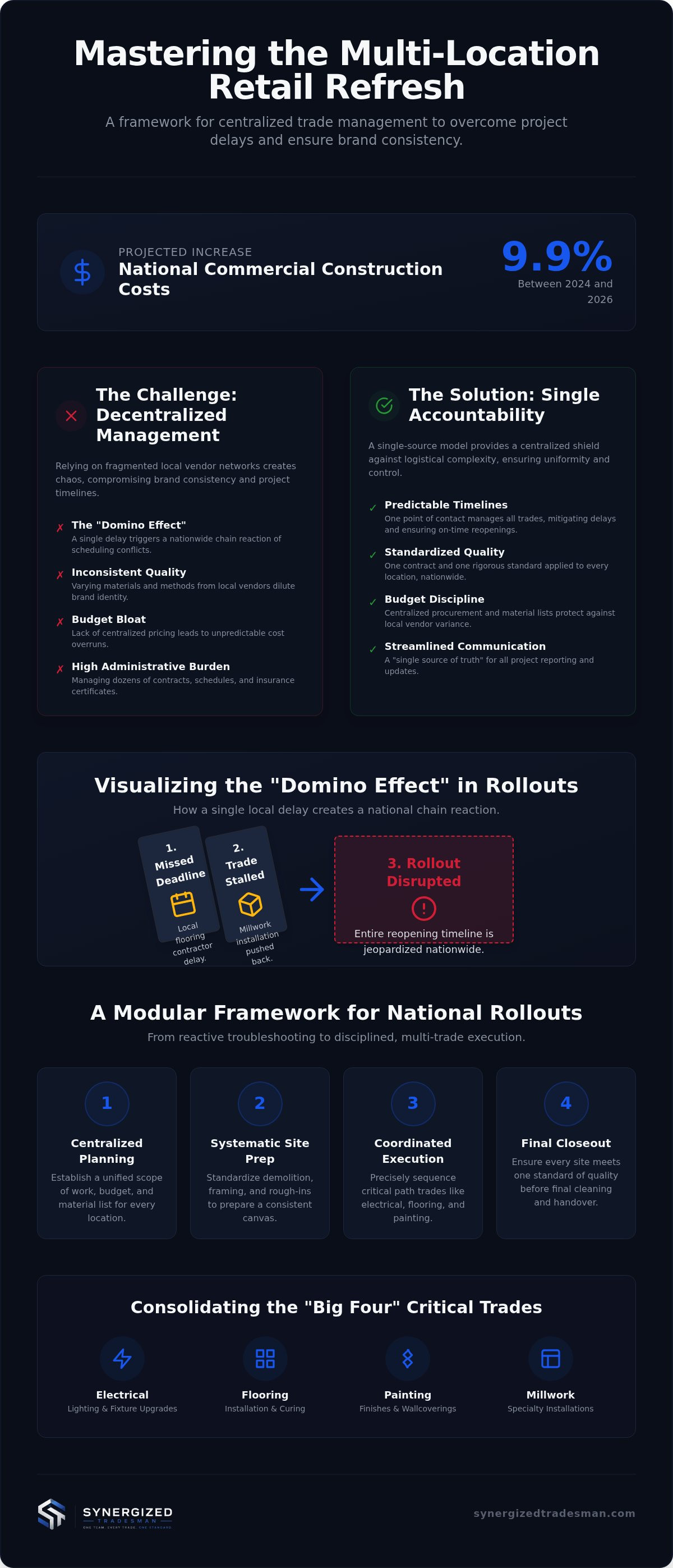
Project schedules in a national rollout are interconnected. A delay at a single site in one region often triggers a chain reaction across the entire program. If a local flooring contractor misses a deadline, it pushes back the millwork installation and final cleaning. This "domino effect" creates significant logistical friction. You must manage staggered start dates while coordinating the delivery of fixtures and inventory. Bottlenecks typically occur with critical path trades that require precise sequencing. These frequently include:
- Electrical and lighting upgrades
- Plumbing and fixture adjustments
- Millwork and specialty installation
When these trades stall, the entire reopening timeline is jeopardized. Successful execution depends on identifying these risks early and maintaining a rigid schedule that accounts for regional logistics. A single delay doesn't just hurt one store; it disrupts the labor allocation for the next ten sites in the queue.
Standardizing Quality Across National Portfolios
Maintaining brand integrity requires a unified scope of work for every location. Inconsistent field execution is the primary driver of poor brand implementation across a portfolio. "Good enough" local work often results in mismatched paint finishes or incorrectly installed fixtures. These small variances accumulate and destroy national brand perception. You need a standardized framework for every project phase of your multi-location retail refresh, from demolition to final closeout. This ensures that a store in the Midwest looks and functions exactly like a store in the Southeast. Relying on a single accountable partner eliminates the variance inherent in using multiple local general contractors. It establishes one standard of quality that applies to every trade, regardless of geography. This level of oversight protects the capital investment and ensures the brand remains cohesive at every customer touchpoint.
The Single Accountability Model: Streamlining Multi-Trade Requirements
Managing a multi-location retail refresh requires a shift from vendor coordination to total trade accountability. Most retail programs falter when the "Big Four"—electrical, flooring, painting, and millwork—are treated as isolated silos. When these trades operate independently, the administrative burden on your corporate team grows exponentially. You're forced to manage dozens of contracts, insurance certificates, and conflicting schedules. Consolidating these requirements under a single accountability model provides a "single source of truth" for project reporting. This ensures that every site follows a uniform standard, from the initial demolition to the final closeout report. Effective Multi-Location Management depends on this level of centralized oversight to maintain budget discipline and schedule integrity.
Coordinating Complex Multi-Trade Workflows
Success in the field relies on the precise sequencing of interdependent trades. You can't install high-end retail fixtures until the flooring is cured and the painting is finished. Integrating metal stud framing and drywall with electrical rough-ins is a frequent bottleneck that requires proactive management. Our framework prioritizes these critical path activities to prevent trade interference. We schedule painting and wallcovering only after the heavy construction is complete, protecting your brand's visual assets. Managing specialty installations like millwork requires a partner who understands how these fixtures interact with the existing electrical and plumbing infrastructure. This methodical approach ensures that every trade moves in sync, reducing the risk of rework or site damage. If you're looking to simplify these complex requirements, you can partner with an expert coordinator to manage the entire rollout.
The Management Advantage of Consolidated Oversight
The Single Accountability Model is the consolidation of all trade risks under one partner. This structure eliminates the "finger-pointing" that common occurs between independent trade contractors. When a millwork installer blames an electrician for a delay, the client usually pays the price in lost time. By using a single source for all trades, you remove this friction. Communication flows directly from the field to your corporate office through one point of contact. This streamlines the decision-making process and ensures that site-specific issues don't escalate into program-wide delays. It's a pragmatic solution for high-volume demands. You gain total visibility into the project lifecycle without the chaos of managing a fragmented vendor list. This model acts as a shield, protecting your internal teams from the daily logistical burdens of a national rollout.
Evaluating Refresh Partners: Vendor Coordination vs. Program Management
Selecting the right partner for a multi-location retail refresh determines whether your program stays on budget or collapses under its own weight. Many organizations mistake simple vendor coordination for professional program management. While coordination merely organizes existing chaos, program management eliminates it through disciplined, standardized execution. Evaluating potential partners requires looking past their design portfolio and focusing on their operational infrastructure. A firm's ability to manage diverse trades under a single standard is the most critical factor in achieving a predictable outcome. You need a partner that acts as a shield, taking on the burden of multi-party logistics so your internal team can focus on core operations.
Local GCs vs. National Execution Partners
Relying on local general contractors creates a fragmented management structure that is difficult to scale. Each local GC brings their own standards, sub-contractors, and reporting styles to the table. This lack of uniformity makes it nearly impossible to maintain brand consistency across a national footprint. A national execution partner centralizes procurement and logistics, acting as a single source of truth for your entire portfolio. When a punch list item arises at Location #42, you shouldn't have to track down a local vendor you've never met. A national partner owns that accountability. They provide the oversight necessary to ensure that the demolition, framing, and final cleaning meet the same high standards at every site.
Selection Criteria for High-Volume Rollouts
Evaluating a firm's multi-trade capabilities is the first step in the selection process. You need a partner that offers end-to-end execution, including specialized work like metal stud framing, electrical integration, and millwork installation. Beyond trade skills, assess their project management technology. High-volume rollouts require real-time reporting and a high frequency of communication to keep all stakeholders aligned. A standardized closeout process is equally vital. It ensures a seamless facility handoff, providing your operations team with the documentation they need to reopen with confidence.
Finally, consider the value of WBE certification in your selection process. Partnering with a certified women-owned commercial construction firm helps you meet corporate procurement goals while ensuring high-level professional oversight. This certification signals a commitment to excellence and compliance that aligns with the rigorous demands of national retail brands. It's a strategic choice that supports both your operational requirements and your corporate responsibility targets.
Logistics and Field Execution: A Framework for National Rollouts
Successful field execution is the result of rigorous upfront planning and a disciplined management structure. A multi-location retail refresh requires a four-phase framework to maintain control over costs and schedules across a national footprint. Phase 1 centers on centralized planning and procurement to eliminate the variance often seen when local contractors source their own supplies. Phase 2 involves systematic site preparation and demolition, a high-risk stage where poor coordination can damage existing infrastructure. Once the site is ready, Phase 3 focuses on synchronized field execution across all trades, ensuring that work sequences remain on the critical path. Phase 4 concludes with a standardized project closeout and final cleaning, providing a seamless handoff to your operations team.
Procurement and Supply Chain Management
Consolidating material orders across an entire program ensures volume pricing and material consistency. This centralized approach prevents the aesthetic mismatches that occur when local vendors use different manufacturers for flooring or paint. You must manage lead times for long-lead items like ACT ceilings or custom millwork months before a single hammer swings. Warehousing these materials and utilizing "just-in-time" delivery minimizes on-site clutter and reduces the risk of theft at active retail sites. This logistical oversight acts as a shield for your budget, protecting you from the price fluctuations and availability issues that plague decentralized projects.
The Field Execution Playbook
Implementing a repeatable "SOP" for every trade on site ensures that the quality of work in one region matches the quality in another. This playbook defines exactly how demolition, metal stud framing, and electrical rough-ins should proceed. Real-time field reporting and quality control milestones allow project managers to identify and correct issues before they impact the reopening timeline. For a deeper look at these operational standards, review our guide on Retail Rollout Strategy and Execution. This structured approach replaces the chaos of vendor coordination with the precision of professional program management.
Closing Out: Documentation and Handoff
Phase 4 is the final transition where many refreshes fail due to a lack of detail. Final cleaning must meet "grand reopening" standards so the store is customer-ready immediately upon project exit. We consolidate all warranties, photos, and permits into a single digital package for your facilities team. Achieving a "zero-item" punch list is the only way to guarantee a smooth store opening. This disciplined approach ensures the multi-location retail refresh delivers the intended return on investment without leaving a trail of unresolved maintenance issues. If you are ready to implement this framework across your portfolio, contact our team to discuss your national rollout requirements.
Executing Your Multi-Location Retail Refresh with Synergized Tradesman
Synergized Tradesman provides the operational infrastructure required to manage complex national programs through a single accountable relationship. We eliminate the friction of multi-vendor coordination by acting as your primary partner for every project phase. Our commitment to a single standard of quality ensures that your brand remains consistent across all locations, regardless of local market conditions. As a certified women-owned commercial construction firm (WBE), we offer the professional oversight necessary to meet both your operational goals and your corporate procurement requirements. This structure simplifies the multi-location retail refresh process, allowing you to scale with confidence.
Why Accountability Matters to Your Bottom Line
Centralizing your rollout management directly impacts your profitability by reducing administrative overhead. Instead of your internal team managing trade logistics for dozens of sites, we take on the burden of coordination and execution. This model accelerates your "speed to market" for new brand concepts and seasonal updates. Rigorous field execution standards protect your capital investment and prevent the budget creep associated with localized vendor variance. By consolidating trade risks, you gain:
- Predictable store reopening timelines
- Fixed procurement costs through volume management
- Standardized quality across demolition, millwork, and final cleaning
Launch Your Program with a Single Point of Contact
Integration is the core of our management philosophy. We work alongside your existing planning and design teams to translate corporate vision into field-ready execution plans. Our process manages everything from national procurement to the daily oversight of field teams. We provide a single point of contact for all trade issues, ensuring that site-level challenges are resolved before they impact the program schedule. Understanding Multi-Trade Commercial Construction Accountability is essential for any director planning a 2026 rollout. This model provides the transparency and facts needed to report success to stakeholders.
Preparing for a 2026 retail rollout requires a partner built for high-volume demands. We provide the national service coverage and multi-trade expertise needed to execute your program without the typical logistical bottlenecks. Contact our project management team today to review your portfolio and establish a standardized playbook for your next refresh cycle. We're ready to serve as the stabilizing force for your national expansion.
Standardizing Your National Rollout for 2026 and Beyond
Executing a successful multi-location retail refresh requires a shift from managing individual contractors to implementing a disciplined program management framework. You've seen how decentralized procurement and local trade variance can compromise brand standards and inflate budgets. By adopting a single accountable relationship model, you eliminate the friction of multi-party logistics and secure predictable store reopening timelines. This centralized approach acts as a shield for your internal teams, allowing them to focus on high-level strategy rather than daily field troubleshooting.
Synergized Tradesman provides the national multi-trade execution needed to maintain one standard of quality across every site. Our status as a certified women-owned business (WBE) ensures that your rollout meets both operational excellence and corporate procurement goals. We handle the complexities of demolition, framing, and millwork installation through a transparent, results-oriented process. It's time to replace vendor chaos with organized oversight and reliable field reporting.
Streamline your retail refresh with Synergized Tradesman today to gain total command over your national portfolio. We look forward to helping you build a more resilient and consistent retail presence.
Frequently Asked Questions
What is included in a multi-location retail refresh program?
A multi-location retail refresh program includes all physical updates required to modernize a store's interior and exterior. This typically involves demolition, metal stud framing, and drywall installation followed by electrical and plumbing upgrades. We also manage finish trades such as flooring, painting, and millwork installation. The program concludes with final cleaning and a comprehensive project closeout to ensure every site is customer-ready for a grand reopening.
How do you maintain consistency across 50+ different retail sites?
Consistency is maintained through a centralized management model that applies one standard of quality to every location. We use a unified execution playbook and centralized procurement to ensure that materials and finishes are identical across all sites. This eliminates the variance that occurs when using multiple local contractors. A single point of contact oversees the entire portfolio, providing total visibility and ensuring brand integrity nationwide.
What are the benefits of the Single Accountability Model in construction?
The Single Accountability Model consolidates all trade risks and management responsibilities under one partner. This structure eliminates the common issue of finger-pointing between independent trade contractors, which often leads to delays and cost overruns. You benefit from having one contract and one contact for all trades, which significantly reduces the administrative burden on your internal procurement and facilities teams while ensuring a consistent result.
How does multi-trade coordination reduce retail rollout costs?
Multi-trade coordination reduces costs by optimizing the project lifecycle and leveraging volume pricing on materials. By managing the sequencing of trades like electrical and flooring under one roof, we eliminate the downtime and rework caused by scheduling conflicts. This streamlined approach lowers administrative overhead and prevents budget bloat. Efficiently managing the critical path ensures faster store reopenings, which directly protects your bottom line.
What should be included in a retail refresh project closeout?
A comprehensive project closeout must include a zero-item punch list to ensure all work meets the required standards. We provide a digital package containing all warranties, permits, and site photos for your facilities team. Final cleaning is also a critical component, ensuring the space meets grand reopening standards. This structured handoff ensures your operations team can resume business without dealing with lingering maintenance issues or documentation gaps.
Can one firm manage electrical, plumbing, and flooring simultaneously?
Yes, a professional program management firm can manage electrical, plumbing, flooring, and millwork simultaneously. We specialize in coordinating these complex multi-trade requirements to ensure that work sequences don't interfere with one another. This integrated approach allows for metal stud framing and electrical rough-ins to proceed in sync, followed by finish trades. Consolidating these trades under one partner ensures that every phase of the project remains on schedule.
How does WBE certification benefit our retail construction procurement?
WBE certification allows your organization to meet corporate diversity and procurement goals while partnering with a high-level construction expert. As a certified women-owned commercial construction firm, Synergized Tradesman provides a level of professional oversight and accountability that aligns with rigorous national brand standards. This certification serves as a signal of our commitment to transparency, compliance, and disciplined project execution across high-volume national rollout programs.
What is the typical timeline for a national retail brand rollout?
Timelines for a national rollout vary based on the scope of work and the number of locations involved. Most programs utilize staggered start dates to manage labor and material logistics across different regions. We focus on shortening the speed to market by identifying critical path trades early in the planning phase. While individual site refreshes may take weeks, the entire national program is structured to maintain a predictable and repeatable pace.


