

A successful retail rollout strategy and execution is rarely undermined by a lack of vision; it's derailed by a lack of centralized accountability. You understand the difficulty of maintaining quality across dozens of locations when each site relies on a different set of uncoordinated contractors. Misalignment between design intent and field reality isn't just an annoyance. It's a direct threat to your timeline and budget. Managing procurement and trade logistics shouldn't feel like a constant battle against regional inconsistency or administrative bloat.
This 2026 management guide provides the framework to bridge the gap between corporate strategy and flawless multi-site execution. You'll learn how a single point of oversight acts as a shield against logistics failures and project delays. We'll outline a standardized model that reduces your administrative burden while ensuring every site meets the same rigorous standard. By shifting to a unified management approach, you can secure predictable project closeouts and maintain total control over your brand's physical footprint. It's time to move beyond managing chaos and start delivering results through disciplined, professional coordination.
Key Takeaways
- Understand the critical distinction between high-level planning and field reality to ensure your retail rollout strategy and execution remains consistent across a national footprint.
- Identify the essential multi-trade requirements, from demolition to final cleaning, that form the backbone of a successful high-volume refresh program.
- Eliminate the "Accountability Vacuum" by moving away from managing individual contractors toward a model of centralized site oversight.
- Learn to standardize the Scope of Work (SOW) and procurement processes to remove regional quality variances and logistics failures.
- Discover the operational benefits of a single accountable relationship with a WBE-certified partner to streamline project closeouts and meet corporate diversity goals.
Defining Retail Rollout Strategy and Execution in 2026
Retail rollout is the systematic deployment of brand standards across multiple physical locations. It’s a high-stakes operational maneuver. In 2026, the market demands a faster speed-to-market than ever before. Brands no longer have the luxury of multi-year deployment cycles. Success requires a sharp distinction between strategy and execution. Strategy is the headquarters-level plan that defines the vision. Execution is the field reality where demolition, metal stud framing, and electrical work actually happen. A breakdown in retail rollout strategy and execution usually occurs when the HQ vision fails to account for the friction of physical labor and site-specific variables.
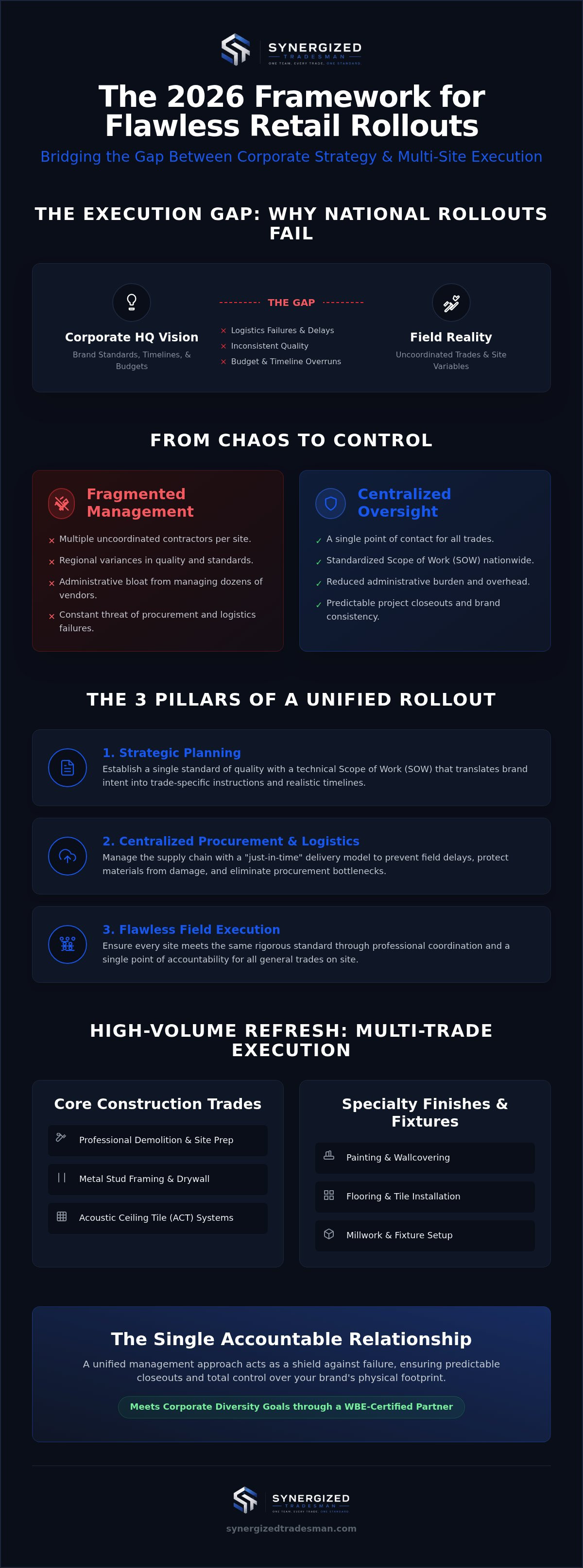
Management must view the rollout through three operational pillars: Planning, Procurement, and Field Execution. When these pillars are uncoordinated, the project suffers from regional quality variances and blown budgets. Reliable delivery depends on a "single source of truth" that bridges the gap between the design board and the job site. This ensures that a store in one region looks and functions exactly like a store in another, regardless of local trade challenges.
The Strategic Planning Phase
Effective planning establishes a single standard of quality across an entire national portfolio. It begins with a technical scope of work (SOW) that translates brand intent into trade-specific instructions. Management must distinguish between light retail refreshes, such as painting and wallcovering updates, and full-scale build-outs that require ACT ceilings and plumbing overhauls. We build realistic timelines by calculating the specific sequencing of trades. This disciplined approach prevents the common mistake of scheduling flooring before the drywall and painting phases are fully cured and inspected.
Procurement and Logistics Management
Logistics management is the shield that protects your timeline. Centralizing the acquisition of fixtures, millwork, and specialty materials is mandatory for high-volume programs. We manage the supply chain to prevent field delays during the critical construction phase. This involves a "just-in-time" delivery model. Materials shouldn't sit on a site for weeks where they can be damaged or stolen. Instead, they arrive exactly when the installation teams are ready. By controlling the flow of goods, we eliminate the procurement bottlenecks that frequently stall national retail rollout strategy and execution. This level of oversight ensures that field teams spend their time building, not waiting for missing shipments.
The Components of a High-Volume Retail Refresh Program
High-volume retail programs require more than just a surface-level facelift. They demand a coordinated multi-trade effort that transforms a space while maintaining operational continuity. A successful retail rollout strategy and execution depends on the synchronization of general trades. These services provide the foundational site preparation necessary for every subsequent phase. Without a stable backbone of structural work, specialty finishes will inevitably fail to meet brand standards. This stage is where management must act as a shield, protecting the project from the friction of uncoordinated labor.
Core Construction Trades for Retail
The transition from an outdated store to a modern environment begins with professional demolition. This phase requires precise site preparation to ensure that new installations aren't compromised by old debris or structural issues. Metal stud framing and drywall then establish the bones of the retail environment. These elements must be perfectly plumb and level to support complex millwork and shelving systems. Additionally, Acoustic Ceiling Tile (ACT) systems are essential for meeting commercial standards for sound management and aesthetics. They hide critical electrical and plumbing infrastructure while providing a clean, professional finish. When these core trades are managed through a single point of contact, the risk of site-level delays drops significantly.
Specialty Finishes and Fixtures
Visual consistency across a national footprint relies on high-quality painting and wallcovering. These finishes represent the critical layer of brand identity that customers notice first. Similarly, flooring and tile installation must provide durable solutions for high-traffic retail spaces. These materials endure thousands of footsteps daily. Poor installation leads to immediate maintenance costs and safety hazards. The final touch that defines the customer experience is the millwork and fixture setup. This requires specialty installation expertise to ensure every display is positioned exactly as the design intent specified. Managing these diverse requirements is complex. Partnering with a provider that offers comprehensive trade management ensures that these specialty finishes are handled with total accountability and professional oversight.
Every location must conclude with a standardized close-out process. This includes final cleaning and a rigorous punch list inspection to verify that all work meets the established "single source of truth" quality standard. Standardizing this phase ensures that the hand-off to the store operations team is seamless. It guarantees that the brand experience is ready for customers on day one without lingering construction issues or administrative loose ends. By treating close-out as a formal trade phase, you secure predictable timelines across the entire rollout.
The Execution Gap: Why National Rollouts Fail
National rollouts often fail because management confuses tracking with execution. Software can identify a delay, but it cannot resolve the trade friction happening on the ground. This execution gap creates a cycle of reactive fixes and budget overruns. When multiple local vendors operate without a central coordinator, an accountability vacuum emerges. If the flooring installation is delayed because the painting crew didn't finish on time, the project loses momentum. These "dead days" represent a significant financial drain on any large-scale retail rollout strategy and execution. Without a physical presence to manage these transitions, the HQ plan remains a theory rather than a reality.
The Hidden Cost of Fragmented Management
Administrative bloat is a primary driver of inefficiency. Managing 10 individual trades across 50 locations creates 500 separate points of contact. This fragmentation leads to extreme quality variance. Site A might meet brand standards, while Site B suffers from poor drywall finishing or misaligned fixtures. Such inconsistencies damage brand equity and complicate future maintenance. Utilizing multi-trade commercial construction models reduces this overhead by consolidating responsibility. Instead of 500 contacts, you have one. This shift eliminates the administrative noise that distracts from core business objectives. It allows your internal team to focus on strategy while a partner handles the trade-level minutiae.
Logistics and Field Coordination Challenges
Field coordination requires a "Single Source of Truth" to prevent logistics failures. For example, electrical and plumbing requirements must be precisely timed with interior finishes and millwork setup. If the plumbing isn't roughed in correctly, the new cabinetry cannot be installed. This creates a bottleneck at the "last mile" of the project where fixtures are staged but cannot be secured. Poor communication between procurement and field teams often results in materials arriving at sites that aren't ready to receive them. This leads to damage, theft, or double-handling costs.
Inconsistent close-out documentation further complicates the issue. Without standardized photos, punch lists, and warranties, facility management teams struggle to maintain the site post-launch. They don't know which contractor performed the work or what specific materials were used. Professional oversight ensures that every site is documented with the same level of rigor. This provides a clear, data-backed path from construction to operation. It ensures that the final 10% of the project is finished with the same intensity as the first 10%.
Building a Framework for Flawless Field Execution
Flawless execution is the result of disciplined processes, not luck. To bridge the gap between HQ intent and site reality, management must implement a standardized framework. This begins with Step 1: Standardizing the Scope of Work (SOW) across all trades and locations. Every crew must work from the same playbook to ensure Site A matches Site B. Step 2 involves implementing a centralized procurement strategy for all long-lead items. By controlling the supply chain, you prevent field teams from stalling while waiting for fixtures or specialty materials. Step 3 requires establishing a single accountable relationship for all field activities. This eliminates the "accountability vacuum" by providing one point of contact for every site. Finally, Step 4 deploys a rigorous quality control and project close-out protocol to verify that every detail meets brand standards before the hand-off.
Integrating Multi-Trade Requirements
Scheduling friction is a major cause of project delays. Coordinating commercial renovation management services allows for the precise synchronization of trades. Electrical and plumbing work must be perfectly timed with drywall and flooring crews to avoid overlapping or waiting periods. This level of coordination creates a "Shield" for the client. We manage all sub-tier logistics internally, taking on the burden of multi-party complexity so you don't have to. It's about maintaining a steady, controlled rhythm on every job site. If you're ready to secure your national program, you can partner with a single-source provider to manage your multi-trade execution.
Close-out and Final Deliverables
The final 5% of a project often dictates the client's perception of success. Final cleaning isn't an afterthought; it's a critical trade requirement. We ensure the site is "customer-ready" immediately upon completion. Standardizing close-out documentation is equally important for a seamless facility hand-off. This includes high-resolution photos, warranty information, and verified punch lists. Using a rigorous punch-list management system ensures 100% completion before the crew exits the site. This discipline prevents the lingering "go-back" lists that frustrate facility managers. A clean, documented, and fully finished site is the only acceptable output for a professional retail rollout strategy and execution. It provides the predictable timelines and project closeouts that high-volume programs demand in 2026.
The Single Accountable Relationship: A New Standard for 2026
In 2026, the benchmark for a successful retail rollout strategy and execution is defined by the consolidation of responsibility. Traditional general contracting often relies on a fragmented network of subcontractors, each operating with their own standards and timelines. This model fails because accountability is diluted across multiple layers. When a framing delay impacts the electrical rough-in, the client is often left to mediate between conflicting parties. The single accountable relationship replaces this friction with a unified management structure. It provides a "shield" for the corporate project manager, taking full responsibility for every trade from demolition to final cleaning. This shift ensures that results are predictable, even in high-pressure environments where timelines are non-negotiable.
Choosing a partner that's a certified women-owned commercial construction firm (WBE) adds another layer of strategic value. It allows organizations to meet their corporate diversity goals without sacrificing operational excellence. This model isn't just about compliance; it's about performance. A national partner with a single standard of quality ensures that your brand identity remains intact across every site. By centralizing oversight, you eliminate the "accountability vacuum" that often plagues large-scale refreshes. You gain a partner that acts as the single source of truth for the entire program. It's a pragmatic approach to a complex logistical challenge.
Efficiency Through Accountability
A master coordinator reduces the administrative burden on internal retail operations teams. Instead of managing dozens of individual trade contractors, your team interacts with one point of contact. This oversight ensures that brand integrity is maintained across every site. Whether the project involves ACT ceilings or complex millwork installation, the standard remains identical. This consistency is vital for facility upgrades where the customer experience must be uniform. We handle the multi-party logistics internally, allowing your team to focus on high-level strategy rather than field-level troubleshooting. Accountability drives efficiency by removing the noise of uncoordinated labor.
Positioning for Success in Future Rollouts
The goal is to build a repeatable model that scales from 10 sites to 100 with ease. A partner "built" for high-volume demands understands the nuances of national scope. They anticipate procurement bottlenecks and trade clashes before they occur. This proactive management allows for faster deployment cycles and reduced costs over the lifecycle of the program. Successful retail rollout strategy and execution ultimately depends on who is responsible when things get complex. By establishing a single accountable relationship now, you secure the infrastructure needed for future growth. You move from a reactive posture to a disciplined, execution-focused strategy that delivers every time.
Securing Operational Excellence in National Rollouts
Success in 2026 relies on your ability to transform complex logistics into a repeatable, standardized process. You've seen how the execution gap occurs when fragmented management meets site-level friction. By centralizing oversight and defining a rigorous scope of work, you eliminate the accountability vacuum that stalls high-volume programs. Every site must meet the same standard of quality, from the initial demolition to the final cleaning. This consistency protects your brand and ensures that your facility upgrades deliver the intended customer experience without administrative bloat.
A sophisticated retail rollout strategy and execution requires a partner that acts as your single source of truth. Synergized Tradesman offers a single accountable relationship for all trades across a national scope of service. As a WBE Certified Women-Owned Business, we provide the disciplined coordination needed to manage multi-party logistics with total responsibility. You don't have to manage the chaos of dozens of individual contractors. Streamline your next national rollout with Synergized Tradesman to secure predictable timelines and flawless field execution. You can move forward with the confidence that your program is built for scale and long-term reliability.
Frequently Asked Questions
What is the difference between a retail rollout and a retail refresh?
A retail rollout is the systematic deployment of brand standards across a group of locations simultaneously or sequentially. In contrast, a retail refresh typically focuses on updating the finishes and fixtures of a single existing site to modernize its appearance. Both require a coordinated retail rollout strategy and execution to ensure that the physical upgrades, such as painting and flooring, align with corporate design intent across the national portfolio.
How long does a typical national retail rollout take to execute?
Execution timelines vary based on the number of locations and the complexity of the trade requirements. A national program involving 50 to 100 sites might span several months, while a smaller pilot program could conclude in weeks. We build predictable schedules by centralizing procurement and coordinating trades like metal stud framing and electrical work. This structured approach prevents the common delays associated with managing multiple uncoordinated local vendors across different regions.
Why is multi-trade coordination critical for retail construction?
Coordination is vital because retail construction involves high-density trade overlap within a compressed schedule. If the plumbing and electrical rough-ins aren't synced with the drywall and flooring crews, the project enters a state of multi-trade friction. Managing these dependencies through a single accountable relationship ensures that each trade enters the site exactly when needed. This prevents dead days and ensures that the final millwork installation isn't compromised by structural or utility errors.
How do you maintain consistency across multiple geographic locations?
Maintaining consistency requires a single source of truth for every project phase. We implement a standardized scope of work and quality control protocol that applies to every location regardless of its geographic position. By using a national partner with a single standard of quality, you eliminate the variances that occur when using different local crews. This ensures that the painting, wallcovering, and fixture setup in one region look identical to those in another.
What are the benefits of using a WBE-certified contractor for a rollout?
Partnering with a WBE-certified construction firm allows corporations to meet their diversity spend targets while securing high-level project management. It demonstrates a commitment to inclusive procurement without sacrificing the technical expertise required for complex rollouts. Synergized Tradesman provides this certification alongside national execution capabilities. This combination allows retail operations teams to achieve social responsibility goals while benefiting from a disciplined, professional approach to multi-trade facility upgrades and renovations.
What documentation is required for a retail project close-out?
A professional project close-out requires a comprehensive package of deliverables to ensure a smooth facility hand-off. This includes high-resolution completion photos, verified punch lists, and signed-off trade inspections. Additionally, facility managers need warranty information for flooring, plumbing, and electrical work. We standardize this documentation across every site in the program. This provides the corporate team with a data-backed record of execution and ensures that final cleaning meets customer-ready standards.
Can a single contractor manage electrical, plumbing, and interior trades?
Yes, a single accountable partner can manage the full spectrum of trades including demolition, electrical, plumbing, and interior finishing. This Synergized model is the most efficient way to handle high-volume demands in 2026. It removes the burden of multi-party logistics from your internal team. By consolidating framing, ACT ceilings, and millwork installation under one coordinator, you reduce administrative bloat and ensure that all trades work toward a single project timeline.
How does procurement impact the timeline of a retail rollout strategy?
Procurement is the primary driver of project momentum. Delays in acquiring long-lead items like specialty fixtures or millwork can stall the entire field execution phase. A centralized procurement strategy ensures that materials arrive at the site exactly when the installation crews are ready. This just-in-time model prevents site damage and theft while keeping the retail rollout strategy and execution on track. Proper supply chain management is the shield that protects your project from logistics failures.


