

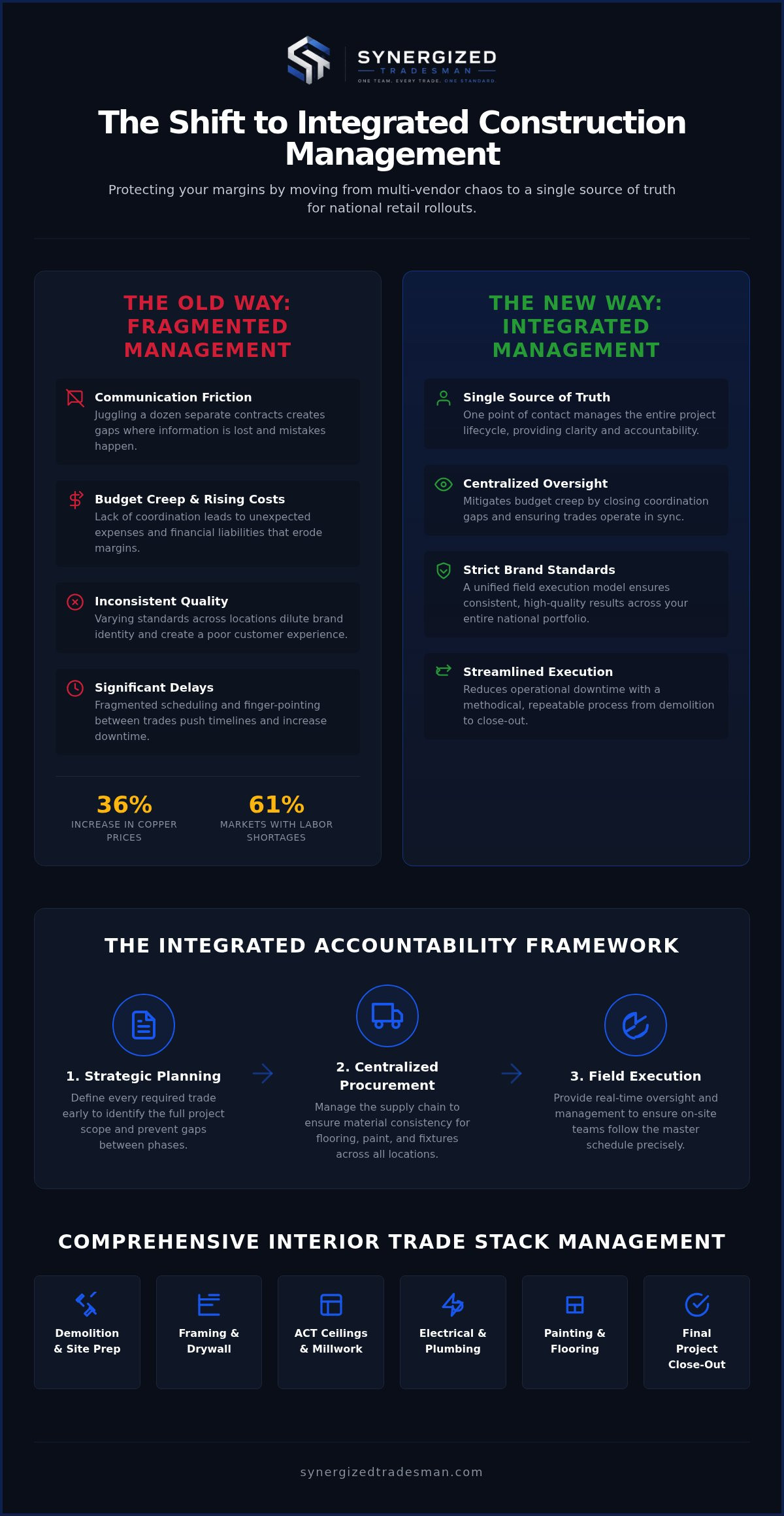
Managing a national retail rollout by juggling a dozen separate trade contractors isn't just inefficient; in 2026, it's a significant financial liability. Transitioning to a model of integrated commercial construction management provides the strategic shield needed to protect your margins. You've likely felt the friction of fragmented communication. Budget creep often starts in the gap between demolition and finishing, while inconsistent quality across locations erodes brand standards. With copper prices up 36% and labor shortages affecting 61% of metro markets, there's no room for communication breakdowns or redundant oversight. These fragmented models leave you exposed to delays and rising costs that aren't easily recovered.
You need a single source of truth for your entire project lifecycle. You'll discover how an integrated accountability framework streamlines multi-trade commercial projects, from procurement to national field execution. This guide breaks down the transition from complex multi-party logistics to a disciplined, standardized approach. We'll examine how this model reduces operational downtime during retail refreshes, secures consistent quality across your entire national portfolio, and provides a single point of contact for every phase of construction. It's time to move toward a more methodical, results-oriented execution strategy.
Key Takeaways
- Learn why transitioning from fragmented trade bidding to integrated commercial construction management reduces communication friction and establishes a single source of truth.
- Understand the operational sequence required to coordinate complex interior trades, ensuring a seamless transition from initial demolition to final project close-out.
- Identify how centralized oversight mitigates budget creep by closing the coordination gaps between separate trade vendors.
- Discover strategies for maintaining strict brand standards across national retail locations through a unified field execution model.
- Evaluate the strategic benefits of partnering with a certified WBE firm to meet corporate procurement mandates while ensuring high-volume execution capability.
What is Integrated Commercial Construction Management?
Integrated commercial construction management is more than a service; it's a strategic accountability framework. It represents a fundamental shift from fragmented, transactional bidding to a unified procurement and management relationship. In a traditional model, you might manage a dozen separate contracts, each with its own standards and timelines. This fragmentation creates gaps where communication fails and costs escalate. By consolidating these trades under a single accountable partner, you eliminate the friction of multi-party logistics. This approach aligns with the core principles of Integrated Project Delivery (IPD), where collaboration and shared responsibility drive project success from day one.
The Single Accountable Relationship Explained
A single accountable relationship acts as a logistical shield for corporate project managers. In complex commercial environments, centralized oversight isn't a luxury; it's a requirement for stability. One point of contact manages every phase, from initial planning and material procurement to field execution. This eliminates the "finger-pointing" common in multi-vendor projects. When one entity is responsible for the entire trade stack, there's no confusion about who owns the timeline. You gain a master coordinator who acts as a single source of truth for the entire project lifecycle. This model covers essential trades, including:
- Demolition and site preparation
- Metal stud framing and drywall
- ACT ceilings and millwork installation
- Electrical and plumbing coordination
- Painting, flooring, and final project close-out
Beyond General Contracting: The Accountability Framework
The traditional general contracting model often involves simply managing subcontractors as they arrive on-site. Integrated commercial construction management moves beyond this by executing a cohesive multi-trade strategy. This framework utilizes standardized field execution to maintain strict project timelines. It's built for high-volume mandates where national consistency is non-negotiable. Whether you're refreshing five locations or fifty, the quality of the millwork or the finish of the tile remains identical. This model replaces the uncertainty of local vendor variability with a reliable, repeatable process that protects your brand's physical identity. It provides a steady, methodical rhythm that allows high-volume retail rollouts to succeed without sacrificing quality or exceeding budgets.
The Logistics of Multi-Trade Coordination and Field Execution
The efficiency of integrated commercial construction management relies on a precise, chronological sequence of events. Most projects fail because trades operate in silos. A unified model begins with demolition and ends with final close-out, ensuring each trade hands off a clean site to the next. This methodical flow prevents the common rework cycle where finishing trades wait for basic infrastructure. Managing the entire lifecycle under one standard ensures that plumbing and electrical rough-ins are verified before drywall is ever hung. This oversight eliminates the risk of wall penetrations and scheduling delays that plague traditional projects.
Phases of Execution: From Planning to Procurement
Successful execution requires a structured three-step approach to logistics:
- Strategic planning and trade-stack identification: We define every required trade early to prevent scope gaps between demolition and finishing.
- Centralized procurement: Material consistency is vital for national brands. We manage the supply chain to ensure the same drywall, flooring, and paint are used across all locations.
- Field execution management: Real-time oversight ensures that on-site teams follow the master schedule exactly.
According to the Associated General Contractors of America, early collaboration is the primary driver of project efficiency. This centralized approach allows for the simultaneous management of electrical and plumbing workflows alongside structural tasks like metal stud framing. It creates a steady rhythm that protects the project timeline from the start.
Managing the Interior Trade Stack
The interior trade stack requires rigorous coordination to protect the final aesthetic. Metal stud framing and drywall must be completed before ACT ceilings and millwork installation begin. If these phases overlap poorly, the risk of damage to expensive fixtures increases. Our model of integrated commercial construction management integrates flooring, tile, and painting into a single finishing phase. This ensures that painters don't work over fresh tile and flooring teams aren't delayed by wet walls.
Specialty installation is the final critical step for retail and commercial spaces. Millwork and fixtures must be installed with precision to meet brand standards. The process concludes with a professional final cleaning and project close-out. This ensures the space is ready for immediate occupancy. To streamline your next project, consider a partner who understands the complexities of multi-trade execution. This level of oversight protects your timeline and your budget through every square foot of the build.
Mitigating Budget Risks Through Centralized Oversight
Managing a budget requires more than just tracking expenses; it requires controlling the variables that cause them to spike. Fragmented trade management is a primary driver of budget volatility. When a dozen separate contractors operate on a single site, coordination gaps are inevitable. These gaps lead to "finger-pointing" when delays occur. If the electrical rough-in isn't ready for the drywall team, the resulting schedule shift creates a cascade of expensive change orders. One entity must own the risk of coordination to shield the client from the hidden costs of vendor misalignment. Adopting integrated commercial construction management ensures that the responsibility for the entire trade stack remains with a single accountable partner.
Reducing the Friction of Fragmented Procurement
Fragmented procurement creates a communication tax that erodes project margins. Every hand-off between a demolition crew and a finishing team is a potential point of failure. Standardized quality across every trade prevents the expensive rework that occurs when standards differ between vendors. Utilizing a commercial general trades contractor provides the necessary oversight in high-stakes environments. This approach is particularly effective for multi-trade commercial construction, where the synchronization of framing, painting, and flooring determines the final project margin. By removing the coordination gap between different vendors, you eliminate the friction that typically leads to budget creep.
Critics often point to the perceived cost of management fees as an obstacle. However, the real cost of a two-week delay in a retail rollout far exceeds these administrative expenses. With material costs rising-copper increased by 36% and aluminum by 45% as of July 2026-efficient execution is the only way to stabilize a budget. You can't afford to let poor coordination waste expensive materials or labor hours.
The "Shield" Concept: Protecting the Client’s Bottom Line
A master coordinator acts as a shield, absorbing logistical shocks before they reach the client's balance sheet. Transparency in procurement allows for more accurate forecasting and prevents the "markup on a markup" common in multi-layered subcontracting. Research on the Integrated Project Delivery model suggests that collaborative structures significantly reduce waste compared to traditional design-bid-build methods. By centralizing oversight, you ensure that every dollar spent contributes to a tangible output. This leads to a higher long-term ROI through consistent, high-standard execution that avoids the "re-refresh" costs associated with poor initial quality. This disciplined approach provides the stabilizing force needed in a fast-moving industry.
Scaling for Success: National Retail Rollout and Refresh Programs
High-volume retail refresh programs introduce a level of complexity that local, single-site contractors are not built to handle. When managing a portfolio of 50 or more locations, the primary challenge shifts from individual craftsmanship to systemic coordination. Integrated commercial construction management provides the centralized command structure necessary to execute simultaneous projects without losing control of the brand standard. Success in these high-stakes environments depends on a repeatable model that can be deployed across national territories with surgical precision. You need a partner who can manage the burden of multi-party logistics while maintaining a steady, predictable pace of execution.
Consistency Across the Portfolio
A retail brand's physical identity must remain identical regardless of the location. Achieving the same "look and feel" from site to site requires more than just a set of blueprints. It demands a standardized approach to every trade, especially millwork and fixture installation. Using a single accountable entity ensures that the specific finishes, lighting levels, and flooring textures are applied uniformly. This disciplined oversight reduces the risk of local vendor variability, which often leads to costly corrections later. Key factors in maintaining this consistency include:
- Standardized procurement of materials to avoid regional substitutions.
- Uniform training for field teams on specific brand assembly requirements.
- Rigorous quality control checks at every phase of the interior build-out.
Minimizing operational disruptions is equally critical. Most retail refreshes occur in active environments where every hour of downtime represents lost revenue. Our model prioritizes efficient trade sequencing to ensure stores remain functional or return to service ahead of schedule. If you are planning a high-volume initiative, you can request a national rollout consultation to see how a unified trade stack protects your speed to market.
High-Volume Logistics and Speed to Market
Rapid-pace rollouts require procurement and execution to move in lockstep. With labor constrained in 61% of US metro markets as of 2026, securing a reliable trade workforce for simultaneous projects is a significant hurdle. A single accountability model solves this by centralizing the management of electrical, plumbing, and finishing trades. This approach ensures that procurement keeps pace with aggressive renovation schedules, preventing the material shortages that often stall multi-site programs.
The final stage of any successful rollout is standardized close-out documentation. For national portfolios, having a uniform set of punch lists, final photos, and sign-off sheets is essential for corporate compliance. This level of detail provides a clear audit trail and ensures that every location meets the exact same standard of completion. It transforms a chaotic series of construction projects into a streamlined, professional program that delivers predictable results every time.
Selecting the Right Partner for Single Source Construction
Selecting a partner for integrated commercial construction management is a high-stakes decision for procurement officers and project managers. You aren't just hiring a contractor; you're choosing a logistical surrogate to represent your interests across a national portfolio. A high-performing partner must demonstrate the capacity to manage a full 10-trade stack while maintaining a single standard of accountability. This requires an organizational structure built for corporate demands rather than local, one-off projects. The transition from the initial RFP to field execution should be methodical, moving from strategic planning into a disciplined rollout that protects your brand's physical identity.
The Value of WBE Certification in Construction
Corporate procurement has evolved beyond simple cost-analysis. Board-level priorities now include Environmental, Social, and Governance (ESG) goals, which directly impact how construction partners are vetted. Partnering with a certified Women-Owned Business Enterprise (WBE) provides a significant strategic advantage in this landscape. It allows your organization to meet diversity spend mandates without compromising on operational excellence or national reach. WBE-certified firms often excel in the reporting and compliance standards required by large-scale corporate entities. This certification ensures your project supports broader ESG initiatives while delivering the specialized trade expertise needed for complex interior build-outs. It's a pragmatic solution for modern procurement departments that value both social responsibility and rigorous project delivery.
Establishing the Single Source of Truth
A master coordinator must act as your single source of truth for every project phase. When vetting a partner, evaluate their ability to manage the entire lifecycle, from demolition to final cleaning. They must have a proven track record in field execution and the administrative rigor to handle close-out documentation for high-volume mandates. Key criteria for selection include:
- National execution capability: The firm must have the infrastructure to deploy teams across multiple territories simultaneously.
- Comprehensive trade management: Verify expertise in metal stud framing, drywall, ACT ceilings, electrical, and plumbing.
- Specialty installation experience: Ensure they can handle the precision required for millwork and fixtures.
- Compliance and reporting: The partner should provide transparent, real-time data on project timelines and budgets.
The transition toward a more accountable construction model is the only way to insulate your budget from the volatility of 2026. You need a partner that acts as a shield against logistical shocks and vendor miscommunication. If your current model relies on fragmented trades and inconsistent quality, it's time to consolidate. Moving toward a single-source relationship reduces the burden on your internal team and ensures every location in your portfolio meets the same corporate standard. It's time to prioritize a results-oriented approach that values transparency and facts over marketing bravado.
Securing Operational Stability in a Volatile Market
The construction landscape of 2026 demands a shift from fragmented trade management to a disciplined, unified model. Consolidating the trade stack eliminates the communication gaps that trigger budget volatility and scheduling delays. Integrated commercial construction management provides a strategic shield, protecting your national brand's identity through every phase of a rollout. This centralized approach allows your internal teams to focus on core business operations rather than vendor disputes.
Successfully executing a high-volume mandate requires a partner built for corporate scale. Synergized Tradesman offers end-to-end management of 10+ core commercial trades with national execution capability. As a certified Women-Owned Business Enterprise (WBE), we help you achieve diversity procurement goals while maintaining a single standard of quality from demolition to final close-out. It's time to adopt a more accountable construction model. Partner with Synergized Tradesman for your next multi-trade commercial project to secure the reliability your portfolio deserves. Build your next project with precision and total transparency.
Frequently Asked Questions
What is the main difference between a general contractor and a single-source construction partner?
A single-source partner provides a unified accountability model that manages the entire trade stack directly, whereas a traditional general contractor often acts as a pass-through for dozens of separate subcontractors. This model creates a single point of contact for planning, procurement, and execution. It eliminates the communication gaps and finger-pointing common in fragmented multi-vendor environments. By acting as a master coordinator, the single-source partner takes total responsibility for the project lifecycle and final quality standards.
How does an integrated model reduce commercial construction costs?
Integrated commercial construction management reduces costs by eliminating the friction of multi-party logistics and redundant management fees. Consolidating trades under one standard prevents the expensive rework caused by miscommunication between separate vendors. With material costs like copper rising 36% year-over-year in 2026, efficient sequencing is essential. Centralized procurement ensures material consistency and prevents the budget creep associated with localized vendor variability and uncoordinated schedule shifts.
Can a single-source provider manage specialized trades like electrical and plumbing?
Yes, a comprehensive single-source provider manages a full 10-trade stack, including specialized services like electrical and plumbing. These trades are integrated into the master workflow alongside structural tasks like metal stud framing and drywall. This ensures that rough-ins are verified before finishing trades arrive on-site. Managing these technical requirements within a single relationship prevents the coordination gaps that typically stall progress and lead to wall penetrations or rework.
What are the benefits of using a WBE-certified firm for commercial construction?
Partnering with a certified Women-Owned Business Enterprise (WBE) helps corporate clients meet Environmental, Social, and Governance (ESG) mandates and diversity procurement goals. This certification provides a strategic advantage for organizations that value both social responsibility and operational excellence. WBE firms like Synergized Tradesman specialize in the high-volume reporting and compliance standards required by national corporate entities. It ensures your project supports broader corporate initiatives while maintaining rigorous field execution standards.
How does integrated construction management improve retail rollout speed?
Speed to market improves through the elimination of the fragmented bidding process and the synchronization of simultaneous project phases. Using integrated commercial construction management allows procurement and execution to move in lockstep across national territories. By centralizing management, you avoid the delays caused by labor shortages, which affected 61% of US metro markets in 2026. This streamlined approach ensures that high-volume retail refreshes stay on schedule and return to service faster.
What trades are typically included in a commercial multi-trade renovation?
A typical commercial multi-trade renovation includes everything from initial demolition to final cleaning. The core trade stack features metal stud framing, drywall, ACT ceilings, and painting or wallcovering. It also incorporates flooring, tile, and millwork installation. Specialty services like electrical and plumbing are managed within the same workflow to ensure technical compliance. Finally, fixture installation and professional cleaning prepare the space for immediate occupancy and corporate sign-off.
How is quality controlled across multiple national project sites?
Quality is controlled through the implementation of a single standard of execution across all project locations. Standardized training and procurement ensure that the same materials and assembly methods are used nationally. This removes the variability found when using local, uncoordinated vendors. Master coordinators use real-time oversight and rigorous field management to verify that every site meets the exact brand standards defined in the initial planning phase.
What documentation should I expect during project close-out?
Clients should expect a comprehensive and standardized close-out package that includes final punch lists and site photographs. This documentation provides a clear audit trail of completed work and ensures compliance with corporate standards. It typically includes sign-off sheets for every trade, from demolition to plumbing and final cleaning. Having uniform documentation across a national portfolio simplifies the auditing process and confirms that each location is fully operational.


